Final Exam Weng (Cumulative+ New)
 Call Kai
 Learn
Learn Practice Test
 Spaced Repetition
 Match
Match Flashcards
 Knowt Play
1/55

There's no tags or description
Looks like no tags are added yet.
Name | Mastery | Learn | Test | Matching | Spaced | Call with Kai |
|---|
No analytics yet
Send a link to your students to track their progress
56 Terms
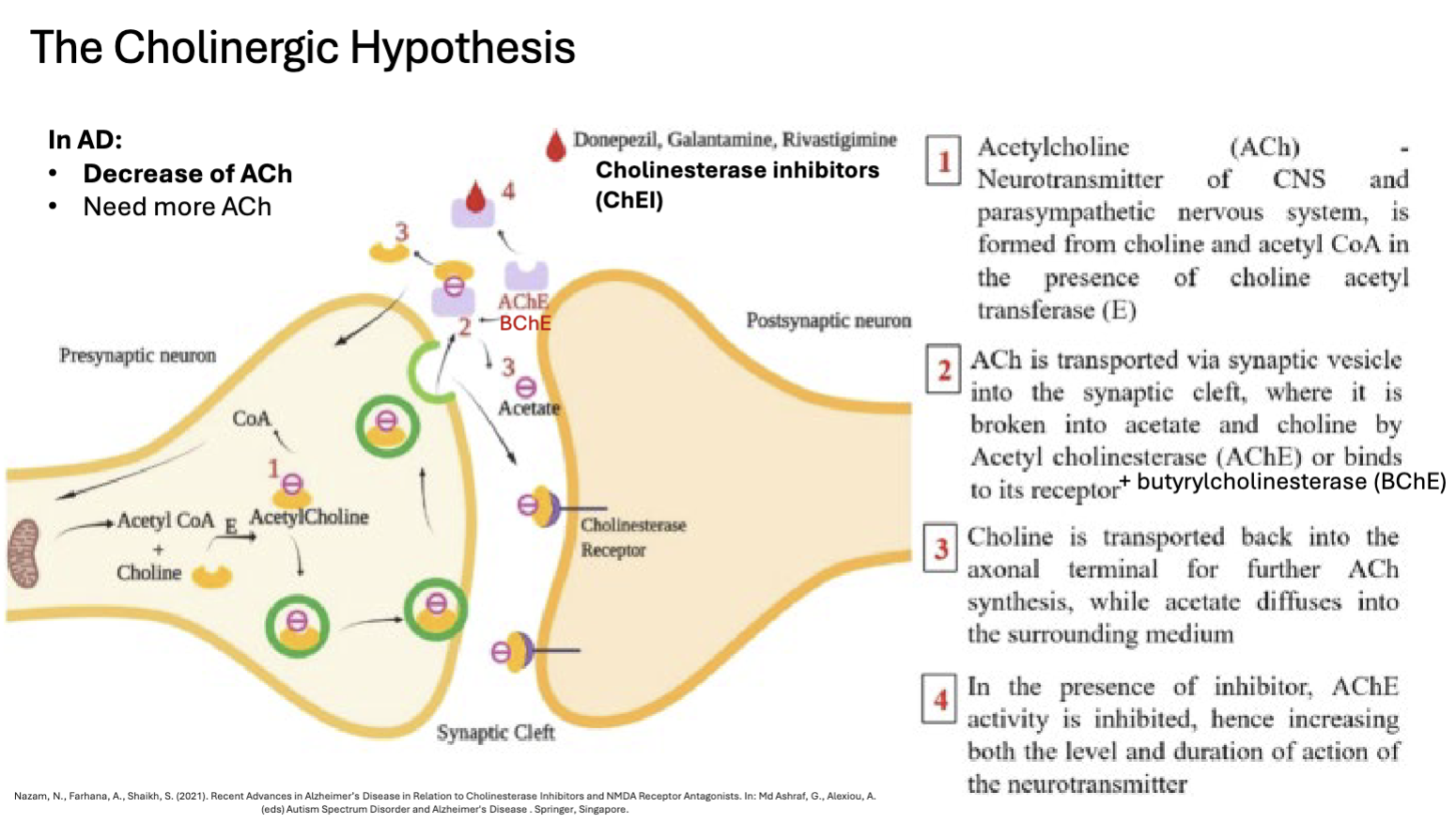
The Cholinergic Hypothesis in AD —> _______ in _______, so we need _______
decrease, ACh, more ACh
Cholinesterase Inhibitors (ChEIs)
MOA: reversibly _______ centrally-acting _______ (and butyrylcholinesterase for rivastigmine) to _______ of _______ at the synaptic gap
Prevents breakdown of _______ in the brain
Acetylcholinesterase inhibitors (ACheIs)
inhibits, AChE, increase concentration, ACh, ACh
_______ (Aricept®) MOA: _______ (_______) in the _______
Donepezil, inhibits AChE, brain
_______ (Exelon®) MOA: _______ and _______ by _______ binding to respective enzyme active sites in the _______
Rivastigmine, inhibits AChE, BChE, covalent, brain
_______ (Razadyne®) MOA: _______ and _______ to _______ more _______ in the brain
Galantamine, inhibits AChE, stimulates nicotinic receptors, release, acetylcholine
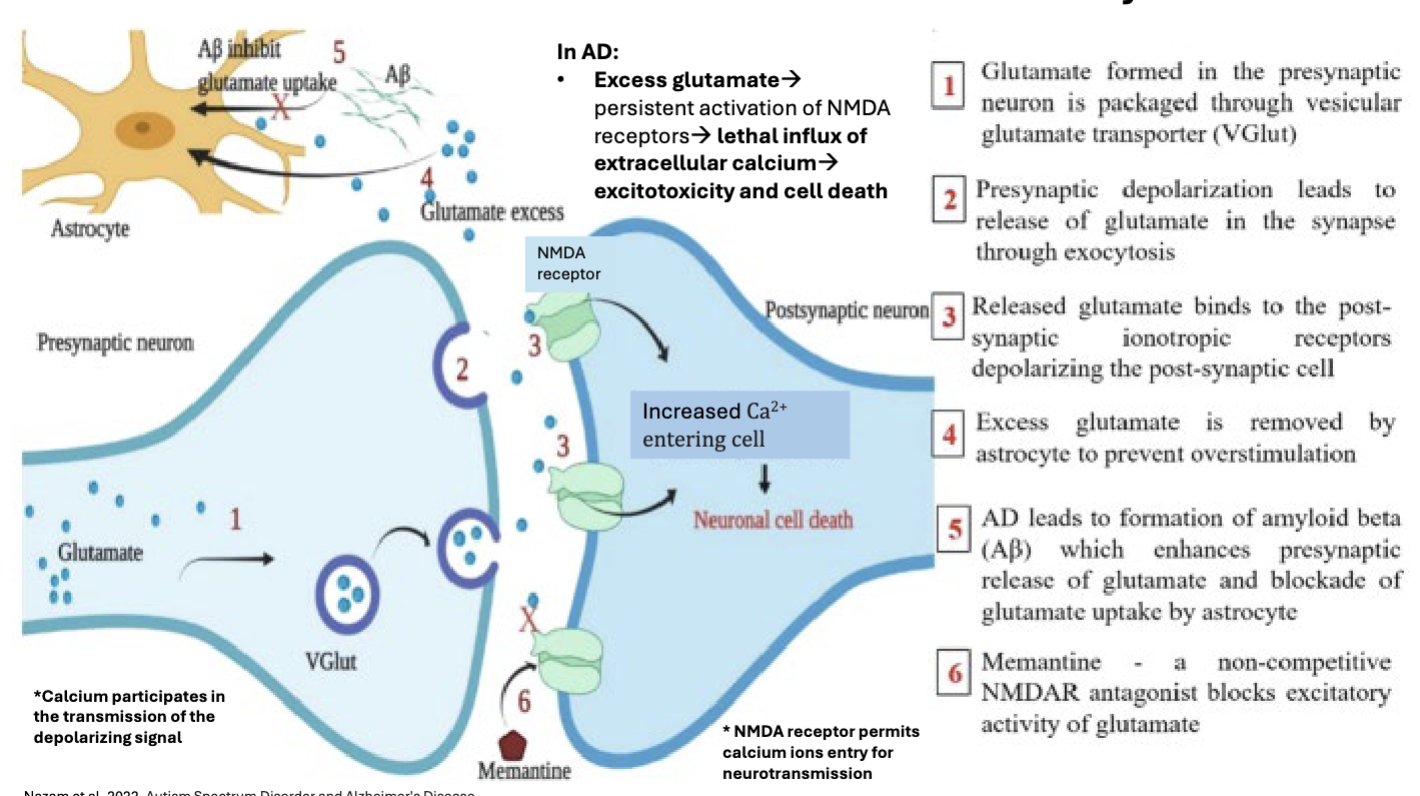
Glutamate-Induced Calcium-Mediated Excitotoxicity in AD:
_______ glutamate —> persistent _______ of _______ receptors —> lethal influx of _______ —> _______ and _______
excess, activation, NMDA, extracellular calcium, excitotoxicity, cell death
N-methyl-D-aspartate (NMDA) Receptor Antagonist
Protects brain from _______ levels of _______, which can overstimulate _______ and result in _______
MOA: binds to NMDA receptors, acting as a _______ that _______ the activity of _______ —> decrease _______-induced _______-mediated excitotoxicity
excessive, glutamate, neurons, neuronal death, non-competitive antagonist, blocks, glutamate, glutamate, calcium
_______ (Namenda®) MOA: _______ toxic effects associated with _______ and regulates _______
Memantine, blocks, excess glutamate, glutamate activation
_______ (Namzaric®) MOA: Same as memantine MOA + _______ in the _______
Donepezil + Memantine, inhibits AChE, brain
What is Parkinson’s Disease (PD)?
Neurodegenerative disease that results in progressive loss of _______ and _______
coordination, movement
Dopamine is _______ in PD
severely reduced
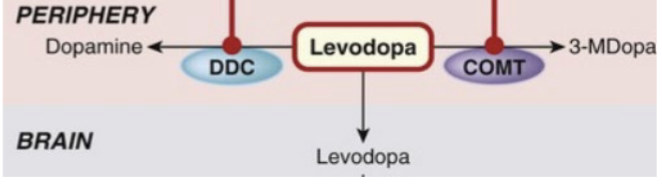
DA _______ freely cross blood-brain barrier (BBB)
_______ crosses BBB (with some help) and is used by brain to synthesize more _______ —> improvement in _______ symptoms
However, only a _______ of L-DOPA actually makes its way across BBB into neuron.
does not, L-DOPA, DA, motor, small percentage
_______ (Sinemet) MOA: _______ (_______) to _______ peripheral metabolism of _______ (DA precursor) to DA_______
Carbidopa _______ in peripheral tissues
Carbidopa/Levodopa, inhibits dopa decarboxylase, DDC, prevent, levodopa, DA, inhibits DDC
_______ (Zelapar) and _______ (Azilect) MOA: selectively _______ to block _______ to _______
Selegiline, Rasagiline, inhibits MAO-B, DA breakdown, DOPAC
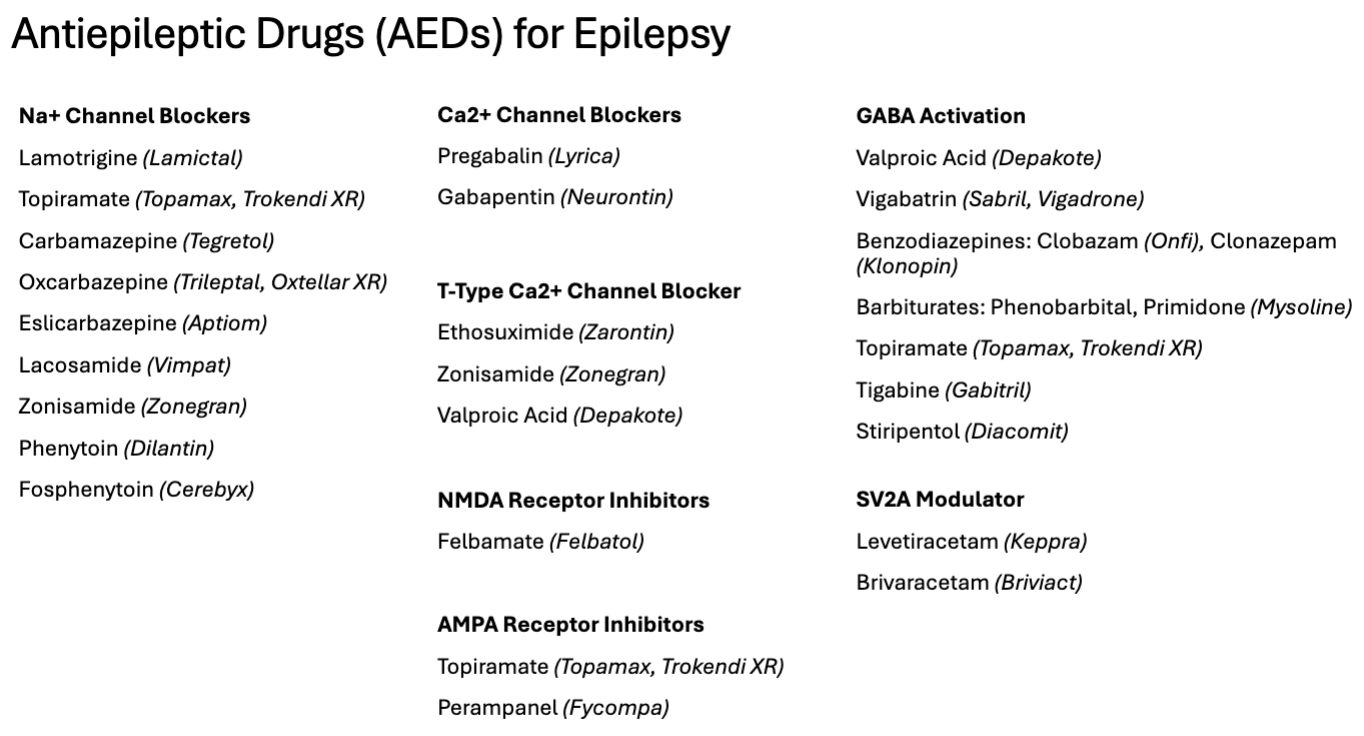
Antiepileptic drugs (AEDs) work by:
• Blocking _______ channels
• Blocking/altering _______ channels
• Increasing _______
• Decreasing _______
Sodium, Calcium, GABA, Glutamate
Suppression of Na+ Influx
Neuronal action potentials are propagated by _______ though _______
After depolarization, _______ is _______ (_______) and returned to resting “standby” state
sodium influx, sodium channels, sodium, inactivated, closed
Suppression of Na+ Influx: Na+ Channel Blockers
Reversibly _______ to _______ in _______ state
_______ return to active state
Decreases/suppresses high frequency _______
binds, sodium channels, inactive, delays, excitation
_______ (Lamictal) MOA: _______
_______ increases lamotrigine concentrations
Oral _______ reduces lamotrigine
Lamotrigine, sodium channel blocker, Valproic Acid, estrogen-containing contraceptives
_______ (Tegretol) MOA: _______
_______ that will _______ its own levels
Carbamazepine, sodium channel blocker, autoinducer, reduce
Suppression of Ca2+ Influx
Ca2+ influx in _______ through _______ channels
Promotes _______
Produces _______
axon terminals, voltage-gated, NT release, neuronal excitation
AEDs: _______ —> decreasing _______ —> decreasing synaptic release of _______
block voltage-gated calcium channels, calcium entry, glutamate
_______ (Lyrica) and _______ (Neurontin) MOA: _______, decreasing synaptic _______
• Binds to voltage gated Ca2+ channels at alpha-2-delta subunit —> _______ Ca2+ _______ —> decreasing synaptic release of _______
Pregabalin, Gabapentin, calcium channel blocker, glutamate release, decreasing, entry, glutamate
Endogenous opioids are naturally occurring _______
Bind to opioid receptors (μ , δ and κ)
_______ —> μ-opioid receptors
Inhibit _______ transmission and modulate _______
peptides, endorphins, pain, mood
Role of Exogenous Opioids
Exogenous opioids are more _______ and provide stronger, longer-lasting, and more controllable _______ compared to endogenous opioids
Act primarily at the μ-opioid receptor
Exogenous opioids mimic _______ at μ-opioid receptors, relieving _______ and inducing _______
potent, analgesia, endorphins, pain, euphoria
Centrally-Acting Opioid Agonists MOA: μ-opioid receptor (_______) _______ that inhibit _______
MOR, agonists, pain signaling
Drugs Used for Parkinson’s Disease (PD)
Dopamine Replacement
Carbidopa/Levodopa (_______)
COMT Inhibitor
Entacapone (_______)
Entacapone + carbidopa/levodopa (_______)
Tolcapone (_______)
Dopamine Agonists
Bromocriptine (_______)
Pramipexole (_______)
Ropinirole (_______ XL)
Rotigotine (_______)
Apomorphine (_______, _______)
Sinemet, Comtan, Stalevo, Tasmar, Cycloset, Mirapex, Requip, Neupro, Apokyn, Kynmobi
Drugs Used for Nociceptive Pain
Centrally Acting Opioids
Morphine
Hydromorphone (_______)
Oxymorphone
Fentanyl (_______)
Methadone
Buprenorphrine
Hydrocodone
Meperidine (_______)
Oxycodone
Dilaudid, Sublimaze, Demorol
Centrally-Acting Opioid Agonists
Presynaptic effect: _______ channels
Postsynaptic effect: _______ channels
closes voltage-gated calcium, opens potassium
GABA-A features:
Pentameric structure
Functions as _______ channel
Major target of many _______ and _______ agents
GABA binds at _ sites between alpha and beta subunits —> triggering _______ with membrane _______
Reduction of excessive _______ —> decrease in _______
chloride ion, anxiolytic, hypnotic, 2, chloride channel opening, hyperpolarization, neuron firing, sympathetic effect
Drugs Used to Treat Anxiety
Benzodiazepines (BZDs)
Alprazolam (_______)
Clonazepam (_______)
Diazepam (_______)
Lorazepam (_______)
Chlordiazepoxide
Clorazepate (_______-T)
Oxazepam
Temazepam (_______)
Benzodiazepine (BZD) Antagonist
Flumazenil (_______)
Miscellaneous Drugs
Buspirone (_______)
Beta-Blocker
Propranolol (_______ LA/XL)
Xanax, Klonopin, Valium, Ativan, Tranxene, Restoril, Romazicon, Buspar, Inderal
KNOW IMAGE
Benzodiazepines (BZDs) MOA: _______ effects of _______ by binding to an _______ binding site —> increasing _______ —> increases _______ of _______
enhance inhibitory, GABA, allosteric, GABA binding affinity, frequency, chloride channel opening
Drugs Used to Treat MDD
Selective Serotonin Reuptake Inhibitor (SSRIs)
Citalopram (_______)
Escitalopram (_______)
Fluoxetine (_______)
Paroxetine (_______)
Sertraline (_______)
SSRI Combined Mechanism
Vilazodone (_______)
Vortioxetine (_______)
Serotonin Norepinephrine Reuptake Inhibitors (SNRIs)
Venlafaxine (_______ XR)
Duloxetine (_______)
Desvenlafaxine (_______)
Levomilnacipran (_______)
Monoamine Oxidase Inhibitors (MAOIs)
Isocarboxazid (_______)
Phenelzine (_______)
Tranylcypromine (_______)
Selegiline (_______- transdermal patch)
Celexa, Lexapro, Prozac, Paxil, Zoloft, Viibryd, Trintellix, Effexor, Cymbalta, Pristiq, Fetzima, Marplan, Nardil, Parnate, Emsam
Selective Serotonin Reuptake Inhibitors (SSRI) MOA: selectively _______ reuptake of _______ by _______
_______ has longest half-life
_______ and _______ are potent CYP___ inhibitors
inhibits, 5-HT, blocking SERT, fluoxetine, fluoxetine, paroxetine, 2D6
Serotonin Norepinephrine Reuptake Inhibitors (SNRIs) MOA: _______ reuptake of _______ by binding to _______
Greater affinity for _______ than _______
Do not have much affinity for other receptors
Better _______
inhibit, 5-HT and NE, SERT and NET, SERT, NET, tolerability
Monoamine oxidase (MAO): degrades monoamines, such as _______
MOA: _______ the activity of MAO enzymes, _______ of monoamine _______ (_______)
5-HT, NE, and DA, inhibit, preventing breakdown, transmitters, 5-HT, DA, and NE
What Happens in Insomnia?
1. Low levels of _______ (_______)
2. Low levels of _______ (_______)
3. High levels of _______ (reticular formation _______ —> _______)
What do all three of these mechanisms have in common?
_______ —> inhibit sleep, inability to suppress arousal/wakefulness
_______ —> activate arousal/wakefulness and inhibit sleep
melatonin, VLPO, GABA, reticular formation, orexin and histamine, hyperactive, inactivates VLPO, inhibit VLPO, activate reticular formation
How do we treat insomnia?
1. Increase _______
2. Increase _______
3. Decrease _______
4. Decrease _______
melatonin, GABA, orexin, histamine
Melatonin Receptor Agonists MOA: selective _______ by binding to _______ receptors —> promotes sleep
dual agonist, both MT1 and MT2 melatonin
Z-Drugs MOA: _______ by selectively binding to _______ receptors at the _______ subunit
Non-_______
enhance GABA, GABAA, alpha-1, BZD GABA agonists
Orexin Receptor Antagonists MOA: _______from binding to _______ and _______, therefore, _______ —> promoting sleep
_______ (_______) drug
blocks orexin A and B, OX1R, OX2R, suppressing arousal/wakefulness, dual orexin receptor antagonist, DORA
Drugs Used to Treat Insomnia:
Melatonin Receptor Agonists
Ramelteon (_______)
Tasimelteon (_______)
Z-Drugs (Non-BZDs)
Eszopiclone (_______)
Zaleplon (_______)
Zolpidem (_______ CR, _______, Edluar, _______)
Orexin Receptor Antagonists
Lemborexant (_______)
Suvorexant (_______)
Rozerem, Hetlioz, Lunesta, Sonata, Ambien, Zolpimist, Intermezzo, DayVigo, Belsomra
Substance Abuse
μ-opioid receptors (MOR): MOR _______ leads to _______ cAMP, _______ K⁺ efflux, _______ Ca²⁺ influx → neuronal _______
Inhibition of _______ interneurons in the mesolimbic pathway (reward system), leads to _______ dopamine _______ → _______ + reinforcement
activation, decreased, increased, decreased, inhibition, GABA, increased, release, euphoria
Drugs Used for Opioid Use Disorder (MBN)
_______
_______
_______
Drugs Used for Alcohol Use Disorder (NAD
_______
_______
_______
Drugs Used for Tobacco Use Disorder (NVB)
_______
_______
_______
Methadone, Buprenorphine, Naltrexone, Naltrexone, Acamprosate, Disulfiram, NCT, Varenicline, Bupropion
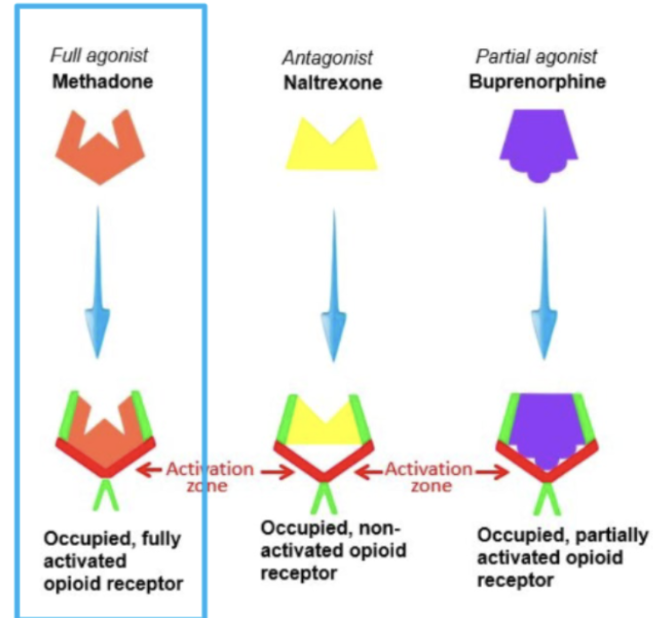
Methadone MOA: _______-acting, _______ that produces sustained receptor _______ (Gi-coupled: _______ cAMP, _______ K⁺ efflux, _______ Ca²⁺ influx), thereby _______ symptoms and reducing _______ while blunting euphoric effects of shorter-acting opioids
_______, _______-acting opioid “substitute”
_______ onset and _______ half-life → _______
long, full MOR agonist, activation, decreased, increased, decreased, suppressing w/d, cravings, safer, long, slow, long, minimal euphoria
Buprenorphine MOA: _______-acting _______ with high receptor _______, producing sufficient receptor activation to _______ symptoms and reduce _______ while exhibiting a _______ that limits euphoria and respiratory depression
_______, _______-acting opioid “substitute”
long, partial MOR agonist, affinity, suppress w/d, cravings, ceiling effect, safer, long
Naltrexone MOA: _______-acting _______ that _______ receptor activation, _______ (no Gi activation → no _______ cAMP), thereby eliminating _______ and reinforcing effects of opioids
Acts as a _______ therapy that _______ effects of _______ opioids
long, competitive MOR antagonist, blocks, preventing opioid-induced signaling, decreased, euphoria, non-opioid, blocks, exogenous
Alcohol Use Disorder
Enhances _______ → _______
Inhibits _______ → _______
Increases _______ → _______
GABA, sedation, glutamate, cognitive slowing, dopamine, reward/euphoria
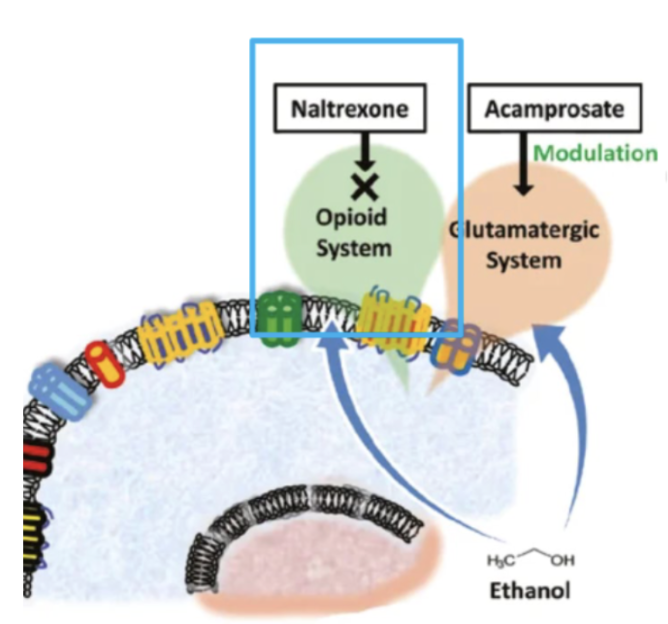
Naltrexone MOA: _______ that binds opioid receptors _______ them, _______ endogenous opioid signaling and blunting _______ in the _______ reward system, thereby reducing alcohol-induced _______ and _______
Does not alleviate _______ and is _______
competitive MOR antagonist, without activating, blocking alcohol-induced, dopamine release, mesolimbic, euphoria, cravings, w/d symptoms, non-addictive
Acamprosate MOA: _______ that restores the balance between excitatory (_______) and inhibitory (_______) neurotransmission disrupted by chronic _______ use, thereby reducing _______ and promoting _______
Does not produce _______ or affect alcohol _______, _______
glutamatergic modulator, glutamate, GABA, alcohol, cravings, abstinence, euphoria, metabolism, non-addictive
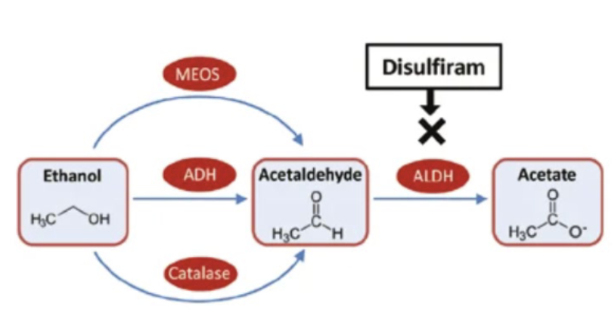
Disulfiram MOA: an _______ (_______) _______ that _______ the _______ of acetaldehyde, a toxic intermediate of alcohol, causing acetaldehyde _______ if alcohol is consumed. This results in unpleasant effects and acts as a _______ to drinking
Creates an _______ reaction (flushing, nausea, vomiting, headache, palpitations) when alcohol is ingested
Does not reduce _______ or _______
_______
aldehyde dehydrogenase, ALDH, inhibitor, blocks, metabolism, accumulation, deterrent, aversive, cravings, w/d symptoms, non-addictive
Varenicline MOA: _______(α4β2) _______ that produces _______-level receptor _______ while competitively _______, thereby reducing _______ and blunting _______ surges responsible for reinforcement + reward
May cause serious neuropsychiatric events
_______ blockade (_______ activity)
partial alpha-4, beta-2, nictotinic ACh receptor agonist, low, stimulation, blocking nicotine binding, w/d symptoms, dopamine, competitive, antagonist
Bupropion MOA: _______ reuptake of _______ to _______ and _______; also acts as a _______
_______ (_______), _______
May increase risk of seizures
blocks neuronal, DA and NE, reduce nicotine cravings, w/d symptoms, nicotinic ACh receptor antagonist, norepinephrine-dopamine reuptake inhibitor, NDRI, non-competitive, seizures
KNOW IMAGE
KNOW IMAGE
KNOW IMAGE