D4.1 - Natural selection
 Call Kai
 Learn
Learn Practice Test
 Spaced Repetition
 Match
Match Flashcards
 Knowt Play
1/15

There's no tags or description
Looks like no tags are added yet.
Name | Mastery | Learn | Test | Matching | Spaced | Call with Kai |
|---|
No analytics yet
Send a link to your students to track their progress
16 Terms
Important key words that you need when answering a longer question in an exam:
Natural selection
Selection pressures
Heritable traits
Favourable characteristics
Genetic variation
Mutation, meiosis and sexual reproduction
What is evolution?
A change in heritable characteristics of organisms over time
What is natural selection?
A process by which the organisms that are better adapted for survival, survive and pass on their heritable characteristics to offspring. This causes evolution.
What is a paradigm shift?
A fundamental change in a scientific concept or understanding.
How is Darwins theory an example of a paradigm shift?
Darwin’s evolutionary theory (he proposed that evolution is driven by natural selection) replaced Lamarcks theory of acquired desirable traits in a lifetime
How do genetic variations exist within a population?
Mutations
Meiosis - the crossover of genetic material in sister chromatids
sexual reproduction - the fusion of gametes / fertilization
Why is genetic variation so important in a population?
Natural selection can only occur if there is genetic variation in a population
What is carrying capacity?
The maximum population that can be supported long-term by an ecosystem, with enough resources and limited competition
What is the effect of overproduction of offspring on the carrying capacity?
If a lot of offspring is produced, then the numbers will exceed the carrying capacity. This will lead to high competition of resources, such as food, shelter, water and territory. It leads to survival of the fittest and those adapted best for survival win and natural selection occurs.
What is the effect of phenotypes on natural selection?
Phenotypes are the observable traits of genotypes, and the organisms that have the phenotype best adapted to their surroundings will survive and reproduce.
What is the effect of density-independent factors on natural selection?
Density-independent factors are mostly abiotic (non-living), such as temperature of the ecosystem, and can act as a selection pressure for organisms. The organisms that thrive best in the abiotic conditions and have the better phenotypes, survive and reproduce.
Why do the favourable traits have to be heritable in order for natural selection to occur?
Organisms that have favourable traits are more likely to survive in order to pass them on to offspring. If the organisms acquire characteristics in their lifetime that help them survive, these will not be passed on to offspring.
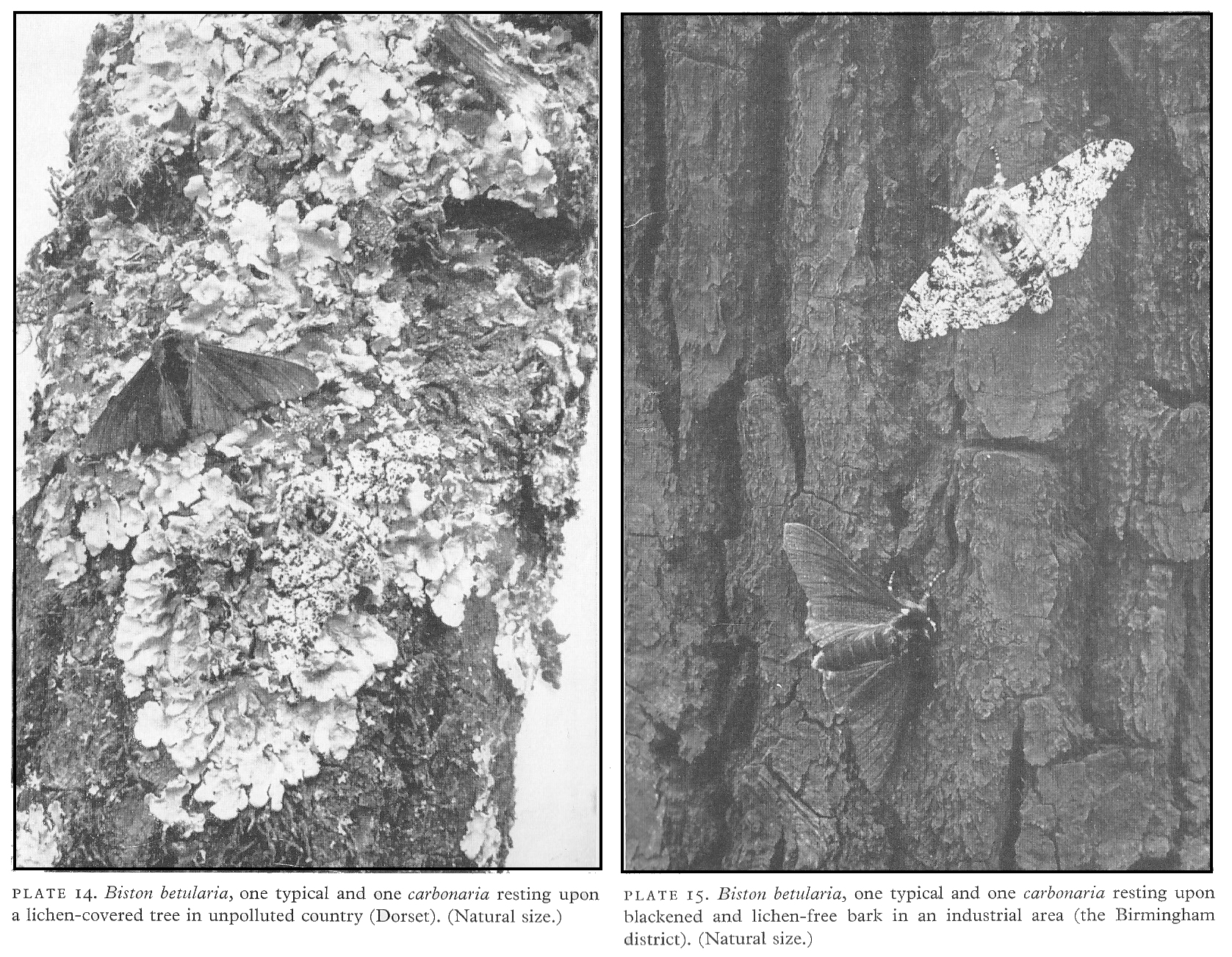
Explain how peppered moths have undergone natural selection
There are dark peppered moths (have an allele that codes for melanin, a dark pigment) and there are white peppered moths (have an allele for being white). This shows genetic variation.
White and dark moths compete to survive - intraspecific competition.
Before the industrial revolution, many of the trees were white. This allowed white peppered moths to camouflage better and survive, as they could hide from predators. Then the industrial revolution turned the trees black, and they could not camouflage anymore. They died, while dark peppered moths survived and reproduced more. The favourable characteristics were passed on due to being heritable traits.
What is sexual selection?
Natural selection that occurs through the preference of one sex, due to their physical differences or behavioural traits.
Give an example of sexual selection
Birds of paradise. The females choose a male to be with, based on their physical appearance and behaviour - they have bright plumage. The males that are chosen are more likely to pass their favourable traits onto offspring
Give an example of a controlled natural selection experiment with controlled selection pressures
Guppies, which are fish, can have different colours that are inherited. The colourful guppies are more likely to be eaten by predators. Female guppies are more likely to mate with colourful male guppies (sexual selection)
Endler set up fish tanks:
Tank with big gravel and predator - over multiple generations, the guppies developed a gravel pattern, to camouflage and hide from predators
Tank with thin gravel and predator - over multiple generations, the guppies developed a thin gravel pattern, to camouflage and hide from predators
The predator was a selective pressure, and the best camouflaged guppies were more likely to survive and reproduce
Then Endler set up fish tanks:
Tank with big gravel and no predator - over multiple generations, the guppies developed a small gravel pattern, to stand out and attract a mate
Tank with small gravel and no predator - over multiple generations, the guppies developed a big gravel pattern, to stand out and attract a mate
The visible male guppies were more likely to survive and reproduce. This is an example of sexual selection