Unit 10 Stem Cells and Regeneration
 Call Kai
 Learn
Learn Practice Test
 Spaced Repetition
 Match
Match Flashcards
 Knowt Play
1/43

There's no tags or description
Looks like no tags are added yet.
Name | Mastery | Learn | Test | Matching | Spaced | Call with Kai |
|---|
No analytics yet
Send a link to your students to track their progress
44 Terms
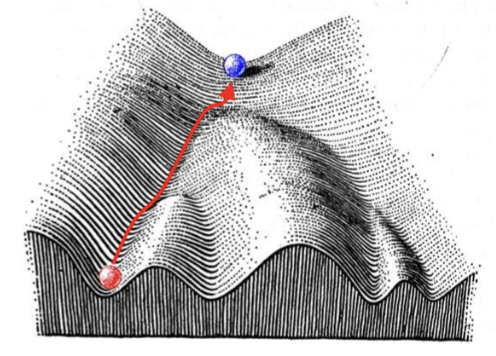
Waddington’s landscape
Start with single cell → end up with a human body, trillions of cells of many cell types. Ball on top of hill with valleys, release ball and travel down the hill → no cues can go in any direction. Different cells go in different direction
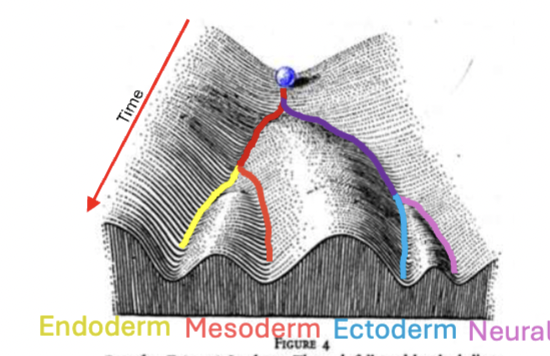
oocyte
one cell embryo that, the second it is fertilized, begins to roll down the hill
Waddington’s landscape explained
A metaphor for how gene regulation modulates development. Among other metaphors, Waddington asks us to imagine a number of marbles rolling down a hill. The marbles will sample the grooves on the slope, and come to rest at the lowest points. These points represent the eventual cell fates, that is, tissue types.
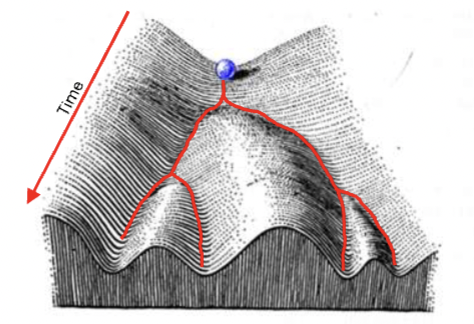
specific path
In the Waddington landscape analogy, The Ball Can Be Directed to a __________, aka the cell can differentiated based on asymmetrical cell division (segregated factors), secreted hormones, and tissue mechanics
tissue mechanics
The substrate the cell is on affects cell differentiation
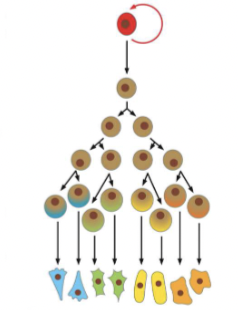
stem cells
at the top of the hill. Precursor to other cells in the body.
A special type of cells that have two important properties. They are able to make more cells like themselves. That is, they self-renew. And they can become other cells that do different things in a process known as differentiation.
progenitors
in the middle of the hill. Biological cells that can differentiate into a specific cell type. Can only differentiate into their "target" cell type
differentiated cells
at the bottom of the hill.
Differentiation is the process by which a cell undergoes phenotypic changes to become a particular specialized cell type. This specialized cell type is characterized by its physiological function and its corresponding role as part of a tissue and/or organ.
totipotent cells
least differentiated (often young), can give rise to entire embryo and supporting tissues
pluripotent cells
more differentiated (likely older), able to give rise to multiple cell types
terminally differentiated cells
have no capacity to divide or differentiation into other cell types
stem cells developmental potential
some proliferative capacity, can give rise to one or a few cell types
stem cells definition
Not terminally differentiated.
Capable of unlimited division.
Semi-immortal (divide an infinite number of times) → cannot maintain cell fate (must change into another cell type)
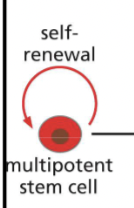
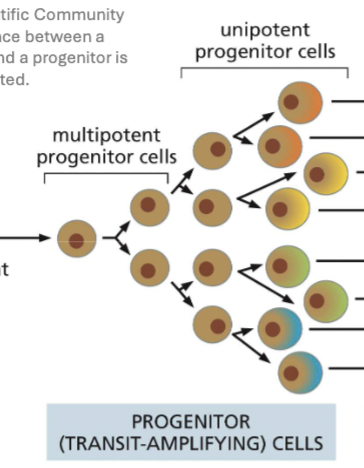
Progenitor cells (transiently amplifying cells)
Divide a limited number of times.
Are on a path to terminal differentiation.
3. Not self-renewing
Totipotent
Can give rise to every cell of the body (includes embryonic)
→ Very early embryonic cells
pluripotent
Can give rise to cells in all three germ layers (ectoderm, mesoderm, and endoderm)
→ baseline - normally say stem cells are this
multipotent
Can become a subset of cells in the organism
→ Multiple tissues within one germ layer, but not all three
mono/unipotent
contributes to one cell type in a tissue.
→ divide infinitely but only become one thing - keratocytes (skin only)
Terminally differentiated
(Not stem cell)
Final functional cell type. May divide a limited number of times under specific situations, but does not change cell type.
ectoderm
skin, nervous system.
the outermost layer of cells or tissue of an embryo in early development, or the parts derived from this, which include the epidermis and nerve tissue.
mesoderm
bones, muscles, circulatory system, heart
the middle layer of an embryo in early development, between the endoderm and ectoderm.
endoderm
intestines, liver, and pancreas.
the innermost layer of cells or tissue of an embryo in early development, or the parts derived from this, which include the lining of the gut and associated structures.
Find it Developmental Test
The process of obtaining descriptive, correlative evidence, such as the expression of a particular gene or the presence of a cell type associated with the development of a particular anatomical structure. Such evidence is a weak indication of causation
→ Identify where cells originate - microinjection of dye, etc
Lose it Developmental Test
This represents a test for necessity, wherein the putatively causal factor— expression of a gene in a particular tissue, for example—is removed and the consequences observed. The claim that such-and-such a gene (or cell type, or act of cell-cell communication, etc.) is required for the regeneration of a particular anatomical structure rests on this type of evidence.
→ Gene knockout or acutally take the tissue and remove it
Move it Developmental Test
This is a test for sufficiency wherein the putatively causal factor is placed in a novel context—say a gene expressed in a tissue in which it is not normally expressed—and shown to result in a particular outcome.
→ Take from some tissue and translocate it somewhere else
specification
cell is capable of developing, as specified, in isolation
determination
cell is capable of developing as intended, within context of other cells
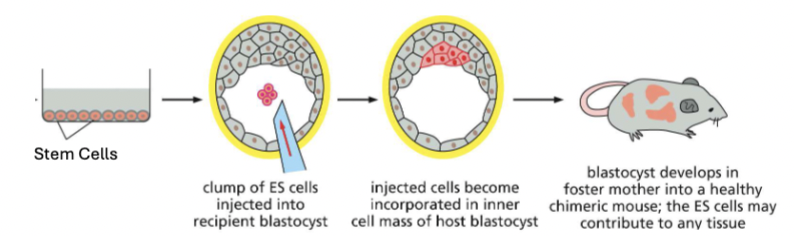
Potency Test by Blastocyst Complementation
If the cells go to all three germ layers (anywhere on organism, we call it Pluripotent
If the cells only create a few type of related tissues, we call it Multipotent
If the cells only create one cell type we call it Unipotent. (Aka: Monopotent)
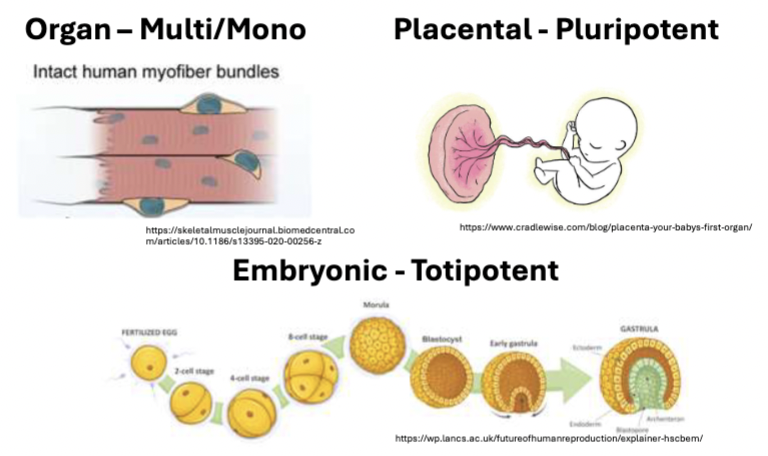
Natural Source of Stem Cells
organ - multi/mono
placental - pluripotent
embryonic - totipotent
stem cell life cycle
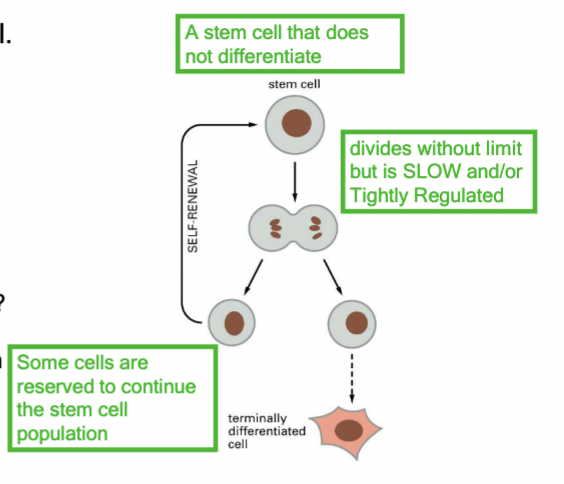
Start with a stem cell that does not differentiate. It divides without limit but is SLOW and/or tightly regulated. Some cells are reserved to continue the stem cell population, others differentiate.
Stem Cell Niche
special place often with unique adhesion (ECM or cell-cell).
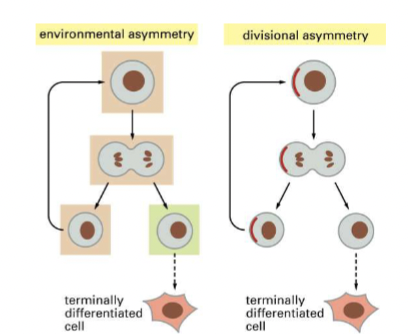
Inheritance of "stem-ness" factors. (often both at work together) - different factors get divided differently, and asymmetry can be caused by hormonal factors or tissue mechanics
An area of a tissue that provides a specific microenvironment, in which stem cells are present in an undifferentiated and self-renewable state. Cells here interact with the stem cells to maintain them or promote their differentiation
protect
Most Organisms _______ Their Stem Cells From Rolling Down the Hill.
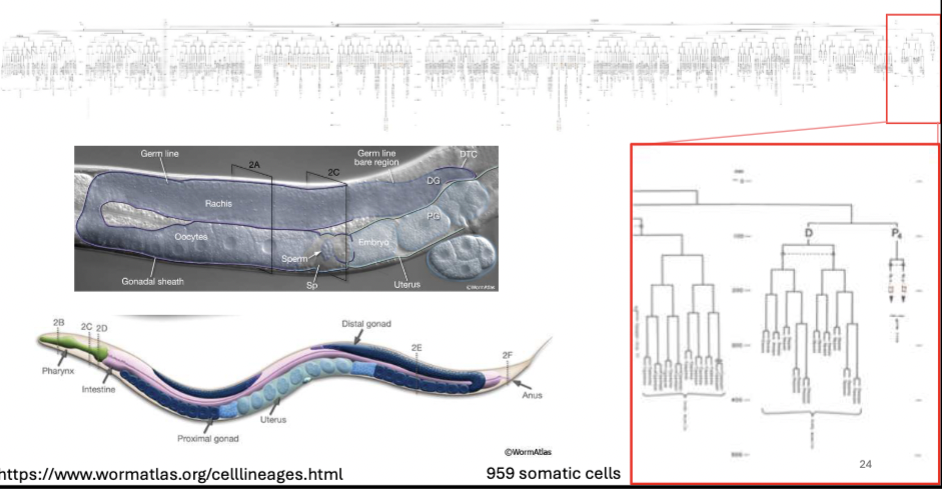
Ex: C. elegans. Stem cell population at right end, divides and pushes down the germ line → meiosis occurs → form oocyte → fertilized and laid
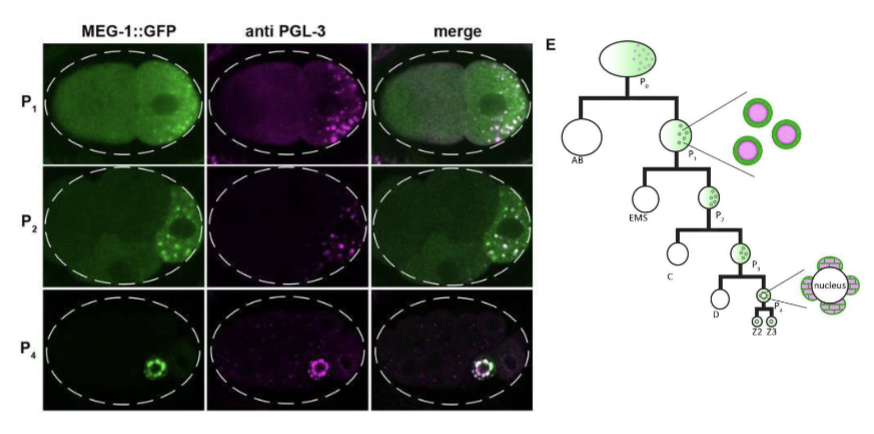
Asymmetric Division of Factors
Factors selectively excluded into different cell types. Two germ lines and all future generations. As the cells divide, sequesters factors → maintain population of stem cells for the next generation.
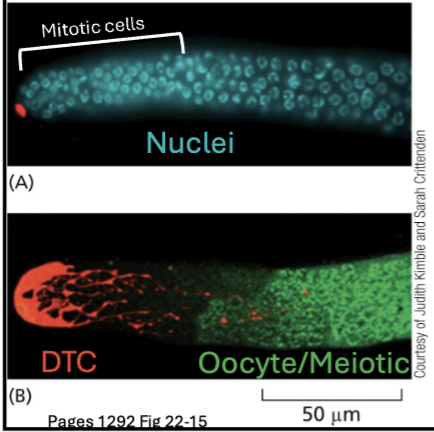
Distal Tip Cell (DTC)
A stem cell niche maintains a cell’s stemness (in C. Elegans)
This cell (red) expresses a Delta ortholog Lag-2 (notch ligand), and covers the tip of the germ line, forming a niche.
The cells under these cells express the Notch receptor ortholog Glp-1 and, therefore, are sensitive to Notch signaling. The cells under these cells divide, pushing some cells out of the niche.
Once pushed out of the niche, Notch signaling is absent, and cells undergo meiosis to produce oocytes.
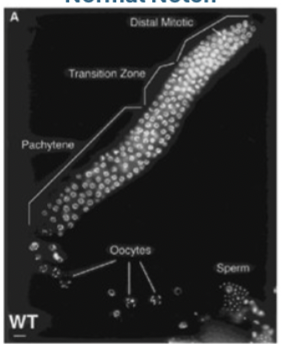
Normal Notch in C. elegans
Lots of small dividing nuclei around DTC
Cells properly develop into sperm and oocytes
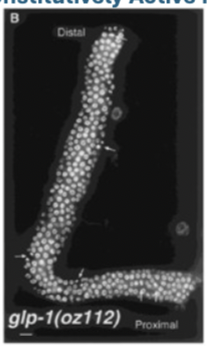
Constitutively active Notch in C. elegans
Germline is full of cells that never enter oogenesis
Animals are sterile
Develop germline tumors
Gain of function - distal tip cell is everywhere - too big of a niche - mitotic cells throughout the germline
loss of function Notch C. elegans
Germline has a few cells
They have LOST IT’s stem cell niche
Same phenotype as laser ablating DTC
Animals are sterile
Only a few germ cells are produced
Loss of niche - no stem cell population - get a few terminally differentiated cells → sterile embryo with no stem cells maintained
Human Germline
Not every organism does a perfect job at maintaining stem cells. For example, these cells start to differentiate into mesoderm-like cells and then get pushed back up the hill.
nuclear transport
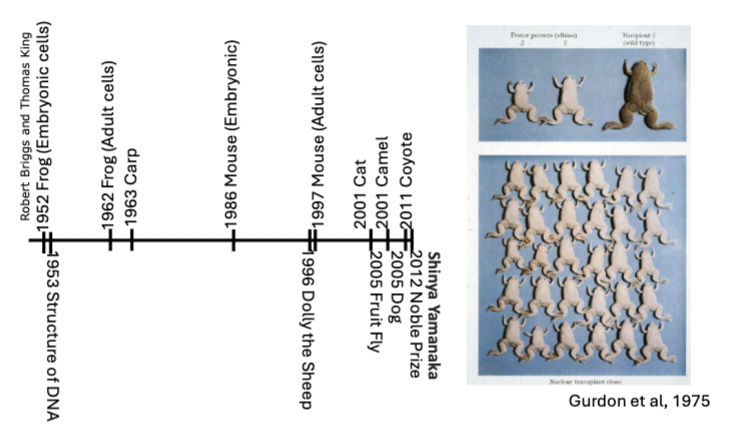
Nuclei Can be Reprogramed. Clone adult animal - Xenopus frog - by nuclear reprogramming
Remove the nuclei for a verified stem cell.
Collect the Nuclei from a terminally differentiated cell.
Place the Nuclei into the stem cell.
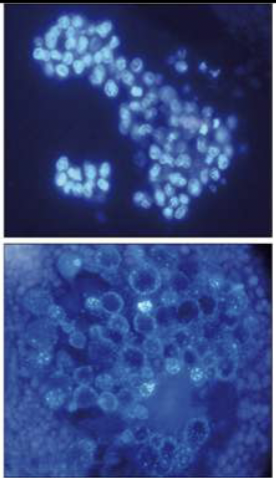
The newly derived hybrid cell is pluripotent, like the original stem cell. There is a large-scale remodeling of the chromatin Chromatin decondenses (nuclei grow 50x). X-inactivation is reversed → The factors for creating stemness were from the cytoplasm.
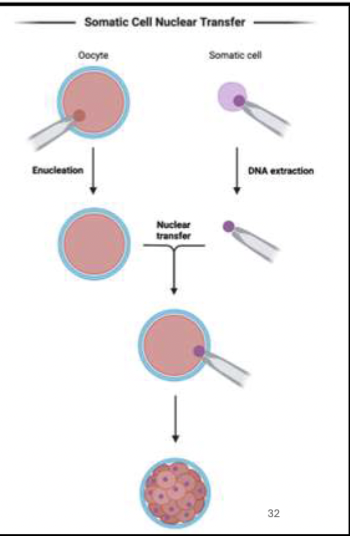
Cloning of Vertebrate Animals
John B. Gurdon. (1962). The developmental capacity of nuclei taken from intestinal epithelium cells of feeding tadpoles.
reprogrammed nuclei
Appear quite different than the original nuclei inside a frog egg. In a normal adult stem cell, small nuclei that are well condensed. As cells differentiate, they start silencing genes they don’t need (epigenetics) and you would have to turn them back on again to go back up the hill → the cytoplasm contains factors to create these.
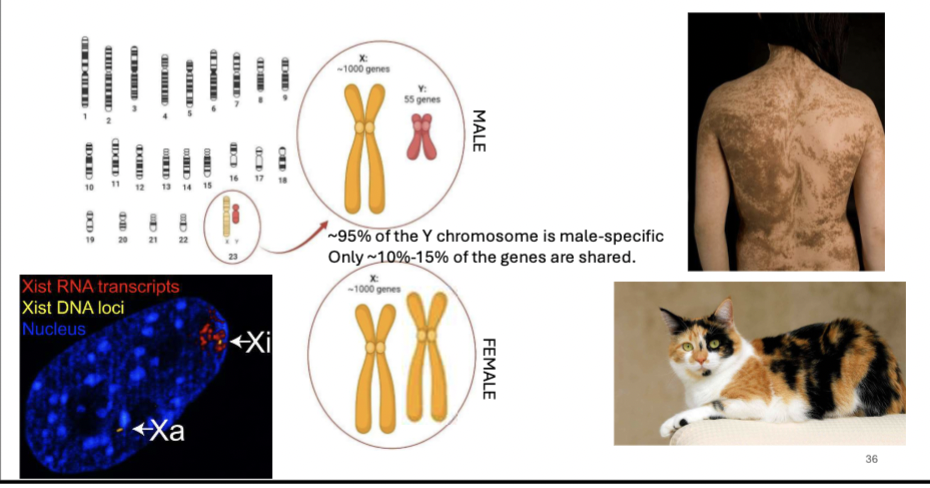
X inactivation
Condensed chromatin. Females have 2 X’s, while the Y does not contain a lot of stuff - almost all of it is male specification. For the 2 X’s, silence one chromosome, inactivated through epigenetic. Contributes to calico cats, skin pigmentation.
the form of dosage compensation in mammalian female cells to balance X-linked gene expression levels of the two sexes
OSKM genes
A set of genes (mRNAs) was identified to be enriched in stem cells. None of them alone conferred stemness. This subset can create stemness in mammals → Oct4, Sox2, Klf4, Myc
The expression of these factors can revert a large number of cells to pluripotent stem cells (iPSCs - Induced pluripotent stem cells)
Strongly reduced the need for embryonic stem cells
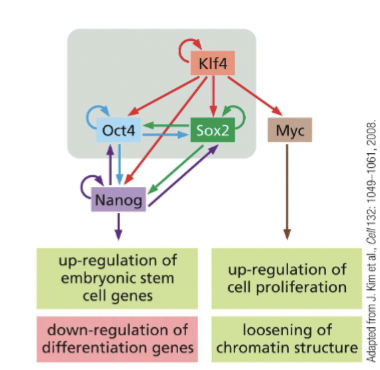
induced pluripotent stem cells (iPSCs)
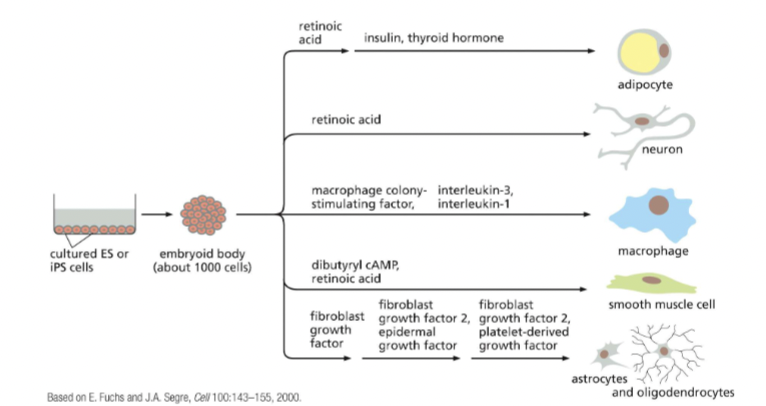
These can be turned into many cell types In Vitro. Different morphogens can be used to turn into any cell type you want. Create embryonic stem cells + turn into almost any cell in the body we want.
A type of pluripotent stem cell derived from adult somatic cells that have been genetically reprogrammed to an embryonic stem (ES) cell-like state through the forced expression of genes and factors important for maintaining the defining properties of ES cells.