1.2.9 indirect txes and subsisdies
 Call Kai
 Learn
Learn Practice Test
 Spaced Repetition
 Match
Match Flashcards
 Knowt Play
1/21

There's no tags or description
Looks like no tags are added yet.
Name | Mastery | Learn | Test | Matching | Spaced | Call with Kai |
|---|
No analytics yet
Send a link to your students to track their progress
22 Terms
What is an indirect tax?
A tax on expenditure, where firms pay the government but pass the cost onto consumers through higher prices.
What is the difference between a specific and ad valorem tax?
A specific tax is a fixed amount per unit, whereas an ad valorem tax is a percentage of the good’s price, so it rises as price rises.
What is tax incidence?
The extent to which consumers or producers bear the burden of a tax.
What determines who pays more of a tax?
The relative elasticities of demand and supply. The more inelastic side of the market bears more of the burden.
How does elasticity affect the burden of a tax?
If demand is more inelastic, consumers pay more because they are less responsive to price changes. If supply is more inelastic, producers pay more.
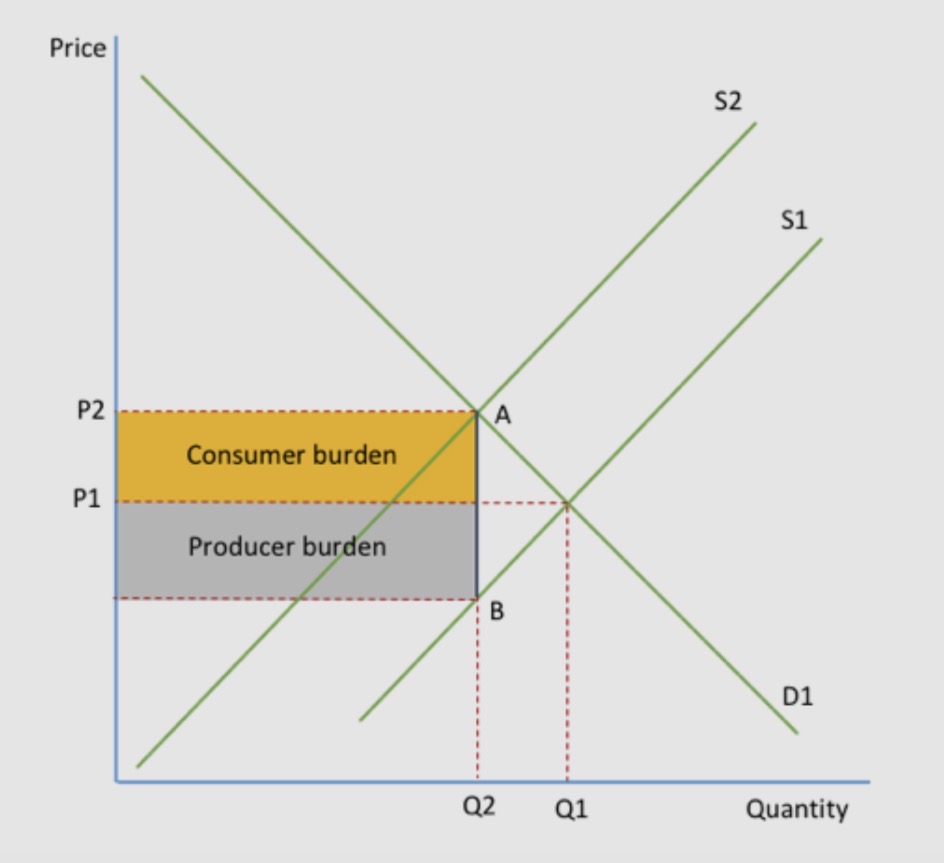
Draw the specific tax diagram and analyse.
Supply shifts left from S1 to S2 because the tax raises firms’ costs
price rises from P1 to P2
quantity falls from Q1 to Q2
the vertical gap between S1 and S2 shows the size of the tax
consumers pay a higher price while producers receive less, so the burden is shared
government revenue is the rectangle equal to tax × Q2
there is a welfare loss because output falls
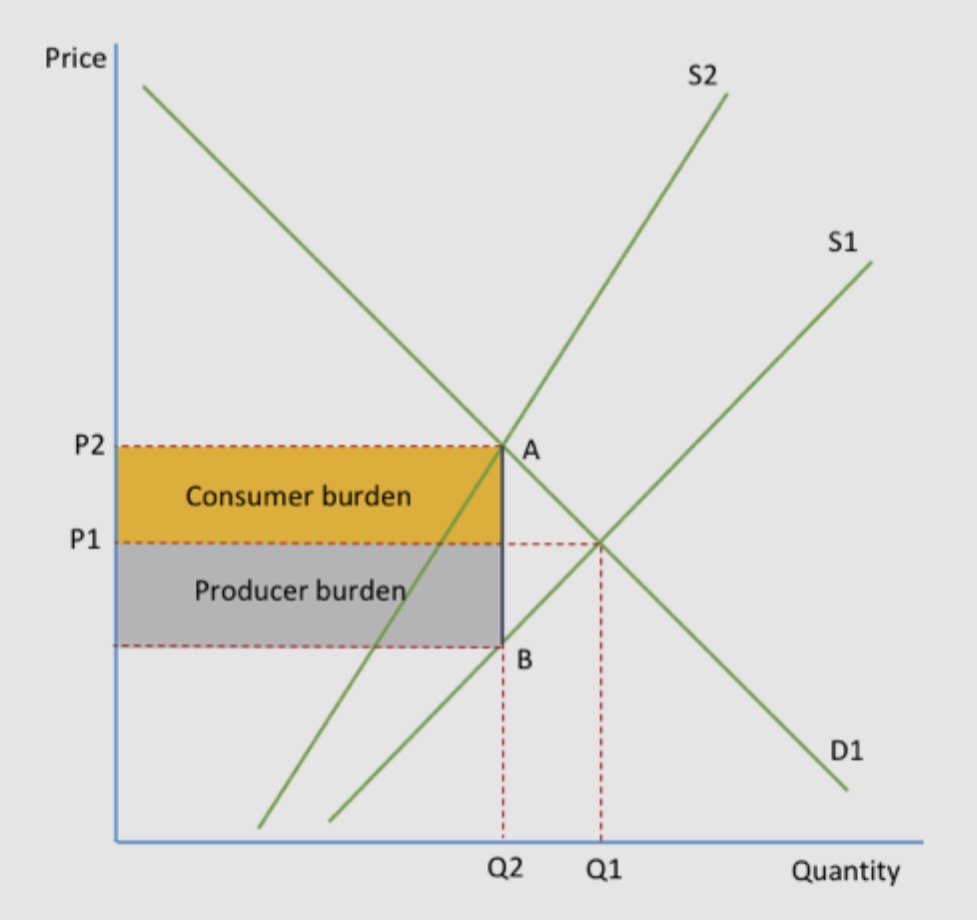
Draw the ad valorem tax diagram and analyse.
The supply curve rotates left rather than shifting parallel
this is because the tax is a percentage of price, so the tax amount gets bigger as price rises
price rises and quantity falls; the gap between S1 and S2 widens at higher prices, showing the larger tax
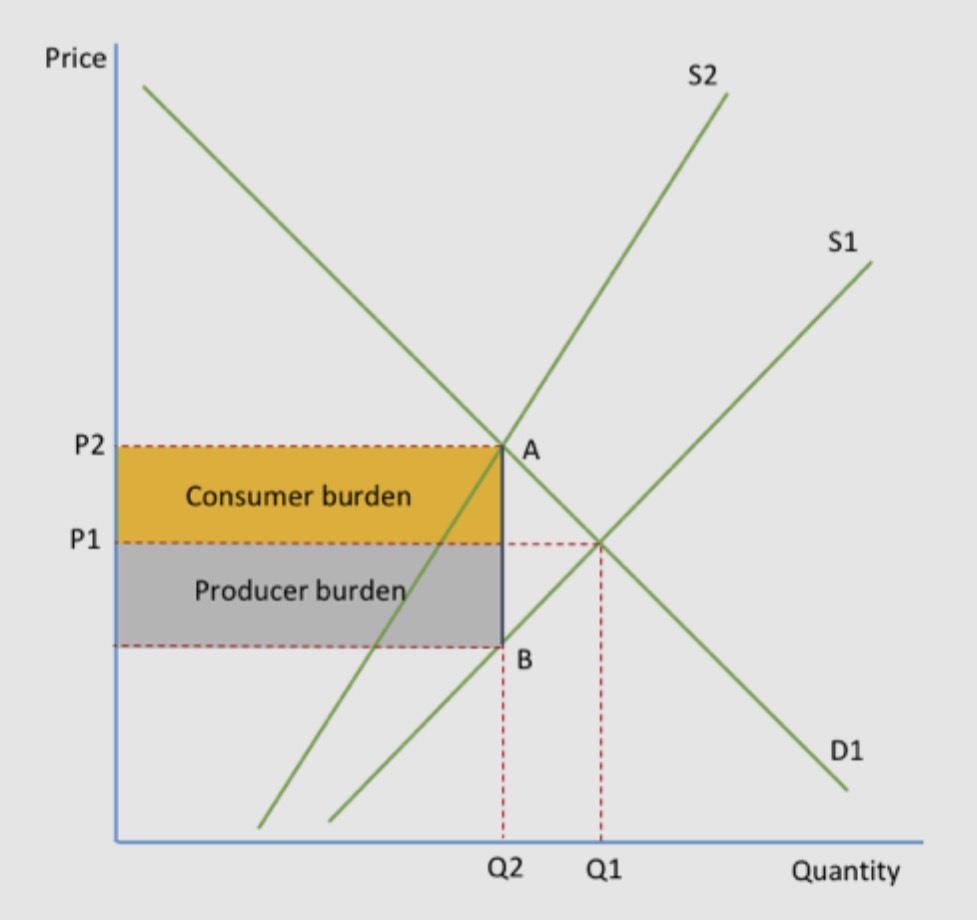
How is tax revenue shown on a diagram?
It is the rectangle between the two supply curves up to Q2, equal to the tax per unit multiplied by quantity sold.
What is a subsidy?
A payment from the government to producers to encourage production or consumption of a good.
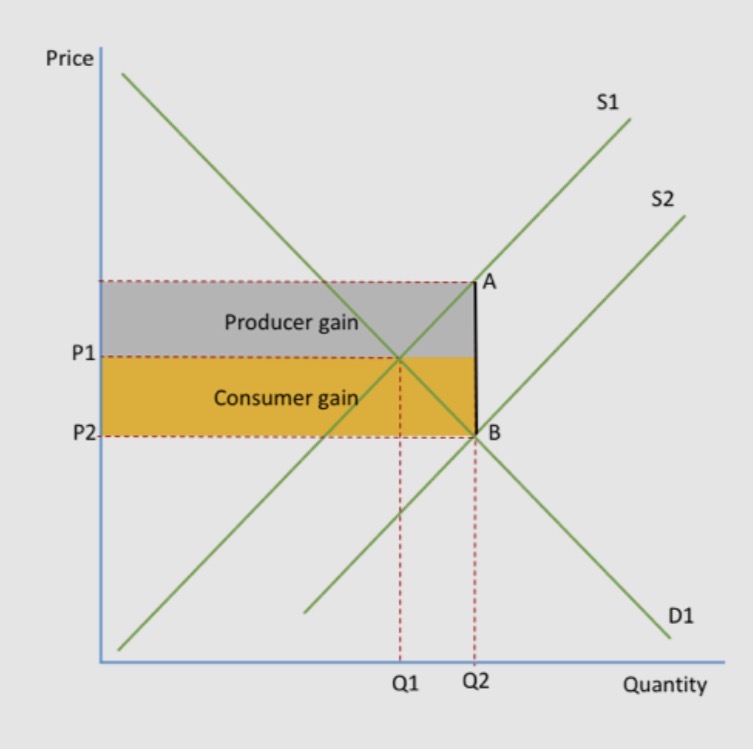
Draw the subsidy diagram and analyse.
A subsidy lowers firms’ costs, so supply shifts right from S1 to S2
price falls from P1 to P2; quantity rises from Q1 to Q2; consumers pay less and producers receive more, so both gain
the total area represents government spending on the subsidy
the distribution of benefits depends on elasticity
Who benefits more from a subsidy?
The side of the market that is more inelastic gains more of the benefit.
What are the key evaluation points for taxes and subsidies?
The impact depends mainly on elasticity; it also depends on the size of the tax or subsidy, the time period, and the government’s objective such as correcting market failure.
What is the impact of an indirect tax on consumers, producers and the government?
Consumers face higher prices; producers receive less revenue and sell less output; the government gains tax revenue.
What is the impact of a subsidy on consumers, producers and the government?
Consumers pay lower prices; producers receive more revenue and produce more; the government must fund the subsidy so spending increases.
What area represents consumer tax burden on the diagram?
The increase in price paid by consumers after the tax.
What area represents producer tax burden on the diagram?
The loss in revenue per unit received by producers after the tax.
What area represents consumer gain on a subsidy diagram?
The benefit from paying a lower price after the subsidy.
What area represents producer gain on a subsidy diagram?
The benefit from receiving a higher effective price after the subsidy.
Why does inelastic demand mean consumers pay more tax?
Because consumers are less responsive to price rises, so firms can pass on more of the tax without losing much demand.
Why does inelastic supply mean producers pay more tax?
Because producers are less responsive to price changes, so they cannot reduce supply much and must absorb more of the tax.
Why does a tax reduce quantity?
It raises production costs, shifts supply left, increases price and reduces equilibrium quantity.
Why does a subsidy increase quantity?
It lowers production costs, shifts supply right, reduces price and increases equilibrium quantity.