APES Units 1-7
 Call Kai
 Learn
Learn Practice Test
 Spaced Repetition
 Match
Match Flashcards
 Knowt Play
1/299

There's no tags or description
Looks like no tags are added yet.
Name | Mastery | Learn | Test | Matching | Spaced | Call with Kai |
|---|
No analytics yet
Send a link to your students to track their progress
300 Terms
SO2
Sulfur Dioxide. Corrosive, comes from coal + oil combustion. Precursor to acid rain/acid deposition.
NOx
Nitric oxide (NO) and nitrogen dioxide (NO2). Comes from all combustion. Irritant, tropospheric O3 precursor, can convert into nitric acid → harmful to marine life.
CO
Carbon monoxide. Asphyxiant → death if exposed too much. Comes from bad exhaust, incomplete combustion, poor ventillation w/ combustion.
PM
Particulate Matter. Comes from biofuel + biomass combustion + certain activities. Reduces visibility, exasperates respiratory issues + cardiovascular issues + cancer.
O3
Ozone. Secondary pollutant when in the troposphere. Degrades plant surfaces, reduces lung function, + damages materials (ex: rubber + plastic).
Pb
Lead. Used to be a gas additive. Impairs central nervous system + impairs ability to learn/concentrate.
Clean Air Act
Required lead to be phased out as a gas additive between 1975-1996. In 2021 no lead in gasoline anywhere.
Secondary Air Pollutants
Pollutants that have undergone transformation in sun, water, or air. Caused by primary pollutants → into secondary pollutants.
Ozone is the major one!! Formed from NOx + VOCs
Photochemical Smog
Polluted orangey-brown haze formed by sunlight driven chemical reactions.
NOx + VOCs → O3 + PANs (family of smog chemicals, stable in cool air so travel long distances)
Irritates eyes + throat + triggers coughing + asthma. PANs = acute tissue irritant esp for plants. O3 reduced photosynthesis.
Reducing Photochemical Smog
Reduce vehicle use, use EVs, vapor recovery nozzle at gas stations
Catalytic converter: VOCs, NOx, CO → N2, H2O, O2, CO2
Thermal Inversions
Ground cools rapidly at night → air near surface cools, becomes dense, + sinks.
Warmer layer of air above (often strengthened by sinking, warning air in high pressure systems) prevents vertical mixing.
Pollutants get trapped near ground → more smog
PM10 vs PM2.5
Larger than PM10 (10mm) usually filtered by nose + throat, but PM10 and less are not.
PM2.5 even more of a concern because they travel further + can be composed of more toxic material.
Radon
Naturally occurring radioactive gas, comes from decay of uranium in rocks + soil. Can enter home through cracks in foundation. Exposure can lead to cancer (2nd leading cause of lung cancer, after smoking).
VOCs
Found in many building materials, furniture, glues, paints, detergents, cleaners, air fresheners Formaldehyde is one of the most toxic (common in new homes, found in particle board and carpeting glue) + is carcinogenic.
Can cause burning sensations in eyes and throat, + breathing difficulties and asthma
Sick Building Syndrome
A buildup of toxic pollutants in weatherized newer buildings containing synthetic materials (most common in office buildings).
Crushed Limestone
Combines w/ SO2 to make calcium sulfate, reducing SO2 emissions. Calcium sulfate can be used for gypsum wall board or for foundations.
Dry Scrubbers
Big column w/ chemical that absorbs/neutralizes NOx, SO2, + VOCs. Often calcium oxide because calcium oxide + SO2 → calcium sulfite
Wet Scrubbers
Chemicals + mist nozzles trap PM in water, mist falls to the bottom or gets trapped at top, sludge collection systems → dispose of polluted water.
Fluidized Bed Combustion
Jets of oxygen make combustion more effiecent + bring SO2 into contact w/ more crushed limestone + reduce temps (reduce NOx)
Acid Depostion
Process where acidic pollutants from the atmosphere fall to Earth’s surface in wet (rain, fog, snow) or dry (dust, gas) form.
Primarily caused by burning fossil fuels. Acidifies bodies of water, harms wildlife, and corrodes buildings + man-made structures
NOx + SO2
Primary pollutants that cause acid deposition. Both react w/ O2 and water in the atmosphere.
SO2 - produced mostly from coal fired power plants, sulfuric acid.
NOx - produced mostly from vehicle emissions and coal power plants, nitric acid.
Decreases pH (increases acidity) of soil + water.
Limestone
Calcium carbonate. A natural base that can neutralize acidic soil/water. Regions w/ this as bedrock have some natural buffering of acid rain. Can also be added to neutralize acid.
Nonrenewable Energy Sources
Exist in fixed amounts that cannot be replaced.
Examples: nuclear (uranium is a finite resourced), fossil fuels
Renewable Energy Sources
Can be replenished naturally at or near rate of consumption + reused. If managed correctly can be used indefinitely.
Examples: hydroelectric, solar, wind, waves, geothermal, + biomass (wood, cow dung, + corn used for biofuel)
Wood and Charcoal
Primarily used in developing countries for heating and cooking.
Removal of trees → soil erosion/degradation, deforestation can decrease amount of precipitation bc disrupting water cycle (?) + decreased CO2 sequestration, if used indoors w/out proper ventilation indoor air pollutants released
Peat
Partially decomposed organic material, including moss that can be burned for fuel. Is a precursor to coal. Can also cause indoor air pollution.
Coal
Electricity + industrial processes. Formed from peat + takes hundreds of millions of years to form. 3 types of coal based on age, exposure to heat/pressure, + depth.
Greater moisture content = more smoke + less efficient
Greater sulfur content = more acid deposition (acid rain formation)
Levels of Coal
Peat (not coal) → Lignite → Bituminous → Anthracite
Further left the more heat + pressure. Anthracite is most desirable because low sulfur/most pure. Bituminous is most used because of it’s availability, has high sulfur content.
Natural Gas
Used for electricity + industrial processes. Some homes use it for heating/cooking/hot water heaters. Is is largest user. Composed mostly of CH4 (80-95%).
Considered the “cleanest” fossil fuel bc produces smaller amounts of particulates, SO2, and CO2 (compared to coal or oil), but still produces CO2
Crude Oil
Naturally occurring unrefined petroleum found underground + in tar sands. Can be refined into gas, diesel fuel, or jet fuel. Also for heating oil + asphalt.
Refined based on different boiling points!
Tar Sands
Slow flowing, viscous deposits of bitumen (asphalt) mixed w/ sand, water, + clay. Crude oil an be extracted w/ surface mining.
Extracting has very neg results (destroys ecosystems, creates large open pits, contaminates watersheds + aquatic life). Extracting process also very energy intensive.
Cogeneration
Use of fuel to generate electricity + deliver head to building or industrial process.
By capturing heat usually lost, power plants achieve up to 90% efficiency compared to 35-75% for separate systems
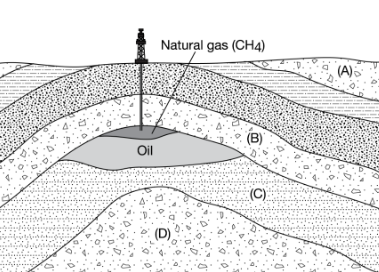
Fossil Fuels in Sedimentary Rocks
Source Rock (D) - Organic matter subjected to heat + pressure over time → oil and gas which collects in reservoir above
Reservoir Rock (C) - Porus, permeable rock that holds oil + natural gas that has migrated from below
Caprock (B) - Impermeable rock that prevents the oil + natural gas from migrating to the surface (rock can still be proud but holes may not be connected)
Combustion
Chemical process. Fuel + O2 → CO2 + H2O
Process of Coal into Energy
Coal pulverized
Coal burned
Heat from combustion turns water to steam
Steam turns turbine
Turbine turns a generator
Generator generates electricity
Fracking
Hydraulic fracturing. Process to remove natural gas from rock.
well is drilled in the ground (lined w/ clay or ceramic to prevent groundwater contamination)
pipe inserted into well to extract natty gas
fracking fluid (water w/ sand + volatile chemicals) is pumped into pipe, fluid breaks the rock holding natty gas
Natural gas trapped in rock escapes + piped out
Environmental Impacts of Fracking
creation of well → habitat destruction + water contamination
pipe not lined properly → fracking fluid contaminates groundwater
fracking fluid contains VOCs, can contaminate groundwater + end up in atmosphere
natty gas may leak out into atmosphere + groundwater
uses a lot of water + creates waste water
can cause earthquakes (breaks rocks) → can cause pipe to crack → natty gas and/or VOCs escape
Nuclear Energy
Advantages: no CO2 emissions, no air pollution, way to achieve energy independence from fossil fuel imports, small land footprint compared to solar + wind
Disadvantages: nuke waste management, $$$ + time consuming to build nuke plants, uranium-235 technically nonrenewable, risk of accidents
Parts of a Nuclear Power Plant
Heat from nuke fission used to heat water vapor to steam → turns turbine.
Control rods - between fuel rods, absorb excess neutrons to prevent meltdown
Cooling towers - stereotypical nuke plant symbol, used to cool + release water vapor
Condenser - turns steam back into liquid water
Biofuels
Liquid fuels created from processed or refined biomass.
Usually ethanol or biodiesel.
Ethanol
Alcohol make by converting starches + sugars from plant material into alcohol + CO2. 90% made in the US comes from corn. Actually probably worse for the environment than regular gas because of the land required + all that, but less directly worse.
Biodiesel
Diesel substitute produced by extracting + altering oil from plants.
Passive Solar
Taking advantage of energy from the sun w/out active technology. Cannot be stored, used when received. Ex: house set up so it receives sunlight that heats it in the morning, ect.
Active Solar
Technologies that capture + store energy of sunlight w/ electrical equipment.
Solar water heating system - pipe of cold water goes to roof where heated up + goes to hot water tank
Photovoltaic systems
Benefits: no CO2 or pollutants, produced energy on peak demand days (hot + sunny), can be economically feasible on small scale
Drawbacks: photovoltaic cells are expensive to make + initial cost is high, manufacturing needs fossil fuels
Photovoltaic System
Photovoltaic cells capture energy from the sun as light, not heat, + convert it directly to electricity. Can directly be used for highway signs, emergency telephones, smart parking meters, + more.
Concentrates Solar Thermal Electricity Generation
Aka CST systems, they’re large scale + similar to convention power plants but energy from from the sun is used to heat water into steam.
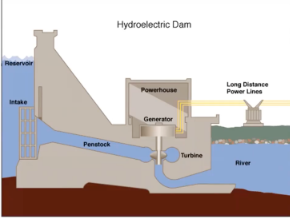
Hydroelectric
Kinetic energy of moving water can be transformed into electricity.
Water stored in a reservoir has potential energy
As water moves through the dam, stored energy is converted into kinetic energy
Kinetic energy of water converts to mechanical kinetic energy of spinning turbine
Spinning turbine causes a generator to turn
Mechanical kinetic energy of turbine is converted to electrical energy from the generator
Electricity flows from the dam to the grid
Same principle applies to tidal energy.
Fish Ladders
Provide a way for salmon to make up up + over a dam to swim upstream.
Advantages of Hydro-Power
No air pollution
No waste
Relatively inexpensive electricity generation
Additional services provided by reservoir (recreation like fishing and boating, can provide irrigation water for agriculture or drinking water for people)
Disadvantages of Hydro-Power
Flooding of land for reservoir
Disruption to flow rates of river
High maintenance cost for tidal power
High construction costs for dams
Most viable sites are already used
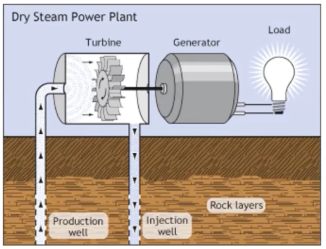
Geothermal Process
Water is pumped down an injection well
Stored heat from the Earth’s interior turns the water into steam
Steam rises from the production well
Kinetic energy of the steam turns a turbine
The turbine turns a generator
The generator produces electricity
Advantages of Geothermal
No CO2 emissions
not dependent on weather
reliable + abundant (in some places)
Disadvantages of Geothermal
limited areas where geo is cheap + efficient
produces hydrogen sulfide gas pollution while drilling
can impact groundwater
implementation requires high up-front cost + costs electricity to run pumps
Wind Energy
Kinetic energy of moving air → kinetic energy of spinning turbine, kinetic energy in generator → electricity
Benefits: renewable, allows for multiple land uses
Drawbacks: birds + bats can be hit, locations must have consistent wind for constant power → backup generators needed for not windy days
Xeriscaping
Matching plants you plant to local environment, saves energy needed to water + take care of them bc they’re already built for the area.
Conserving Energy at Home
shorter showers
adjust thermostat
energy efficient appliances
Conserving Energy in Transport
carpool
use EVs + hybrids
public transit
CAFE
Corporate Average Fuel Economy Standards. Made car mpg more efficient.
Percent Change Equation
% change = (X2 - X1)/X1 = (new - old)/old
Green Building Design Features
passive design elements (passive solar, windows facing sun, ect)
insulation
lighting from the sun
Hydrogen Fuel Cells
H2 + O2 → H2O + electricity
Hydrogen atoms separate into protons + electrons by membrane + electrons forced to use an alt route → generates the electrical current.
Not a lot of H2 available for refueling yet, but no air pollutants released.
4 Types of Forests
Tropical - hot year-round w/ high rainfall + most biodiverse
Boreal - found in high attitudes, dominated by conifers
Temperate - occur in places w/ distinct seasons, mix of deciduos and conifers
Subtropical - occur just N and S of the tropics, also a mix of trees
Provisioning Services of Forests
Lumber, paper, fuel
Cultural Services of Forests
Recreation (camping, hiking, ect), aesthetics, ecotourism.
Regulating Services of Forests
Storage of atmospheric carbon, purifies water + air, stabilize soil + reduce erosion, influences local/regional climate (provides shade + reflects light due to high albedo).
Supporting Services of Forests
Provides habitat, nutrient cycling, photosynthesis, water cycling.
Tragedy of the Commons
The tendency for a shared, limited resource to become depleted if it’s not regulated in some way.
Only applies to public commons.
Land or resource must become degraded or depleted.
Clear Cutting
Removing most or all trees from an area (can be combines w/ replanting so all the trees that regrow are the same age). Leads to deforestation, increases erosion from wind and water (esp. on slopes → higher change of landslides) which adds silt/sediment to nearby streams, increasing turbidity.
Tilling
Turns compacted soil to prepare for planting seeds.
Benefits: loosens soil allowing aeration and drainage, chops up existing weeds, helps mix compost + fertilizers into the soil.
Drawbacks: reveals bare soil → erosion, kills beneficial bacteria → reduced soil nutrients, releases stored CO2, requires burning fossil fuels
Slash + Burn Agriculture
Occurs in developing countries w/ subsistence farming. Typically in tropical forests w/ low nutrient soil.
Drawbacks: unsustainable (ash nutrients only remain for a few years) → have to keep slash + burning new plots, releases CO2 because combustion
Synthetic Fertilizers
Synthesized in large industrial plants (which requires fossil fuels).
Benefits: easy to transport + use, time released, customized for the soil’s specific needs
Drawbacks: production → CO2, water soluble so enters runoff → eutrophication, often overused, does nothing for soil texture
Organic Fertilizers
Manure, compost, bone meal or fish emulsion.
Benefits: working into soil so stay put (less runoff concern), improve soil texture
Drawbacks: must be gathered (labor intensive process), nutrient levels unknown, harder to use (needs to be worked into soil)
Furrow Irrigation
Trenches built on either side of crops + filled with water. Oldest technique.
Pros: high sediment water can be used, allows for some precision of aplication
Cons: not efficient w/ sandy soil because it just passed through, most inefficient method (33% lost to evaporation + runoff), soil erosion occurs, waterlogging + salinization
Flood Irrigation
Lake or stream diverted to agricultural field, entire field flooded + water soaks in evenly, levee needed to retain water.
Pros: easy + inexpensive
Cons: requires body of water, not for all crops (usually is for rice), land but be graded (sloped + leveled), levees needed, inefficient (20% lost to evaporation), waterlogging + salinization can occur
Spray Irrigation
Pumps are used to spray from a nozzle directly on crops.
Pros: precision application, can be efficient (5%-25% lost to evaporation), can be programmed to run at certain times of day
Cons: larger up-front cost, probably included machinery (CO2 emissions), nozzles can clog, pivot systems can wear ruts into soil
Drip Irrigation
Uses piped w/ micropores that drip water onto crops.
Pros: very efficient (5% evaporation), reduced nutrient leaching, no land grading needed, good for sandy soil
Cons: very expensive, micropores can clog, ones pipes are put down they’re difficult to move + vulnerable to punctures
Waterlogging
Pore spaces in soil required for plant roots, pore spaces provide O2 to roots for cellular respiration, waterlogging results in death of roots → kills plants.
To remediate, allow soil to dry out + add sand.
Salinization
Freshwater has trace salts, after irrigation water evaporates salts build up in soil, most crops have low salt tolerance so salt kills plants.
Most likely to occur w/ furrow irrigation in warm areas with lots of sunlight.
To remediate, flush soil w/ lots of water
Depleted Aquifers
Overuse of irrigation can lead to depleted aquifers.
Persistent Pesticides
Remains in the environment for years or decades.
Problematic Pesticides
Can be transported through wind, runoff, and groundwater recharge. Can contaminate makes, streams, groundwater, and well water. Can result in killing of non-targeted species through bioaccumulation and biomagnification.
GMOs
Genetically Modified Organisms. Involve taking an adventurous gene from one organism and inserting it into the genome of another.
Ex: Bt corn that had a gene from a type of soil bacteria that naturally produces a toxin that kills insect larvae.
Meat Production lack of Efficency
Beef requires more than 80x as much land as wheat and 20x-30x more land than poultry or farmed fish.
Land requirements: land the animal occupies, land to provide food for animal to eat, land for disposal of waste
Meat Production Greenhouse Gases
CO2 → mechanization
CH4 - produced by cow’s digestive process + manure decomp
N2O - produced from nitrification + denitrification of manure
CAFOs / Concentrated Animal Feeding Operations
Large indoor/outdoor structures designed for max occupancy of animals and max output of meat. Used for beef + dairy cows, hogs, + poultry. Animals have very little space.
Benefits: less land usage, feeding is more efficient, profits increased → fatter animals because less movement + fed high calories grains
Drawbacks: ethical concerns, high antibiotic use to curb outbreaks because they’re in a very concentrated space → antibiotic resistance, growth hormones, high water usage (cleaning + hydration), increased animal runoff + need for waste disposal
Manure Lagoon
Large human made pond lined w/ rubber to prevent leaking into groundwater. Used by large CAFOs, bacteria used to break down waste like sewage treatment plants, manure used as fertilizer.
Risks: produces a lot of N2O, leaks in liner = groundwater contamination, can overflow into bodies of water, can lead to disease
Free Range Grazing
Allowing animals to graze outdoors on grass for most/all of life.
Benefits: more sustainable, less antibiotic use needed (animals more spread out), less fossil fuels used to make food cause animals eat the grass, waste is dispersed on it’s own, grazing can maintain grasslands
Drawbacks: uses more land, cost of meat is higher, overgrazing can occur if not managed correctly
Overgrazing
Excessive grazing in one area that can reduce or remove vegetation. Erodes + compacts soil. Arid environments w/ nutrient poor soils especially prone .
Desertification
Transformation of arable, productive, low precipitation land to desert-like unproductive land. Caused by climate change, overgrazing, + logging.
Nomadic Grazing
Sustainable solution to overgrazing. Farmers move herd of animals over long distances to seasonally productive feeding grounds.
Most sustainable way to graze animals, vegetation has time to regenerate, mimics natural grazing cycles of bison and wildebeests.
Rotational grazing
Cycling of livestock around a particular part of pasture to not overgraze an area.
Fishery
Commercially harvestable pop of fish w/in a particular ecological region.
Tragedy of the commons particularly applicable.
Fishery Collapse
When a fishery declines by 90% or more.
Commercial fishing methods
Purse Seine Nets
Bottom Trawling
Gill Nets
Long Line Fishing
Pole + Line fishing
Dredging
Traps + Pots
Purse Seine Nets
Used to capture a school of fish often spotted w/ sonar or planes. Massive nets result in overfishing + bycatch.
Bottom Trawling
Nets are towed that drag across the seafloor to catch species that live on/near seafloor. Results in habitat destruction, esp in fragile ecosystems like grass meadows, sponge gardens, + coral reefs.
Sonar in Fishing
Pros: more efficient + profitable
Cons: overfishing + can interfere w/ behavior of marine species
Gill Nets
Set up to capture any fish that swim into them so result in a high amount of bycatch. Non-target species like turtles get caught.
Long Line Fishing
Lines can be over a mile long. Can result in overfishing.
Birds, turtles, + marine mammals also get caught on lines + hooks.
Pole + Line Fishing
The classing guy w/ fishing rod. Least environmental + ecological impact.