Modelling Complex Software Systems
 Call Kai
 Learn
Learn Practice Test
 Spaced Repetition
 Match
Match Flashcards
 Knowt Play
1/90

There's no tags or description
Looks like no tags are added yet.
Name | Mastery | Learn | Test | Matching | Spaced | Call with Kai |
|---|
No analytics yet
Send a link to your students to track their progress
91 Terms
Concurrency
A design principle for potential parallelism that allows multiple tasks to be completed at once
Interference
Data is accessed in an uncontrolled manner by multiple processes
Deadlock
Two processes cannot progress because their progression is dependent on resources that the other is holding
Safety
Concurrency principle that states “nothing bad will ever happen”
Liveness
Concurrency principle that states “something good will eventually happen”
Thread
Java class for representing a process
run()
Java method containing what a process actually does (should not be called directly)
o.start()
Java method that calls .run() on process o
sleep(long ms)
Java method that suspends a thread for a given time
yield()
Java method that pauses a current thread
t.join()
Java method that suspends the caller process until t is complete
Semaphore
Data structure used to track and synchronise access to a resource. Consists of the number of available permits and set of waiting processes
S ← (k, {})
Semaphore initialisation value
synchronized
Java keyword for synchronising methods and objects
volatile
Java keyword that prompts the machine to reload a value without caching
Monitor
Data structure that manages concurrency by encapsulating the responsibility for managing the data with the object that owns it.
wait()
Java method used to pause a process until it is notified
notify()
Java method used to wake up a single thread that is waiting for a lock
notifyAll()
Java method used to wake up all threads that are waiting for a lock
interrupt()
Java method used to pull a thread out of a non-active state (e.g. waiting/sleeping)
Finite State Processes
Modelling language for concurrent programs
ERROR
Goes to FSP state -1
STOP
Goes to FSP deadlock state
END
Goes to FSP E state
property
FSP keyword for safety
progress
FSP keyword for liveness
fluent FL = <{s1, …, sN}, {e1, …, eN}> initially 1
FSP fluent structure
assert ALWAYS_F = []F
FSP check that F is always true
assert EVENTUALLY_F = <>F
FSP check that F is eventually true
assert F_UNTIL_G = F U G
FSP check that F is true until G turns true
Dynamical system
Mathematical model that describes how a system evolves over time. Made up of a state space, update rule and initial condition
Logistic map
Formula for computing the change in population over discrete time steps
[0, 1)
Logistic map: r value for which population decreases
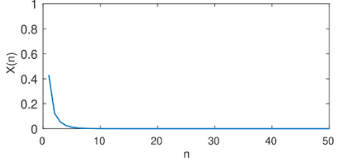
[1, 2)
Logistic map: r value for which population linearly approaches equilibrium
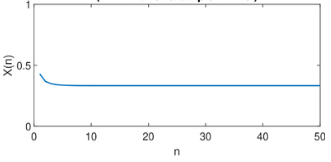
[2, 3)
Logistic map: r value for which population oscillates towards equilibrium
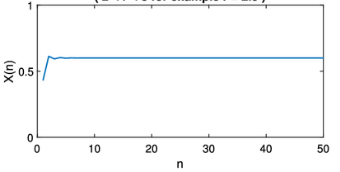
[3, 3.45)
Logistic map: r value for which population oscillates between 2 values
[3.45, 3.57)
Logistic map: r value for which population increasingly oscillates between >2 values
[3.57, 4)
Logistic map: r value for which population is chaotic with windows of stability
[4, inf)
Logistic map: r value for which population is fully chaotic
Butterfly Effect
Two states with imperceptibly different amounts produce wildly different outputs
Bifurcation diagram
Graph that maps r value onto convergence value of logistic map.
Ordinary Differential Equation
Mathematic model that uses macro-equations to model the rate of change of a system
Lotka Volterra Model
Model of predator prey numbers
gamma
LV: death rate of foxes
delta
LV: rate that foxes turn rabbits (food) into foxes (reproduction)
alpha
LV: rabbit growth rate
beta
LV: rate that foxes eat rabbits
transient
Model behaviour when it moves towards a state
fixed point
Model behaviour when it reaches a steady state
limit cycle
Model behaviour when it oscillates
class 1
Wolfram class that rapidly converges to uniform state
class 2
Wolfram class that rapidly converges to repetitive state
class 3
Wolfram class that appears to remain chaotic
class 4
Wolfram class that appears to remain chaotic with periods of stability
Rule 110
Turing complete 1D cellular automaton rule
Von Neumann
2D CA Neighborhood that doesn’t include diagonals
Moore
2D CA Neighborhood that does include diagonals
Loneliness
Game of life rule that kills a cell with <2 neighbours
Overcrowding
Game of life rule that kills a cell with >3 neighbours
Survival
Game of life rule that sustains an existing cell with 2-3 neighbours
Reproduction
Game of life rule that produces a new cell with 3 neighbours
Separation
Feature of Boids Model of Flocking Behaviour that prevents collisions
Cohesion
Feature of Boids Model of Flocking Behaviour that provides safety in numbers
Alignment
Feature of Boids Model of Flocking Behaviour that keeps boids moving in the same direction
Self-contained
Essential agent feature: has boundary
Autonomous
Essential agent feature: acts for itself
Dynamic state
Essential agent feature: attributes change over time
Social
Essential agent feature: interacts with others
Adaptive
Optional agent feature: learns from the past
Goal-directed
Optional agent feature: wants to achieve something
Heterogeneous
Optional agent feature: has different types
Reachable
A marking that can be reached from the initial marking
Final
A marking in which no hot transitions are enabled
epsilon
symbol for cold transitions (external to system)
phi
symbol for silent transitions (not visible to observer)
sequential run
Sequence of steps from initial marking
complete sequential run
Sequential run that leads to a final marking or cannot have any addition steps inserted
state explosion problem
Rapid growth of marking graph when adding tokens
interleaving semantics
List of all complete sequential runs
Distributed run
Acyclic net representing a series of steps towards a marking.
Boundedness
Set of all reachable marking is finite
k-boundedness
For all reachable markings, there are no places with > k tokens
safety
For all reachable markings, there are no places with multiple tokens
liveness
From every possible reachable marking, we can reach a marking that enables a transition
deadlock-freedom
Every reachable marking enables at least one transition
workflow net
Petri net with source place (•x = {}) and sink place (x• = {})
workflow system
A workflow net and initial marking that puts one token in the source (and nowhere else)
Option to complete
For every reachable marking, we can find a way to place a token in the sink
Proper completion
If we place a token in the sink, there is only one there and none elsewhere
No dead transitions
Every transition can be enabled by a reachable marking
Soundness
Option to complete, proper completion and no dead transitions