Micro ch 12 Perfect Competition
 Call Kai
 Learn
Learn Practice Test
 Spaced Repetition
 Match
Match Flashcards
 Knowt Play
1/31

There's no tags or description
Looks like no tags are added yet.
Name | Mastery | Learn | Test | Matching | Spaced | Call with Kai |
|---|
No analytics yet
Send a link to your students to track their progress
32 Terms
What is perfect competition?
A market where:
Many firms sell identical products
There are no restrictions to enter the industry
Established firms have no advantages over new ones
Sellers and buyers are well informed about prices
What is a price taker
A firm that cannot influence the price of a good/service and must accept the market price as given.
Why is demand perfectly elastic for a perfectly competitive firm?
Because all firms sell identical products (perfect substitutes), so consumers can switch instantly to another seller.
Define Elastic
Responsive to change
Demand elasticity = How much buyers respond to price changes.
Supply elasticity = How much sellers respond to price changes.
What is the goal of firms?
To maximize economic profit
Economic Profit
total revenue - total cost
Opportinity cost of production
everything the firm gives up to produce the product
Why is normal profit included in total cost?
Because normal profit is an opportunity cost—the minimum profit needed to keep the firm in business.
What is normal profit?
The minimum profit needed to keep a firm in business; it is treated as a cost because it is an opportunity cost.
Total Revenue formula
P x Q
Marginal revenue
The change in total revenue that results from a one-unit increase in the quality sold
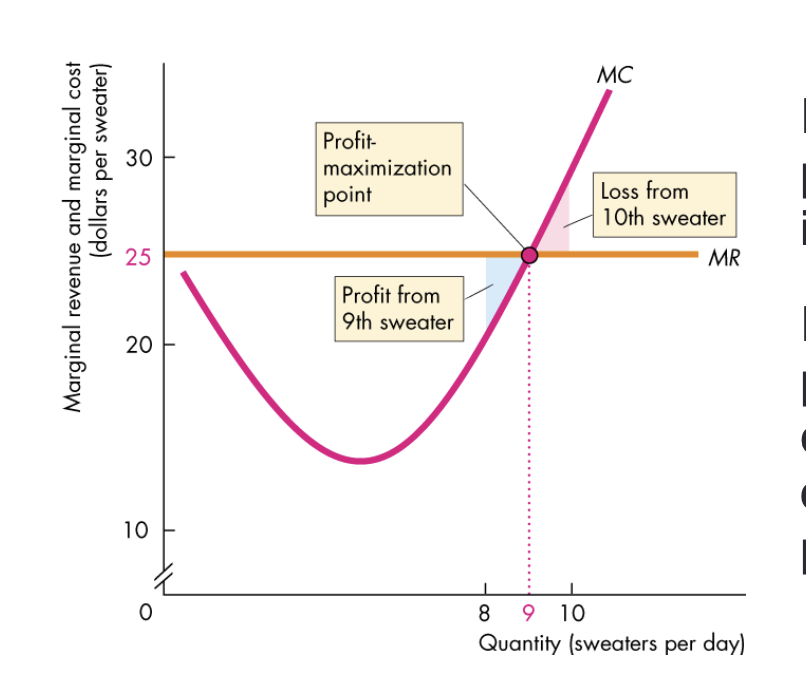
Profit maximization
when marginal revenue equals marginal cost (MR = MC)
Profit Maximization Graph
In a perfect competition, MR = P, so P is horizontal
X-axis is quantity, Y-axis is MR and MC
MC is U because of diminishing returns
Profit is maximized when MR and MC intersect
Whats the shutdown point?
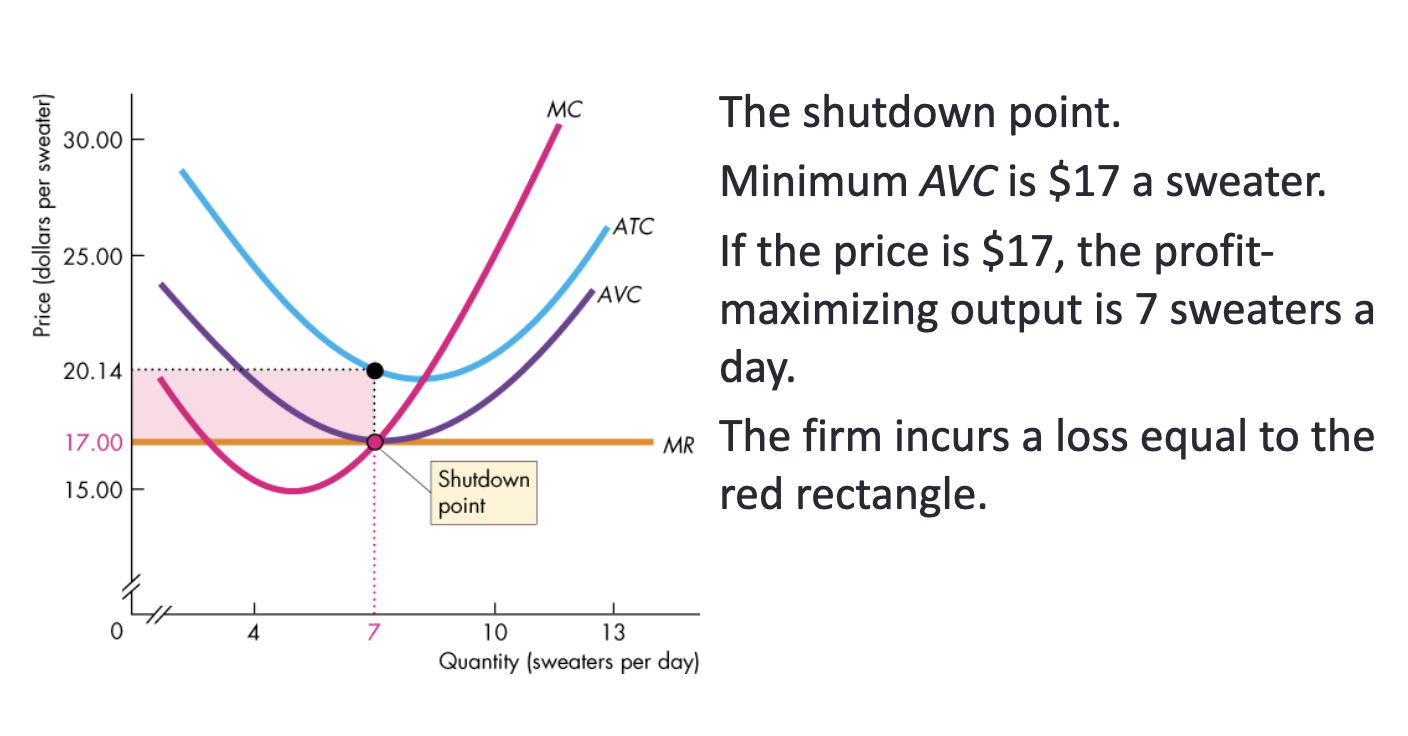
The price and quantity at which a firm is indiferent between producing and shutting
AVC is at its minimum
MC curve crosses the AVC curve
MC always crosses AVC at AVC's minimum point.
MC always crosses ATC at ATC's minimum point.
Shutdown Point Graph
Profit-maximizing output: MR = MC
Q = 7
P = AVC = 17
AVC is at its minimum
MC crosses AVC
Firm is indifferent between producing and shutting down
What is the short-run market supply curve?
The quantity supplied by all firms in the market at each price when the number of firms and plant sizes remain unchanged.
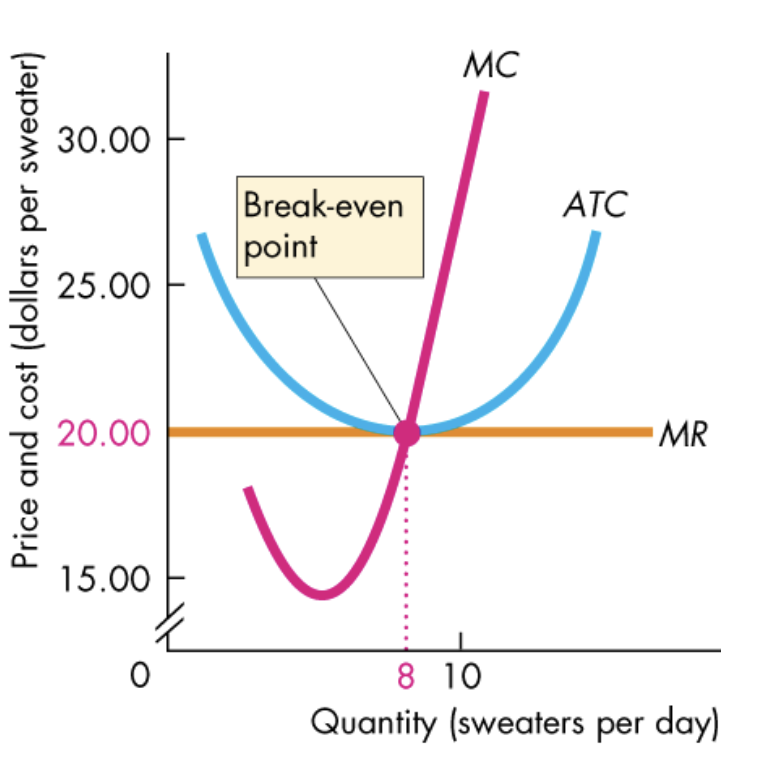
Break-even Graph
Price touches ATC
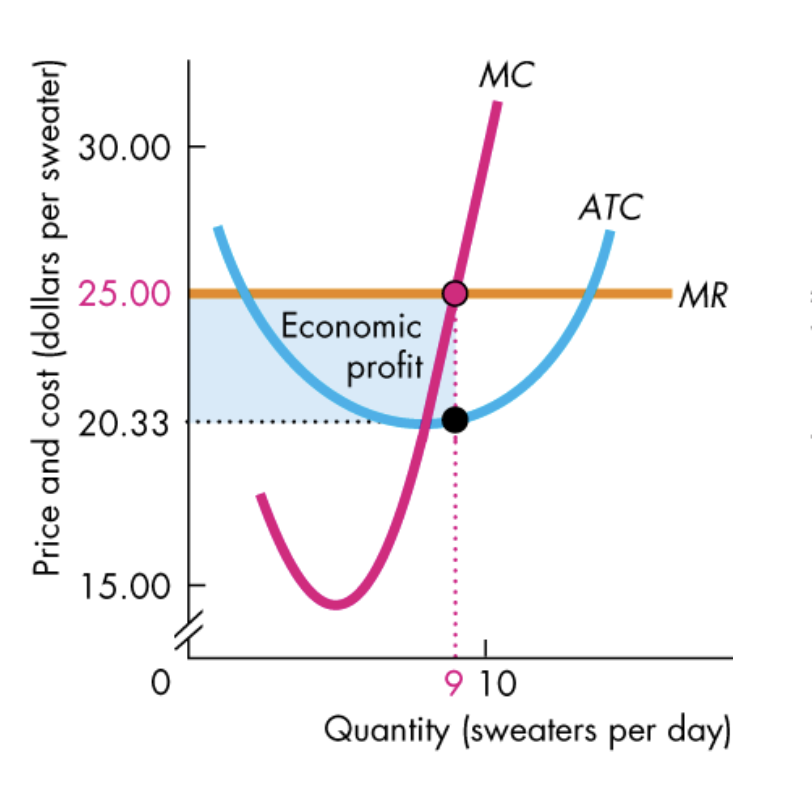
Economic Profit Graph
Price > ATC
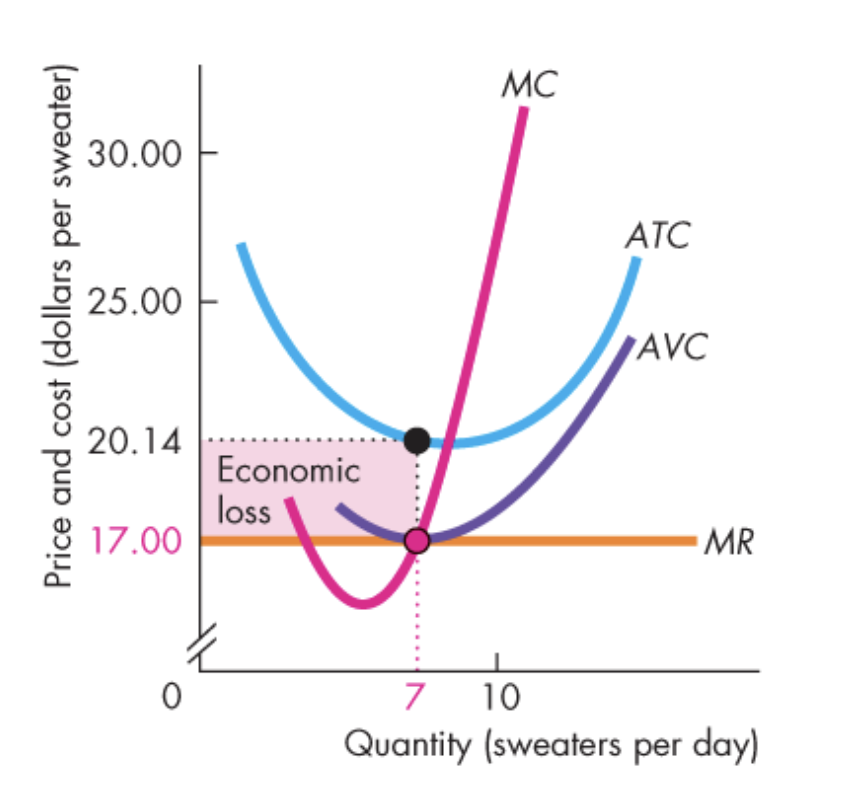
Economic Loss Graph
Price < ATC
What happens when firms earn economic profit in the long run?
New firms enter the industry, increasing supply and lowering price until economic profit is zero.
What happens when firms incur economic losses in the long run?
Firms exit the industry, decreasing supply and raising price until economic profit is zero.
What is the long-run equilibrium condition in perfect competition?
Economic profit = 0
P = ATC
Resources are used effieicntly when…
No one can be made better off without making someone else worse off.
What does the market demand curve represent?
Marginal Social Benefit (MSB).
What does the market supply curve represent?
MSC Marginal Social Cost
When is the market supply curve equal to MSC?
When firms bear all the costs of production.
Perfect Competition and Efficiency
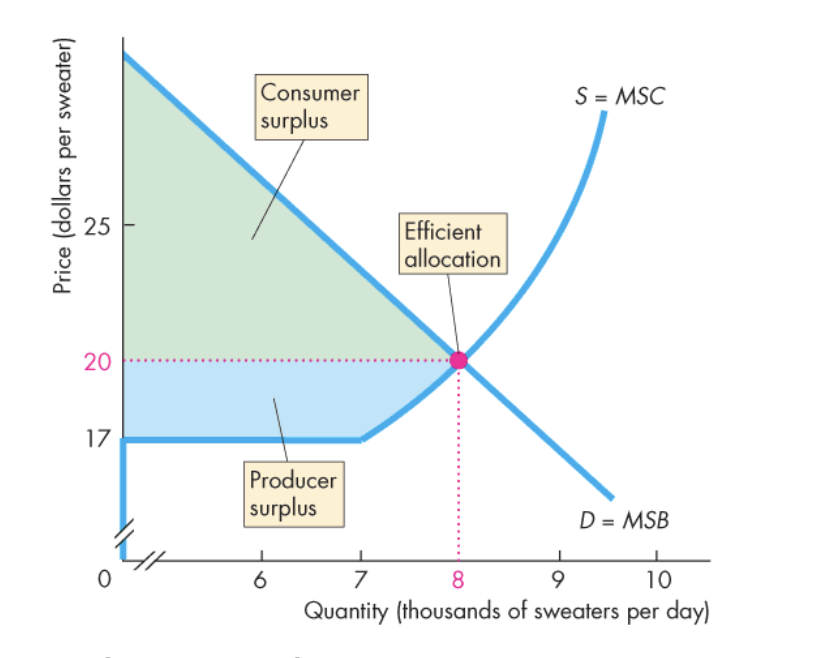
MSB = MSC
Consumer surplus in the graph
area above price line and below demand curve
Producer surplus in the graph
area below the price line and above the supply curve
Total Surplus in the graph
consumer suplus + producer surplus
Graph of Efficient Allocation
Market equilibrium where MSB = MSC and total surplus is maximized.
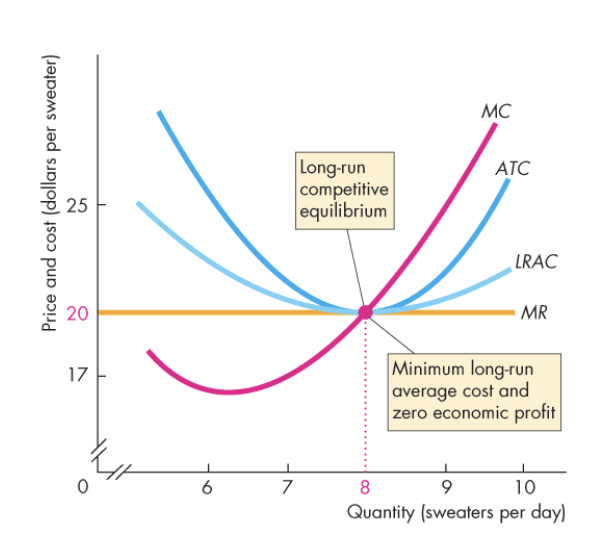
Long-Run Competitive Equilibrium
MR = MC
P = ATC
P = minimum LRAC
Economic profit = 0
Firm produces at the lowest possible cost
No incentive for firms to enter or exit