Mood Disorders: Bipolar I
 Call Kai
 Learn
Learn Practice Test
 Spaced Repetition
 Match
Match Flashcards
 Knowt Play
1/22

There's no tags or description
Looks like no tags are added yet.
Name | Mastery | Learn | Test | Matching | Spaced | Call with Kai |
|---|
No analytics yet
Send a link to your students to track their progress
23 Terms
Bipolar Disorders - General
First characterized by Kraepelin
The presence of manic or hypomanic episodes
Abnormally and persistently elevated, expansive,
or irritable mood, and abnormally and persistently increased activity
or energy
Usually (~70%) mania immediately precede / follow depressive periods
Manic episodes tend to be ~3X shorter than depressive bouts (2-3
moths)When a bipolar individual is between episodes but not experiencing
symptoms of either depression or mania, that is referred to as euthymic
How are depressive episodes different in bipolar disorders compared to depressive disorders?
Depressive episodes in BD= mood lability, psychotic
features, psychomotor retardation, substance abuse (NOT IN DMS)Depressive episodes in MDD= anxiety, agitation,
insomnia, weight loss
Manic and Hypomanic Episodes: Diagnostic Criteria
Inflated self-esteem or grandiosity (unrealistic sense of superiority).
Decreased need for sleep.
- This is different than insomnia (this is a source of unreliability when diagnosing –
important)More talkative.
Flight of ideas or subjective experience that thoughts are racing.
Distractibility
Increase in goal-directed activity or non-goal-directed activity
Excessive involvement in activities that have a high potential for painful
consequences
-e.g., engaging in unrestrained buying sprees, sexual
indiscretions, or foolish business investments). “value judgements”
Manic vs. Hypomanic
Both Include: Abnormally and Persistently elevated, Expansive, or Irritable mood and abnormally
Manic Episode: lasting at least 1 week and present most of the day, nearly every day
abnormally and persistently increased goal-directed activity or energy
Causes marked impairment
Hypomanic Episode: lasting at least 4 consecutive days and present most of the day, nearly every day.
Includes abnormally and persistently increased activity or energy
Does NOT cause marked impairment
Bipolar I
Manic episode and also possible hypomania.
Experiences episodes of mania and can have periods of depression.
Even if the periods of depression do not reach the threshold for a major
depressive episode, the diagnosis of bipolar I disorder is still given.i.e. If you have a manic episode, the diagnosis is bipolar I
Bipolar II
Person experiences hypomanic episodes, but his or her symptoms are below
the threshold for full-blown mania.Person experiences periods of depressed mood that meet the criteria for
major depression.i.e. Must have hypomania AND major depressive episode
Usually have more lifetime episodes than BPI
Cyclothymic Disorder
≥ 2 years (≥ 1 year in kids/teens) of:
Mild hypomanic symptoms (not full episode)
Mild depressive symptoms (not full episode)
Symptoms present at least half the time
No symptom-free period longer than 2 months
Causes distress or problems in daily functioning
Think of it as: long-term, milder mood swings (highs + lows)
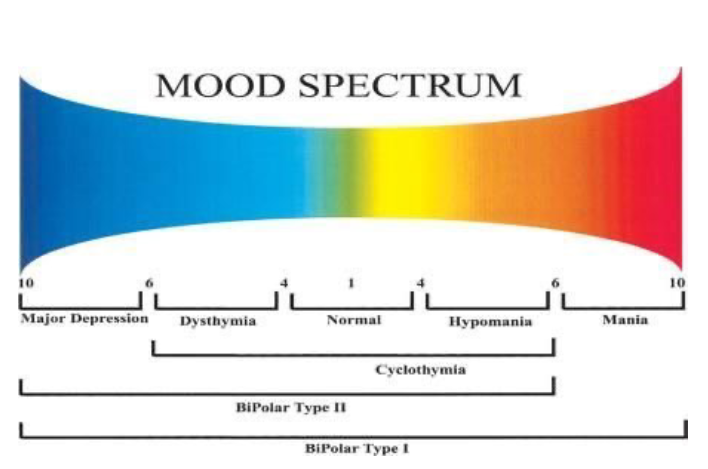
Bipolar Spectrum
Bipolar I:
Full mania (may also have depression)
Bipolar II:
Hypomania + major depression
Cyclothymia:
Mild highs + mild lows (not full episodes)
Key idea:
Severity increases: Cyclothymia → Bipolar II → Bipolar I
Note:
Cyclothymia = no full hypomanic or depressive episodes
Bipolar Disorder Specifiers
Specifiers are extra labels added to a diagnosis to describe how the disorder looks in that person. They help show that mood disorders do not look the same in everyone.
Specifiers are extra labels added to a diagnosis to describe how the disorder looks in that person. They help show that mood disorders do not look the same in everyone.
With melancholic features
With atypical features
With catatonic features
With seasonal pattern
With peripartum onset
With anxious distress
With psychotic features
With mixed features
With melancholic features
Depression with:
loss of pleasure in almost everything
worse mood in the morning
not feeling better even when good things happen
excessive guilt
waking up very early
With atypical features
Mood can improve when good things happen, plus 2 or more of these:
weight gain or increased appetite
sleeping too much
“leaden paralysis” = arms and legs feel very heavy
very sensitive to rejection
With catatonic features
Strong psychomotor symptoms, such as:
very little movement / immobility
extreme movement or agitation
mutism (not speaking)
rigidity (stiffness)
With seasonal pattern
Mood episodes:
happen at the same time of year for at least 2 years
usually happen in fall or winter
full remission usually happens in spring
there are no nonseasonal episodes during that same 2-year period
With peripartum onset
Mood symptoms begin:
during pregnancy, or
within 4 weeks after delivery
With anxious distress
Person feels:
keyed up
distressed
anxious
afraid of losing control or that something bad will happen
Note: this is generally the only specifier used for cyclothymia.
With psychotic features
There are:
delusions or
hallucinations
These are usually mood-congruent, meaning they match the person’s mood.
For example, in depression they often involve themes like:
guilt
worthlessness
death
This can be further described as:
mood-congruent = psychotic symptoms match the mood
mood-incongruent = psychotic symptoms do not match the mood
With mixed features
This means symptoms of the opposite mood state are also present.
In depression: there may also be increased energy, elevated/expansive mood, and being very talkative
looks somewhat like mania, but not enough to meet full bipolar criteria
In mania or hypomania: there may also be depressed mood, loss of interest, etc.
looks somewhat like depression, but not enough to meet full depressive disorder criteria
Remission specifiers Partial remission
Some symptoms of the last episode are still present, but full criteria are not met
orthere has been a symptom-free period of less than 2 months
Full remission
For 2 months or more, there have been no significant signs or symptoms
Severity specifiers Mild
only a few extra symptoms beyond what is needed for diagnosis
symptoms are upsetting but manageable
only minor problems in social or work functioning
Moderate
symptoms and impairment are between mild and severe
Severe
many more symptoms than the minimum needed for diagnosis
symptoms are very distressing and hard to manage
major interference with social or work functioning
Bipolar Disorder: With Rapid Cycling
Rapid cycling means a person has had at least 4 mood episodes in the past 12 months.
These episodes can be:
manic
hypomanic
major depressive
They can happen in any order or combination.
When does one episode count as separate from another?
To count as separate, episodes must be divided by either:
full remission = at least 2 months with no symptoms
ora switch to the opposite mood state
for example, depression switching to mania/hypomania, or the reverse
Important facts
Females are more likely to have rapid cycling
It is more common in bipolar II than bipolar I
It is linked to:
earlier onset
worse long-term outcome
more suicide attempts
How to name a bipolar diagnosis (3 parts)
1) Name the bipolar disorder
Bipolar I
Bipolar II
Cyclothymia
2) Name the current or most recent mood episode
Manic
Hypomanic
Depressed
Euthymic = currently stable / normal mood
3) Add specifiers
Include:
severity (mild, moderate, severe)
psychotic features if present
remission status if relevant
any other important specifiers that apply to that episode
Example
Bipolar II disorder, current episode depressed, moderate severity, with mixed features
Can episodes happen more than 4 times per year? Yes.
The DSM says rapid cycling = 4 or more episodes per year, but it does not officially create extra DSM labels beyond that.
Terms some people use (not special official DSM categories):
Ultra-rapid cycling
mood switches over days to weeks
Ultra-ultra rapid cycling (ultradian)
mood switches over hours to days
Bipolar Disorder: Rapid Cycling
Rapid cycling means 4 or more separate mood episodes in 1 year.
These episodes can be:
major depressive episodes (MDE)
manic episodes
hypomanic episodes
An episode counts as separate if there is either:
full remission for 2 months = 2 months with no symptoms
ora switch to the opposite polarity
example: depression → mania
or mania → depression