FUNDAMENTALS OF LAW
 Call Kai
 Learn
Learn Practice Test
 Spaced Repetition
 Match
Match Flashcards
 Knowt Play
1/7

Earn XP
Description and Tags
Name | Mastery | Learn | Test | Matching | Spaced | Call with Kai |
|---|
No analytics yet
Send a link to your students to track their progress
8 Terms
Law
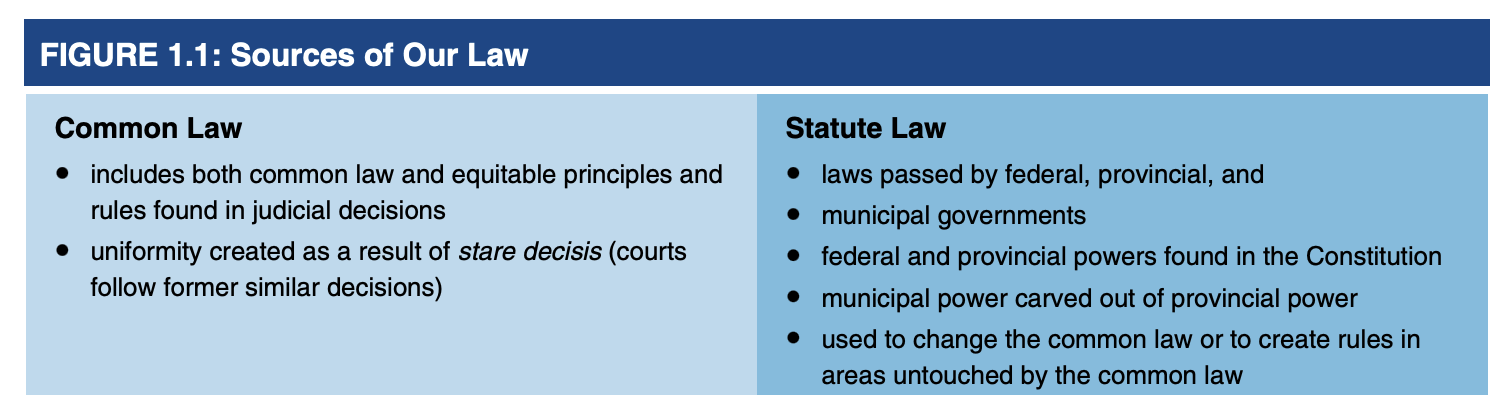
“Law” can be defined as the enforceable body of rules which governs a society. In British Columbia, our law comes from two sources: common law and statute law. These two sources of law are briefly discussed below.
Common Law
Common law refers to court-based, judge-made law that is typically recorded in written decisions; a system of law made up of principles and rules of action based upon the ancient customs and usages of the people of a nation which have been recognized, affirmed or enforced by the courts
Stare Decisis
Literally, “let the former decision stand” – to abide by prior decisions and not to disturb the doctrine of the courts that, when the court has once laid down a principle of law applicable to a certain state of facts, it will adhere to that principle, and apply it to all future cases where the facts are substantially the same, regardless of whether the parties and property are the same.
Equity (in common law)
The concept of justice being administered by the courts according to fairness as contrasted with the strictly formulated rules of common law. In law the term “equity” denotes the spirit and habit of fairness, justness, and right dealing which would regulate interaction of person with person. The courts of equity operated to correct the laws, not overrule or overwhelm the common law. Equity operated to relieve from the harshness of the common law. It had a discretionary function to meet individual circumstances.
Joining of the Two Systems
Today, in Canada, the two court systems are also combined; consequently, judges in all the provinces (except Quebec, which operates under a different system of law) can apply both common law and equitable principles in deciding a matter. If there is a conflict between the two, equitable principles take priority.
Specific Performance (equitable remedy)
The court, rather than granting damages in lieu of performance, orders that the terms of the contract be carried out by the party in default
Injunction (equitable remedy)
A court order which either restrains a party from doing something or requires a party to do something
Statute Law
Statute law, or legislation, is the body of law made by our government representatives in the federal Parliament, provincial legislature, or municipal council.