Equine Medical conditions
 Call Kai
 Learn
Learn Practice Test
 Spaced Repetition
 Match
Match Flashcards
 Knowt Play
1/18

There's no tags or description
Looks like no tags are added yet.
Name | Mastery | Learn | Test | Matching | Spaced | Call with Kai |
|---|
No analytics yet
Send a link to your students to track their progress
19 Terms
Rain rot
Grease heel
Dermatophytosis
Culicoides hypersensitivity
Melanomas - what is it? Who is it common in? What do they look like? Problems? Treatment?
Common skin tumor
Mostly found in grey horses
Typically a black, hairless mass found around lips, eyes, ears, salivary glands, anus, penis, vulva.
Often benign and slow growing in grey horses.
Causes problems if interfere with tack or normal bodily functions
Can metastasize-especially in non-grey horses = BAD
Treatment: surgical removal or cimetidine-may help reduce size.
(Tagament. H2 (histamine) blocker. Antiacid!)
Uveitis (Recurrent) - nickname? What is it? What causes it? Clinical sings? Treatment?
• “moonblindness”
• Most common eye issue in horses-can be chronic
• Intraocular inflammation-painful!
• Can cause secondary changes that may cause blindness (cataracts)
• Causes: viral, bacterial (lepto), parasitic, trauma, etc.
• Clinical Signs: squinting, serous discharge, miosis, photophobia
• Need to find underlying cause and treat it!
• Treatment: Steroids, NSAIDs, +/- antibiotics
Exercise Induced Pulmonary Hemorrhage - What is it? What causes it? How do we diagnose? Treatment?
• EIPH, “bleeders”
• Capillaries in the lungs rupture due to increased blood pressure
• Typically from short periods of strenuous exercise-racing, polo, etc.
• Diagnose with endoscope after exercise
• Can cause horse to be euthanized on the track
• No real cure other than retirement
Laryngeal Hemiplegia - what is it? Causes? Diagnosis? Treatment? !!!!*** On Exam!!!
• Also called “roaring”
• Paralysis of an arytenoid cartilage-usually left side
• Unknown cause-hereditary? damage to laryngeal nerve?
• Causes distinctive noise on inspiration while exercising, exercise intolerance
• Diagnose using endoscope
• Treatment: tie back surgery
Choke - what is it? Predisposing fts? Signs? treatment?
• Esophageal obstruction-usually food
• Predisposing factors-bolting food, dental issues, age
• Signs-lowered head, hypersalivation, coughing, frequent attempts to swallow, nasal discharge (food)
• Treatment: massage throat area (left side), sedation, pass nasogastric tube, soften food
• A scar in the esophagus may cause a stricture and increase the chances for choke again
Gastric Ulcers - Predisposing fts? Who is it common in? Clinical signs? Treatment/prevention?
• Predisposing factors-stalled, meal fed, high carbohydrate diet, in heavy work or stressful environment, off feed, on NSAID
• Racehorses
• Clinical signs-anorexia, weight loss, poor hair coat, issues being girthed up, bucking under saddle, diarrhea
• Treatment and Prevention: Omeprazole (proton pump inhibitor) and small, frequent meals high in fiber
Colic - What is colic? Clinical signs?
• “abdominal pain”
• Many, many causes-impaction of food, gas, sand, parasites (rounds, tapes), torsion
• Clinical signs: restlessness, kicking, biting, looking at belly, sweating, pawing, laying down, rolling, decreased fecal output, increased HR and RR (THE HIGHER the HR the POORER the prognosis - Dr coombs observation), prolonged CRT, decreased or increased gut sounds
Colic - what should owner do? What should doctor do?
• Common to have owner walk horse until Dr. can get there-keep horse from rolling, keeps owner calm
• Dr. will do brief exam looking at gut sounds, HR, temp, mm, rectal palpation, etc.
• Will probably pass nasogastric tube-this is both a diagnostic and therapeutic tool provides decompression and removes fluid from the stomach
Colic treatment?
• Treatment options-give mineral oil through NG tube to coat GI and increase movement, pain meds (NSAID-Banamine - endotoxic effects), sometimes an alpha 2 agonist, antispasmodics, fluids, surgery.
• Monitor patient closely
• Surgery is a last resort-requires general anesthesia-very risky, may be indicated if animal continues to deteriorate with treatment
Salmonella - what is it? 3 types? Dx? Treatment? Is it zoonotic?
• Highly resistant bacteria with many strains Salmonella agona, S. newport, S. anatum, S. Krefeld, S. typhimurium.
• Infected horses are classified in to three types-carrier, mild clinical, acute clinical
• Clinical signs may be moderate or severe - nasty pee…?
• Diagnosis requires multiple fecal cultures because organism cannot be consistently cultured from fecal material
• Treatment-fluids, NSAIDS, plasma - Usually no antibiotics! Treating signs…
• Antibiotics are controversial
• Animal must be quarantined
• Prevention is difficult because organism is present in the environment
• Zoonotic
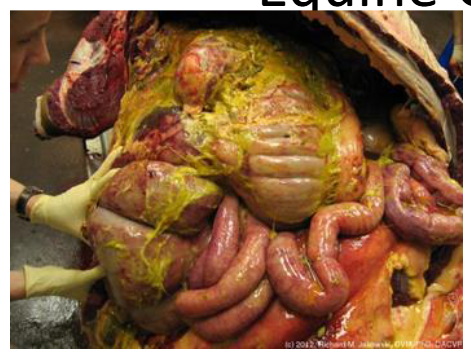
Picture - ?
Fibrin going into intestinal tract/outside of it? FROM salmonella
Caslicks - what is it? Why is it bad? How is it done?
• Vulva-protective seal for vagina
Surgical procedure, putting seal to protect air from moving in and out, feces going into it, etc.
• Anus and vulva need to be in a vertical plane
• Sometimes anus is sunken in-conformational fault
• Feces is able to enter vagina
• Most common cause of uterine infections
• Can be born with it, get it with old age, thin females, foaling injury, racehorses
• Verify current tetanus vaccine
• Local anesthesia, twitch, sedation
• Empty rectum if possible
• Wrap tail
• Prep perineum
• Dorsal vulva is split or removed and sutured closed
Blister beetle?
Blister Beetles
• Insects that live in alfalfa, feasting on their blooms
• These beetles contain the toxic compound cantharidin
• Causes GI irritation (colic), renal damage, possible death
• Severity correlates directly with amount of beetles ingested but even 1 could potentially kill a horse!
• Treatment: FLUIDS, mineral oil-will act as a GI protectant by coating GI mucosa and will help toxin move out, banamine-will decrease temp, neutralize GI endotoxins, increase tissue perfusion, cause vasoconstriction
• Best to cut hay before and or after blooming
• Verify beetle-free when purchasing alfalfa, and double check it
Slaframine poisoning? What is it called? What causes it? Signs?
• Clover slobbers
• Cause-moldy clover
• Excessive salivation
• Remove horses from clover and slobber will stop
Red Maple toxicity - What is it from? Effects? Signs? Treatment?
• Dead and wilted leaves are very toxic
• Specific toxin is unknown
• Causes hemolysis of red blood cells which decreases oxygenation
• Clinical signs: weakness, increased RR and HR, icterus, dark brown urine-what owners will notice
• Treatment: supportive care