9.2 - Dislocations & burger vectors
 Call Kai
 Learn
Learn Practice Test
 Spaced Repetition
 Match
Match Flashcards
 Knowt Play
1/7

There's no tags or description
Looks like no tags are added yet.
Name | Mastery | Learn | Test | Matching | Spaced | Call with Kai |
|---|
No analytics yet
Send a link to your students to track their progress
8 Terms
What are dislocations?
Where do they come from?
dislocations = 1D lattice defects representing linear perturbation of the lattice
Origins:
Crystal growth (formation of crystal lattice)
Recrystallisation (after recovery in the annealing process)
Result of residual stresses
Plastic deformation
What are the 2 types of dislocations?
Draw them
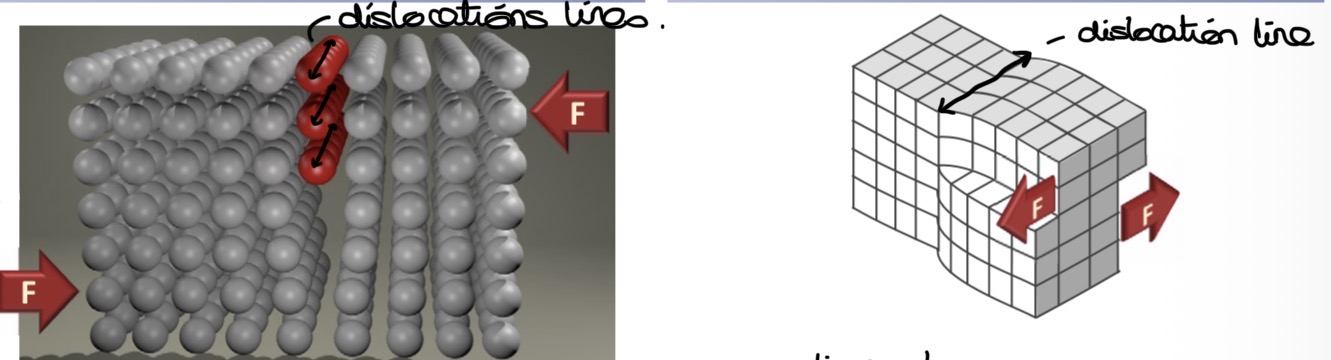
EDGE dislocation
→ extra half-plane of storms that is inserted into the crystal lattice & has no continuation on the opposite side
→ burger vector perpendicular to the dislocation line
→ move in the same direction as the applied force
SCREW dislocation
→ spiral planar ramp (step) resulting from shear deformation
→ burger vector // to the dislocation line
→ move perpendicular to the applied force
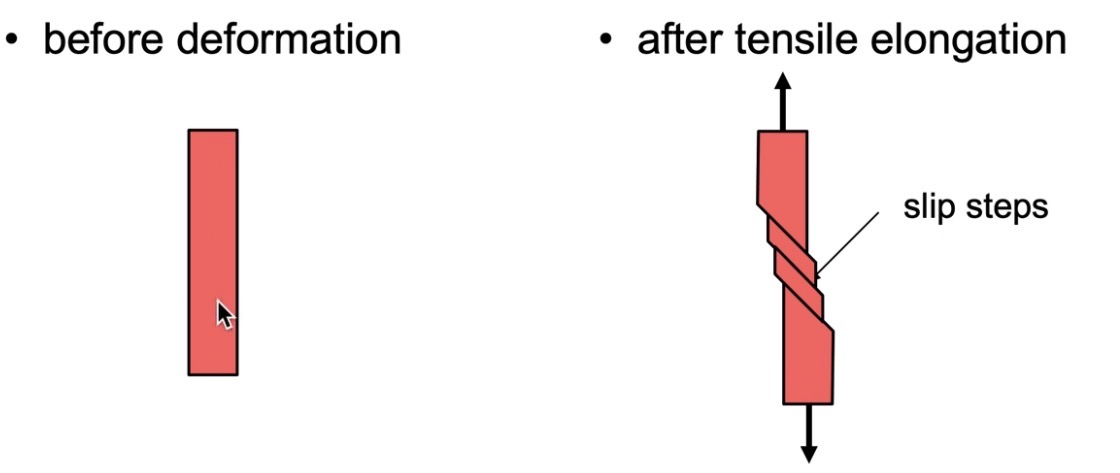
What happens at the macroscopic scale when dislocations move?
It produces lasting (permanent) deformation
How would elastic & plastic deformations be for a perfect crystal (no defects)?
How do defects overcome this?
Perfect crystal:
plastic deformation
→ would be very difficult to plastically deform it because it would imply to move all the atoms at once (break all atomic bonds at once)
→ would require a very high stress
elastic deformation
→ would be very easy to elastically deform because there is no defect to hinder atomic displacement
Real crystal:
→ easier to deform plastically because the required stress is reduced as atoms slide progressively (one row at a time)
→ dislocations make that possible, and make the material stronger in the mean time by causing internal stresses
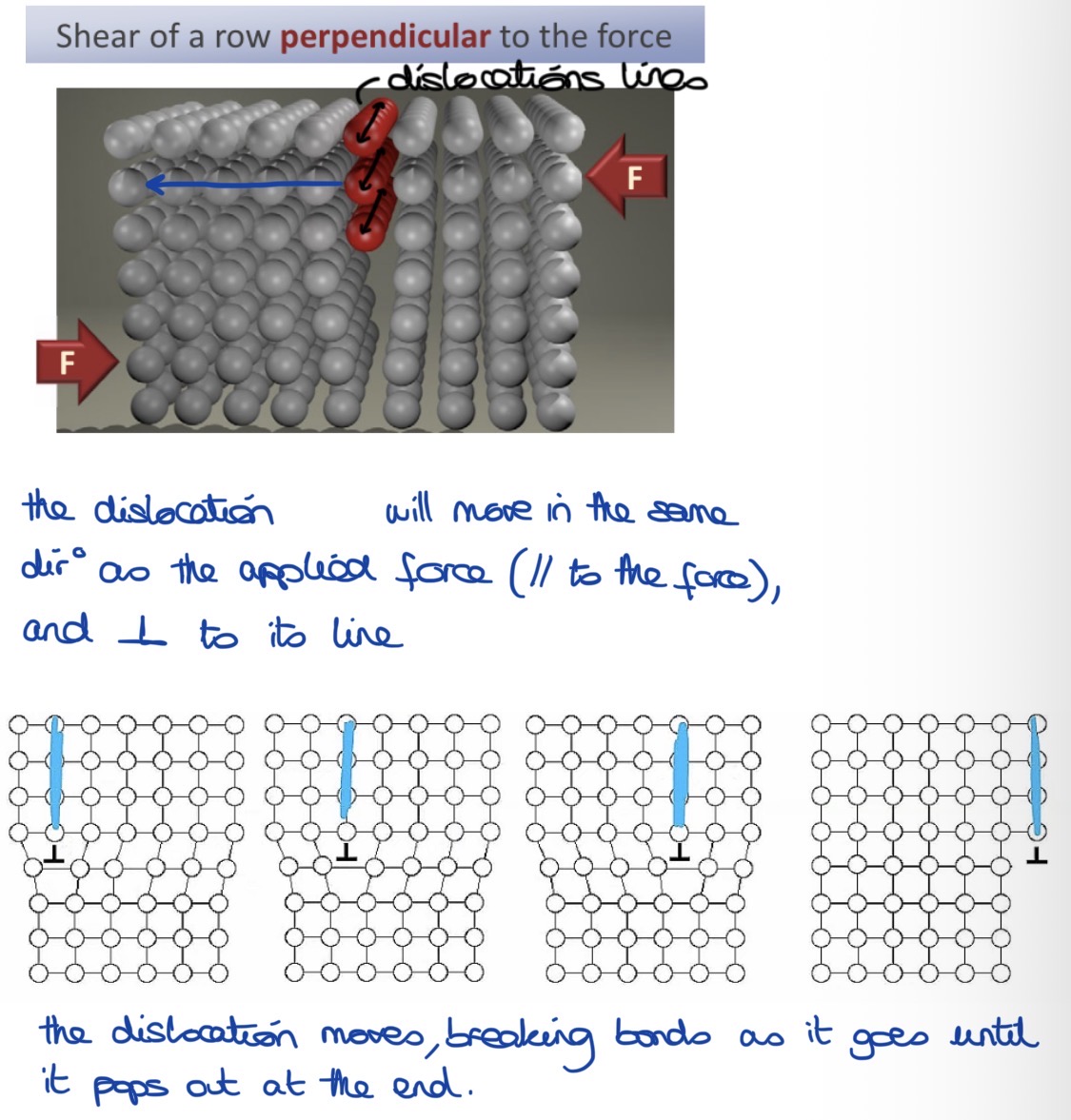
Explain the movement of an edge dislocation
→ the edge dislocation moves in the same direction as the applied force but perpendicular to its dislocation line
→ bonds break and reform as the dislocation moves until it pops out at the end
Explain the movement of a screw dislocation
→ the screw dislocation moves perpendicular to the applied force & // to the dislocation line
→ goes on until it reaches the end of the material
What’s a burger vector? What does it do?
How do we get it?
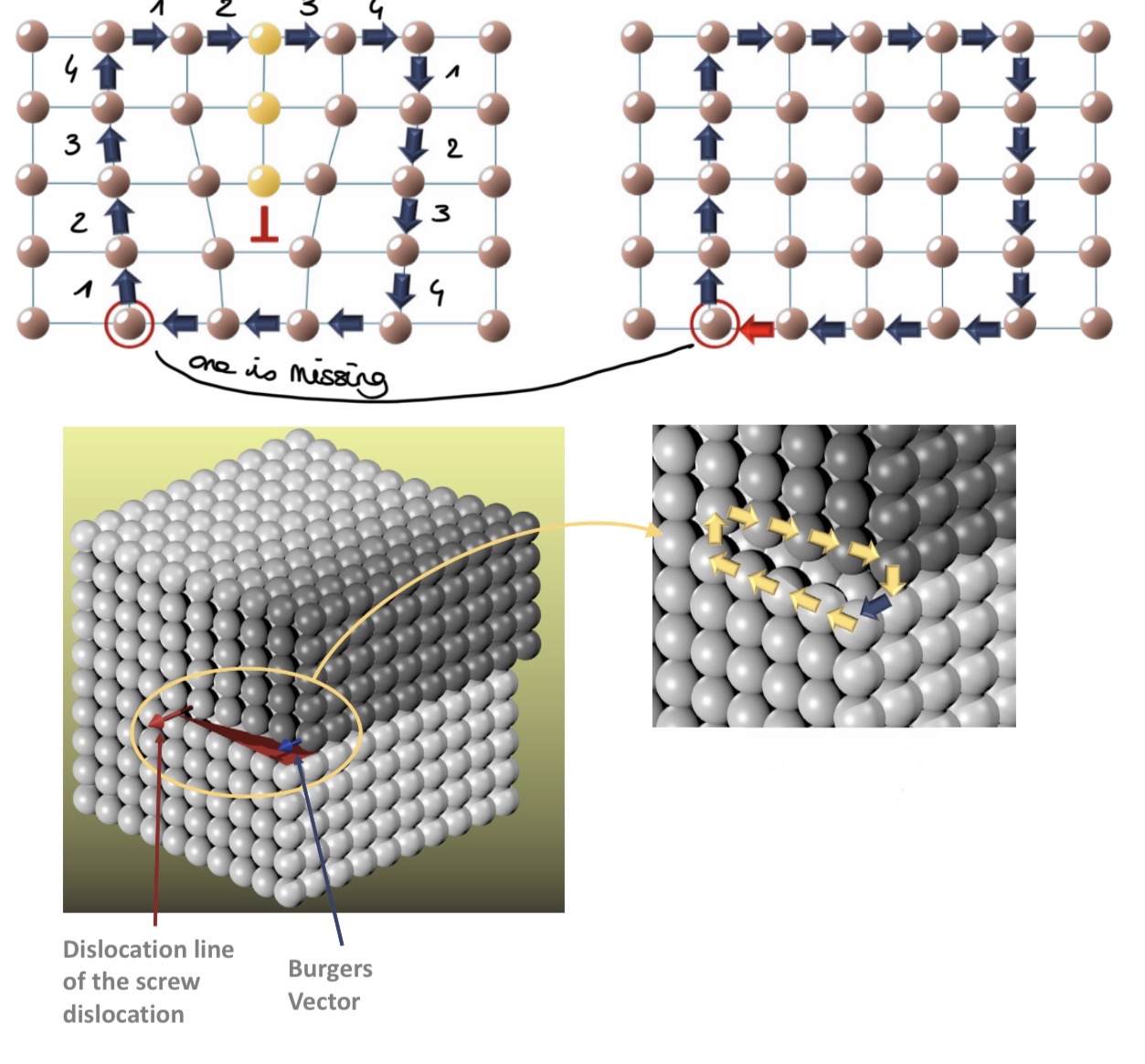
Burger vector characterises dislocations → quantifies the displacement of atoms around a dislocation line
Method
→ draw a closed loop in the undistorted lattice moving from atom to atom, by the same number of steps in each direction
→ draw the same loop in the distorted lattice (including the dislocation) (the loop won’t be closed)
→ gap required to close the 2nd loop = burger vector
Edge dislocations:
→ burger vector perpendicular to dislocation line
Screw dislocation:
→ burger vector // to dislocation line
What’s the difference between single crystals & polycrystals?
What does it involve for each concerning deformation?
single crystal = the entire structure is continuous, unbroken lattice, uniform orientation, no grain boundaries
→ displacement is localised to most favourably I oriented slip system, leading t non-uniform deformation
polycrystal = composed of many, small, individual crystals (grains) with different orientations, sperated by grain boundaries
→ displacement is distributed across multiple grains
→ deformation starts in favourably oriented grains and spreads to less favourable ones as the load increases