REA TESTS - INCORRECT QUESTIONS
 Call Kai
 Learn
Learn Practice Test
 Spaced Repetition
 Match
Match Flashcards
 Knowt Play
1/15

There's no tags or description
Looks like no tags are added yet.
Name | Mastery | Learn | Test | Matching | Spaced | Call with Kai |
|---|
No analytics yet
Send a link to your students to track their progress
16 Terms
True or False: The Minoans dominated trade in the Eastern Medierreanean.
True
True or False: The Minoans’ civilization on the Isle of Crete was eventually invaded by the Mycenaeans.
False
“He was renowned as a charismatic teacher, and his decision to lecture on theology in Paris added to its reputation as a center of learning. He agreed to tutor a young woman of keen intelligence; they had a love affair with disastrous consequences, and in repentance he became a monk. Other monks considered his theology heretical, and he died shortly after a condemnation of his teaching.”
The passage above describes the career of:
Peter Abelard
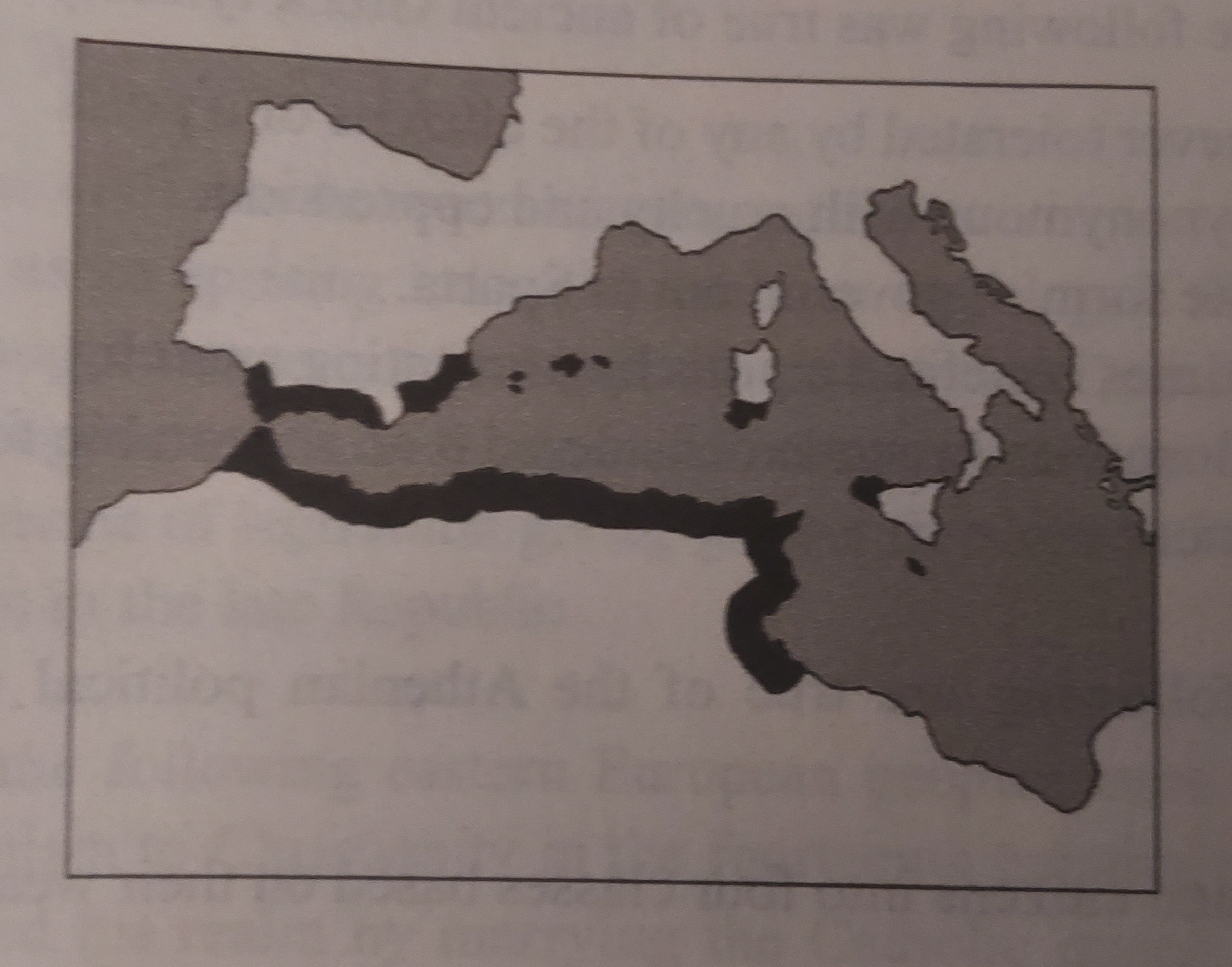
In the map of the western Mediterranean below, the shaded areas indicate:
areas colonized by the Phoenicians
Which of the following occupations did NOT fit into the medieval conception of society described by the phrase “those who fight, those who pray, those who work?”
merchants
What was the Peloponnesian League?
An alliance of Greek city-states led by Sparta.
“His father had wanted him to become a lawyer, but he eventually abandoned the study of law and turned to classical literature. Though he wrote extensively in Latin, which he sought to restore to its classical style, his more popular literary achievements consisted of his vernacular poetry.”
Who was the individual described above?
Francesco Petrarch
"His rise to fame and fortune was based on his service as a privateer. He claimed part of the American west coast for his native land and was hailed as the first of his countrymen to circumnavigate the globe. In return for his service, he was knighted by his monarch aboard his flagship."
Who is the individual described above?
Francis Drake
Which of the following statements is NOT true of feudalism?
It describes the relationship between a lord and the serfs who worked his fief.
The Romans were indebted to the Etruscans for all of the following EXCEPT
the legion
In the ninth and tenth centuries A.D., western Europe suffered invasions from:
Saracens, Vikings, and Magyars
The decline of the polis in the Hellenistic period and the opening of the Near East to the Greeks after Alexander the Great’s conquest of the Persian Empire led to a rise of a religion in the Mediterranean known as
Mithraism
Which of the following gave religious toleration to the Huguenots?
Edict of Nantes
Who was Hugo Grotius?
A Dutch political theorist who used the concept of natural law to discuss the nature of just war.
Which of the following did NOT field large armies in the Thirty Years’ War?
England
The survival of the Roman Republic during the first century B.C. was most seriously threatened by which of the following?
wealthy citizens who commanded the armies of the Republic