PartTech - Size Enlargement
 Call Kai
 Learn
Learn Practice Test
 Spaced Repetition
 Match
Match Flashcards
 Knowt Play
1/131

There's no tags or description
Looks like no tags are added yet.
Name | Mastery | Learn | Test | Matching | Spaced | Call with Kai | Chat |
|---|
No analytics yet
Send a link to your students to track their progress
132 Terms
Size enlargement
This is the process by which smaller particles are put together to form larger masses in which the original particles can still be identified.
Size enlargement
It is any process whereby small particles are agglomerated, compacted, or otherwise brought together into larger, relatively permanent masses in which the original particles can still be distinguished.
Granulation
Compaction (e.g. tabletting)
Extrusion
Sintering
Spray drying
Prilling
Methods of Size Enlargement (6)
TRUE
TRUE or FALSE. Size enlargement is performed for a wide variety of reasons such as improved flow, better dissolution, etc.
Interparticle forces
Size enlargement processes depend on these forces. These forces dictate how particles adhere to one another.
Van der Waals Forces
Forces due to adsorbed liquid layers
Forces due to Liquid Bridges
Electrostatic Forces
Solid Bridges
Enumerate examples of Interparticle Forces (5)
Van der Waals Forces
Identify what Interparticle Force is being described:
There exist between all solids molecularly based attractive forces collectively known as ___________. These weak attractive forces help fine particles stick together, particularly at the early stages of agglomeration.
Forces due to Adsorbed Liquid Layers
Identify what Interparticle Force is being described:
Particles in the presence of a condensable vapor will have a layer of adsorbed vapor on their surface. If these particles are in contact, a bonding force results from the overlapping of the adsorbed layers.
Critical partial pressure
Interparticle Forces: Forces due to Adsorbed Liquid Layers
According to Coelho and Harnby (1978) there is a __________ at which the adsorbed layer bonding gives way to liquid bridge bonding.
Forces due to Liquid Bridges
Identify what Interparticle Force is being described:
Even in very small proportions, the presence of liquid on the surface of particles affects the interparticle forces by the smoothing effect it has on surface imperfections and its effect of reducing the interparticle distance.
TRUE
Interparticle Forces: Forces due to Liquid Bridges
TRUE or FALSE. These forces are usually negligible in magnitude compared with forces resulting when the proportion of liquid present is sufficient to form interparticle liquid bridges.
Electrostatic Forces
Identify what Interparticle Force is being described:
These forces may be attractive or repulsive, do not require contact between particles, and can act over relatively long distances.
Electrostatic Charging of Particles and Surfaces
Interparticle Forces: Electrostatic Forces
These occur as a result of friction caused by interparticle collisions and frequent rubbing of particles against equipment surfaces during processing.
FALSE
The charge is caused by the transfer of electrons between the bodies.
Interparticle Forces: Electrostatic Forces
TRUE or FALSE. The charge is caused by the transfer of protons and neutrons between the bodies.
TRUE
Interparticle Forces: Electrostatic Forces
TRUE or FALSE. The force between two charged spheres is proportional to the product of their charges
Solid Bridges
Identify what Interparticle Force is being described:
Granules formed by liquid bridges are usually not the end product in a granulation process. More permanent bonding within the granule is created by __________ formed as liquid is removed from the original granule.
Crystalline Bridges
Liquid Binder Bridges
Solid Binder Bridges
Interparticle Forces: Solid Bridges
Solid bridges between particles may take three forms. Give the three (3) forms.
FALSE
In practice, all interparticle forces act simultaneously.
TRUE or FALSE. In practice, all interparticle forces act independently.
FALSE
The relative importance of the forces varies with changes in particle properties and with changes in the humidity of the surrounding atmosphere.
TRUE or FALSE. The relative importance of the forces does not vary with changes in particle properties and with changes in the humidity of the surrounding atmosphere.
Binding Mechanism
Wet Agglomeration Rate Processes
Wetting and Nucleation
Mechanisms in Size Enlargement (3)
Binding Mechanism
Identify what Mechanism in Size Enlargement is being described:
Solid bridges can form between particles by the sintering of ores, the crystallization of dissolved substances during drying, or the hardening of bonding agents such as glue and resins. Liquid bridges produce cohesion through interfacial forces and capillary suction.
TRUE
Mechanisms in Size Enlargement: Binding Mechanism
TRUE or FALSE. The strength of the liquid bridges in a granule depends on the state of saturation.
Pendular state
Funicular state
Capillary state
Mechanisms in Size Enlargement: Binding Mechanism
What distinct states can be identified in a collection of particles bound by a liquid? (3)
Pendular state
Mechanisms in Size Enlargement: Binding Mechanism
Identify what state is being described:
At the lowest liquid loading, small amounts of liquid are held as discrete lens-shaped rings at the points of contact of the particles.
Funicular state
Mechanisms in Size Enlargement: Binding Mechanism
Identify what state is being described:
As the liquid content increases, the rings coalesce, and there is a continuous network of liquid interspersed with air.
Capillary state
Mechanisms in Size Enlargement: Binding Mechanism
Identify what state is being described:
This state is reached when all the pore space in the agglomerate is completely filled. This state also has the highest particle strength.
Wet Agglomeration Rate Processes
Identify what Mechanism in Size Enlargement is being described:
In this mechanism, a liquid is added to an agitated powder bed to promote aggregation. The liquid temporarily combines the solids into granules through liquid bridges until permanent bridges form.
FALSE
The process depends on the mechanical properties of the liquid, solids, and their interactions.
Mechanisms in Size Enlargement: Wet Agglomeration Rate Processes
TRUE or FALSE. The process depends on the chemical properties of the liquid, solids, and their interactions.
Wetting and nucleation
Consolidation and growth
Attrition and breakage
Mechanisms in Size Enlargement: Wet Agglomeration Rate Processes
Give the three (3) main rate processes in Wet Agglomeration.
Wet agglomeration
Mechanisms in Size Enlargement: Wet Agglomeration Rate Processes
Wetting and Nucleation
In ____________, the wetting process begins when liquid droplets are introduced to the powder bed.
Immersion nucleation
Coating nucleation
Mechanisms in Size Enlargement: Wet Agglomeration Rate Processes
Wetting and Nucleation
Give the two (2) types of nucleation
Immersion nucleation
Mechanisms in Size Enlargement: Wet Agglomeration Rate Processes
Wetting and Nucleation
Identify what type of nucleation is being described:
Droplets engulf smaller particles to form granule nuclei.
Coating nucleation
Mechanisms in Size Enlargement: Wet Agglomeration Rate Processes
Wetting and Nucleation
Identify what type of nucleation is being described:
Droplets decorate larger particles for future liquid bridges.
Consolidation and Growth
Mechanisms in Size Enlargement: Wet Agglomeration Rate Processes
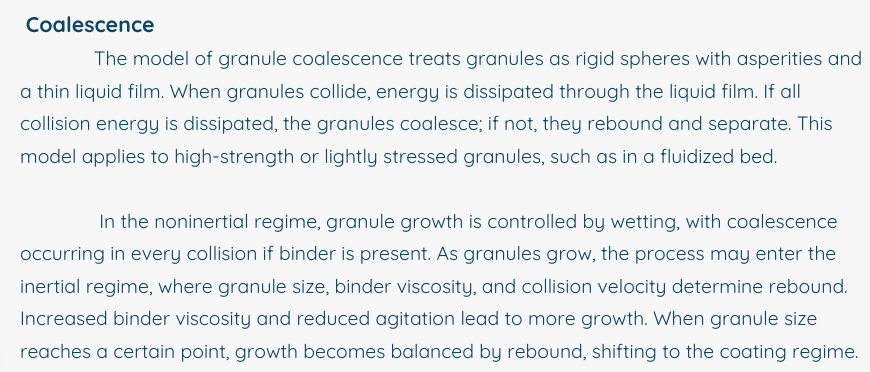
When granules contact, they either rebound or stick, with rebound prevented by dissipating energy through friction, deformation, viscosity, or capillary bridges. The mechanical properties of the liquid and its availability at the surface influence coalescence.
Mechanisms in Size Enlargement: Wet Agglomeration Rate Processes
read lungs ah
Granule growth
Mechanisms in Size Enlargement: Wet Agglomeration Rate Processes
This is primarily controlled by surface liquid availability and granule deformability. Surface liquid appears through liquid addition or pore elimination via consolidation.
Maximum pore saturation (smax)
Deformation stokes number (Stdef)
Mechanisms in Size Enlargement: Wet Agglomeration Rate Processes
Give the two (2) key parameters in Granule Growth.
Maximum pore saturation (smax)
Mechanisms in Size Enlargement: Wet Agglomeration Rate Processes
Identify what parameter in Granule Growth is being described:
Represents liquid volume in the densest granule state.
Deformation stokes number (Stdef)
Mechanisms in Size Enlargement: Wet Agglomeration Rate Processes
Identify what parameter in Granule Growth is being described:
This influences granule deformation.
Granule Breakage
Mechanisms in Size Enlargement: Wet Agglomeration Rate Processes
Attrition and Breakage
This can occur during granulation (to aid liquid distribution) or in the final product (which is undesirable).
Breakage
Mechanisms in Size Enlargement: Wet Agglomeration Rate Processes
Attrition and Breakage
This helps distribute liquid, especially for viscous or poorly wetting binders.
Breakage
Mechanisms in Size Enlargement: Wet Agglomeration Rate Processes
Attrition and Breakage
This can also determine equilibrium granule size if it occurs before the coalescence limit is reached.
TRUE
Mechanisms in Size Enlargement: Wet Agglomeration Rate Processes
Attrition and Breakage
TRUE or FALSE. Predicting breakage is challenging.
0.2
Mechanisms in Size Enlargement: Wet Agglomeration Rate Processes
Attrition and Breakage
Predicting breakage is challenging, but studies suggest it is controlled by the deformation Stokes number (Stdef), with a critical value around ___ marking the transition between granule stability and breakage.
Compaction
In __________, extreme stress forces particles together, increasing density through several stages.
FALSE
As stress increases, interparticle porosity decreases, and particles deform elastically.
TRUE or FALSE. As stress increases, interparticle porosity increases, and particles deform elastically.
Powder filling
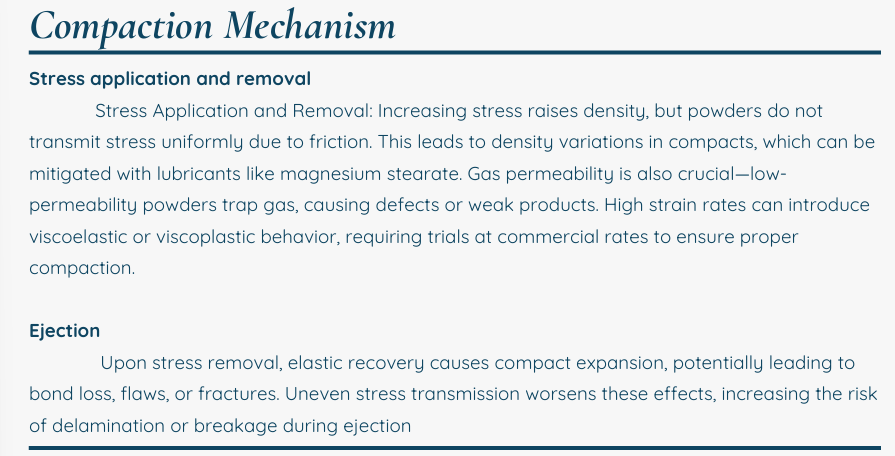
Stress application and removal
Ejection
Industrial Compaction involves… (3)
Powder Filling
This affects compact weight and density, influenced by bulk density, flowability, tool-wall friction, and segregation tendencies.
read lungs
Granulation
This is the process of creating granules from a solid substance or by combining one or more powder particulates through compression activities and/or with a binding agent.
FALSE
Granulation prevents segregation of powder constituents, improving flow properties, and enhancing compaction characteristics.
TRUE or FALSE. Granulation allows segregation of powder constituents, improving flow properties, and enhancing compaction characteristics.
Dry Granulation
Wet Granulation
Give the Main Types of Granulation (2)
Dry granulation
Identify what Type of Granulation is being described:
Granulated without the use of liquid binders.
Dry granulation
Identify what Type of Granulation is being described:
Ideal for moisture sensitive or heat sensitive materials.
Wet granulation
Identify what Type of Granulation is being described:
Can handle powders with poor compressibility
Wet granulation
Identify what Type of Granulation is being described:
Produces strong, dense, and uniform granules.
Wet granulation
Identify what Type of Granulation is being described:
High-shear granulators, fluidized bed granulators, and spray dryers
Dry granulation
Identify what Type of Granulation is being described:
Roller compactors, slugging machines, and mills.
Blending of Selected Materials
Compaction
Milling/Granulation
Sizing
Final Mixing
Steps in Dry Granulation (5 and in order)
Blending of Selected materials
Identify what Step in Dry Granulation is being described:
Raw materials and Active materials at constant composition are to be fed to a blender for uniform distribution of powders (different materials) ensuring homogeneity.
Roller Compaction
Steps in Dry Granulation: 2. Compaction
By __________, a powder blend compacted by applying high pressure on the powder to increase the size of the granule. material exits as ribbons or flakes
Slugging
Steps in Dry Granulation: 2. Compaction
By _________, powdered solids are mixed and then pressed into flat faced large-sized tablets (slugs) on a conventional tablet press. The process is performed without using heat or solvents
Milling/Granulation
Identify what Step in Dry Granulation is being described:
Breaking down and granulating the slugs (from slugging) or the ribbons (from roller compaction using a mill or granulator).
TRUE
Steps in Dry Granulation: 4. Sizing
TRUE or FALSE. To achieve the desired sizes, the material is passed through sieves or screens to separate the granules.
Lubricants or Glidants
Steps in Dry Granulation: 5. Final Mixing
Granules are blended with _________ or __________ to improve flow and prevent sticking
Extragranular Excipients (e.g. diluents, disintegrants)
Steps in Dry Granulation: 5. Final Mixing
These are added to the granules and mixed well to ensure uniform distribution.
Wet Granulation Method
A process of size enlargement wherein fine powders are bind together with a solvent containing binder or granulating agent to form a granule or a larger molecule.
Water
Give an example of a solvent containing binder or a granulating agent.
Wetting and Nucleation
Coalescence or ball growth
Consolidation
Attrition/Breakage
Give the Mechanisms in Wet Granulation (4)
Wetting and Nucleation
Identify what Mechanism in Wet Granulation is being described:
It involves the initial wetting of powder bed and existing granules by the granulating fluid to form nuclei. This step is largely influenced by spray rate or fluid distribution as well as feed formulation properties, in comparison with mechanical mixing.
Nuclei
These are molecules that are composed of particulates and solvent binding agents.
Coalescence or ball growth
Identify what Mechanism in Wet Granulation is being described:
Partially wetted primary particles and larger nuclei come together to form granules composed of several particles.
Coalescence
This refers to the successful collision of two granules to form a new, larger granule.
Consolidation
Identify what Mechanism in Wet Granulation is being described:
As granules increase in size, they are consolidated by compaction forces due to bed agitation. The extent of the consolidation depends on the agitation in the granulation equipment and the resistance of the granules to deformation.
Attrition/Breakage
Identify what Mechanism in Wet Granulation is being described:
At this stage, formed granules break into fragments which bind to other granules forming a layer of material over the surviving granule.
Tumbling Granulators
Identify what Equipment in Wet Granulation is being described:
Particles are set in motion by the tumbling action caused by the balance between gravity and centrifugal forces.
Drum granulator
Inclined disc granulator
Give the most common types of Tumbling Granulators (2)
1 - 20 mm
250 um
Tumbling granulators generally produce granules in the size range of ____ to ____ mm and are not suitable for making granules smaller than ___ um.
FALSE
Drum and disc granulators generally operate in continuous feed mode.
TRUE or FALSE. Drum and disc granulators generally operate in batch feed mode.
Disc or Pan granulators
Identify what Equipment in Wet Granulation is being described:
The equipment consists of a rotating tilted disc or pan with a rim. Solids and fluid agents are continuously added to the disc.
Pelletizer
Disc or pan granulators are referred to as _______ in the iron ore industry.
Pan granulator
Disc or pan granulators are referred to as _______ in the agricultural chemical industry.
Critical speed (Nc)
In disc or pan granulators, the required disc rotation speed is given in the terms of the __________.
50% to 75%
45 deg to 55 deg
The typical operating range for a disc granulator is ____ to ____ percent of critical speed, with angles of ____ to ____ degrees.
Dry
Dry vs Wet Granulation
Requires less equipment, less space, and less cost.
Dry
Dry vs Wet Granulation
Is used for powder blends that are sensitive to moisture and heat
Wet
Dry vs Wet Granulation
Requires more equipment, more space, and higher investment costs
Wet
Dry vs Wet Granulation
Used to prevent the active ingredients in the powder blender from being destructed.
Dry
Dry vs Wet Granulation
Includes the direct compression process of the finely ground powder.
Wet
Dry vs Wet Granulation
Mixes the finely ground powder with a granulating liquid first and then forces it through a sieve. The mixture is then compressed to make a tablet.
Dry
Dry vs Wet Granulation
Doesn’t involve the wetting of materials, so there are fewer chances that the raw materials will change.
Dry
Dry vs Wet Granulation
Requires less cleaning time of the equipment
Dry
Dry vs Wet Granulation
Is reproducible and scaleable
Wet
Dry vs Wet Granulation
Involves the wetting of materials, so there are more chances that raw materials, like density and particle size distribution will affect the final product.
Wet
Dry vs Wet Granulation
Requires more cleaning time of the equipment
Wet
Dry vs Wet Granulation
Is difficult to scale up
Melt Granulation
Spray Drying Granulaton
Extrusion-Spheronization
Fluidized Bed Granulation
High Shear Granulation
Enumerate Other Variations of Granulation (5)
Melt granulation
Identify what Other Variations of Granulation is being described:
Uses a molten binder or wax instead of a liquid binder to form granules
Spray Drying granulation
Identify what Other Variations of Granulation is being described:
Combines granulation with drying in a single step, used for liquid feed stocks
Extrusion-Spheronization
Identify what Other Variations of Granulation is being described:
This specialized granulation technique is used to produce spherical granules (pellets).