CHM 111: Lecture 4 Review
0.0(0)
Studied by 0 people Call Kai
 Learn
Learn Practice Test
 Spaced Repetition
 Match
Match Flashcards
 Knowt Play
Card Sorting
1/16

Earn XP
Description and Tags
Last updated 1:17 AM on 5/9/23
Name | Mastery | Learn | Test | Matching | Spaced | Call with Kai |
|---|
No analytics yet
Send a link to your students to track their progress
17 Terms
1
New cards
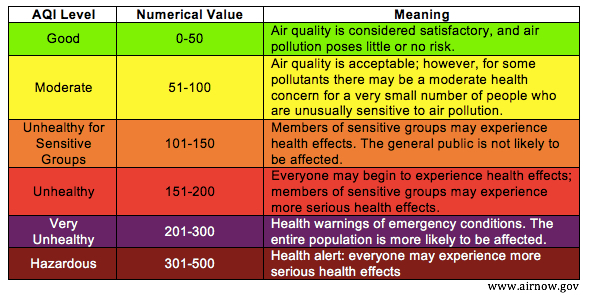
**The Air Quality Index (AQI):** The Environmental Protection Agency (EPA) gives daily forecasts of air quality based on various air pollutants. The table below shows the EPA’s Air Quality Index (AQI) ratings and the parameters for each of the ratings. The color of the row corresponds to the color used on maps to communicate to the public the possible risks. The numerical value ranges from 0 to 500 and does not have any units, as it is an aggregate of many pollutant levels.
If the AQI for today was reported as 173, which of the following precautions should be taken?
Select all that apply.
A) People in sensitive groups should avoid going outside.
B) Those required to be outside should take precautions such as wearing a mask.
C) No extra precautions are necessary at this level.
D) Everyone should limit their time spent outside.
E) When the levels are this high, it is against the law to be outside.
If the AQI for today was reported as 173, which of the following precautions should be taken?
Select all that apply.
A) People in sensitive groups should avoid going outside.
B) Those required to be outside should take precautions such as wearing a mask.
C) No extra precautions are necessary at this level.
D) Everyone should limit their time spent outside.
E) When the levels are this high, it is against the law to be outside.
A) People in sensitive groups should avoid going outside.
B) Those required to be outside should take precautions such as wearing a mask.
D) Everyone should limit their time spent outside.
B) Those required to be outside should take precautions such as wearing a mask.
D) Everyone should limit their time spent outside.
2
New cards
The color orange on an AQI map indicates that the air is “Unhealthy for Sensitive Groups.” What are some sensitive groups of people?
Select all that apply
A) healthy adults
B) people with respiratory issues such as asthma
C) elderly people
D) athletes
E) infants and young children
Select all that apply
A) healthy adults
B) people with respiratory issues such as asthma
C) elderly people
D) athletes
E) infants and young children
B) people with respiratory issues such as asthma
C) elderly people
E) infants and young children
C) elderly people
E) infants and young children
3
New cards
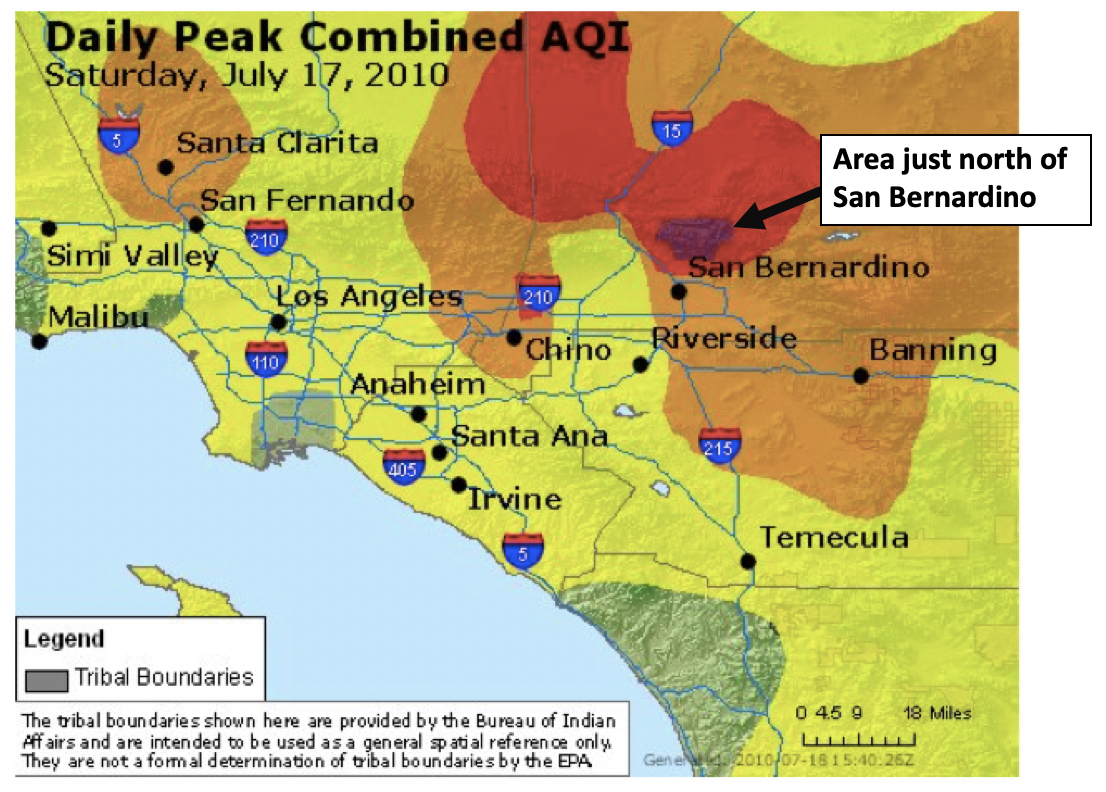
Above is the AQI map of the Los Angeles area on a particular day.
What is the Combined AQI Level in **Anaheim**?
What is the Combined AQI Level in the mountains just **north of San Bernardino**?
What is the Combined AQI Level in **Anaheim**?
What is the Combined AQI Level in the mountains just **north of San Bernardino**?
Moderate, Very Unhealthy
4
New cards
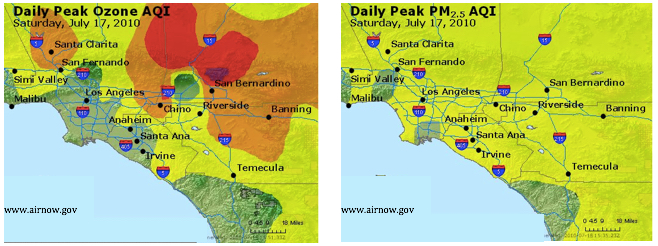
Below are two maps that show more specific details of the Los Angeles area AQI for ozone (a common air pollutant) and particulate matter (dust, pollen, etc.).
What is the **ozone** pollution AQI level for **Santa Clarita** on this day?
What is the **particulate matter (PM)** AQI level for **Riverside** on this day?
What is the **ozone** pollution AQI level for **Santa Clarita** on this day?
What is the **particulate matter (PM)** AQI level for **Riverside** on this day?
Unhealthy for Sensitive Groups, Moderate
5
New cards
In looking at the two maps from Question 4 along with the map of the Los Angeles area from Question 3 (consider the entire region, not just the city of Los Angeles), which pollutant (ozone or particulate matter) is the biggest contributor to the combined AQI for the day in the Los Angeles area?
Pay attention to which pollutants are being shown on the AQI maps.
A) Ozone
B) Particulate Matter
Pay attention to which pollutants are being shown on the AQI maps.
A) Ozone
B) Particulate Matter
A) Ozone
6
New cards
Suppose concentration of ozone in the air today was measured to be 86 ppb. What is this concentration expressed in ppm?
0\.086 ppm
7
New cards
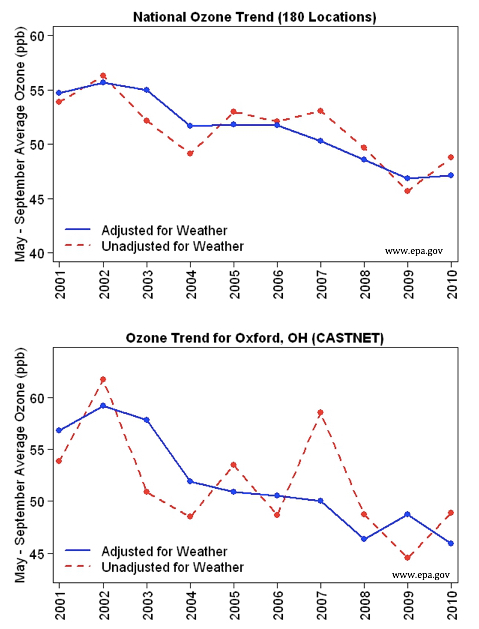
Below are graphs of the national average ozone trend and the ozone trend in Oxford, Ohio from 2001-2010.
Which of these lines is more meaningful for evaluating the trend in ozone concentration over the time period? *Consider the information presented in the "Good up high, bad nearby" text.*
A) blue line (Adjusted for Weather)
B) red line (Unadjusted for Weather)
Which of these lines is more meaningful for evaluating the trend in ozone concentration over the time period? *Consider the information presented in the "Good up high, bad nearby" text.*
A) blue line (Adjusted for Weather)
B) red line (Unadjusted for Weather)
A) blue line (Adjusted for Weather)
8
New cards
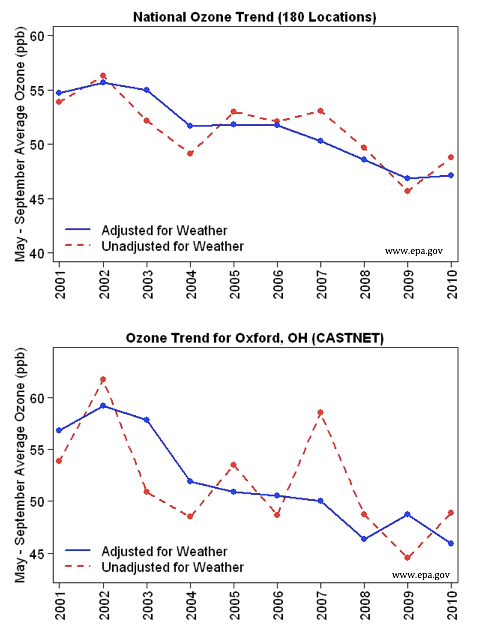
Based on the top graph (*National Ozone Trend*), does there appear to be a trend in the data over the time period presented?
What conclusions about ozone concentrations over time can you draw from the data in the top graph?
What conclusions about ozone concentrations over time can you draw from the data in the top graph?
Yes, Ozone concentrations have decreased over the past 10 years.
9
New cards
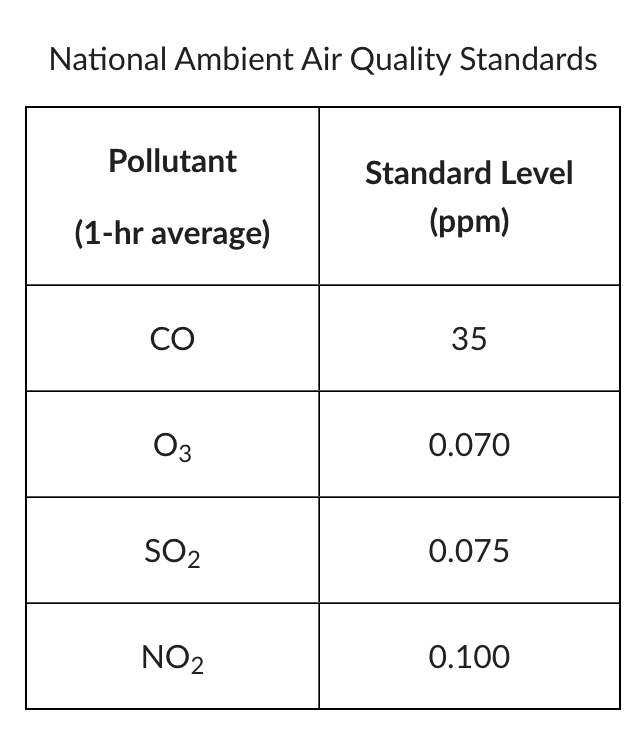
*A particular sample of air is analyzed and found to contain:*
**40 ppb NO2, 0.080 ppm ozone (O3), 150 ppb SO2 and 0.0025% CO**
Referring to the NAAQS table and the particular air sample above, which of the pollutants will present a health risk if someone is exposed to this air sample for one hour*? Assume an average human is exposed to this particular sample of air for a one-hour period under typical conditions.*
Select all that apply.
A) CO
B) NO2
C) O3
D) SO2
**40 ppb NO2, 0.080 ppm ozone (O3), 150 ppb SO2 and 0.0025% CO**
Referring to the NAAQS table and the particular air sample above, which of the pollutants will present a health risk if someone is exposed to this air sample for one hour*? Assume an average human is exposed to this particular sample of air for a one-hour period under typical conditions.*
Select all that apply.
A) CO
B) NO2
C) O3
D) SO2
C) O3
D) SO2
D) SO2
10
New cards
What makes a chemical reaction different from two substances being mixed together to form a mixture?
**Select all that apply.**
A) In a chemical reaction, new products are formed.
B) In a mixture, new products are formed.
C) In a chemical reaction, the products can be converted back into the reactants through a PHYSICAL process.
D) Chemical reactions can violate the Law of Conservation of Mass, but mixtures cannot.
E) In a chemical reaction, the products can have very different chemical properties than the reactants.
**Select all that apply.**
A) In a chemical reaction, new products are formed.
B) In a mixture, new products are formed.
C) In a chemical reaction, the products can be converted back into the reactants through a PHYSICAL process.
D) Chemical reactions can violate the Law of Conservation of Mass, but mixtures cannot.
E) In a chemical reaction, the products can have very different chemical properties than the reactants.
A) In a chemical reaction, new products are formed.
E) In a chemical reaction, the products can have very different chemical properties than the reactants.
E) In a chemical reaction, the products can have very different chemical properties than the reactants.
11
New cards
How are chemical equations balanced?
A) By adjusting the subscripts of chemical formulas.
B) By adjusting subscripts of chemical formulas and adding coefficients to the chemical equation.
C) By adding whole number coefficients to the chemical equation.
A) By adjusting the subscripts of chemical formulas.
B) By adjusting subscripts of chemical formulas and adding coefficients to the chemical equation.
C) By adding whole number coefficients to the chemical equation.
C) By adding whole number coefficients to the chemical equation.
12
New cards
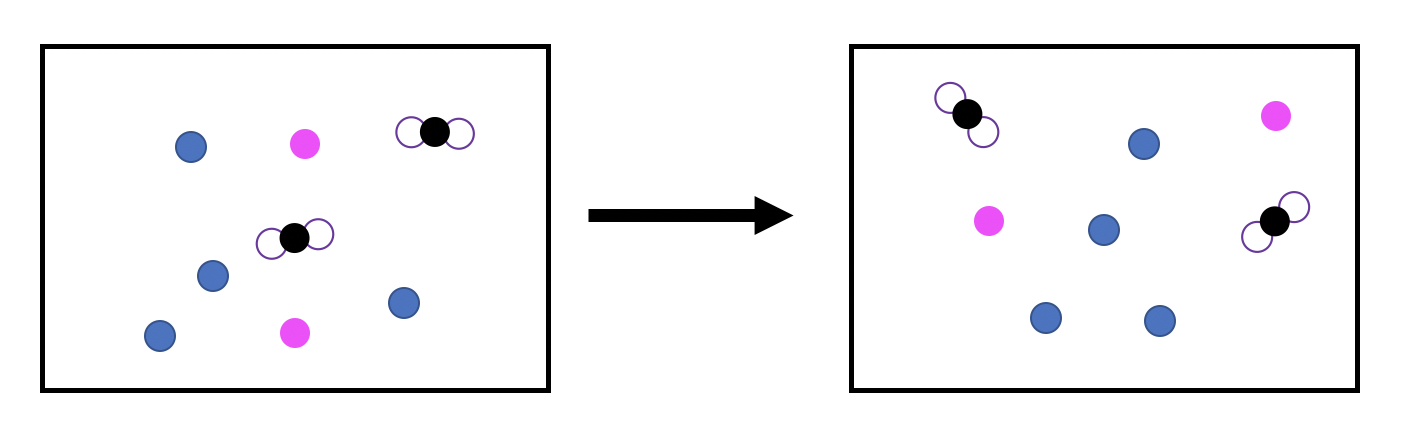
Does the following image represent a chemical reaction?
No
13
New cards
Which is the balanced chemical equation showing hydrogen peroxide (H2O2) decomposing into hydrogen (H2) and oxygen (O2)?
A) H2 + O2 → H2O2
B) 2 H2O2 → 2 H2 + O2
C) H2O2 → H2 + O2
D) 2 H2 + O2 → 2 H2O2
A) H2 + O2 → H2O2
B) 2 H2O2 → 2 H2 + O2
C) H2O2 → H2 + O2
D) 2 H2 + O2 → 2 H2O2
C) H2O2 → H2 + O2
14
New cards
Which statement about the reaction of methane with oxygen (shown below) is *not* correct?
CH4 + 2 O2 ⟶ CO2 + 2 H2O
A) The products are one molecule of carbon dioxide and two molecules of water.
B) Four atoms of hydrogen combine with four atoms of oxygen to produce water.
C) One molecule of methane combines with two molecules of oxygen.
D) The equation is balanced because the number of atoms of each element does not change.
CH4 + 2 O2 ⟶ CO2 + 2 H2O
A) The products are one molecule of carbon dioxide and two molecules of water.
B) Four atoms of hydrogen combine with four atoms of oxygen to produce water.
C) One molecule of methane combines with two molecules of oxygen.
D) The equation is balanced because the number of atoms of each element does not change.
B) Four atoms of hydrogen combine with four atoms of oxygen to produce water.
15
New cards
Balance the following equation using whole number coefficients.
*Enter your numbers carefully! Make sure to include "1" if necessary.*
The formation of diphosphorus pentoxide.
(?) P + (?) O2 → (?) P2O5
*Enter your numbers carefully! Make sure to include "1" if necessary.*
The formation of diphosphorus pentoxide.
(?) P + (?) O2 → (?) P2O5
4, 5, 2
16
New cards
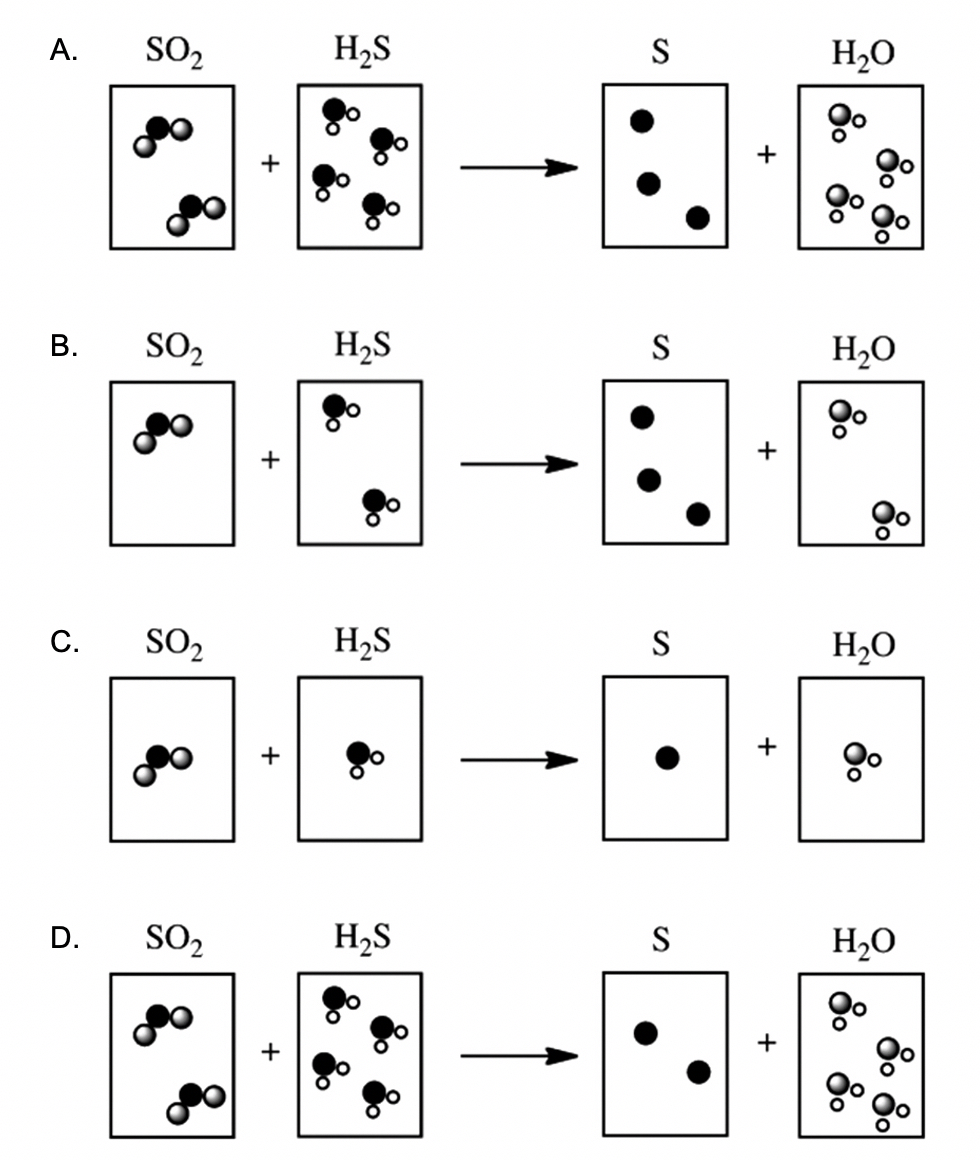
Which of the following representations depicts a balanced reaction?
B
17
New cards
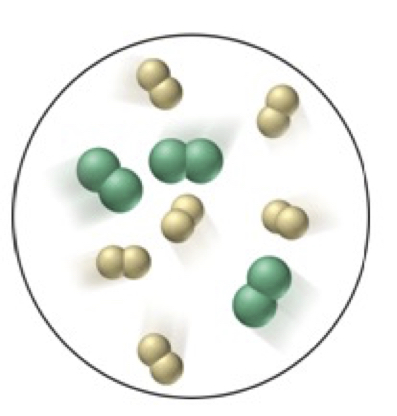
Chlorine trifluoride, an extremely reactive substance, is formed as a gas by the reaction of elemental chlorine (Cl2) and fluorine (F2).
The molecular scene below shows a mixture of the reactants (Cl2 and F2) before the reaction starts. (*Chlorine is* ***green****, and fluorine is* ***yellow****.)*
*Hint, you will need to determine a balanced chemical equation!*
What is the limiting reagent based on this representation?
How many molecules of chlorine trifluoride (ClF3) can be formed?
The molecular scene below shows a mixture of the reactants (Cl2 and F2) before the reaction starts. (*Chlorine is* ***green****, and fluorine is* ***yellow****.)*
*Hint, you will need to determine a balanced chemical equation!*
What is the limiting reagent based on this representation?
How many molecules of chlorine trifluoride (ClF3) can be formed?
Fluorine, 4