4. Dynamic Games
 Call Kai
 Learn
Learn Practice Test
 Spaced Repetition
 Match
Match Flashcards
 Knowt Play
1/10

There's no tags or description
Looks like no tags are added yet.
Name | Mastery | Learn | Test | Matching | Spaced | Call with Kai |
|---|
No analytics yet
Send a link to your students to track their progress
11 Terms
How do we represent dynamic games?
In this representation of games, we must also account for timing and knowledge — who moves first, information about the other peoples responses and strategies is still complete
These types of games are extensive form games
We do this via game trees and nodes, where players are assigned nodes, which end at payoffs
How is strategy conceived differently?
Strategy refers to a complete plan of action for every contingency rather than just a single action; thus, a strategy x also includes the plan of action even for events which don’t actually happen (are off the equilibrium path)
A pure strategy specifies an action at every node and a mixed strategy is a probability distribution over these pure strategies
An ‘on-path’ probability distribution occurs with probability 1 whereas ‘off-path’ is reached with a probability of 0
Visualisation of a normal form dynamic game table
We can see there are apparent NE at Enter(Not Invest, Not Invest), Enter(Not Invest, Invest), and Not Enter(Invest, Invest) but this doesn’t restrict the off-path outcomes at all
They might be playing a non-best response off path so we need to try and restrict the solution concept

Visualisation of a normal form dynamic game tree
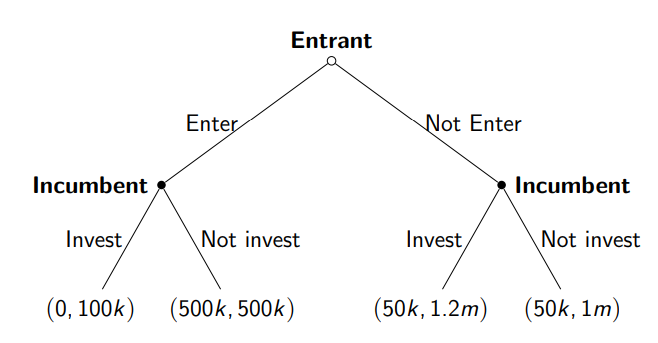
What is sequential rationality?
This is the notion that at every information set, each player should play a best response
A sequentially rational equilibrium can be found using backward induction (when there is perfect information)
If no two terminal nodes provide the same payoff to one of the players, then the sequentially rational equilibrium is unique
What is backwards induction?
It involves finding player 2’s best response to player 1 at every node they can choose at
Given the best responses of player 2, find the best response of player 1 in the first stage of the game
This allows us to find the only sequentially rational Nash Equilibrium
Backwards induction doesn’t work if information is imperfect because this involves one player assigning a belief about another players’ actions
What is a subgame perfect Nash Equilibrium (SPNE)?
A subgame G’ of an extensive form game G consists of one node and all of its successors
A subgame can only have one node as its root, thus, stages of play where there is more than one node in an information set can’t be subgames
A SPNE of a game G is a strategy profile σ* that constitutes a Nash Equilibrium in all the subgames of G
SPNE are restrictions on available NE’s, thus every SPNE is a NE but not vice versa
How is lack of knowledge represented in a game tree?
Dashed or dotted lines, as well as ellipses around nodes, are used to convey nodes which are part of the same information set but are indistinguishable
Rock, paper, scissors, is an example of when a player doesn’t know the outcome he will be presented with
What is the difference between perfect and imperfect information?
A game of complete information in which every information set is a singleton (there is only one node in an information set that a person has) and there are no moves of Nature is called a game of perfect information
A game in which some information sets contain several nodes or in which there are moves of Nature is called a game of imperfect information
In both cases information is complete, but in imperfect cases, an information set contains more than one node, so strategies of another person (or Nature) are known, but which one is chosen is not
How do we redefine mixed strategies for dynamic games?
A behavioural strategy specifies for each information set hi ∈ Hi an independent probability distribution over Ai(hi) and is denoted by σi : Hi → △Ai(hi), where σi(ai(hi)) is the probability that player i plays action ai(hi) ∈ Ai(hi) in information set hi
This definition allows for randomization to occur at each stage in the game rather than just once at the beginning
What is a game of perfect recall?
This is a game in which a player never forgets information that they previously knew
In games of perfect recall, mixed and behavioural strategies are basically identical because a person knows their past actions, and these actions thus being determinate, are equivalent to a fixed mixed strategy