Long - run aggregate supply (3)
 Call Kai
 Learn
Learn Practice Test
 Spaced Repetition
 Match
Match Flashcards
 Knowt Play
1/10

There's no tags or description
Looks like no tags are added yet.
Name | Mastery | Learn | Test | Matching | Spaced | Call with Kai |
|---|
No analytics yet
Send a link to your students to track their progress
11 Terms
What is long run aggregate supply (LRAS) influenced by ?
Long run aggregate supply (LRAS) is influenced by a change in the productive capacity of the economy
Productive capacity is changed by changes to the quantity or quality of the factors of production
What two opposing views do economists have on how LRAS works in an economy ?
The original view is called the classical view
The insights developed by John Maynard Keynes in 1936 are called the Keynesian view
What does the classical view believe ?
The classical view believes that the LRAS is perfectly inelastic(vertical) at a point of full employment of all available resources
This point corresponds to the maximum possible output on a production possibilities frontier (PPF) -(The maximum possible production (output) that a country can generate if it uses all of its factors of production to produce only two goods/services)
What does the classical view believe will happen in the long - run ?
The classical view believes that in the long- run, an economy will always return to this full employment level of output
There may be short-run output gaps in the economy
During extreme periods of economic growth, there can be an inflationary gap (The amount by which the actual level of national output (Real GDP) exceeds potential output) that develops
In the long run this will self-correct and return to the long-run level of output, but at a higher average price level
During slowdowns or recessions there can be a recessionary gap (The amount by which the actual level of national output (Real GDP) is less than the potential output) that develops
In the long-run this will self-correct and return to the long-run level of output, but at a lower average price level
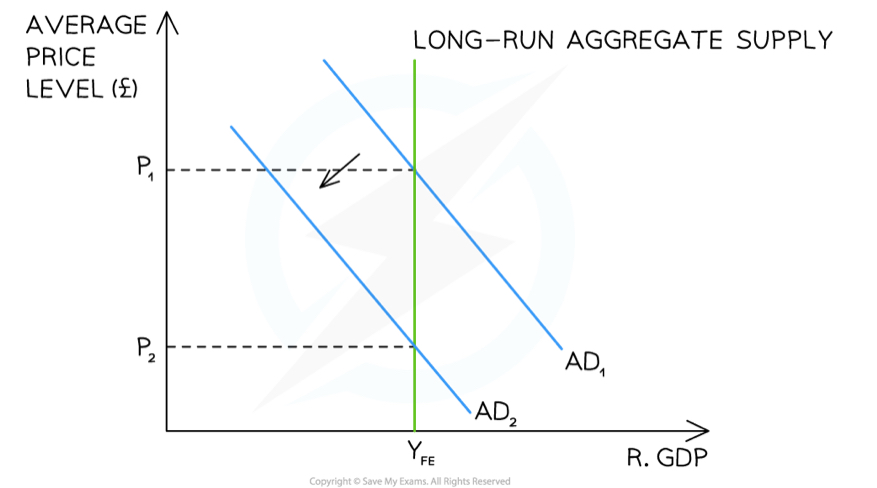
A diagram that shows the Classical View of long-run aggregate supply (LRAS) with a vertical aggregate supply curve at the full employment level of output (YFE) - Diagram Analysis
Using all available factors of prodution, the long-term output of this economy (LRAS) occurs at YFE
The economy is initially in equilibrium at the intersection of AD1 and LRAS (P1, YFE)
A slowdown reduces output from AD1→AD2 and creates a short term recessionary gap
This self corrects in the long term and returns the economy to the long-run equilibrium at the intersection of AD2 and LRAS (P2, YFE)
What did Keynes believe ?
Keynes believed that the long-run aggregate supply curve (LRAS)was more L shaped
Supply is elastic at lower levels of output as there is a lot of spare production capacity in the economy
Struggling firms will increase output without raising prices
Supply is perfectly inelastic (vertical) at a point of full employment (YFE) of all available resources
The closer the economy gets to this point the more price inflation will occur as firms compete for scarce resources
What does the keynesian view believe will happen to an economy ?
The Keynesian view believes that an economy will not always self-correct and return to the full employment level of output (YFE)
It can get stuck at an equilibrium well below the full employment level of output e.g. Great Depression
What else does the keynesian view believe about the government ?
The Keynesian view believes that there is role for the government to increase its expenditure so as to shift aggregate demand and change the negative 'animal spirits' in the economy
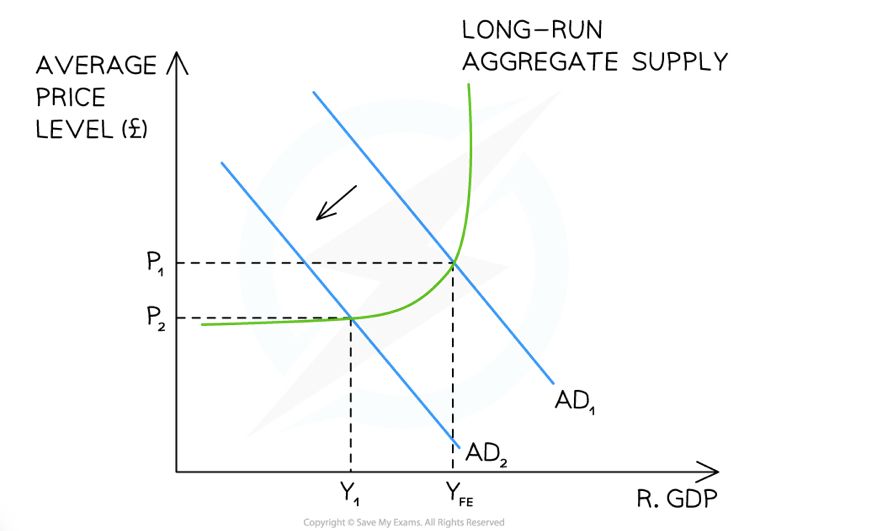
A diagram that shows the Keynesian View of long-run aggregate supply (LRAS) with a vertical aggregate supply curve at the full employment level of output (YFE) becoming more elastic at lower levels of output - Diagram Analysis
Using all available factors of production, the long-term output of this economy (LRAS) occurs at YFE
The economy is initially in equilibrium at the intersection of AD1 and LRAS (P1, YFE)
A slowdown reduces output from AD1→AD2 and creates a recessionary gap Y1-YFE
The economy may reach a point where average prices stop falling (P2), but output continues to fall
This economy may not self-correct to YFE for years
The low output leads to high unemployment and low confidence in the economy
This stops further investment and further reduces consumption
Keynes argued that this was where governments needed to intervene with significant expenditure e.g. Roosevelt's New Deal; response to financial crisis of 2008
What will impact the long - run aggregate supply (LRAS) ?
Any factor that changes the quantity or quality of a factor of production will impact the long-run aggregate supply (LRAS) of an economy:
This corresponds to an outward or inward shift of the potential output of an economy on the PPF
The following factors will shift the entire LRAS curve outwards and increase the potential output of the economy:
Technological advances: these often improve the quality of the factors of production e.g. development of metal alloys
Changes in relative productivity: process innovation often results in productivity improvement e.g. moving from labour intensive car production to automated car production
Changes in education and skills: over time this increases the quality of labour in an economy
Changes in government regulations: these can improve the quantity of the factors of production. e.g. deregulation of fracking (extracting oil from shale deposits) increased oil reserves
Demographic changes and migration: a positive net birth rate or positive net migration rate will increase the quantity of labour available
Competition policy: regulating industries so as to prevent monopoly power results in more firms supplying goods/services in an economy and this increases the potential output of an economy