6.3 Current Account of the Balance of Payments
 Call Kai
 Learn
Learn Practice Test
 Spaced Repetition
 Match
Match Flashcards
 Knowt Play
1/26

There's no tags or description
Looks like no tags are added yet.
Name | Mastery | Learn | Test | Matching | Spaced | Call with Kai |
|---|
No analytics yet
Send a link to your students to track their progress
27 Terms
What is a country's balance of payments + what does it consist of (3)
A country's balance of payments is a record of all the economic transactions between residents of that country and residents in other countries over a year
- Consists of the current account, the capital account and the financial account
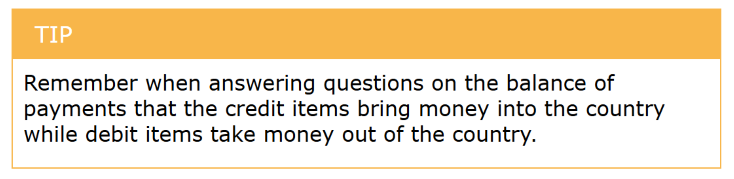
- Money into the country = credit, out of the country = debit
What is the capital account
Within the balance of payments, a record of the sale and purchase of copyrights, patents, trademarks, and money brought into the country by immigrants and taken out by emigrants
What is the financial account
Within the balance of payments, a record of the transfer of financial and capital assets between the country and the rest of the world
What are the main components of the current account
Trade in goods (visible trade)
2. Trade in services (invisible trade)
3. Primary income (investment income)
4. Secondary income (transfers)
What is trade in goods
Exports and imports of physical goods such as cars, electronics, or oil.
- Exports = credit, Imports = debit
How do you calculate the balance of trade in goods
Balance of trade in goods = Exports of goods − Imports of goods
What is trade in services
Exports and imports of services such as shipping, banking, tourism, or insurance.
How do you calculate the balance of trade in services
Balance of trade in services = Exports of services − Imports of services
What is primary income
Income earned from overseas assets, e.g., dividends, interest, and profits.
What is secondary income
Transfers with no economic return, e.g., remittances, foreign aid, workers' remittances or gifts.
What are workers' remittances
Payments of money sent by workers living abroad back to their home country, usually to support family members.
How is the current account balance calculated
CAB = Trade in goods + Trade in services + Primary income + Secondary income
What does a current account surplus mean
Credits > debits → more money entering the country from exports, investment, or transfers.
What does a current account deficit mean
Debits > credits → more money leaving the country for imports, investment, or transfers.
Tip - credits vs debits
What are some causes of current account imbalances (5)
Domestic economic growth
2. Exchange rate changes
3. Competitiveness of domestic industries
4. Global economic conditions
5. Inflation differences
What are the main causes of a current account deficit (opposite of surplus)
A current account deficit can arise from:
• Strong domestic growth increasing imports of raw materials and capital goods, while exports may be diverted to the home market (short‑term and usually self‑correcting).
• Recession or slow growth in trading partners, which reduces their demand for exports (a cyclical, temporary deficit).
• Structural weaknesses such as low productivity, high inflation, an overvalued exchange rate, poor skills/education, and low investment/innovation — making domestic firms internationally uncompetitive (long‑term and not self‑correcting).
What are the main causes of a current account surplus (opposite of deficit)
A current account surplus can result from:
• Weak domestic demand, which reduces imports of consumer goods, raw materials, and capital goods (often not beneficial, as it reflects recession).
• Strong economic growth in trading partners, increasing demand for the country’s exports and possibly boosting remittance inflows.
• Structural advantages, such as high productivity, good education and training, innovation, low inflation, and a competitive (low) exchange rate, making domestic products more price‑competitive.
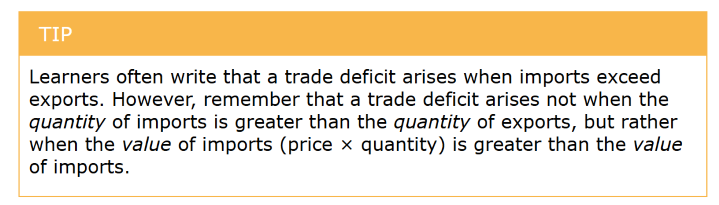
Tip - when does a trade deficit occur
What are the consequences of a current account deficit (4) + Key explanation + chain of reasoning
Money leaving the economy → lower aggregate demand → slower economic growth
Higher unemployment → especially in export industries due to reduced demand
Borrowing from abroad → rise in foreign debt
Depreciation of currency → import prices rise → inflation risk
Key explanation:
• A current account deficit means a country is consuming more than it produces
• It must be financed by borrowing or attracting foreign investment
• This leads to future outflows of income (e.g. interest, profit repatriation)
• These outflows further reduce aggregate demand over time
Chain (exam-ready):
👉 Deficit → money leaves economy → ↓ AD → ↓ growth → ↑ unemployment
What are the consequences of a current account surplus (3) + Key explanation + chain of reasoning
More money entering the economy → higher GDP → stronger growth and employment
Currency appreciation → exports become more expensive → surplus may fall over time
Stronger foreign reserves → enables investment abroad
Key explanation:
• A current account surplus means a country is earning more than it is spending
• Domestic consumption may be lower, leading to a reduced standard of living
• High export demand + increased money supply can cause inflationary pressure
• Surplus countries may face external pressure from deficit countries to reduce imbalances
Chain (exam-ready):
👉 Surplus → money enters economy → ↑ AD → ↑ growth & employment → possible inflation & currency appreciation
How should the significance of a current account imbalance be assessed
• The significance of a deficit or surplus depends on its size relative to GDP, not the absolute dollar amount.
• A small country with a small monetary deficit may face greater concern if the deficit is a high percentage of GDP.
• A large country with a much bigger dollar deficit may face less concern if the deficit forms a relatively small share of GDP.
How does domestic economic growth affect the current account
Rapid growth → higher incomes → more imports → may worsen CAB (deficit).
How does exchange rate affect the current account
Strong domestic currency → exports expensive, imports cheaper → CAB deficit may worsen
Weak domestic currency → exports cheaper, imports expensive → CAB may improve
How do competitiveness and productivity affect the current account
High productivity → cheaper exports → CAB improves
Low productivity → exports decline → CAB worsens
Exam tip: How to explain CAB imbalances step by step.
Identify the factor (growth, exchange rate, productivity, inflation, global conditions)
2. Explain how it affects exports or imports
3. Show effect on CAB (surplus or deficit)
4. Evaluate impact on domestic and external economy
Exam tip: How to discuss consequences of CAB imbalances.
For deficit: slower growth, unemployment, foreign debt, currency depreciation
2. For surplus: growth and employment rise, currency appreciation, risk to competitiveness
3. Always include evaluation: short-term vs long-term effects