6 - Bipolar, DSM5 + symptoms
 Call Kai
 Learn
Learn Practice Test
 Spaced Repetition
 Match
Match Flashcards
 Knowt Play
1/65

There's no tags or description
Looks like no tags are added yet.
Name | Mastery | Learn | Test | Matching | Spaced | Call with Kai |
|---|
No analytics yet
Send a link to your students to track their progress
66 Terms
Moods alternate between "Poles"
1. Severe mania. 2. Hypomania.
1. Mild depression. 2. Severe depression.
What happens to moods according to the "Poles" concept?
What are the states listed under the "High" mood category?
What are the states listed under the "Lows" mood category?
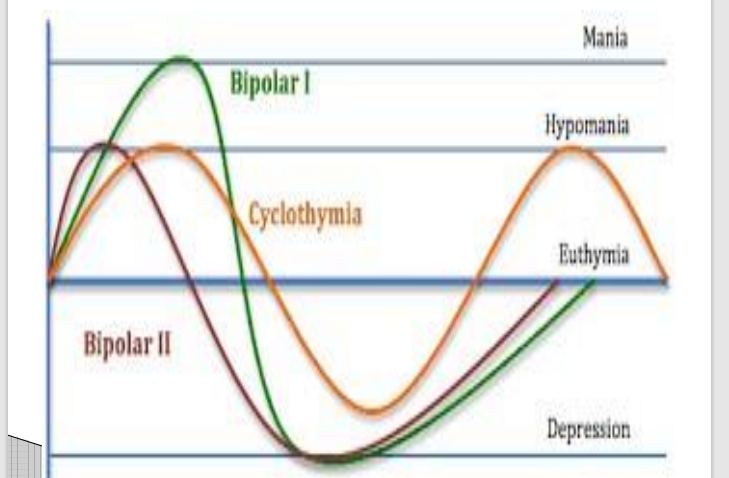
It reaches the peak of Mania and descends into deep Depression.
Based on the chart, what characterizes the peak and trough of Bipolar I?
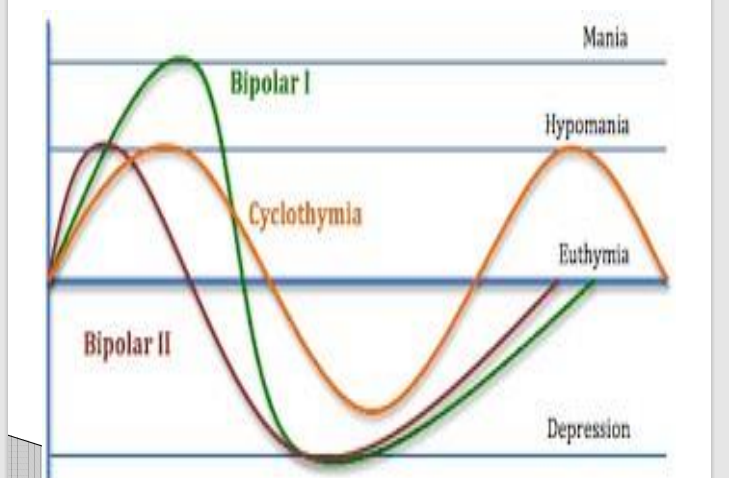
Bipolar I reaches full Mania, while Bipolar II only reaches Hypomania.
What is the primary difference between Bipolar I and Bipolar II regarding the "Highs"?
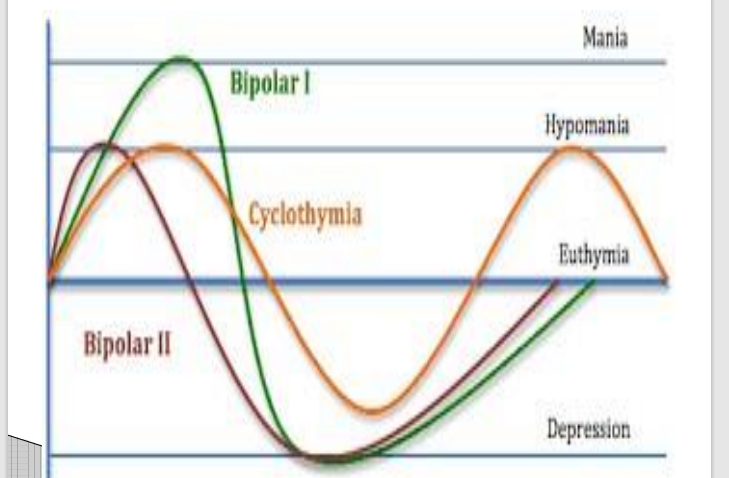
It is represented as continuous fluctuations between Hypomania and mild depression without reaching the extremes of Mania or severe Depression.
How is Cyclothymia represented in terms of mood fluctuations?
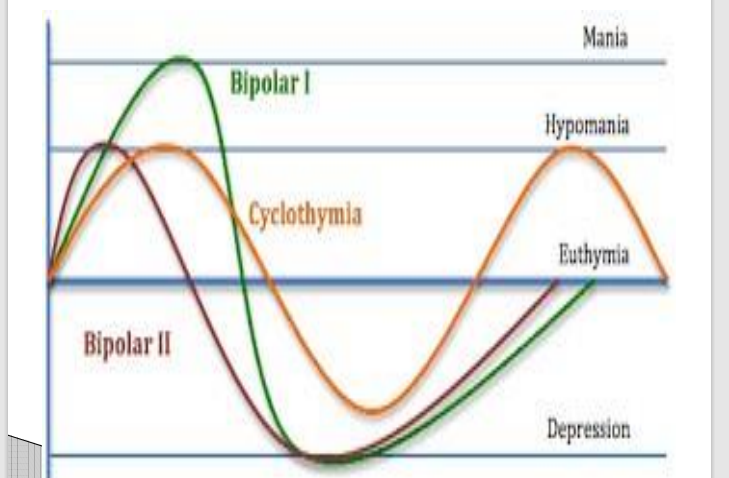
It represents the Normal or stable mood state (baseline).
What does the term "Euthymia" represent on the mood chart?
They were separated from the depressive disorders.
What change occurred regarding Bipolar disorders in the DSM-5 classification?
between the chapters on schizophrenia spectrum / other psychotic disorders and depressive disorders.
Because it links schizophrenia spectrum and depressive disorders in terms of
symptomatology
family history,
genetics.
Where are Bipolar and its related disorders placed in the DSM-5?
Why is the Bipolar chapter considered a "bridge" between two diagnostic classes?
At least 1 week, present most of the day, nearly every day
(or any duration if hospitalization is necessary).
What is the required duration for a Manic Episode according to DSM-5? “Bipolar I”
1. Mood Component (one or more of these):
Abnormally and persistently elevated mood
OR abnormally and persistently expansive mood
OR abnormally and persistently irritable mood
AND
2. Activity/Energy Component (one or both of these):
Abnormally and persistently goal-directed behavior
OR abnormally and persistently energy
lasting at least 1 week, present most of the day, nearly every day (or any duration if hospitalization is necessary).
What are the characteristics and duration of mood and energy in Criterion A for a Manic Episode?
قاعدة (3 أو 4) (Criterion B):
إذا كان المريض "سعيداً جداً" (Elevated/Expansive)، نحتاج 3 أعراض فقط لتشخيصه.
أما إذا كان "متهيجاً وعدوانياً" (Irritable) ، فالمقياس يرتفع لـ 4 أعراض، لأن التهيج قد يتداخل مع اضطرابات أخرى.
1. Inflated self-esteem or grandiosity.
2. Decreased need for sleep.
3. More talkative or pressure to keep talking.
4. Flight of ideas or racing thoughts.
5. Distractibility.
6. Increase in goal-directed activity or psychomotor agitation.
7. Excessive involvement in risky activities (high potential for painful consequences).
What are the 7 symptoms listed in Criterion B for a Manic Episode? “Bipolar I”
1. Marked impairment in social or occupational functioning.
2. Necessity of hospitalization to prevent harm.
3. Presence of psychotic features.
What are the three indicators in Criterion C that confirm the severity of a Manic Episode?
Direct physiological effects of a substance (drug of abuse, medication, or other treatment) or another medical condition.
What does Criterion D exclude from a Manic Episode diagnosis?
When it persists at a fully syndromal level beyond the physiological effect of that treatment (e.g., medication or ECT).
عندما تستمر بمستوى متلازمة كاملة تتجاوز التأثير الفسيولوجي لذلك العلاج (مثل الأدوية أو العلاج بالصدمات الكهربائية).
When is a manic episode emerging during antidepressant treatment sufficient for a Bipolar I diagnosis?
متى تكون نوبة الهوس التي تظهر أثناء العلاج بمضادات الاكتئاب كافية لتشخيص ثنائي القطب من النوع الأول؟
Manic episodes must last at least 7 days and be accompanied by psychotic features,
OR symptoms must be severe enough to require immediate hospitalization.
What are the diagnostic requirements for Bipolar I disorder regarding manic episodes?
Typically lasting at least two weeks.
How long do depressive episodes typically last in Bipolar I disorder?
النوبات المختلطة (Mixed Features)
النص يشير لنقطة متقدمة جداً في علم النفس السريري؛ المريض قد لا يكون "سعيداً صرفاً" أو "حزيناً صرفاً".
قد يكون في قمة الهوس (نشاط عالي) ولكن مع مشاعر "اكتئابية" (ضيق ويأس).
أو يكون مكتئباً (خمول) ولكن مع "سمات هوسية" (تسارع أفكار). هذه الحالات تُسمى سريرياً بـ Mixed Episodes وهي تتطلب دقة عالية في التشخيص.
Can a person with Bipolar I have symptoms of both mania and depression simultaneously?
At least 4 consecutive days, present most of the day, nearly every day.
What is the required duration for a hypomanic episode according to Criterion A?
Three or more (four if the mood is only irritable), representing a noticeable change from usual behavior.
1. Inflated self-esteem or grandiosity.
2. Decreased need for sleep.
3. More talkative or pressure to keep talking.
4. Flight of ideas or racing thoughts.
5. Distractibility.
6. Increase in goal-directed activity or psychomotor agitation.
7. Excessive involvement in risky activities (high potential for painful consequences).
How many symptoms are required in Criterion B for a Hypomanic Episode?
No, the episode is not severe enough to cause marked impairment or necessitate hospitalization (Criterion E).
Does a Hypomanic Episode cause marked impairment in functioning or require hospitalization?
The episode is, by definition, considered manic (Manic Episode).
What happens to the diagnosis if psychotic features are present during a hypomanic period?
You must have experienced at least
one hypomanic episode
one major depressive episode in your lifetime.
. المقارنة مع النوع الثاني (Bipolar II)
في النوع الثاني (II): نوبة الاكتئاب الجسيم هي شرط إلزامي للتشخيص (لا يمكن تشخيص النوع الثاني بدونها).
في النوع الأول (I): نوبة الاكتئاب الجسيم ليست شرطاً نظرياً، ولكنها موجودة عملياً في أغلب الحالات وبنفس القوة.
What is the minimum clinical requirement to be diagnosed with Bipolar II disorder?
suicidal thoughts
Unexplained or uncontrollable crying.
anhedonia
insomnia OR hypersomnia
severe fatigue (anergia) (even without physical exertion)
List the common symptoms of a Major Depressive Episode ?
Also called cyclothymia, it is a chronic mood disorder requiring symptoms to be present for at least 2 years.
Define Cyclothymic disorder and state its required duration for diagnosis in adults.
It involves frequent but mild symptoms of depression alternating with mild symptoms of mania
these symptoms do not reach the clinical severity of full manic or major depressive episodes.
Describe the pattern of mood fluctuations in Cyclothymic disorder and how it differs from severe Bipolar types.
Dysthymia (Persistent Depressive Disorder).
Which other chronic mood disorder is compared to cyclothymia in terms of the 2-year duration requirement?
During Lows:
Sadness,
feeling inadequate,
social withdrawal,
oversleeping (e.g., 10 hours/night).
During Highs:
Being boisterous (energetic/cheerful), صاخب (نشيط ومبتهج)
overly confident,
socially uninhibited,
gregarious, حب الاختلاط،
needing little sleep.
Describe the behavioral characteristics of a person with Cyclothymia during their "Low" and "High" periods
False. It is considered a milder form of bipolar disorder, involving cyclical mood swings that do not meet the full criteria for mania or major depression.
Cyclothymic disorder involves mood swings that are severe enough to meet full criteria for both mania and major depression. ✅❌
it usually develops in adolescence
When does Cyclothymic disorder typically develop?
true
Individuals with cyclothymic disorder may appear to function normally, though others may perceive them as moody or difficult ✅❌
false. often do not seek treatment because their mood swings are not perceived as severe.
Individuals with cyclothymic disorder frequently seek treatment early due to the severity of their symptoms. ✅❌
true
If untreated, cyclothymic disorder can increase the risk of developing bipolar disorder. ✅❌
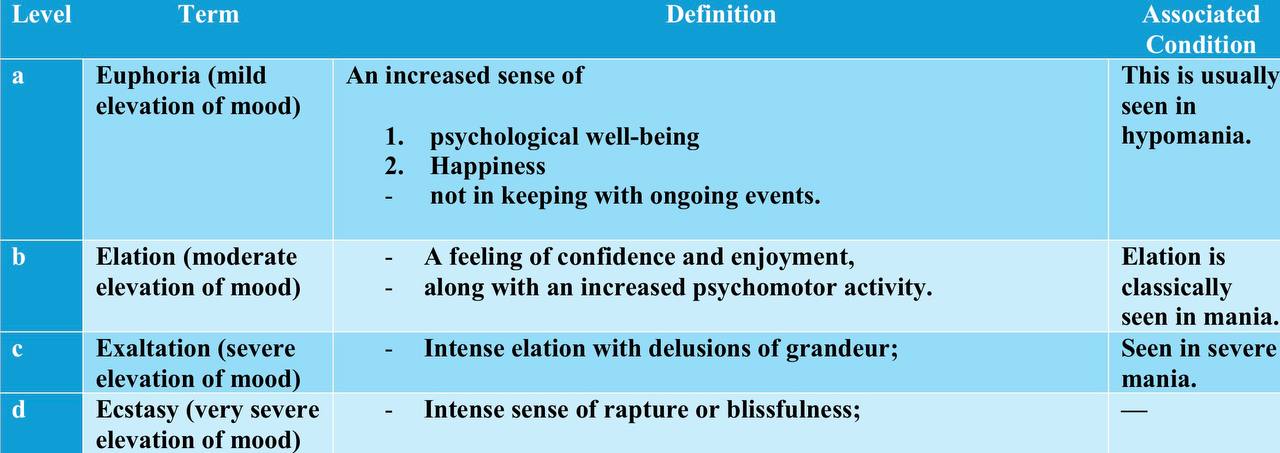
depending on the severity of the manic episode.
what are the stages of elevated mood? and what determines these stages? (openQ)
it ranges from overactiveness and restlessness to manic excitement.
The person is described as being ‘on-the-toe-on-the-go' (constant, high-speed movement).
Describe the spectrum of increased psychomotor activity in mania and its characteristic movement state.
1. Goal-oriented: The activity usually has a perceived purpose or goal.
2. Based on external environmental cues: The person reacts excessively to stimuli in their surroundings.
What are the two primary characteristics of activity during a manic episode regarding its purpose and stimuli?
Delivery: Rapid, pressured, loud, and difficult to interrupt.
Social Manner:
Continuous & intrusive
without regard for others' wishes to communicate or the relevance of the topic.
Describe the delivery and social manner of speech during a manic episode?
Jokes
puns تلاعب بالكلام
singing
theatricality with dramatic mannerisms & excessive gesturing. (Loudness becomes more important than the content).
What are the theatrical and expressive features that characterize manic speech?
A nearly continuous flow of accelerated speech
where thoughts race faster than they can be expressed,
leading to abrupt shifts from one topic to another.
Define "Flight of Ideas" and its effect on the flow of speech?
Initially: Connections are apparent (واضحة) and often based on external environmental cues.
When Severe: Speech becomes disorganized, incoherent, and distressful to the individual.
How do the connections between topics change as flight of ideas progresses from mild to severe?
It becomes very difficult to speak because thoughts are experienced as too crowded to be expressed
What is the subjective experience of an individual when thoughts become extremely crowded?
Delusions (or ideas) of grandeur are present along with markedly inflated self-esteem.
What characterizes the delusions of grandeur and self-esteem in a manic state?
Delusions of persecution may develop secondary to delusions of grandeur (e.g., "I am so great that people are against me").
How can delusions of persecution develop in relation to delusions of grandeur?
Both auditory and visual hallucinations can occur
often with religious content (e.g., God appearing or speaking to the individual).
Describe the types and typical content of hallucinations that can occur during mania.
false. During a manic episode, some individuals may engage in excessive communication, such as writing numerous letters, emails, or messages on a wide range of topics.
Manic episodes are typically associated with reduced communication and minimal interest in writing or contacting others. ✅❌
They are called mood congruent psychotic features because the symptoms are in keeping with the elevated mood.
What are psychotic symptoms called when they align with an elevated mood state, and why?
Distractibility is a common feature that results in rapid changes in speech and activity in response to external stimuli (in response to even irrelevant external stimuli)
Define "Distractibility" in mania and describe its effect on speech and activity.
true
During mania or hypomania, individuals often show increased alertness and attempt to engage in multiple activities simultaneously, with hypomania sometimes associated with improved functioning and productivity ✅❌
true
Increased goal-directed activity in mania often involves excessive planning and participation in multiple domains such as
occupational
social
political
religious activities.
✅❌
false. Manic episodes are often associated with increased sexual drive, fantasies, and behaviors.
Sexual interest and behavior typically decline during manic episodes. ✅❌
Appetite may be increased, but later there is usually decreased food intake due to marked over-activity.
Describe the progression of appetite and food intake during a manic episode?
Insight into the illness is absent, especially in severe mania.
What is the status of insight into the illness during mania, particularly in severe cases?
true
Expansive mood, grandiosity, and impaired judgment in mania can lead to reckless behaviors such as excessive spending, giving away possessions, risky driving, and poor financial decisions. ✅❌
true
During manic states, individuals may alter their dress, makeup, or overall appearance to be more sexually suggestive. ✅❌
true
Impulsive marriages and divorces take place during a manic episode ✅❌
It can lead to constipation, physical exhaustion, and even death.
How can continuous physical activity combined with lack of sleep and food affect the patient's physical health?
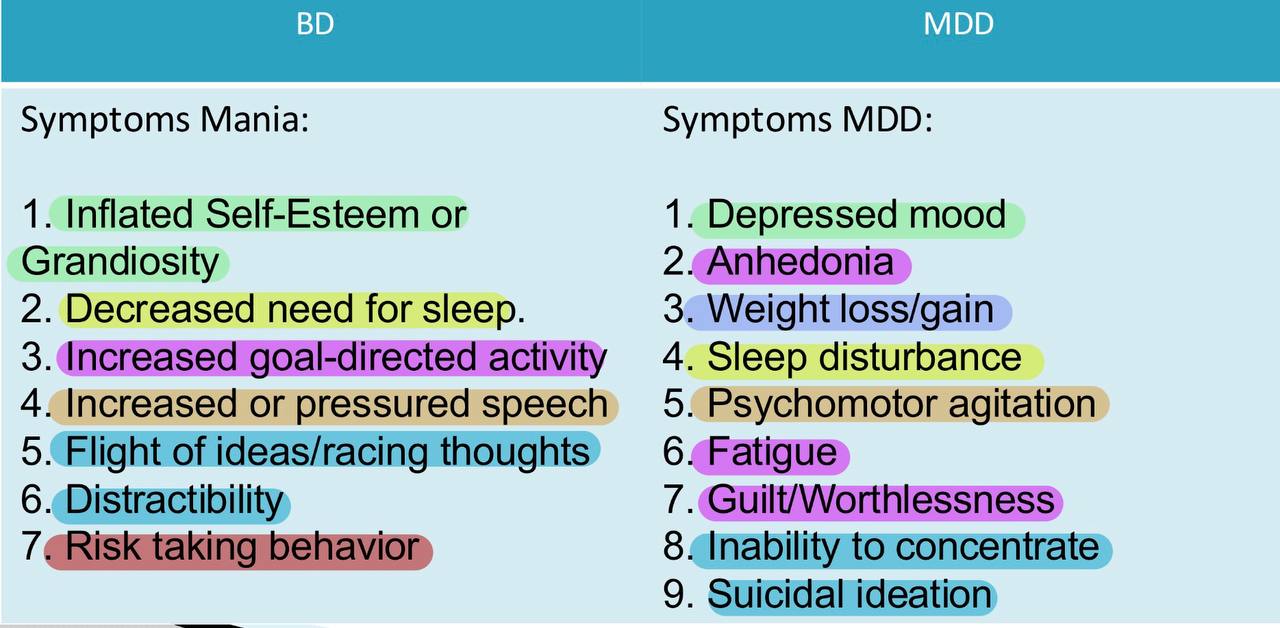
whats the difference between MDD and BD ? What's
It is most often diagnosed in older children and teenagers, but it can occur in children of any age.
At what age is bipolar disorder most often diagnosed, and can it occur in younger children?
As in adults, it causes mood swings from the highs of hyperactivity or euphoria (mania) to the lows of serious depression.
What does bipolar disorder cause in children, and how does it compare to adults?
Mood Swings: Severe swings that are different from their usual mood.
Behavior: Hyperactive, impulsive, aggressive, or socially inappropriate.
Risky Actions: Reckless behaviors (out of character), alcohol/drug abuse, or wild spending sprees.
Sleep: Insomnia or significantly decreased need for sleep.
Depression: Depressed or irritable mood most of the day, nearly every day.
Self-View: Grandiose and inflated view of own capabilities.
Suicide: Suicidal thoughts or behaviors (in older children and teens).
list the signs and symptoms of bipolar disorder in children?
Symptoms occur in distinct episodes. Between these episodes, children return to their usual behavior and mood.
Describe the pattern of symptoms in children with bipolar disorder and their state between episodes.
ADHD
ODD oppositional defiant disorder
conduct disorder
anxiety disorders
major depression.
Which childhood disorders cause symptoms similar to bipolar disorder, making diagnosis challenging?
Because other mental health conditions often cause similar symptoms or occur along with bipolar disorder.
Why can the diagnosis of bipolar disorder in children be challenging?
Impulsivity.
Energy: Increase in energy or being "on the go".
Attention: Being easily distracted or inattention.
Communication: Talking a lot and frequently interrupting others.
Activity: Hyperactivity.
Lability: Behavioral and emotional lability.
List the similarities between manic episodes of bipolar disorder and ADHD? (OPENQ)

what are the differences between BD & ADHD?
Distractibility
talkativeness
difficulty maintaining attention
loss of social functioning.
What are the overlapping symptoms between ADHD and bipolar mania/hypomania?
Onset of symptoms at an early age.
Continuity of symptoms in the absence of mood episodes (manic/depressive).
What are two strong indicators that suggest a diagnosis of ADHD rather than bipolar disorder?
Cyclical symptoms,
increase in goal-directed activity,
inflated sense of self
decreased need for sleep.
Which symptoms strongly suggest a manic or hypomanic episode rather than just ADHD?