Microbiology Ch 9 Microbial Growth Openstax
 Call Kai
 Learn
Learn Practice Test
 Spaced Repetition
 Match
Match Flashcards
 Knowt Play
1/31

There's no tags or description
Looks like no tags are added yet.
Name | Mastery | Learn | Test | Matching | Spaced | Call with Kai |
|---|
No analytics yet
Send a link to your students to track their progress
32 Terms
Microbial Growth
- Reflects an increase in number NOT size
- Binary Fission:
1. DNA replicates
2. Division (septum) appears in the middle of the cell
3. 2 cells separate
Generation Time
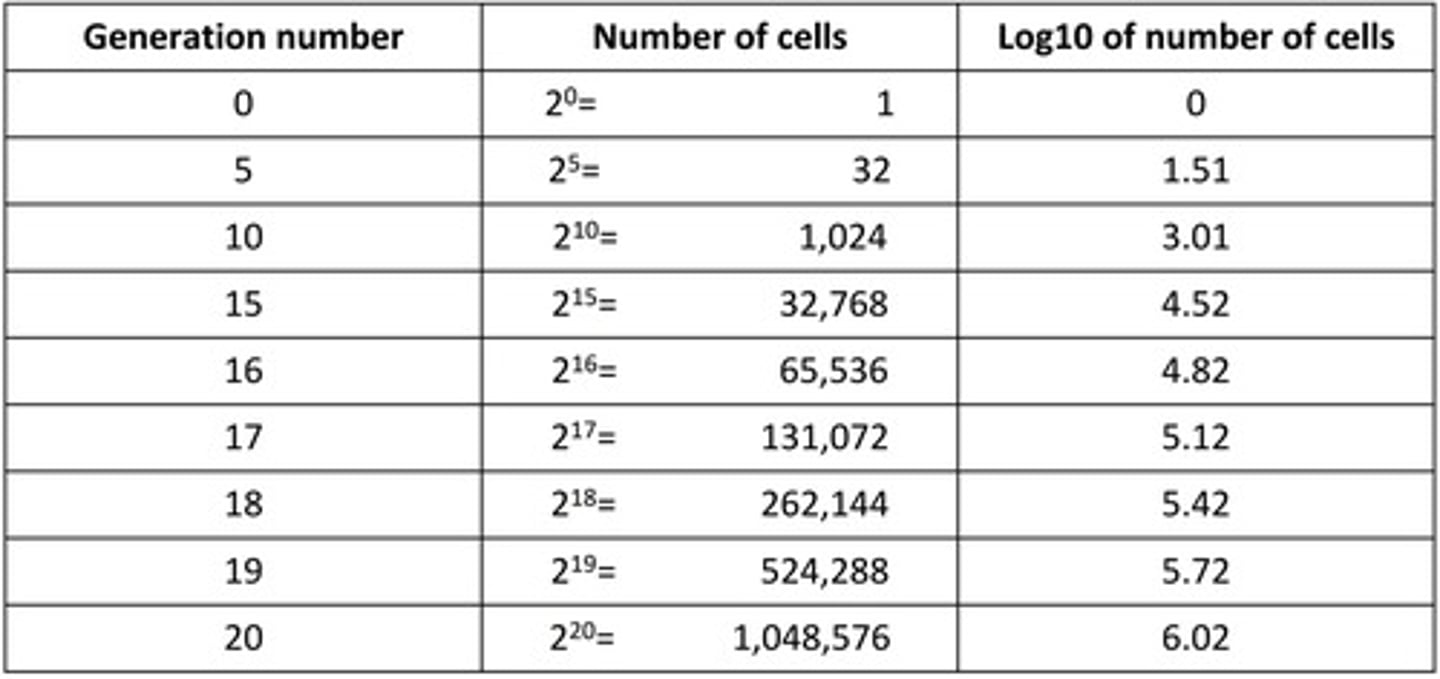
- Time to double the cell number
# of Generation. # of Cells
0 1
1 2
2 4
3. 8
Binary Fission: Exponentials of 2
- Shorter the generation time the faster they grow
- Generation Time (GT) depends on the microbe & the conditions
Bacterial Growth Curve
- Number of cells in a batch culture plotted vs time
1. Lag Phase: No increase in the # of living bacterial cells
2. Log Phase: Exponential increase in the # of living bacterial cells
3. Stationary Phase: Plateau in the # of living bacterial cell; rate of cell division & death roughly equal
4. Death or Decline Phase: Exponential decrease in the # of living bacterial cells
Lag Phase
- Cell will take time to adapt to new environment before actively dividing
- May be introduced as spores
- May be utilizing diff biochemical pathways for growth in other media
- May experience physical changes upon introduction to new medium
Log Phase
Cell can divide now
Stationary Phase
- Exhaustion of nutrients
- Accumulation of waste products
- Changes in pH
- # of cells made = # that die
Death Phase
- Logarithmic decline
- Some cells may survive - endoscopes may form
- Cells may be hard to identify
- Persister cells have slow metabolism
Direct Method
Method of quantification of bacteria
- Quantify cell #s
- Plate counts (require serial #): Pour and spread plates
- Filtration
- MPN (most probable #)
- Direct microscopic count: uses microscopic, special slides with grids, count the # of bacteria in the diluted samples & DOES NOT distinguish between live & dead cells
Serial Dilution
More precise and easier way to prepare high dilutions
Indirect Methods
Quantify factors that depend on cell numbers
- Turbidity
- Metabolic activity
- Dry Weight
Turbidity
- Uses spectrometry
- More cells = more turbid (cloudy) the suspension is
- Useful to monitor cell growth
- Can measure: Transmittance (lower the %, more cells)
Absorbance or Optical Density (OD): The bigger the # the more cells
PRO: quick and easy
CON: DOE NOT provide absolute #, DOES NOT differentiate bwtn living & dead cells
Biofilms
- Microbial communities: Usually found on solids substrates submerged in or exposed to the aqueous solution (dental plaque)
- Form slime or hydrogels: Made up of polysaccharides & protein/DNA
- Cell to cell communication allows bacteria to coordinate their activity forming a functional community (quorum sensing)
- Share nutrients, resist harmful environment
- May contain more than one type of microorganism
- Resist anti microbial
Life Cycle of Biofilms
1. Reversible attachment of platonic cells (seconds)
2. First colonizers become irreversibly attached (seconds, minutes)
3. Growth and cell division (hours, days)
4. Production of EPS form of water channels. (Hours, days)
5. Attachment of secondary colonizers and dispersion of microbes to new sites (days, months).
Quorum Sensing
- signaling molecules are different for gram-positive and gram-negative
- mechanism by which cells in a biofilm coordinate their activities in response to environmental stimuli
-Chemical called auto inducers, provoke gene expression
The effect of oxygen
- Strict Anaerobes: Very sensitive to O2 & die even with short exposure
- Facultative Anaerobes: grow in the presents or absence of O2, +O2 (aerobic respiration), -O2 (fermentation)
Toxic Oxygen
Produced during normal respiration (ETC) and from ionizing radiation, drugs, or our own white blood cells and must be inactivated to avoid cellular damage
Superoxide Free Radicals
O2; reactive and toxic
peroxide anion (O2 2-)
Highly reactive oxidant
Hydroxyl radical (OH)
- Most reactive and short-lived
- Results from the incomplete reduction of hydrogen peroxide
Harmful effects of reactive oxygen species
- Damage of DNA
- oxidation of poly unsaturated fatty acids and lipids and amino acids and proteins
- Oxidative and active specific enzymes by oxidation of cofactors
Positive role of toxic oxygen
- Used in phagocytosis
- Phagocytosis cells, ingest pathogens and exposed them to toxic oxygen species found in specific organelles
Strict Anaerobes
Very sensitive to O2: do not have the enzymes to degrade oxygen radicals and die even with short exposure
Bacterial Growth in the Environment
- Natural conditions cannot be controlled
- many species coexist
- Changes and conditions may cause population shifts as conditions favor certain members of the population over others
- Most natural ecosystems are characterized by low nutrient level
- Bacteria must be able to survive periods of starvation
Low Nutrient Levels
- Response to depleted amino acid pool, amino acid starvation, reduces the rate of protein synthesis by decreasing the synthesis of rRNA, shut down a number of energy draining activities as a single response
- Low levels of nitrogen; turn on genes of ammonia production from other nitrogen sources, stored in glutamine (ammonia supply for cell)
Effect of Osmotic Pressure
- Hypertonic environments or an increase in salt or sugar may cause PLASMOLYSIS (plasma membrane burst inside the cell wall
- High osmotic pressure inhibits or slows down bacterial growth
- this method of growth inhabitation is used to preserve food ie jams, and jellies and salted fish or meat
Extreme of Obilgate Halophiles
REQUIRE high osmotic pressure
Facultative Halophiles
- TOLERATE high osmotic pressure
- "Facultative" refers to an ability to tolerate, not a requirement
Culture Media
- nutrients prepare for microbial growth; they are sterile (no living microbes) & inoculate (introduction of microbe into medium)
- Can you liquid (broth) or solid
- Solid media contain agar: complex polysaccharide, used as solidifying agent in culture, media and petri plates , slants and deeps, generally not metabolized by microbes (they do not eat agar)
Obtaining Pure Cultures
- contains only one species or strain a bacteria
- bacteria spread throughout the surface of the dish containing agar medium. Each bacterial cell will form
- A colony is a population of cells arising from a single cell or from a group attached cells (Colony Forming Unit CFU)
- Before removing a single colony and growing it on another plate or broth, you will have isolated species of bacteria, ie Pure Culture
- The streak plate method is used to isolate pure cultures
Chemically Defined Media
exact chemical composition is known
Complex Media
Extracts and digest of yeast, meats, or plants
Examples: nutrient broth, TSB (tryptic soy broth), BHI (brain heart infusion) nutrient agar TSA PDA