14 CAC
 Call Kai
 Learn
Learn Practice Test
 Spaced Repetition
 Match
Match Flashcards
 Knowt Play
1/33

There's no tags or description
Looks like no tags are added yet.
Name | Mastery | Learn | Test | Matching | Spaced | Call with Kai |
|---|
No analytics yet
Send a link to your students to track their progress
34 Terms
what is the major purpose of aerobic catabolism
to “capture” the energy in biological fuel molecules and use it to make ATP.
needs oxygen
what are some general features of the CAC
Occurs in the matrix - you have to bring pyruvate from cytosol to matrix
Oxidizes the acetate in acetyl-CoA, happens twice- 2 carbon atoms converted to 2 CO2
Cyclic process - starts and ends with oxaloacetate (OAA)
Final stage in the aerobic catabolism of carbohydrates, fatty acids and amino acids
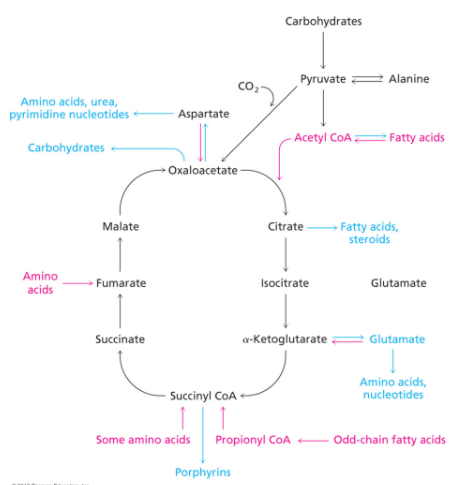
Endless metabolic connections - involved in synthesis for a bunch of things, why it has to be in steady state
what type of pathway is the CAC
its an amphibolic pathway
Used in both catabolic and anabolic processes
This depends on cellular conditions
Oxidation of fuel molecules
Synthesis of metabolic intermediates
what are the main things that happen in the CAC
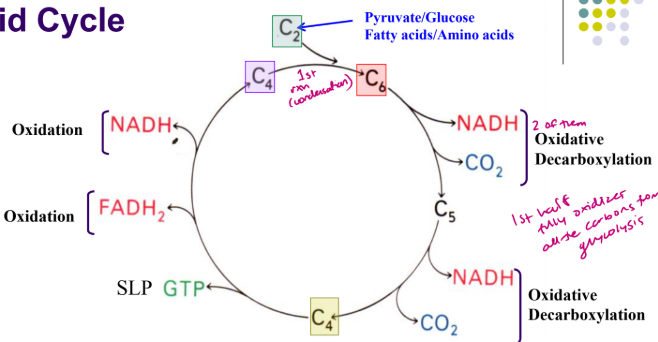
acetyl-CoA (C2) condenses with oxaloacetate (C4) to make citrate (C6)
two carbons are “lost” as CO2
oxaloacetate is regenerated
3 NADH (2.5), 1 FADH2 (1.5) and 1 GTP are made - from one cycle you make 10 ATP’s for one acetyl CoA
theres 5 energy capture steps
what are the reaction in the CAC and the enzymes involved
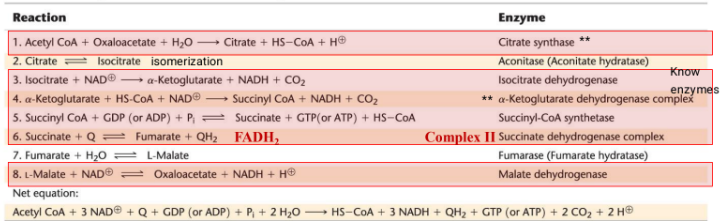
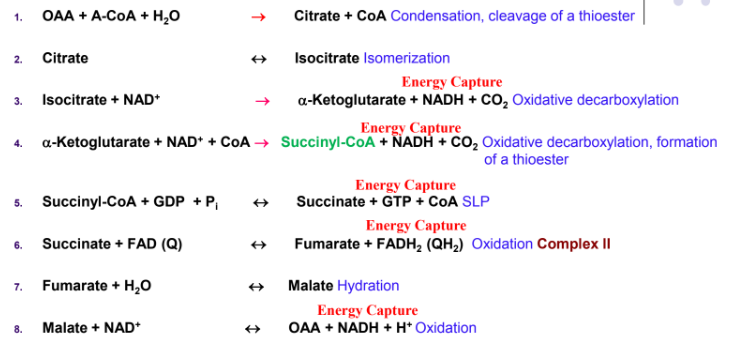
Regulated reactions - 134 bc of arrow
How many energy capture steps? 34568
ENZYMES IN RED MEMORIZE - know structure of products and reactants
why do we need to add water as the first step in CAC
Add water to ensure its a net exergonic rxn and couple it to the energy of the thioester bond
- exergonic and anabolic
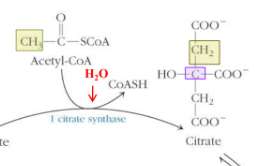
what reaction is coupled in the first step
Step 1: OAA + A-CoA → Citroyl-CoA
Step 2: Citroyl-CoA + H2O → Citrate + HSCoA
step 2 pulls reaction forward
Hydrolysis of thioester makes the citrate synthase reaction exergonic
irriversible
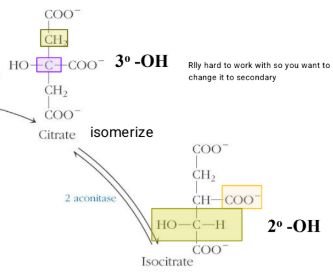
what is the second step of CAC
the isomerization of citrate a tertiary alcohol to isocitrate a secondary alcohol
two part process where citrate loses H20 and its added back differently
reversible
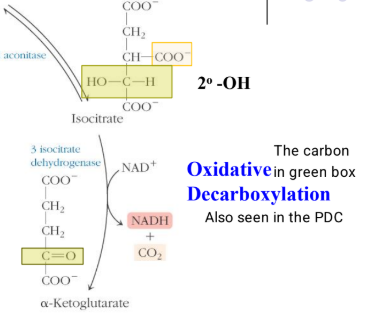
what is the third step in the CAC
with the enzyme isocitrate dehydrogenase
its the first oxidative decarboxylation (also seen in the PDC), its regulated, irriversible, and an energy capture stage because NAD+ is reduced to NADH
carbon dioxide is also produced as well as alpha-ketoglutarate with a carbonyl ketone
takes isocitrate and NAD+ to make NADK, CO2, and alpha-ketoglutarate
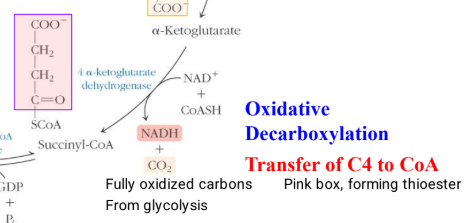
what is the fourth reaction of the CAC
regulated with enzyme alpha-ketoglutarate dehydrogenase complex
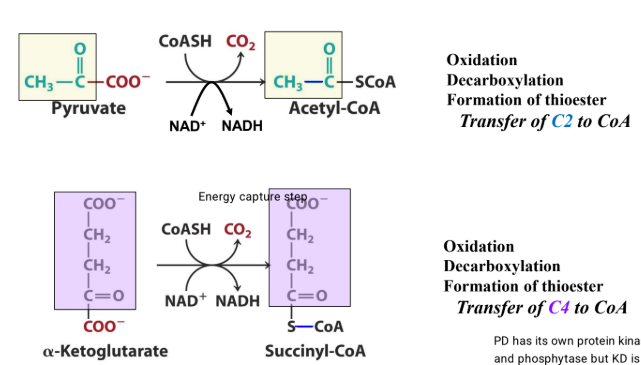
the second oxidative decarboxylation step, transfer of C4 to CoA and forms a thioester high energy bond
now all tthe carbons from glycolysis are fully oxidized
take alpha-ketoglutarate, NAD+ and CoASH (coenzyme A that has acyl group and the sulfur part is reactive) to make NADH, CO2, and succinyl-CoA
energy capture step, irriverisble
what is the difference of pyruvate dehydrogenase and alpha-ketoglutarate dehydrogenase
The only major difference is seen with regulation of the two complexes.
PD has its own protein kinase and phosphytase but KD is allosterically regulated
what is the fifth reaction of CAC
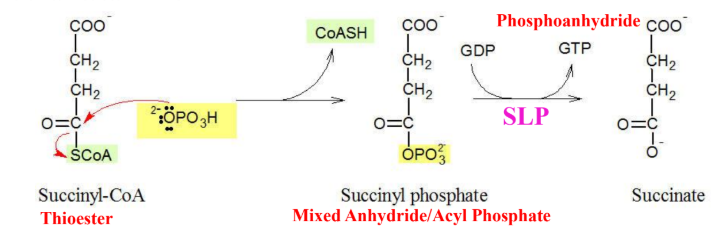
regulated by enzyme succinyl-CoA synthetase
the energy stores in the thioester bond drives the formation of GTP
its a substrate level phosphorylation, and an energy capture step, reversible
takes succinyl-CoA, GDP, and inorganic phosphate to make succinate, GTP, and CoASH
what are the intermediate in reaction 5
what is the difference between an enzyme synthase and synthetase
synthetase means that theres an NTP involved
what do the last three reactions in the CAC do
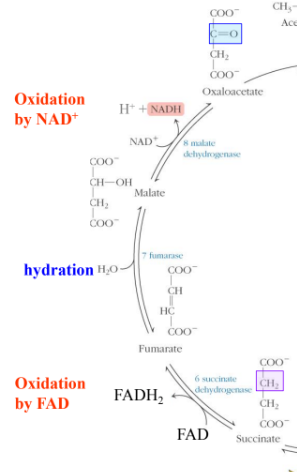
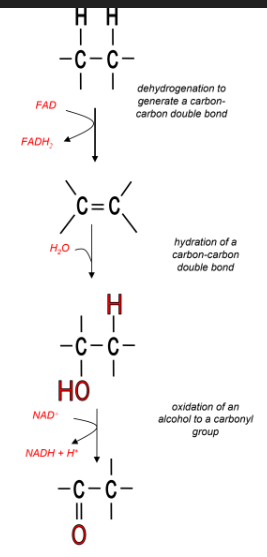
The last three reactions convert a methylene group of succinate to a carbonyl group in OAA
rxn 6 = succinate and FAD turns into FADH2 and fumarate with the enzyme succinate dehydrogenase complex (oxidation by FAD), energy capture, reversible
rxn 7 = fumarate goes through hydrating and makes malate, water added accross double bond, reversible
rxn 8 = takes malate and NAD+ to make oxaloacetate, NADH, and H+ ions with the enzyme malate dehydrogenase, reversible, energy capture (oxidation by NAD+)
what is the relationship between GTP and ATP
GTP + ADP → GDP + ATP
so 1GTP = 1ATP
can also be done with nucleotides
what does the sequence of the oxidation of fatty acids look like
what is the review of all the reactions in the CAC
how does the CAC connect to the ETC
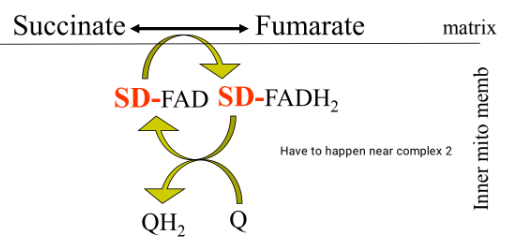
in reaction 6 when succinate turns fumarate with succinate dehydrogenase and the succunate is oxidized and loses electrons for FAD to accept them and become FADH2 this happens in the matrix then the FADH2 is in the inner mitochondrial membrane to go through complex 2
➢FADH2 is reoxidized by donating electrons to Q a mobile electron carrier, (also called ubiqunione or Coenzyme Q)
➢QH2 is reoxidized by Complex III in the electron transport chain (ETC)
➢Succinate dehydrogenase (SD) a membrane bound enzyme and is part of complex II in the ETC
see slide 19
what are the different inhibition and activations in the CAC
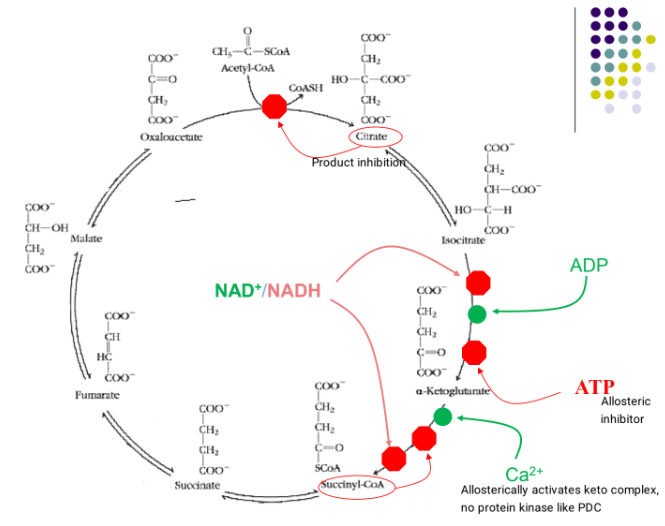
citrate product inhibits reaction 1
NADH inhibits reaction 3 and 4
ADP activates reaction 3 when ATP allosterically inhibits it
succinyl-CoA product inhibits reaxtion 4 where Ca2+ allosterically activates the keto complex
match the reaction numbers to the questions
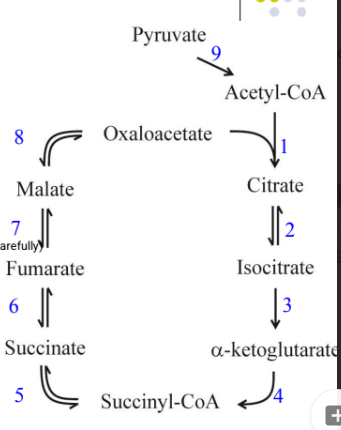
the reaction that links glycolysis with the CAC - rxn 9
the oxidative decarboxylation reactions - rxn 9, 3, 4
the irreversible (exergonic) reactions - rxn 1, 3, 4, 9
the “energy capture” steps; the reactions in which NADH, FADH2 or GTP are generated - rxn 3, 4, 5, 6, 8, 9
the reactions in which CO2 is produced - rxn 9, 3, 4
the regulated reactions - 9, 1, 3, 4
substrate level phosphorylation reaction - 5
oxidation reactions- 9, 3, 4, 6, 8
what reactions take place in the CAC and what do they do
Anaplerotic Reactions - to help keep in steady state
reactions that:
Replenish citric acid cycle intermediates.
Intermediates may be consumed in other processes.
Must be adequate intermediates to continue CAC.
Many reactions may be anaplerotic
Amino acid breakdown
Pyruvate carboxylase
what are two alternative fates for pyruvate
they can become acetyl-CoA with the PDH complex, lost of acetyl reduces the activity of PDH bc it activates kinase and with product inhibition
they can also become oxaloacetate and high amounts of acetyl-CoA activates this pathway
use oxaloacetate to power the CAC and oxidize acetyl-CoA from fats
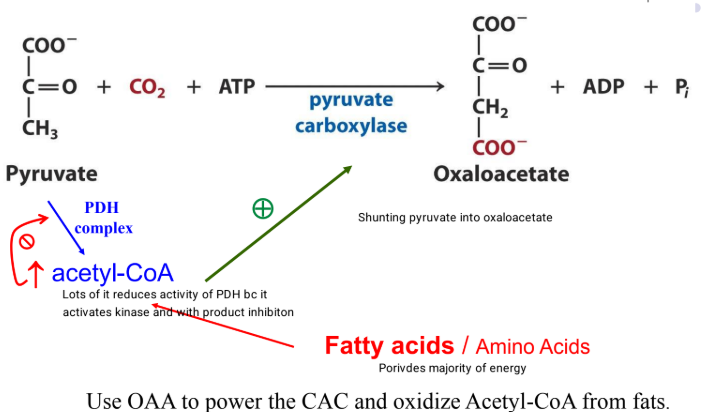
where do fats burn
fats burn in the flames of carbohydrates
cant primarily use fats for energy bc its so slow, so you need a balance of fatty acids and carbs
you need to breakdown carbohydrates at the same time
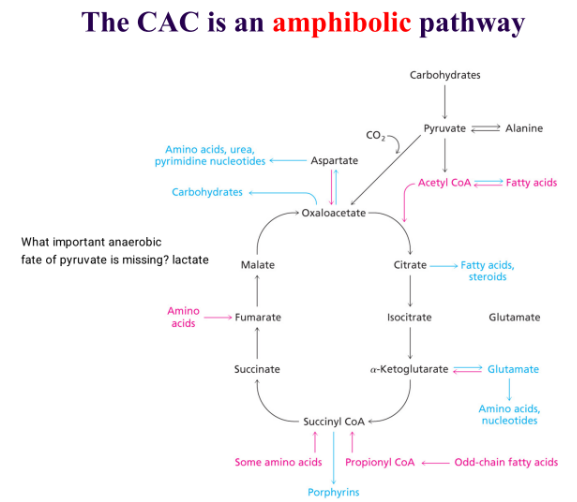
what are the functions of the CAC
Provide biosynthetic precursors
An important step in the generation of ATP for cellular needs
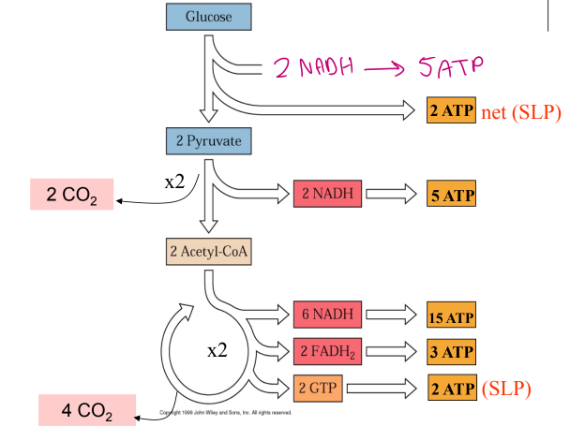
Each round of the CAC generates 10 ATP - theres 5 energy capture steps
complete aerobic oxidation of glucose yields a net of 32 ATP.
anaerobic glycolysis generates 2 ATP (net) from glucose and 3 ATP net from glycogen
what is the ATP yield from the completion oxidation of glucose under aerobic conditions
32 ATP
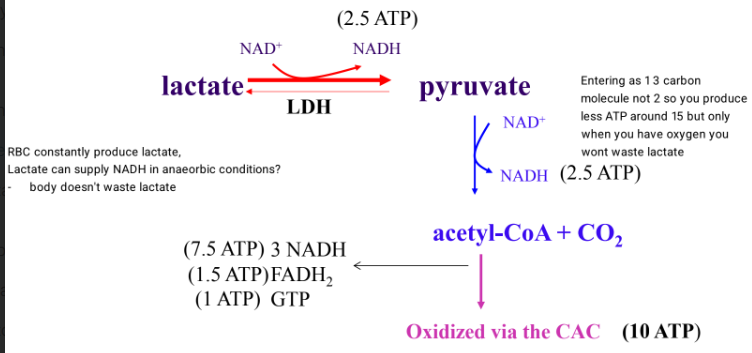
when is lactate used as a fuel
its a metabolic fuel in aerobic metabolism
oxidation of lactate generates 15 ATP
How much water is generated by the ETC from the oxidation of lactate?
6
The two e- from each NADH and FADH2 generates one water molecule via the ETC
water is the primary product of the ETC
How much water is generated by the ETC from the oxidation of glucose?
12 - everything happens twice
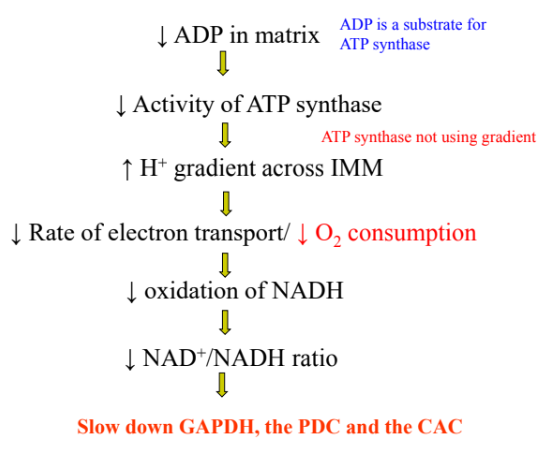
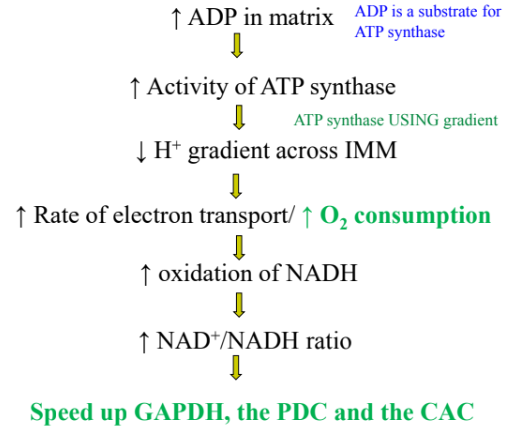
what is the major driving force in the regulation of aerobic metabolism
the relative concentration of ADP in the matrix
what happens when ADP decreases in the matrix
what happens when ADP increases in the matrix
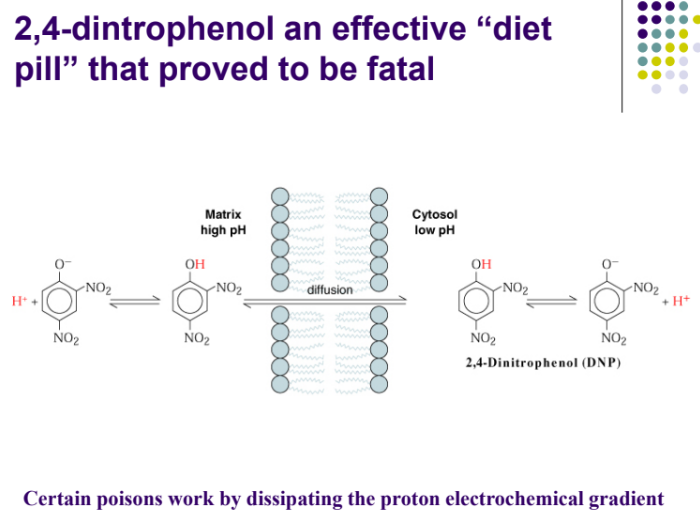
what increases in the presence of an uncoupler
oxygen consumption
•This refers to situations when electron transport occurs without/ reduced ATP synthesis (and thus, also, when catabolism of fuel molecules occurs without/reduced ATP synthesis).
•The proton gradient is then dissipated faster, and the rate of electron transport increases (O2 consumption goes up). The rate of re-oxidation of reduced electron carriers increases, and the rate of reactions in the CAC increases!
•Catabolic pathways are active as cell needs Energy
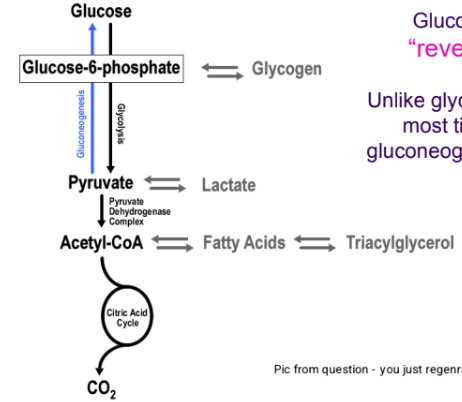
what is gluconeogenesis
Gluconeogenesis is the “reverse” of glycolysis. Unlike glycolysis, which occurs in most tissues (ubiquitous), gluconeogenesis occurs primarily in the liver.
is not endergonic