Chemistry RP1
 Call Kai
 Learn
Learn Practice Test
 Spaced Repetition
 Match
Match Flashcards
 Knowt Play
1/22

Earn XP
Description and Tags
Make up a volumetric solution and carry out a simple acid-base titration
Name | Mastery | Learn | Test | Matching | Spaced | Call with Kai | Chat |
|---|
No analytics yet
Send a link to your students to track their progress
23 Terms
What is a standard solution?
A solution of which you accurately know the concentration.
What is this?
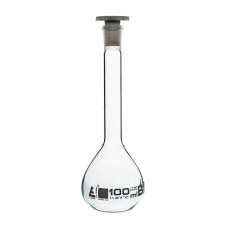
A volumetric flask.
What equipment do you need for making the standard solution?
Weighing boat (clean and dry)
Mass balance (accurate to 2/3 decimal places)
Spatula
Beaker
100 cm3 measuring cylinder
Glass rod
Funnel
250 cm3 volumetric flask
Stopper (for the volumetric flask)
What equipment do you need for carrying out the titration?
Safety filler pipette
Burette
Pipette
Conical flask
Burette stand
Talk me through how to make a standard solution.
1) Place the weighing boat on the mass balance.
2) Use a spatula to transfer the anhydrous solid to the weighing boat.
3) Re-weigh the boat containing the anhydrous solid, record this value.
4) Pour the anhydrous solid into a beaker.
5) Re-weigh the empty weighing boat, record this value.
6) Subtract the mass value of the empty weighing boat from the mass value of the weighing boat containing the anhydrous solid, this is the mass of the solid transferred to the beaker (weighing by difference method).
7) Measure out 100cm3 distilled water with a measuring cylinder.
8) Transfer the measured distilled water to the beaker containing the anhydrous solid.
9) Stir the contents of the beaker with a glass rod until all the solid has dissolved.
10) Transfer the contents of the beaker to the volumetric flask using a funnel to prevent spillage.
11) Fill up the rest of the volumetric flask with distilled water until it meets the 250cm3 graduation mark.
12) Place a stopper in the volumetric flask and invert it several times.
13) Label the volumetric flask with the name of the solution and it’s concentration.
How do you work out the concentration of the standard solution?
1) Divide the precise mass solid in the volumetric flask by the Mr of the anhydrous solid (found using periodic table) to work out the moles of solid in the volumetric flask (n = m / Mr).
2) Divide the moles of solid in the volumetric flask by the volume in the volumetric flask (250cm3 / 0.25dm3) to get the concentration of the standard solution ( c = n / v).
Talk me through how to carry out a titration with the standard solution.
1) Fill the burette with standard solution.
2) Pipette 25cm3 of the unknown concentration solution into a conical flask.
3) Add a suitable indicator to the conical flask containing the unknown concentration solution.
4) Titrate the solution in the conical flask with the standard solution.
5) Record the volume of standard solution needed to neutralise the solution in the conical flask for each titration.
REPEAT STEPS 4 AND 5 UNTIL YOU GET CONCORDANT RESULTS.
What are concordant results?
Results that are within 0.1 cm3 of each other.
What is the name of the solution of which you know the concentration in a titration?
Titrant.
What is the name of the solution of which you do not know the concentration in a titration?
Analyte.
What does titre mean?
The minimum volume of titrant required to reach the end point in a titration.
Talk me through how to calculate the concentration of the analyte from your mean titre value.
1) Write a balanced symbol equation for the reaction between the acid and the base.
2) Convert all units of volume into dm3.
3) Calculate the moles of titrant in the titre with, n = c v.
4) Work out the moles of analyte with the mole ratios from the balanced symbol equation.
5) Calculate the concentration of analyte with c = n / v.
True or false? When calculating mean titre, you include all obtained titre values.
False. WHEN CALCULATING MEAN TITRE, YOU ONLY INCLUDE CONCORDANT RESULTS.
Give three possible procedural errors you could make during this titration. How do you eliminate them?
Incorrect reading from the burette (ensure that the meniscus sits on the 0 cm3 line on the burette, made sure there were no air bubbles in the burette).
Uneven distribution of solid particles in standard solution (invert the volumetric flask several times).
Difficulty determining the end point (place white tile under conical flask to better see colour change).
Why do we use concordant results?
To eliminate the effect of random errors in titration results.
How do you choose an indicator for the reaction?
Choose an indicator that changes colour during the end point of the reaction.
What do you rinse the container that is going to contain the analyte with?
Rinse the conical flask with analyte, this avoids dilution contamination.
What do you rinse the container that is going to contain the standard solution with?
Distilled water, even if the titrant is diluted it doesn’t matter as the concentration of the analyte is what you want to find.
How do you calculate % uncertainty?
% uncertainty = ( uncertainty / reading) x 100
Give three safety precautions you should take.
Wear eye protection.
Immediately wash affected parts of spillage if there is one.
Treat unknown substances as potentially harmful and toxic by wearing gloves.
What is a non-hygroscopic substance?
A substance that does not absorb moisture from the air.
Why must the substance used to make a standard solution be stable, crystalline, and non-hygroscopic?
To ensure that the mass of the substance measured on the mass balance is true to the number of moles of substance in the standard solution, so that the concentration of the standard solution is accurate.
What is a meniscus?
The curve (dip) in the upper surface of a liquid inside a container/glassware.