B1.2 Proteins
 Call Kai
 Learn
Learn Practice Test
 Spaced Repetition
 Match
Match Flashcards
 Knowt Play
1/22

There's no tags or description
Looks like no tags are added yet.
Name | Mastery | Learn | Test | Matching | Spaced | Call with Kai |
|---|
No analytics yet
Send a link to your students to track their progress
23 Terms
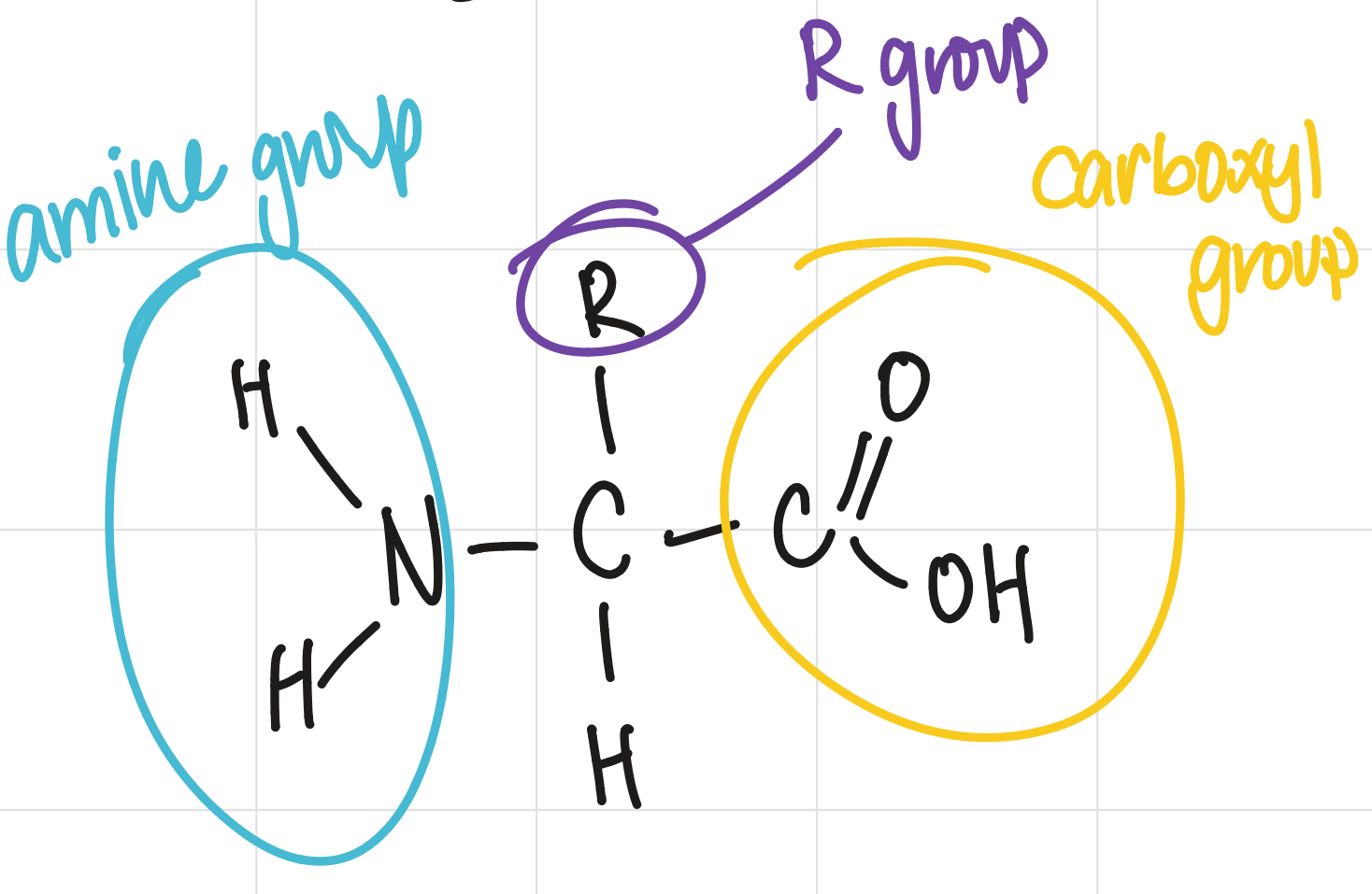
amino acid
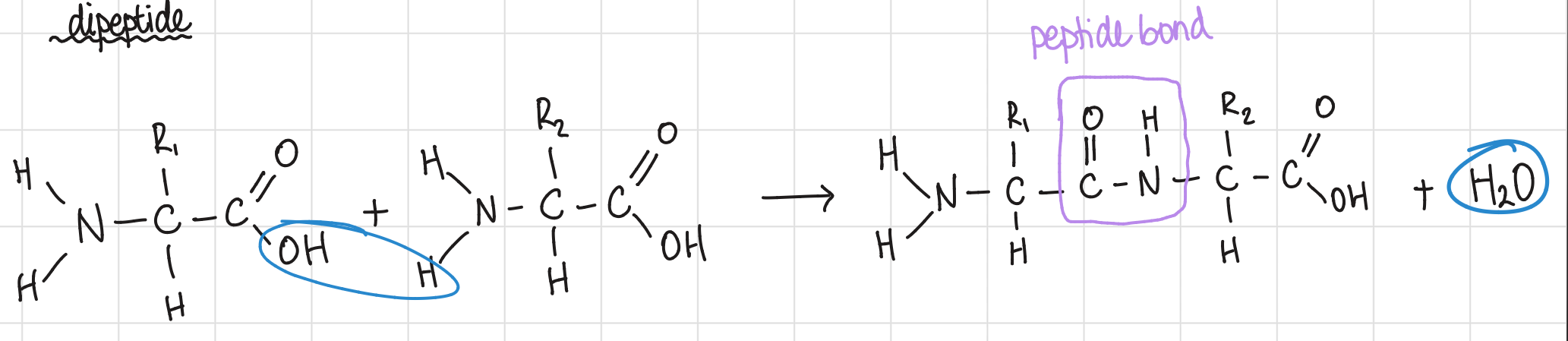
dipeptide formation
amino acid + amino acid → dipeptide + water
condensation reaction
dietary requirements for amino acids
there are 20 amino acids
9 essential amino acids, eaten from diet
11 non-essential amino acids can be made in liver
vegans must make sure they are consuming essential amino acids
R group
is different for each type of amino acid
20 types
R group with more carboxyl groups than amino groups is an acidic amino acid
R groups with more amino groups than carboxyl groups is a basic amino acid
non-polar R groups
from hydrophobic bonds (interactions) with each other or other hydrophobic molecules
found on the inside of most proteins but on outside of integral proteins in contact with fatty acid
at the active site of enzymes if the substate is non-polar
polar R group (hydrophilic)
form hydrogen bonds
found on the outside of proteins in contact with water
are weak and broken by high temperatures
charged R groups (hydrophilic)
form ionic bonds (between positively and negatively charged R groups)
amine and carboxyl groups in R groups can become charged by binding/disassociation of H+ ions to participate in ionic bonding
bonds broken by changes in pH (change the charge on the R group)
R groups containing sulphur
cysteins form disulphide bridges which are covalent and therefore strong
each S is part of an R group on separate amino acids
broken by high temperature
polypeptides
amino acids joined together at ribosome to make polypeptide
any number of amino acids can be added to chain
20n possibilities
all proteins/polypeptides produced by an organism are known as the proteome
examples of polypeptides
insulin hormone - is made of two polypeptides, one of 21 amino acids, the other 30
titin - found in the muscle, has 34350 amino acids
lipase has 449
denaturation
a three dimensional change in protein as a result of bonds being broken by pH or temperature
primary structure
determines three dimensional shape
type and order of amino acids
amino acid sequence is coded for by genes
mistake in order can lead to change in the molecule’s shape
secondary structure
structure held in place by hydrogen bonds
alpha helix and beta pleated sheet
tertiary structure
the way in which the polypeptide is further twisted and folded to make a £D shape
held in place by bonds between R groups of the amino acids
include disulphide bridges, ionic bonds, hydrophobic interactions and hydrogen bonds
soluble proteins
protein is folded so that polar R groups face outwards and non polar R groups face inwards
hydrophobic amino acids are clustered in the core of globular proteins
quaternary structure
3D arrangement of two or more polypeptide chains joined together to form one functional protein
conjugated proteins
also have one or more non protein part (prosthetic group) of the molecule
globular proteins
usually have a metabolic function - all enzymes are globular
irregular, specific primary structure, folded into a very specific 3D shape
soluble
unstable (exposure to pH/temp changes results in denaturation)
haemoglobin molecule
quaternary - made from 4 polypeptides
conjugated protein - contains prosthetic group: contains 4 haem groups
oxygen bind to haem group, x4 increases its ability to carry oxygen
haemoglobin can change shape to aid the release/binding of oxygen
insulin
globular
quaternary - made from two polypeptides
non-conjugated protein (doesn’t contain prosthetic group)
binds to liver and muscle cells and causes them to take up glucose and convert it to insoluble glycogen
small sizes allow it o dissolve and be carried by blood plasma
fibrous proteins
structural proteins
repetitive sequences in primary structure
insoluble
stable
collagen
found in skin
strong, flexible and insoluble
quaternary - three polypeptides wound round each other
repeating amino acid sequence P-G-X
G = glycine - contains small R groups which faces inwards allowing chains to be tightly wound each other
P - proline, - stops alpha helix from forming to keep structure straight (no coils) and maintain stability
X varies, allows for different forms of collage in different tissues
collagen structure in relation to function
long and thin → allows it to provide structural support in skin and connective tissue
strength → chains closely bonded to provide structural support