W12: Social Isolation and Loneliness in Community-Dwelling Older Adults
 Call Kai
 Learn
Learn Practice Test
 Spaced Repetition
 Match
Match Flashcards
 Knowt Play
1/15

Earn XP
Description and Tags
Guest Lecture
Name | Mastery | Learn | Test | Matching | Spaced | Call with Kai |
|---|
No analytics yet
Send a link to your students to track their progress
16 Terms
what is loneliness?
· subjective emotional state of feeling isolated or alone
what is social isolation?
· objective measure of being alone
what did a pre-pandemic study find on loneliness and social isolation?
· Pre-pandemic CLSA cross-sectional study: 10.8% lonely and 16.2% socially isolated
why are loneliness and social isolation factors of consideration for older adults?
· Older adults face risks of loneliness and social isolation through age-related changes (e.g., retirement, death of loved ones)
· Home care recipients are vulnerable due to complex health needs and demographics
· Medically complex community-dwelling older adults are prone to health complications
· Oder adults reporting chronic loneliness also reported more visits to the doctor and hospitals, more contact with community nurses, and greater hospitalizations
what are the general health impacts of being lonely?
· Loneliness is associated with lower health status across a variety of domains and higher possibility of mortality
· Loneliness may represent a point in a pathway through which risk factors interact and influence health
· Health behaviors associated with loneliness are less physical activity, increased alcohol consumption, unhealthy diet, and smoking
o May explain observed health outcomes: lack of social network, mental health concerns
what is the stress buffering hypothesis?
the mitigation of stress and its effects that may occur is dependent on the degree of social support
what were the areas of focus for this research?
1) Improve processes for identifying socially isolated and lonely individuals
2) Expanded identification and understanding of needs among vulnerable older adults
3) Recommendations for interventions tailored to available community resources and organizations
4) Strategies to increase utilization and provision of community-based programs and resources
what were the methods involved in this study?
· The initial needs assessment was conducted on a comprehensive dataset of approximately 500,000 interRAI Home Care assessments
· Retrospective secondary data analysis of interRAI Home Care clients in the Huron and Perth regions in comparison to the rest of Ontario
· Further analyses included use of the interRAI Home Care and the InterRAI Check-up Self-report assessments from both the Huron and Perth regions and Ontario-level data
· All datasets utilized are standardized and comprehensive evaluations that include a range of domains such as cognitive function, physical health, social supports, mental health, and a variety of clinical assessment protocols and validated scales
what did the figures find?
Figure 1
· Forward sortation areas (FSA) by sex revealed a 60-40 sex split in the population (60 for women)
Figure 2
· Nearly 85-90% of the population were above the age of 64
Figure 3
· Initial needs assessment showed that the prevalence of loneliness is doubled in Listowel than any other FSA
what is a resource inventory and how does that relate to this study?
· Looking at whether loneliness is due to a lack of resources, and assumption is no based on the number of resources, so the issue may be more of access or lack of knowledge of services
· Includes resources that are explicitly designed for the purpose of reducing loneliness and those that indirectly address this concern
o E.g., Meals on Wheels has the potential for social interaction; doesn’t necessarily mean that there is a connection there
what was the goal of the scoping review done?
· To understand the interventions available for community-dwelling older adults aiming at reducing social isolation and loneliness in the literature
o Excluded those living in care homes, primary care, qualitative data
what did the figure from the scoping review find?
· Isolation typologies: lonely, isolated, both, neither
what were the social isolation index variants?
· Original Home Care Assessment
o Sum of six items on marital status, living arrangement, length of day spent alone, change in social activities, relationship with family, presence of informal helper
· Shortened Check-up Self-report Assessment
o Sum of three items on marital status, living arrangement, and change in social activities
what was the intervention implementation?
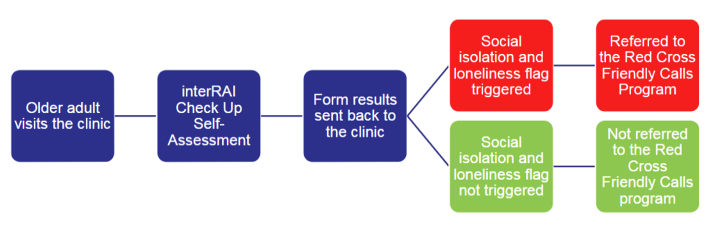
what were the key insights from this study?
1) Need for a centralized and supported approach to coordination
2) Created a foundation for a coordinated and evidence-based response
3) Operationalization of loneliness and social isolation may increase quality of life
4) Contributions to capacity-building at the local level in Huron-Perth
5) Established a targeted mechanism for social isolation and loneliness
what are the main research priorities?
Better care
· Transform the home and primary care provided to community-dwelling older adults
· interRAI assessments can be used to identify clinical indicators and highlight areas in need of focus
· Lonely and socially isolated individuals can be flagged and referred to community supports
· Alleviate pressure and create more space in primary care for urgent matters
More connected
· Transform the healthcare system through integrated care and data in the service of learning and driving improvements in the clinical, organization, and system levels
· interRAI assessments provide an integrated network of assessments throughout the continuum of care
· Connecting individuals with community supports, resources, and other members