7 DNA Mutation & Repair
 Call Kai
 Learn
Learn Practice Test
 Spaced Repetition
 Match
Match Flashcards
 Knowt Play
1/39

There's no tags or description
Looks like no tags are added yet.
Name | Mastery | Learn | Test | Matching | Spaced | Call with Kai |
|---|
No analytics yet
Send a link to your students to track their progress
40 Terms
aim
investigates how UV-C irradiation affects yeast DNA
strains used
D02 wild-type - has functional RAD9
D02-Δrad9/Δrad9 - RAD9 deleted from both copies
both strands are diploid
what does this practical measure
Does deleting RAD9 affect yeast survival and mutation rate after UV-C damage?
after UV-c exposure:
1. survival - how many cells survive UV irradiation and form colonies
2. mutation - how many cells survive UV irradiation and form colonies
why is yeast used
- easy to grow
- cheap to culture
- eukaryotic, like human cells
- able to exist as haploid or diploid cells
- useful for studying cell cycle control and DNA repair
- cell cycle only takes 50 mins, fast enough to study cell division experimentally
what wavelength is UV-C
290-180nm
why does UV-C damage DNA
The main damage caused by pyrimidine dimers
- happens when two adjacent pyrimidines on the same DNA strand become covalently bonded. I.e TT, CC and TC
- These dimers distort the DNA double helix and block normal DNA replication.
how does DNA repair itself in yeast
1. photoreactivation
2. excision repair
3. error prone repair
4. recombinational repair
1. photoreactivation
repairs pyrimidine dimers using light.
photolyase uses light energy to break apart the pyrimidine dimer.
2. Excision repair
This removes the damaged section of DNA and replaces it.
1. Damage is recognised.
2. DNA is cut around the damaged region.
3. The damaged piece is removed.
4. DNA polymerase fills the gap using the other strand as a template.
5. DNA ligase seals the nick.
3. Error-prone repair
This is a less accurate repair process.
Sometimes the cell has to repair DNA even when the correct template is unclear.
This can save the cell, but can introduce mistakes . RAD18 involved in this
recombinational repair
used when DNA replication is blocked by damage and leaves a gap.
repairs the missing information by using another similar DNA molecule or chromosome as a template.
RAD51 important as helps DNA molecules find similar partner sequences and begin recombination.
checkpoint
A checkpoint is a surveillance system in the cell cycle.
It checks whether the cell is ready to move to the next stage.
A checkpoint can stop the cell cycle if:
- DNA is damaged
- DNA replication is incomplete
- mitosis has not completed properly
- the spindle is faulty
RAD9
a DNA damage checkpoint gene.
Rad9p is involved in:
- recognising DNA damage
- helping DNA repair
- activating downstream checkpoint signalling
- stopping the cell cycle at G2 if DNA is damaged
- can activate RAD53 which is also needed for G2 arrest after DNA damage
What happens if RAD9 is deleted
So after DNA damage:
- cells do not arrest properly at G2
- they continue into M phase
- DNA may not be repaired before division
- this can reduce survival
- this can increase mutation frequency
therefore more sensitive to UV-C than wild type
ADE2 and red colonies
ADE2/ade2
one working ADE2 allele and one mutant ade2 allele = white colonies
ade2/ade2
A red colony indicates mutation affecting the remaining functional ADE2 copy.
why does the red colony appear
The red colour happens because if the adenine biosynthesis pathway is blocked around the ADE2 step, a compound called AIR accumulates and is oxidised to form a red pigment.
main experiment idea
You expose yeast cells to different UV-C doses:
0 J m⁻²
30 J m⁻²
60 J m⁻²
90 J m⁻²
Then you count:
total colonies
- tells you survival
red or red-sector colonies
- tells you mutation at the ADE2 locus
Then you compare wild-type and rad9 mutant yeast.
step 1
1. place a yeast suspension onto a haemocytometer and count cells under a microscope.
counting rules
count cells touching the top or left boundary lines
do not count cells touching the bottom or right boundary lines
what if the culture is too concentrated
dilute the culture first.
needs to be 20-200 cells per large square
dilute 1:10 and record dilution factor
equation for haemocytometer calculation
cells/ml = average cells per large square × 10 × 1000 × dilution factor
how to calculate cell density
original cell density = calculated cell density × dilution factor
1. count total cells in 4 large squares (in 0.4 mm³)
2. divide by 4 = average cells in 0.1 mm³
3. x10 to give cells per 1.0 mm³
4. x1000 to give cells per ml
5. if you diluted before counting x dilution factor
2. Dilute yeast culture to the target density
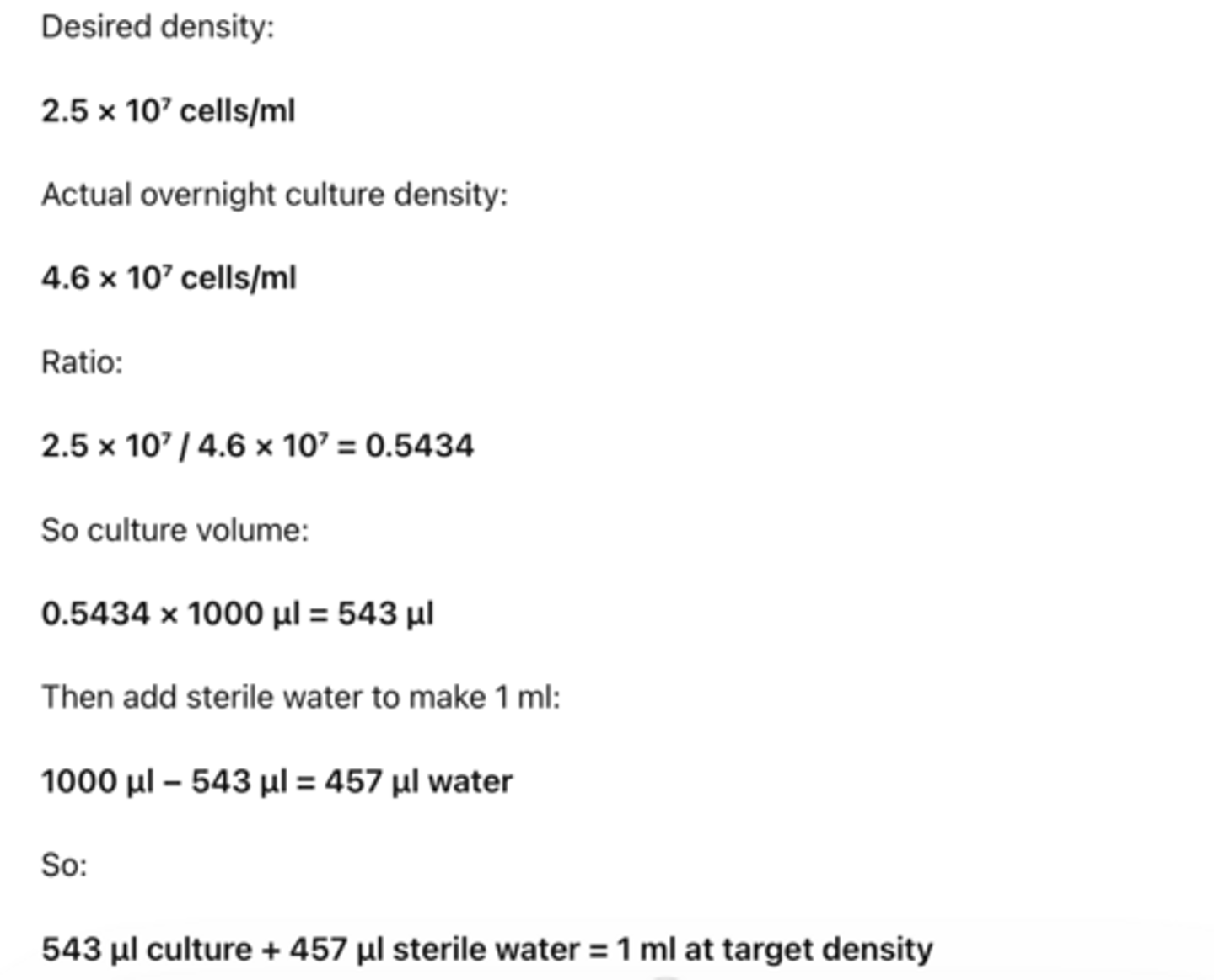
goal is 500 cells per plate
plating volume is 200 µl
so final yeast suspension needs to contain 500 cells per 200 µl = 2.5 × 10³ cells/ml
How to calculate how much culture to add
volume of culture needed = desired density / actual density × 1000 µl
3. make a 10-fold dilution seires
100 µl sample + 900 µl sterile water
10⁻¹ dilution
4. plate yeast cells on YED plates
add 200 µl of diluted yeast suspension onto each YED plate.
spread
4. irradiation with different UV-C doses
control = 0J m⁻²
low UV = 30J m⁻²
medium UV = 60J m⁻²
high UV = 90J m⁻²
in session 2 what are the steps
1. Count total colonies on each plate.
2. Count red colonies or red sectors.
3. Record results for each UV dose.
4. Calculate percentage survival.
5. Calculate percentage mutants.
6. Plot survival and mutation graphs.
7. Compare wild-type and rad9 mutant yeast.
What a fully red colony means
A fully red colony may come from a cell where mutation happened before colony growth began.
So all cells in the colony inherited the ade2/ade2 mutant genotype.
What a sectored colony means
both white and red areas.
This suggests the mutation happened after some cell divisions, not at the very beginning. for example
- a white cell starts forming a colony
- during colony growth, one descendant cell gets an ADE2 mutation
- descendants of that mutant cell form a red sector
- the rest of the colony remains white
why are red colonies often smaller
because ade2 mutants cannot make adenine properly.
They require adenine in the growth medium and may grow less efficiently than ADE2 cells.
why do we look fo unusual colony shapes and not just colour
Mutations in many genes can affect colony morphology, not just ADE2.
uv-c van cause other visible phenotypes
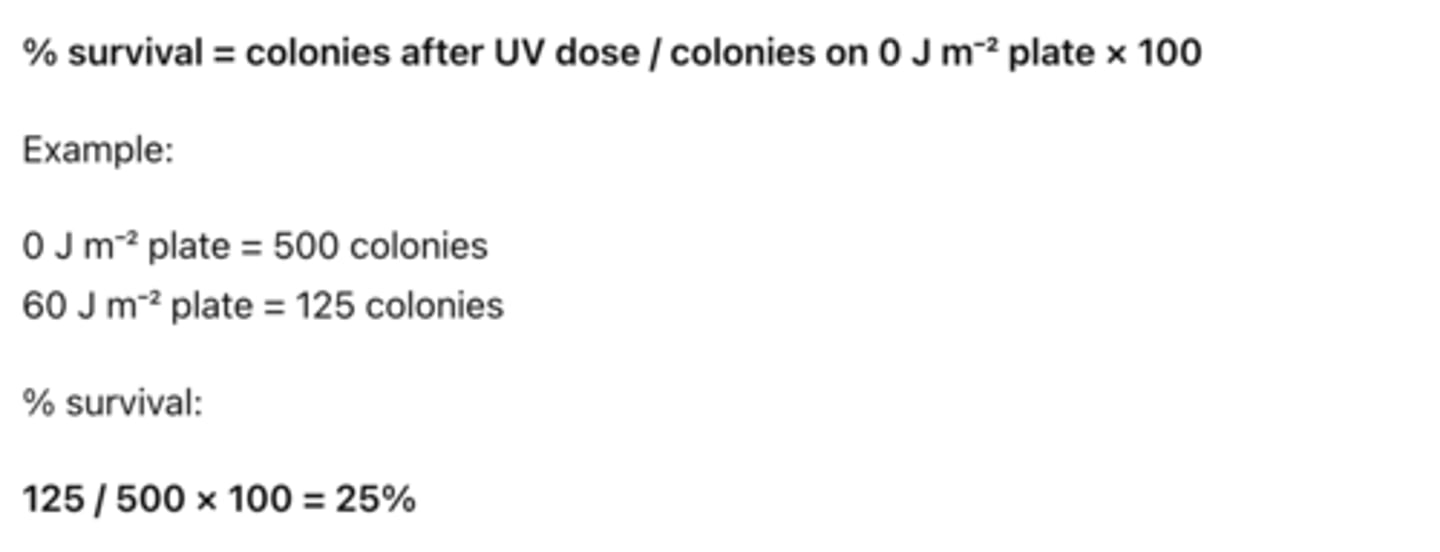
percentage survival equation
% survival = colonies after UV dose / colonies on 0 J m⁻² plate × 100
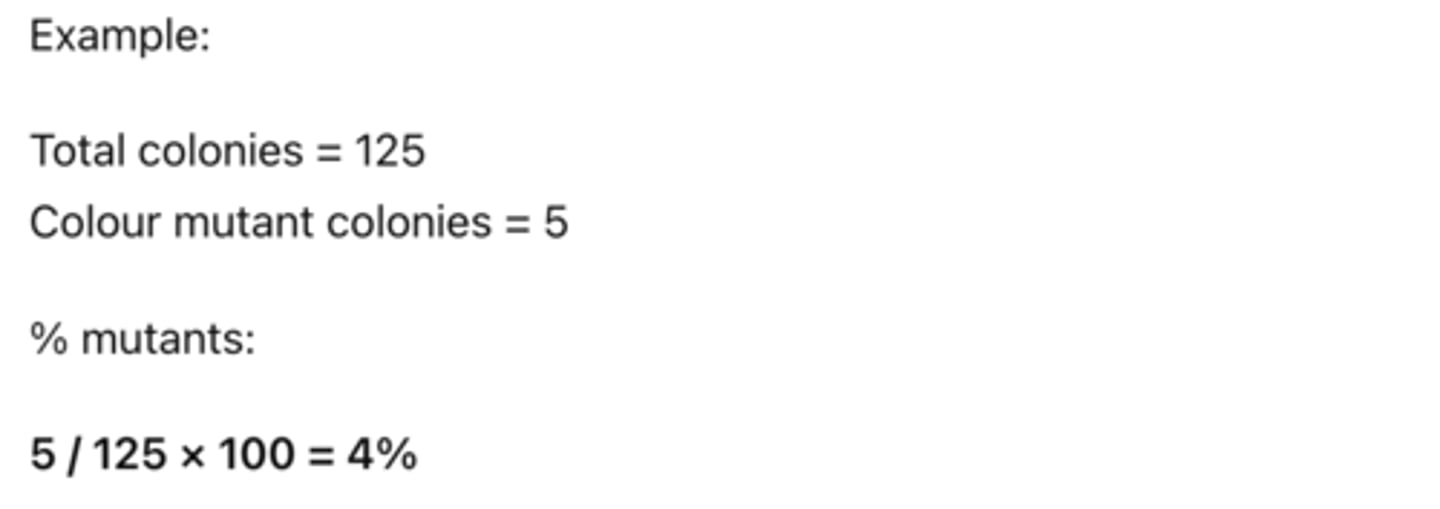
percentage mutants equation
% mutants = colour mutant colonies / total colonies on that plate × 100
Graph 1: survival curve
Plot % survival on y-axis
against:
UV-C dose on x-axis
expected shape:
survival decreases as UV-C dose increases
rad9 mutant likely decreases more steeply than wild-type
Graph 2: mutation frequency
Plot: % mutants on y-axis
against:
UV-C dose on x-axis
Expected trend:
mutation frequency may increase with UV-C dose
rad9 mutants may show more red mutants because damaged DNA is not properly checkpointed/repaired before division
why diploidity matters
Both strains are diploid and heterozygous:
ADE2/ade2
Because they have one functional ADE2 copy, they are white.
To become red, they need loss or mutation of the functional ADE2 copy so the genotype behaves like:
ade2/ade2
This makes red mutants rarer than if you were working with haploid ade2 cells
Expected comparison: wild-type
- better survival after UV-C
- lower mutation frequency
- functional RAD9
- checkpoint allows G2
- arrest and repair
Expected comparison: D02-Δrad9/Δrad9
- lower survival after UV-C
- higher mutation frequency among survivors
- no functional Rad9p
- cells continue into mitosis - despite damaged DNA
Lethal effects of radiation
can cause reproductive death
- the cell may frow but can't divide to form viable progeny
- if a cell can't form a colony, it's treated as not surviving