Edexcel IGCSE Poetry Anthology Texts - Search For My Tongue
 Call Kai
 Learn
Learn Practice Test
 Spaced Repetition
 Match
Match Flashcards
 Knowt Play
1/12

There's no tags or description
Looks like no tags are added yet.
Name | Mastery | Learn | Test | Matching | Spaced | Call with Kai |
|---|
No analytics yet
Send a link to your students to track their progress
13 Terms
General notes/themes about poem
- Sujata Bhatt talks about her experiences of immigrating to the US, and what it is like living in a country in which her mother tongue (Gujarati) is not spoken
- Themes: Identity; language; cultural heritage ; immigration
Structure of Poem
- Free verse: Lack of rhyme makes the poem seem more conversational/serious, and lack of meter emphasises uncertainty
- Three stanzas, the middle stanza written in Gujarati, visualising her mother tongue flooding back, and the third stanza being a translation of the stanza prior
Search For My Tongue [Title]
- Search referring to a desire to recover Bhatt's identity
- Tongue relating to language
You ask me what I mean
by saying I have lost my tongue. [stanza one]
- Emphatic position of 'you' - direct address to the reader, engaging the reader - confrontational/accusatory tone
- 'Lost my tongue' - idiom (a phrase that is commonplace in one language but may make no sense if translated into another language) - she has not literally lost her tongue, but her ability to speak her native language. The use of the idiom in particular is interesting - those who don't know the idiom may not get what she is trying to say, mirroring her struggle of having to speak her foreign tongue all the time while her native language falters
I ask you, what would you do
if you had two tongues in your mouth,
- Again, direct address - inviting the reader to consider her situation by asking what the reader would do - proposing a hypothetical
- 'two tongues in your mouth' - metaphor, referring to being bilingual
and lost the first one, the mother tongue,
and could not really know the other,
the foreign tongue.
- Contrast between the tongue/language she is familiar with, and the tongue/language that feels unfamiliar and she feels alienated from.
- Bhatt fears not being able to speak any language because both are becoming unfamiliar
You could not use them both together
even if you thought that way.
And if you lived in a place you had to
speak a foreign tongue,
- Speaking these two languages in her experience have not gone together nicely; the languages are strangers to each other, not working in harmony
- Flipping the perspective - she is the one who was forced to adapt to an unknown environment, and inviting the reader to empathise with her, as if the reader was the one who was forced
your mother tongue would rot,
rot and die in your mouth
until you had to "spit it out".
- Lexical field of death, decay - there is a lack of nurture and is generally an unpleasant image.
- Many harsh consonant sounds + plosives - forceful, mirroring Bhatt's struggle
- 'spit it out' - monosyllabic, forceful + harsh - another idiom Bhatt has learnt from the foreign tongue. Significant that it is placed in " " - she does not resonate with the phrase? Unfamiliarity? A phrase other people around her may say but she doesn't?
I thought I spit it out
but overnight while I dream,
- volta/turning point - her mother tongue is about to flood back and she will feel reassured again
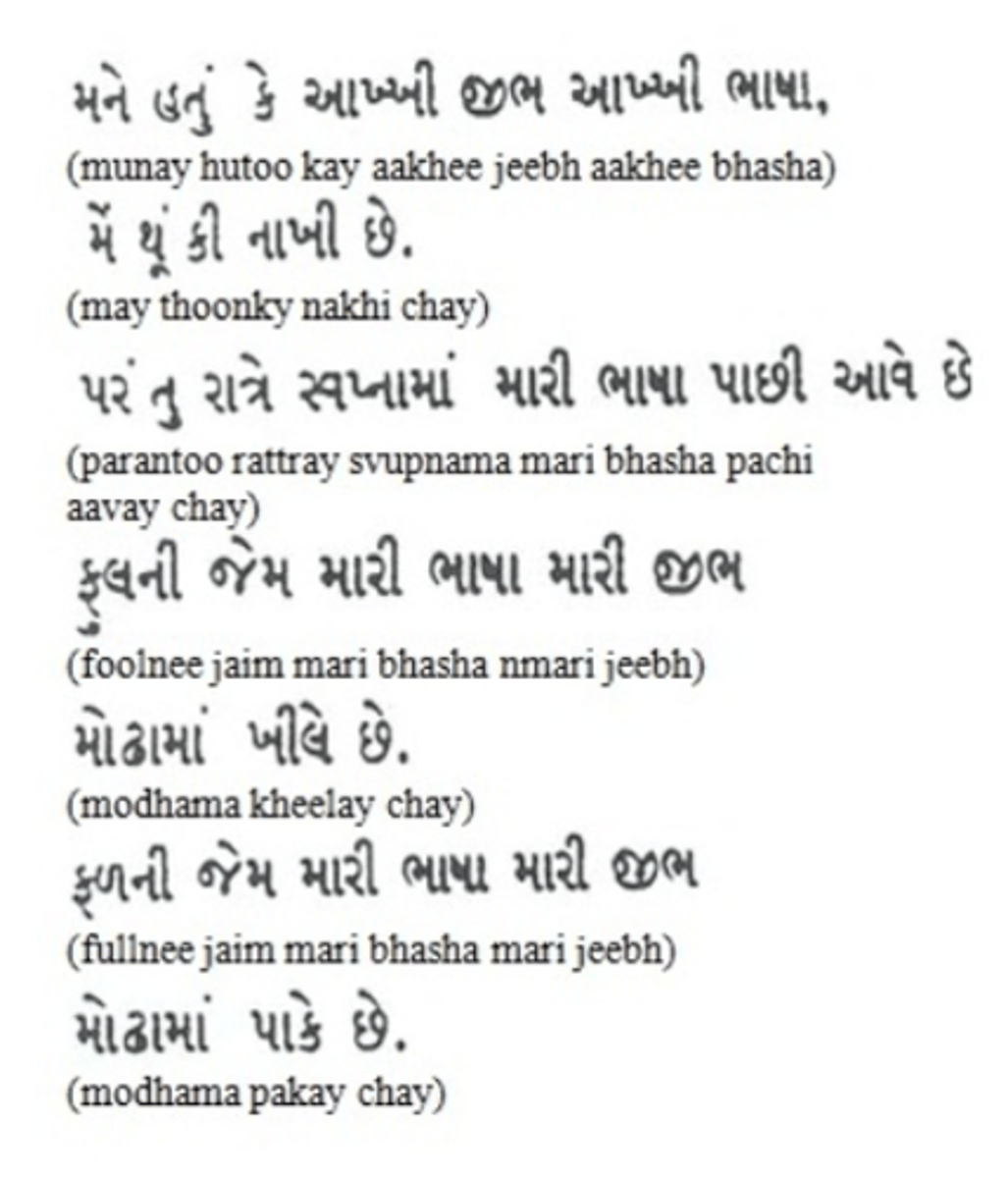
munay hutoo kay aakhee jeebh aakhee bhasha
may thoonky nakhi chay
parantoo rattray svupnama mari bhasha pachi aavay chay
foolnee jaim mari bhasha nmari jeebh
modhama kheelay chay
fullnee jaim mari bhasha mari jeebh
modhama pakay chay [stanza two]
- Gujarati script + anglicised pronunciation underneath
- Gujarati stanza in middle of poem - central - this is the language at her core
- She is sharing her uncomfortable experience with the reader, as the (target) reader cannot read Gujarati - we feel lost like Bhatt does - uncertainty
it grows back, a stump of a shoot,
grows longer, grows moist, grows strong veins, [stanza three]
- Throughout this stanza we will see anaphora of 'it' as her mother tongue begins to flourish in her sleep
- Lexical field of nature + growth, floral imagery of life in contrast to the previous stanza of death
- Listing + repitition of grows - cannot control the flooding of her mother tongue
it ties the other tongue in knots,
the bud opens, the bud opens in my mouth,
it pushes the other tongue aside.
- There is this triumphant tone present, as if the mother tongue has won over the foreign tongue, despite her thinking her mother tongue was lost previously + the foreign tongue has been silenced
Everytime I think I've forgotten,
I think I've lost the mother tongue,
it blossoms out of my mouth.
- Sense of doubt, but short lived as the poem ends on a positive note of celebration and relief