Issues and debates key terms
 Call Kai
 Learn
Learn Practice Test
 Spaced Repetition
 Match
Match Flashcards
 Knowt Play
1/32

There's no tags or description
Looks like no tags are added yet.
Name | Mastery | Learn | Test | Matching | Spaced | Call with Kai |
|---|
No analytics yet
Send a link to your students to track their progress
33 Terms
Universality
The assumption that all humans are the same in terms of psychological processes, so findings and theories can be applied to everyone regardless of gender or culture.
Universality occurs when behaviour is assumed to be true of all people, even when research may only have been conducted on a limited group.
Gender bias
A tendency for psychological research or theory to misrepresent, ignore, or distort the behaviour of men or women, leading to conclusions that are not equally valid for both genders.
Gender bias occurs when males or females are treated unfairly in psychological research, either because differences are exaggerated, minimised, or one gender is treated as the norm.
Gender bias is the differential treatment and/or representation of males and females, based on stereotypes and not on real differences.
Androcentrism
A form of gender bias in which male behaviour is taken as the standard or norm, and female behaviour is judged against this standard.
“Male-centred psychology.”
Example: Early research on stress focused on the male fight-or-flight response and treated that as the normal human response. This is androcentrism because male behaviour was taken as the norm.
Alpha bias
A type of gender bias that exaggerates the differences between males and females, often presenting the genders as fundamentally different.
Alpha bias tends to overstate gender differences, which can reinforce stereotypes and make one gender appear superior or inferior.
Example: Freud argued that women were more morally inferior than men because of penis envy. This is alpha bias because it exaggerates gender differences.
Freud argued that because girls do not suffer from the same opedius conflict as boys, they do not identify with their mothers as strongly as boys identify with their fathers, and so develop weak superegos.
Beta bias
A type of gender bias that minimises or ignores differences between males and females, often assuming that findings from males apply equally to females.
Beta bias occurs when researchers assume gender differences do not matter, leading to findings from one sex being generalised to both sexes.
Example: Research into stress responses (fight or flight) was based mostly on men, but the findings were generalised to women too. This is beta bias because gender differences were ignored or minimised. Later research found women have a ‘tend and befriend’ response
Cultural bias
The tendency to judge behaviour from the perspective of one’s own cultural assumptions and to assume that this view is correct or universal.
Cultural bias occurs when psychological theories, research methods, or findings are distorted by the assumptions and values of a particular culture.
E.g. Diagnosis of schizophrenia
Ethnocentrism
Judging other cultures using the standards, values, or norms of one’s own culture, often seeing one’s own culture as superior or more normal/correct.
It is a lack of awareness that other ways of seeing things can be as valid as one’s own
Example: Ainsworth’s Strange Situation judged attachment types using American values of independence, which may make other cultures seem abnormal. This is ethnocentrism.
Cultural relativism
The idea that behaviour can only be properly understood within the context of the culture in which it occurs, rather than being judged by the standards of another culture.
Cultural relativism argues that norms and values are culture-specific, so behaviour should be interpreted according to the social and cultural context in which it is found.
Says we cant generalise across cultures
Free will
The view that human behaviour is self-determined and that people are able to make conscious choices about their actions.
Free will suggests that individuals are active agents who can choose between alternatives and are therefore responsible for their behaviour.
Determinism
The view that behaviour is caused by internal or external forces and is therefore not under full conscious control. - free will is an illusion
Hard determinism
The belief that all behaviour is caused by forces beyond the individual’s control, so free will does not exist at all.
Hard determinism takes an extreme causal view, arguing that every action has a cause and that human choice is an illusion.
Soft determinism
The view that behaviour may be constrained by biological or environmental forces, but people still have some conscious choice within those limits.
“Choice exists, but within limits.”
Biological determinism
The idea that behaviour is innate, determined by biological factors such as genes, hormones, brain structure, or neurochemistry.
Biological determinism explains behaviour as the result of innate physiological processes, rather than conscious decision-making.
Environmental determinism
The idea that behaviour is determined by external influences, especially learning through conditioning, reinforcement, punishment, or experience.
“The environment shapes behaviour.”
Psychic determinism
The psychodynamic view that behaviour is determined by unconscious drives, conflicts, and early childhood experiences.
Psychic determinism suggests that even behaviour that appears accidental is caused by unconscious mental processes.
Example: Freud would argue that a slip of the tongue is not accidental but caused by unconscious thoughts or conflicts. This is psychic determinism.
Causal explanations
Explanations that identify the factors or variables that produce behaviour, based on the idea that behaviour has predictable causes.
Psychology’s scientific emphasis on causal explanations means it aims to explain behaviour in terms of cause and effect relationships that can be studied objectively.
Nature-nurture debate
One of the oldest debates in psychology which centres on the relative contributions of genetic inheritance and environmental factors to human development and behaviour.
Nature
The view that behaviour is influenced by innate factors, especially genes, heredity, biology, and maturation.
E.g. Gottesman and Shields (1991) found the chance of developing schizophrenia increases from 1% (general population) to 46% for those with two parents who have scizophrenia.
Nurture
The view that behaviour is shaped by environmental influences, such as upbringing, learning, experience, and culture.
Heredity
The genetic transmission of characteristics from parents to offspring, influencing traits and behaviour.
Heredity refers to the extent to which behaviour is influenced by inherited genetic factors.
Environment
All the external influences that affect development and behaviour, including family, education, life experiences, social interactions, and culture.
Interactionist approach
The view that behaviour is the result of an interaction between nature and nurture, rather than being caused by one alone.
The interactionist approach argues that biological predispositions and environmental experiences work together to shape behaviour.
Example: The diathesis-stress model suggests someone may inherit a vulnerability to depression, but only develop it after stressful life events. This is the interactionist approach because both nature and nurture are involved.
Holism
The view that behaviour should be understood by looking at the whole person or whole system, rather than breaking it down into separate parts.
Holism argues that behaviour is often more than the sum of its parts, so a complete explanation must consider the full context.
Human behaviour should be viewed as a whole integrated experience
Reductionism
The view that complex behaviour can be explained by breaking it down into simpler component parts.
“Explaining behaviour in smaller pieces.”
Example: A biological psychologist explains OCD only in terms of low serotonin levels.
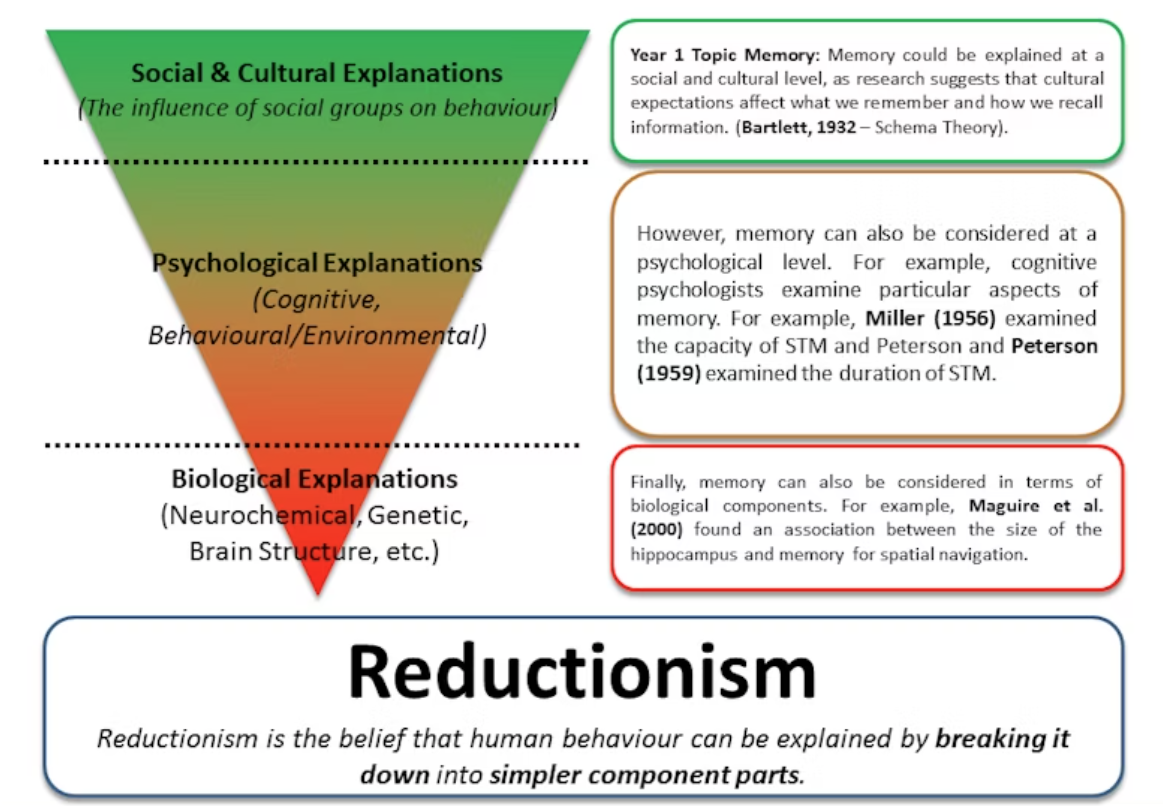
Levels of explanation (reductionist)
The idea that behaviour can be explained at different layers, such as the biological, cognitive, social, or environmental level.
Levels of explanation refer to the fact that the same behaviour may be explained in different ways depending on the degree of detail or the focus of analysis.
Lowest level = Physiological (biological) explanations, Middle level = psychological explanations (e.g. cognitive and behavioural), Highest level = social and cultural explanations (influence of social groups)
Example: Depression could be explained biologically through serotonin, cognitively through negative thinking, and socially through life stress. These are different levels of explanation.
Biological reductionism
Explaining behaviour in terms of physical and biological processes, such as genes, neurotransmitters, hormones, or brain structures.
Biological reductionism reduces complex human behaviour to lower-level biological mechanisms.
Example: Explaining criminal behaviour purely in terms of genes or brain abnormalities is biological reductionism.
Environmental reductionism
Explaining behaviour in terms of simple stimulus-response links, conditioning, reinforcement, and environmental learning histories. - Behaviour is shaped through experience/environment.
Example: A behaviourist explains phobias purely as a learned response through conditioning. This is environmental reductionism.
Stimulus-response reductionism
A form of environmental reductionism in which behaviour is explained as a response to an external stimulus, without considering internal thought processes.
This is the behaviourist view that all behaviour can be understood as learned associations between stimuli and responses.
Example: In the case of Little Albert, the child learns to fear the white rat after it is paired with a loud noise. This is stimulus-response reductionism because behaviour is explained as a learned association between stimulus and response.
Idiographic approach
An approach that focuses on the unique individual, aiming for an in-depth understanding of personal experience, often using qualitative methods or case studies.
The idiographic approach seeks to understand the rich complexity of individual behaviour, rather than producing general laws.
Favour qualitative research methods - case study, unstructured interview and thematic analysis
Example: Freud’s case study of Little Hans focused in depth on one child’s unique experiences. This is idiographic because it studies the individual in detail.
Nomothetic approach
An approach that aims to discover general laws or universal principles of behaviour by studying large groups and using standardised, scientific methods and statistical(quantitative) techniques to analyse data.
The nomothetic approach focuses on what people have in common, allowing predictions and generalisations to be made.
Ethical implications
The wider consequences that psychological research or theory may have for participants, groups, institutions, or society as a whole.
Ethical implications go beyond whether a study followed ethical guidelines; they concern the long-term effects and possible uses of psychological knowledge.
Example: Research showing how easily people obey authority, such as Milgram’s obedience study, has ethical implications because the findings could help society understand dangerous obedience — but could also be used to increase control over people.
Social sensitivity
The extent to which psychological research may affect the lives, rights, reputation, or treatment of individuals or social groups, especially if findings could be used to stigmatise or control them.
Research is socially sensitive when its findings have the potential to be misused, cause discrimination, or influence how certain groups are viewed or treated.
Example: Bowlby’s maternal deprivation theory was socially sensitive because it suggested that prolonged separation from the mother could harm children, which may have led some mothers to feel blamed or judged. This is social sensitivity because the research affects how a social group is viewed.
Four aspects of the scientific research that raise ethical implications in socially sensitive research (Identified by Seiber and Stanley 1998):
Four aspects of the scientific research that raise ethical implications in socially sensitive research:
The research question
The methodology
Institutional context
Interpretation and application of findings