3a - motion perception
 Call Kai
 Learn
Learn Practice Test
 Spaced Repetition
 Match
Match Flashcards
 Knowt Play
1/27

There's no tags or description
Looks like no tags are added yet.
Name | Mastery | Learn | Test | Matching | Spaced | Call with Kai |
|---|
No analytics yet
Send a link to your students to track their progress
28 Terms
why is motion perception important
important to understand that there are objects moving around us and us moving
how do we detect motion
cells in the V1 respond to lines and edges moving in a particular direction
what is motion after effect
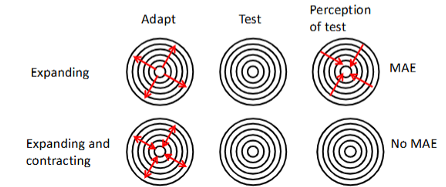
When viewing a stationary object 'up' and 'down', detectors fire equally.
Prolonged viewing of downward motion causes reduced firing of down detectors (adaptation)
Viewing a stationary object post-adaptation results in greater 'up' activation than 'down' hence we perceive upward motion
what is local motion
motion of individual (local) elements
what is global motion
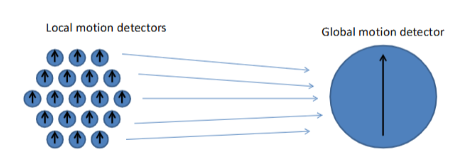
we can group the motion of many individual elements to percieve a complex pattern of glocal motion
how do we process global motion
we need to pool information from multiple motion detectors
what is motion coherence
motion coherence threshold is the minimum proportion of signal dots needed to detect coherent motion.
in humans this is about 10%, 5% when highly practised
depends on the proportion of signal to noise dots
whats the difference between local and global motion detectors?
local - small receptive fields
global - large receptive fields
which area of the brain is responsible for processing motion
Area MT (middle temporal)
how do we know MT is an important area for motion processing
nearly all cells in area MT respond to motion - and they have a preferred direction
what is artificial stimulation (Salzman et al 1990)
salzman et al 1990 indentified cells in monkey area MT that all had the same preferred direction
artificial stimulation of cells led to motion judgements being biased towards preferred direction (i.e. down)
what did tootell et al. (1995) find in fMRI imaging
when we adapt to motion, then view stationary test, we experience motion in the opposite direction.
(motion after effect)
lesion study on mt
Newsome and Pare (1988) introduced small lesion to monkey MT, undamaged coherence threshold was 5%, damaged was 80%
what is optic flow
patterns of retinal motion produced when we move
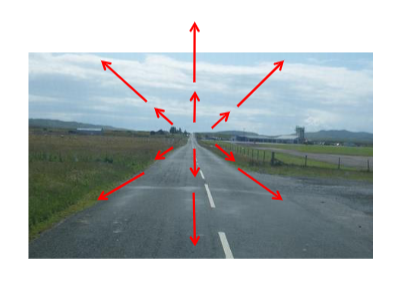
when is expansion in optic flow
created by forward translation (focus of expansion is the middle point you are moving towards)
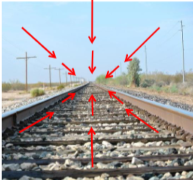
what is contraction in optic flow
created by backwards translation
what is horizontal optic flow (constant speed)
created by eye, head or body rotation. all objects move at same speed across retina regardless of depth
what is horizontal optic flow (parallax)
created by lateral translation, closer objects move faster on the retina that further away objects
what is a roll optic flow
created by eye, head or body flow
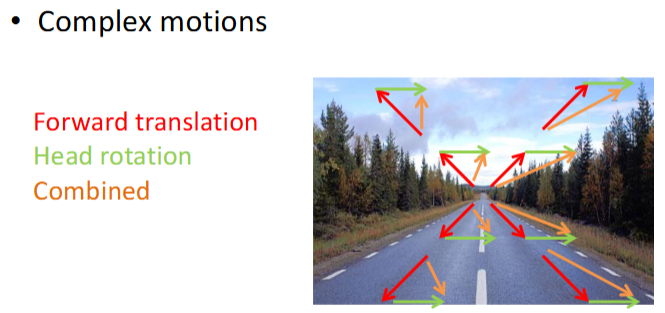
what are complex motions optic flow
multiple directions, e.g. forward translation and head rotation
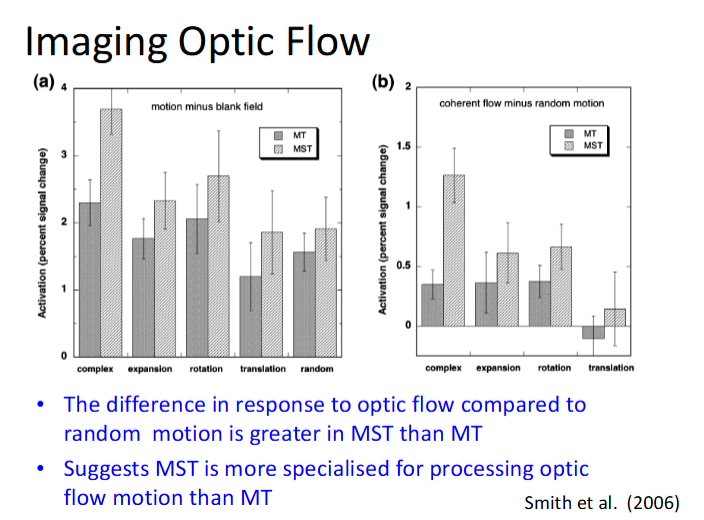
what did Duffy and Wurtz (1991) , & smithfind regarding gobal optic flow
found neurons that responded preferentially to global optic flow patterns - MT and MST
smith found that response from optic flow rather than random motion was greater in MST than MT
what is optic flow used for
Gibson - optic flow tells us where we are heading and to control locomotion
but land and lee note this isnt the only info we use and when we are driving we look at other parts of the scene
postural stability - balance relies on vestibular and proprioceptive information but visual information is also important
outline swinging room experiment Lee & Aronson
moving walls and ceiling but floors fixed, simulates optic flow that would be experienced by someone swaying
13-16 month old toddler pps, toddlers compensated by moving backwards - 26% swayed, 23% staggered and 33% fell over
adults also swayed, optic flow is an important source of information for balance
what are the 2 sources of object motion during self motion (warren and rushton)
self motion and object motion
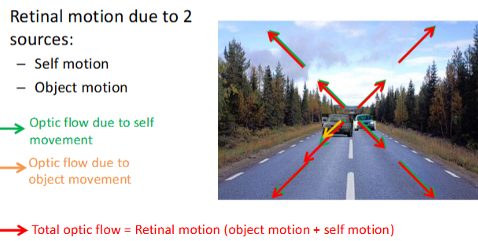
what is flow parsing
retinal motion due to self-motion subtracted
remaining motion attributed to object motion
warren and rushton (2009) showed that an optic flow field influenced the percieved trajectory of a moving object even when the flow was in a different part of the stimulus.
what is biological motion
the motion of another persons’ body creates a complex pattern of movement.
we appear to be particularly adept at percieving biological motion
point-light walker stimuli shows that we can percieve gender, identity and affect through movement
outline Grossman and Blakes fMRI study on biological vs scrambled motion
Area STS (superior temporal sulcus) more active for biological motion compared to scrampled
outline Grossman et al’s TMS experiment on biological motion
TMS to STS caused significant decrease in ability to distinguish bioloigcal motion from scrambled
tms to MT had no effect on biological motion perception
SO - biological motion is a special type of complex motion processed in the STS