Free Living Amoebas
 Call Kai
 Learn
Learn Practice Test
 Spaced Repetition
 Match
Match Flashcards
 Knowt Play
1/69

There's no tags or description
Looks like no tags are added yet.
Name | Mastery | Learn | Test | Matching | Spaced | Call with Kai |
|---|
No analytics yet
Send a link to your students to track their progress
70 Terms
What is the causative agent for Primary amoebic meningoencephalitis
Naegleria fowleri
What are the two causative agents for Granulomatous amoebic encephalitis?
Balamuthia mandrillaris and Acanthamoeba spp.
PAM is very _____ and _____, while GAE is _____ and more _____
fast; deadly; slower; chronic
What is the causative agent for keratitis?
Acanthamoeba spp.
What is the infectious stage for N. fowleri?
trophozoite
N. fowleri can transition between the _____ form, as well as a _____, and _____ form
cyst; trophozoite; flagellated
how is one infected with N. fowleri?
water up the nose
when N. fowleri trophozoites get up the nose, they travel to the _____ and cause _____
brain; PAM
What is the infectious stage for Acanthamboeba and B. mandrillaris?
trophozoites
how are humans infected with Acanthamoeba or B. mandrillaris?
respiratory tract or skin infection
Once humans are infected with Acanthamboema spp. or B. mandrillaris, they travel to the _____ and cause _____
brain; GAE
What type of water usually contains free-living ameba?
warm freshwater
N. fowleri cysts are common in _____ temperatures and _____ conditions
cooler; unfavorable
N. fowleri flagellates are most common in _____ concentrations and are _____ usually found in humans
low ion; NOT
N. fowleri trophozoites prefer _____ temperatues and can survive on _____ (ex. vivo) or _____ (in vivo)
warmer; bacteria; blood cells
What are the two forms of Amebic encephalitis?
Acute primary amebic meningoencephalitis (PAM) and Granulomatous amebic encephalitis (GAE)
What are the side effects associated with PAM?
severe headache/miningeal signs, fever, vomiting, neurological deficits
PAM can progress to _____ followed by _____ in about _____
coma; death; 10 days
PAM commonly occurs in _____ and _____ patients
children; young adults
PAM occurs in immuno-_____ individuals
COMPETENT!!!
All cases of PAM have a history of contact with contaminated _____
warm fresh water (Swimming/diving)
N. fowleri enter the brain via the _____ to cause PAM, and the disease is mostly _____
olfactory mucosa; fatal
PAM rates dramatically increase in the _____ months
summer
What is the causative agent for Granulomatous amebic encephalitis?
Acanthamoeba and Balamunthia spp.
What are the 3 main symptoms associated with GAE?
headaches; altered mental status, neurologic deficits
GAE symptoms progress over several _____ to death
WEEKS (slower moving than PAM)
GAE occurs primarily in immuno-_____ persons
SUPPRESSED
Acanthamoeba/Balamunthia spp. enter the brain by _____ spread from _____ or _____
hematogenous; respiratory tract; ulcerated skin
GAE can be _____, but is more commonly _____ to _____
fulminant; subacute; chronic
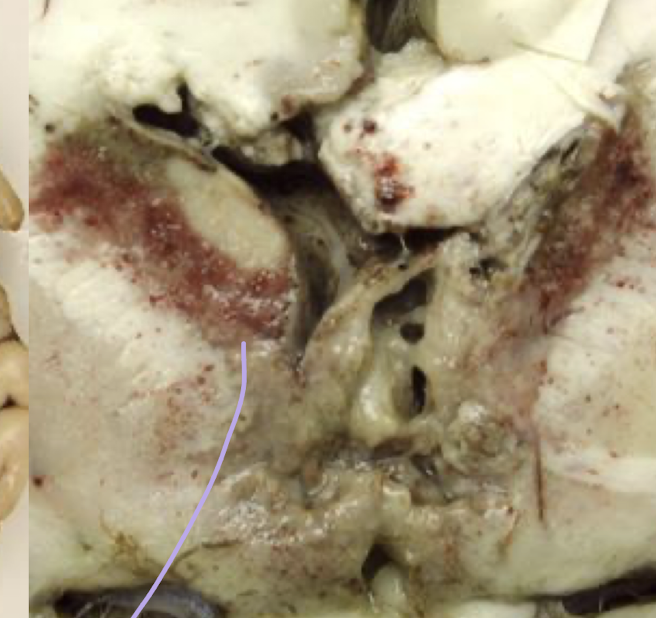
What condition is this?
GAE
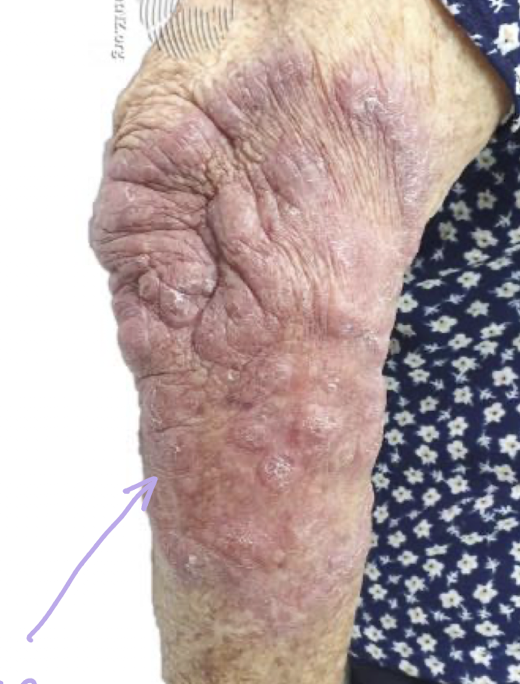
What condition is this?
Skin infection of Acanthamoeba/Balamunthia spp. → can progress to GAE!!!
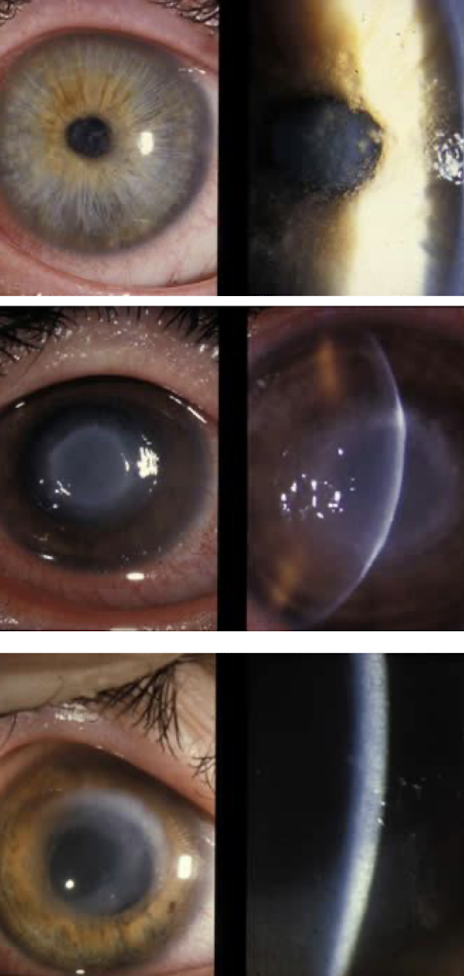
What condition is this? What parasite causes it?
Keratitis; Acanthamoeba spp.
Why is Naegleri fowleri so quickly to progress??
no cyst form in humans → Always on the go
about how big are N. fowleri trophozoites?
10-35um
What are the 3 main distinguishing features of N. fowleri?
granular vacuolated cytoplasm, single large nucleus, dense karyosome w/ NO peripheral chromatin
N. fowleri trophozoites are often associated with lots of _____
immune cells
How do you diagnose N. fowleri?
wet mount of CSF
N. fowleri is commonly diagnosed on _____
autopsy
How do you diagnose Acanthamoeba/Balamuthia?
microscopic exam of stained biopsies
what are the 3 most common biopsy locations for Acanthamoeba and Balamunthia infections?
brain, skin, cornea
Which organisms are there currently available molecular and IFA tests?
Acanthamoeba/Balamuthia
what type of molecular testing is done for Acanthamoeba/Balamuthia?
sequencing
What are the two most recognizable traits of Acanthamoeba spp. cysts?
staring, wrinkled outer wall and variable inner wall
how big are Acanthamoebe cysts?
10-25um
Acanthamoeba have no _____ trophozoite, unlike N. fowleri
flagellate
how big are Acanthamboeba spp. trophozoites?
15-45um
What is the defining feature of Acanamoeba trophozoites?
spine-like processes (acanthopodia)
What do B. mandrillaris cysts look like?
round, separate outer and inner wall
How big are B. mandrillaris cysts?
10-25um
how big are B. mandrillaris trophozoites?
15-60um
What is the defining feature of B. mandrillaris trophozoites?
long, seller pseudopodia
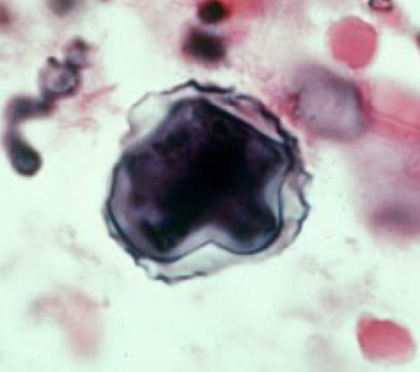
Which amoeba is this? What form?
Acanthamoeba spp. cyst
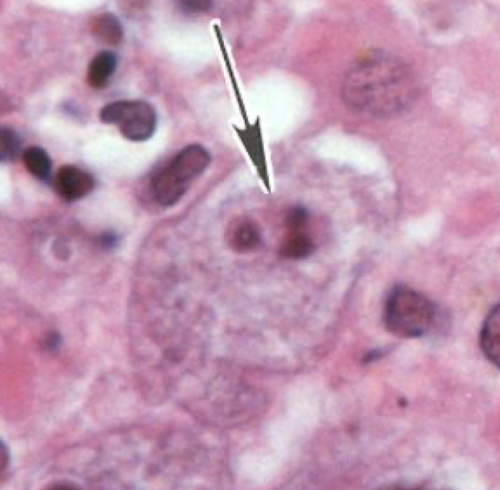
Which amoeba is this? What form?
B. mandrillaris trophozoite
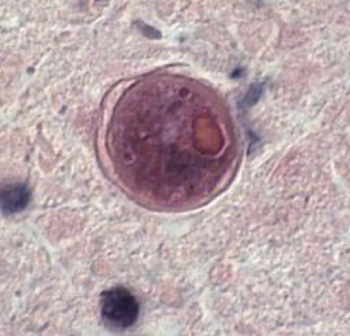
Which amoeba is this? What form?
B. mandrillaris cyst
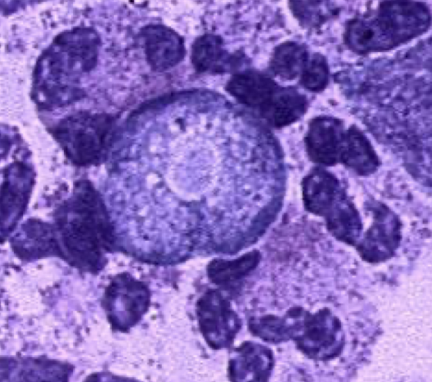
Which amoeba is this? What form?
N. fowleri, trophozoite
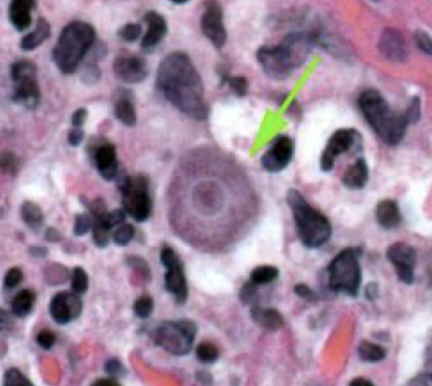
Which amoeba is this? What form?
Acanthamboeba spp. trophozoite
IFA assays are _____, but not _____
available; widely practiced
A _____ stain can be used to differentiate amoebas from macrophages
CD68 stain
Few patients typically survive _____ or _____ infections
N. fowleri; GAE
What is the typical treatment for N. fowleri?
LARGE doses of ampho B
Acanthamboeba and Balamuthia seem to be _____ to amphotericin B, but there are a few reported survivals with aggressive treatment using _____
resistant; pentamidine
Why are there not many treatment options for free living amoeba?
they are RARE → not a lot of opportunities to trial drugs
_____ and _____infections caused by Acanthamoeba infections are generally _____
eye; skin; treatable
What is used to treat Acanthamoeba spp. Keratinitis?
topic eyedrops or creams
Despite being incredibly dangerous, the risk of free living amoeba infection is _____
LOW
What is the causative agent for Keratitis?
Acanthamoeba spp.
Acanthamoeba causes painful _____ and _____ that follow corneal _____ or association with _____ use
keratitis; corneal ulcers; trauma; contact lens
True or False: Keratitis ONLY occurs in contact users, particular those with poor lens care practices
FALSE: non contact lens users and those with safe practices are STILL AT RISK
you have an increases risk of Acanthamoeba keratitis is you have _____ contact lens _____ and/or exposure to _____
poor; hygiene; contaminated water
There are some RARE cases of _____ of Acanthamoeba keratitis with _____ involvement, but it typically does NOT travel to the _____
dissemination; skin; brain