Physics SAC 1 - Light & Heat
 Call Kai
 Learn
Learn Practice Test
 Spaced Repetition
 Match
Match Flashcards
 Knowt Play
1/43

There's no tags or description
Looks like no tags are added yet.
Name | Mastery | Learn | Test | Matching | Spaced | Call with Kai |
|---|
No analytics yet
Send a link to your students to track their progress
44 Terms
What are waves?
Waves are disturbances that transfer energy from one place to another without transferring matter, they travel through vibrations/oscillations.
Periodic waves are a type of wave that transfers energy at regular intervals throughout a medium (the disturbance repeats itself). While pulse waves are single, non-repeating disturbances that travel through a medium, such as a flick of a rope,
Mechanical waves
Require a medium to travel through like solids, gases, and liquids.
E.g. sound waves
Electromagnetic waves
Does not require a medium to travel through (can travel through voids like a vacuum)
E.g. Light waves
Wavelength (λ)
the distance between successive crests, troughs, or identical points in a wave cycle, measured in metres (m)
Amplitude (A)
The maximum extent of a vibration or oscillation, measured from the position of equilibrium, measured as either metres or intensity (m or pa or dB or lux, etc).
Wave velocity (v)
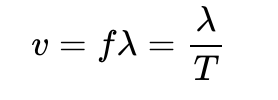
The distance a wave travels per unit time, calculated as the product of its wavelength and frequency, measured in metres per second (m/s)
The speed and direction a wave travels.
Period (T)
The time it takes for one complete cycle of a wave to pass a given point, measured in seconds (s).
T =1/f
(note: Period and frequency are inversely proportional to one another: 𝑓 = 1/𝑇 and 𝑇 = 1/𝑓)
Frequency (f)
The number of complete wave cycles that pass a point in one second, measured in hertz (Hz)
Wave equation
Longitudinal waves
Have particle displacement parallel to the direction of wave travel. I.e. the particles of the medium move back and forth in the same direction as the wave.
E.g. A sound wave (compressions and rarefactions move through air, causing particles to oscillate along the direction of the wave.)
Transverse waves
Have particle displacement perpendicular to the direction of wave travel. I.e. particles move up and down or side to side while the wave moves forward.
E.g. A light wave or a wave on a string (oscillations are at right angles to the direction of the wave's advance.)
Note: The two primary transverse graphs are displacement-time and displacement-distance
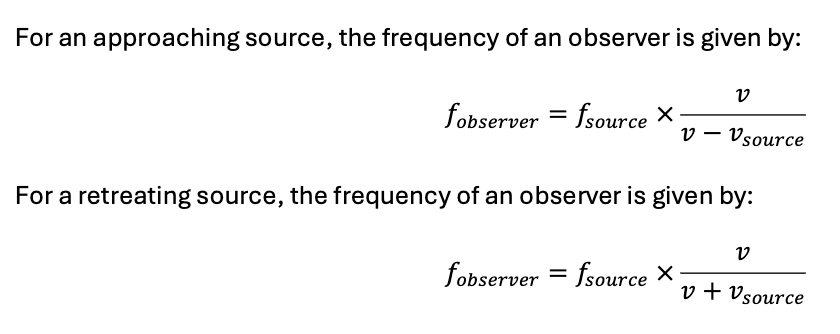
Doppler effect
The change in frequency or wavelength of a wave in relation to an observer moving relative to the wave source
Redshift
Light wavelength increases when a source moves away from the observer. (decrease in frequency)
Blueshift
Light wavelength decreases when a source moves towards the observer. (increase in frequency)
Sunlight
The Sun emits electromagnetic radiation across many wavelengths including visible light, infrared and ultraviolet.
Blackbody radiation
Refers to the electromagnetic radiation emitted by an idealised object that absorbs all incident radiation, regardless of frequency or angle (doesn’t reflect light). Black bodies emit radiation based on their temperature, and as temperature increases the peak wavelength moves to shorter wavelengths (higher energy radiation emitted).
Wien’s Displacement Law
States that the blackbody radiation peak wavelength (λmax) is inversely proportional to its absolute temperature (T), meaning hotter objects emit radiation at shorter wavelengths
The light emission of objects become bluer as the temperature increases
(Hotter → shorter wavelength → bluer colour.)
Black surfaces absorbs things more easily than white surfaces.

Stefan–Boltzmann Law
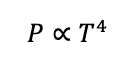
Describes the power radiated from a blackbody in terms of its temperature. States that the total energy radiated per unit surface area of a blackbody is directly proportional to the fourth power of its absolute temperature (T).
Total energy radiated by an object depends on its temperature.
P = eσAT4
Where:
P = power radiated
σ = Stefan–Boltzmann constant (5.67 × 10⁻⁸Wm-2K-4)
A = surface area
T = temperature (Kelvin)
e = emissivity of the surface
Dictates that hotter objects radiate significantly more energy.
Electromagnetic spectrum
It’s the entire range of electromagnetic radiation, organised by frequency or wavelength. It is a spectrum of light, quantised as photons.
Wave equation for electromagnetic radiation:
c = f x λ
where c= speed of light (3.00 ×10⁸ms-1): f = frequency (Hz): and λ = wavelength (m)
ORDER: Radio → Microwave → Infrared → Visible → Ultraviolet → X-ray → Gamma
Key ideas:
• wavelength decreases across spectrum
• frequency increases
• energy increases
Refraction
The bending of light as it travels from one medium to another.
The denser the medium, the higher the refractive index of the medium (the more light bends) and the slower the speed of light in that medium
Example: light bending entering water
Refractive index
The refractive index is inversely proportional to the speed of light in that medium. Therefore, as the refractive index increases, the speed of light decreases.
n = c/v
Where
n = refractive index
c = speed of light in vacuum
v = speed of light in medium
Example: glass ≈ 1.5
Snell’s Law
Relationship between angles of refraction.
n1sinθ1=n2sinθ2
Where n1= refractive index of the first medium, n2= refractive index of the second medium, θ1 = angle of incidence, θ2 = angle of refraction
Total internal reflection
Light reflects completely back into a medium rather than refracting.
Conditions:
Light travels high refractive index → low refractive index
Incident angle greater than critical angle
Summary:
1. If the angle of incidence is less than the critical angle:
Light is partly refracted into the second medium and partly reflected.
The reflected wave usually has lower intensity than the refracted wave. (θi = θr)
2. If the angle of incidence is equal to the critical angle:
The refracted ray travels along the boundary between the two mediums
The angle between the ray and the normal is 90°.
3. If the angle of incidence is greater than the critical angle:
Total internal reflection occurs.
All the light is reflected back into the original medium, and no refracted ray enters the second medium.
Critical angle
The critical angle is the angle of incidence in a denser medium for which the refracted ray travels along the boundary (90° to the normal). Beyond this angle, total internal reflection occurs.
sin(θc) = n2 / n1
I.e. The angle of incidence in the denser medium that produces a refracted ray of 90°.
The critical angle only exists when light travels from:
higher refractive index → lower refractive index
It is measured in the denser medium
Dispersion
Splitting of white light into its component colours (ROYGBIV) because different wavelengths refract by different amounts in a medium.
This occurs because the refractive index depends on wavelength. Red light (longest wavelength) refracts least, while violet light (shortest wavelength) refracts most, producing a spectrum.
Example: prism or rainbow.
Optical phenomena
Rainbows
Caused by:
Refraction entering water droplets
Internal reflection
Dispersion
Different wavelengths leave at different angles.
Mirages
Optical illusion caused by refraction in layers of air with different temperatures.
Hot air near ground → light bends → appears like water.
Kinetic Particle Model
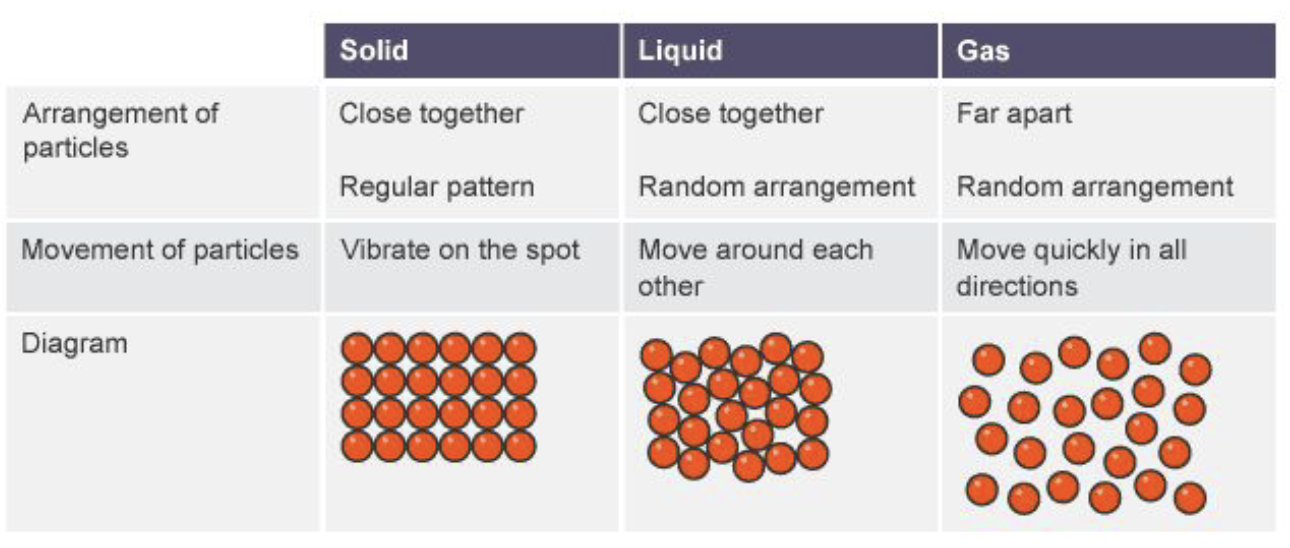
The kinetic particle model states that all matter is made of tiny particles (atoms or molecules) that are in constant, random, rapid motion, with space between them. During collisions, no kinetic energy is lost or gained overall, and particles experience forces of attraction and repulsion. Particle arrangement determines the state of matter (solid, liquid, gas): solids vibrate in place, liquids rotate and translate, and gas particles are far apart compared with their size. Heating increases particle energy, causing faster vibration or movement away from equilibrium. Higher temperature = greater particle motion
Kinetic energy + tempeature
Kinetic energy is the energy associated with the motion of objects and is a scalar quantity (magnitude, no direction). Temperature measures the average translational kinetic energy of particles in a substance. Higher temperature means particles move faster and therefore have greater kinetic energy.
Kelvin scale
Kelvin (K) is the SI temperature scale and does not use the word “degree.”
Conversion: K = °C + 273.15, °C = K − 273.15.
Water freezes/melts at 0°C = 273.15 K and boils at 100°C = 373.15 K.
Higher temperature means higher particle kinetic energy. 0 K (absolute zero) is the lowest theoretically possible temperature where particles have minimum energy.
Laws of thermodynamics
Zeroth law
if two systems are each in thermal equilibrium (same temp) with a third system, they are in thermal equilibrium with each other.
If Ta=Tc, and Tb=Tc, then Ta = Tb
First Law of Thermodynamics
Any change in the internal energy (ΔU) of a system is equal to the energy added by heating (+Q) or removed by cooling (-Q), minus the work done on (-W) or by (+W) the system
ΔU=Q-W
Heat transfer
Heat transfer is the movement of energy due to a temperature difference and is measured in joules (J). Heat always moves from warmer objects to cooler objects until equilibrium is reached. Hot objects in a cooler room cool down to room temperature, while cold objects in a warmer room heat up. Heat can be transferred by conduction, convection, or radiation.
Conduction
Conduction is the transfer of heat through a material without the material itself moving.
Occurs when particles collide with neighbouring particles and transfer energy.
Most effective in solids, especially metals.
In a solid, particles are closely packed and vibrate in place. When one part of the solid is heated, those particles vibrate faster and collide with neighbouring particles, passing energy along the material.
In metals, conduction is particularly efficient because energy can be transferred by both particle collisions and delocalised electrons.
Materials that conduct heat easily are called thermal conductors, while materials that conduct heat poorly are called thermal insulators.
Why is conduction easier in solids and liquids?
Conduction is easier in solids and liquids because particles are closer together, so they collide more easily and transfer energy. The rate of conduction depends on the temperature difference between materials (bigger difference = faster conduction speed, e.g. with 400°C and 20°C heat transfers quickly compared to 40°C and 20°C), thickness of the material, surface area, and the nature of the material.
Insulators vs conductors
Conductors and insulators differ in how easily they allow heat to pass through them.
E.g. Metals are good conductors because they transfer heat efficiently, while wood is a good insulator because it transfers heat poorly. Metal feels colder than wood because it conducts heat away from your hand faster (transfers heat from your hand into itself quickly), while wood does not conduct heat away as well and therefore feels warmer.
Convection
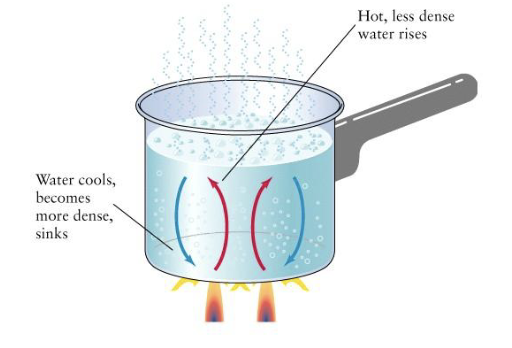
Convection is heat transfer within a fluid (liquid or gas) by mass movement of particles. When a fluid is heated, particles gain energy, spread out, become less dense, and rise, while cooler, denser fluid sinks, forming convection currents. Example: boiling water currents. Hot air rises, and gases are less dense than liquids so gas sits on top (e.g., steam above water).
Radiation
Radiation is heat transfer by electromagnetic waves and does not require a medium. Any object above absolute zero emits thermal radiation. When radiation reaches an object it can be reflected, transmitted, or absorbed. The rate of emission or absorption depends on the temperature difference with surroundings, surface area, surface characteristics, and wavelength of radiation. Example: the Sun heating Earth.
Radiation is energy emitted as electromagnetic waves from the surface of an object (bigger surface, the more places radiation can leave from). I.e. More surface = more “exit points” for energy
Specific heat capacity
The amount of energy that must be transffered to change tthe temeprature of 1kg of the materal by 1°C or 1K
Heat energy equation
Q = mcΔT
Where
Q = heat energy transferred in joules (J)
m = mass of material being heated in kilograms (kg)
c = specific heat capacity of the material (J kg-1 or K-1)
ΔT = temperature change (°C or K)
When heat is transferred to or from a system, the temperature change depends on the energy transferred (Q), the mass of the material (m), and the specific heat capacity (c).
Latent heat
Latent heat is the energy required to change the state of 1 kg of a substance at constant temperature by overcoming attractive forces between particles. Latent heat of fusion (Lfusion) changes a substance between solid and liquid, while latent heat of vaporisation (Lvapour) changes between liquid and gas. Latent heat of vaporisation is usually greater than latent heat of fusion.
Added energy goes into breaking intermolecular forces between particles, becomes potential energy, not kinetic energy.
Heating curve
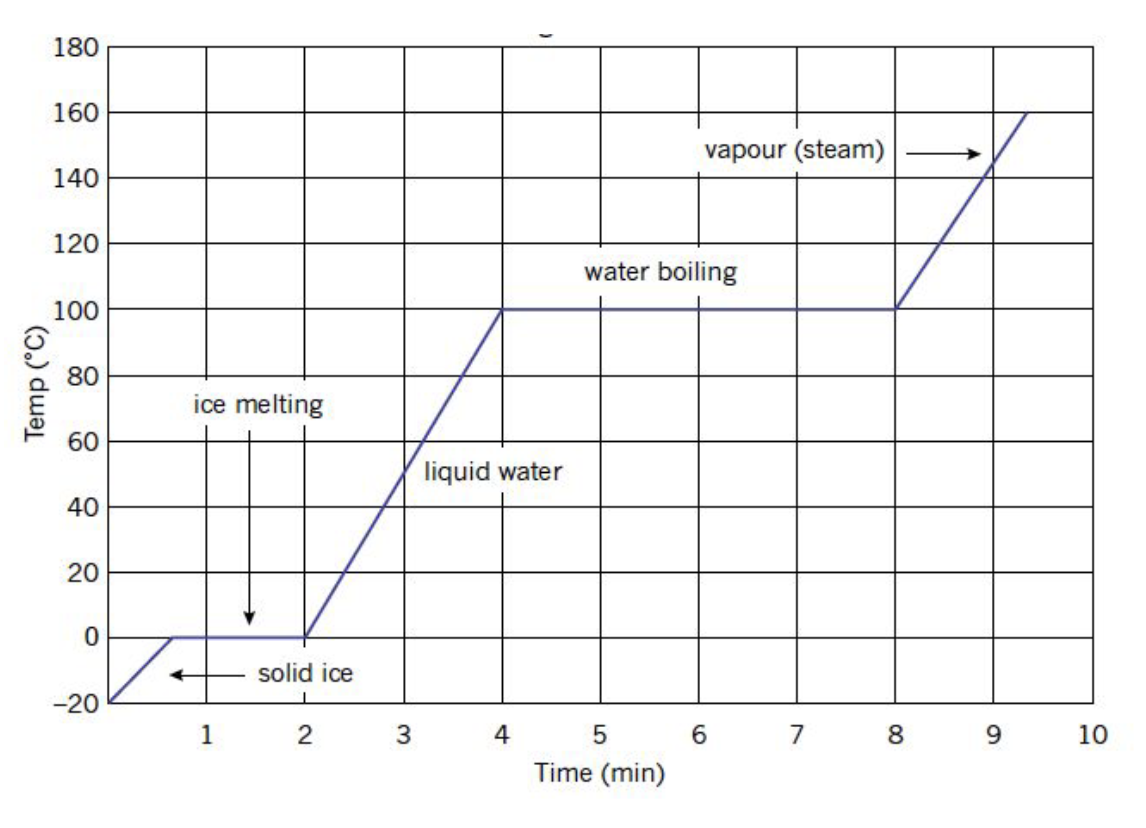
A heating curve shows temperature vs time or energy. Rising sections represent temperature change due to specific heat capacity, while horizontal sections represent latent heat during phase changes. The first flat line is the melting point (fusion) and the higher flat line is vaporisation. During phase change ΔT = 0 so Q does not increase temperature, because energy breaks intermolecular bonds rather than increasing kinetic energy.
Evaporation
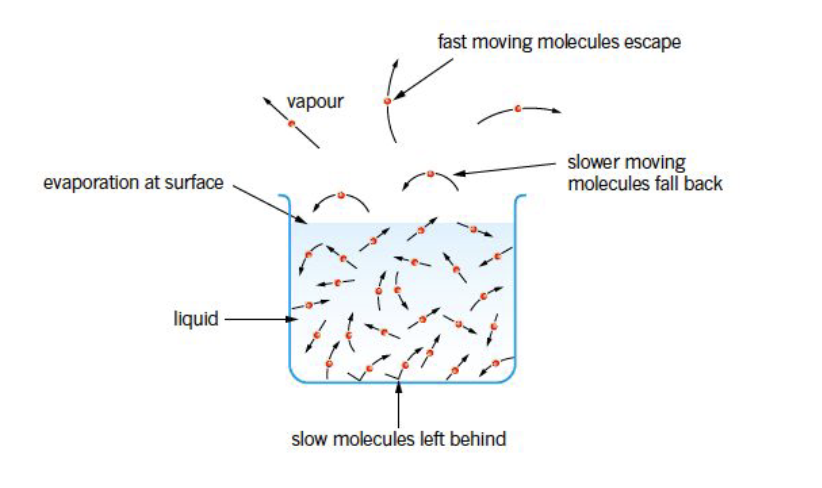
Evaporation occurs when liquid particles escape from the surface into the gas phase. The fastest particles escape, decreasing the average energy of the remaining liquid, causing cooling (e.g., sweating). Rate depends on volatility (more volatile = faster), temperature (hotter = faster), humidity (more humidity = slower evaporation), and air movement (wind increases evaporation).
Greenhouse effect
The greenhouse effect occurs when greenhouse gases (CO₂, methane, water vapour) trap infrared radiation in Earth’s atmosphere. Sunlight reaches Earth, some is reflected, while some is absorbed and re-emitted as infrared radiation. Greenhouse gases absorb this infrared radiation and trap heat, warming the planet. This process is necessary for life, otherwise Earth would be too cold.
The Sun sends radiation (mostly: visible light, some UV, some infrared), Earth absorbs the sunlight and warms up, Objects that are cooler than the Sun emit longer wavelength radiation. So Earth re-emits energy as infrared radiation (heat radiation). Greenhouse gases (CO₂, methane, water vapour) are very good at absorbing infrared wavelengths because of their molecular structure and charge distribution (uneven charges). They then re-radiate that energy back toward Earth, trapping heat.
retention
the ability of a material or system to hold, keep, or maintain a physical quantity (such as heat, charge, or a liquid) within itself, resisting its loss or dispersal.
why does blue light bend more than red?
Shorter wavelengths of light (violet and blue) are slowed more and consequently experience more bending than do the longer wavelengths (orange and red).