Physics--Things you need to know (definitions/important things to remember)
 Call Kai
 Learn
Learn Practice Test
 Spaced Repetition
 Match
Match Flashcards
 Knowt Play
1/207

Earn XP
Description and Tags
DONE SO FAR: Topic A (ONLY UNTIL POSTULATES OF RELATIVITY), Topic B, and Topic C
Name | Mastery | Learn | Test | Matching | Spaced | Call with Kai |
|---|
No analytics yet
Send a link to your students to track their progress
208 Terms
Projectile motion:
when is initial velocity 0?
when object is dropped from rest
NOT when it’s launched at an angle or horizontally
UCM: acceleration of an object moving with UCM
always toward center of circle
always changing, because direction of speed always changes. Speed is constant.
UCM: velocity of an object moving w UCM
tangentual to circle of motion of object. a and v are always perpendicular
When does UCM happen?
when object has constant speed and moves in a circular path.
Projectile motion: What’s special about horizontal velocity?
it stays constant throughout all ideal projectile motion
Air resistance
when forces balance, an object reaches terminal velocity.
Constant force object falls with when net force=0
as drag force increase, magnitude approaches weight of object
When can you use suvat
when acceleration is constant
can static friction be bigger than kinetic friction
yea
what direction is elastic force
it is restoring: always points to equilibrium position.
Newton’s first law
An object will remain in translational equilibrium unless acted upon by a net (unbalanced) force.
Newton’s Second Law
The net force acting on an object is equal to the rate of change of the object’s momentum (F=ma)
Newton’s Third Law
When one object exerts a force on a second object, the second object simultaneously exerts a force equal in magnitude and opposite in direction to the first object.
2 Postulates of Special Relativity
the laws of physics are the same in all intertial frames of reference (no acceleration)
the speed of light in a vacuum is constant for all intertial frames.
Assumptions for an ideal gas
the moldecules undergo perfectly elastic collisions (no loss of momentum/KE)
there are no intermolecular forces between the molecules
molecules are in constant random motion
gas contains a large number of identical particles
particles occupy negligible volume in the container
Real gas will approximate an ideal gas when…
pressure of the gas is low
density of the gas is low
temperature of the gas is moderate to high
What is internal energy of ideal gas
all random kinetic energy
no intermolecular forces, no potential energy in gas phase
Gas Laws
Boyle’s law—-P and 1/V (isothermal) are a curved line down
Charles’ Law—-V and T (Isobaric) is straight line up
Amonton’s Law—-P and T (isochoric) is a straight line up
Luminosity
power output of an object emitting thermal radiation
Temperature
measure of the average random kinetic energy of the particles of a substance
This is a macroscopic property: no single particle has temp.
Internal energy
total intermolecular potential energy added to the random kinetic energy of the molecules of a substance
what is heat
synonym for thermal energy, measured in Joules
NOT TEMP
NOT INTERNAL ENERGY
intermolecular potential energy and random kinetic energy
Intermolecular PE is due to phase
random KE is due to temp
How does the internal energy of an ideal gas differ from that of a real gas?
internal energy of ideal gas relies only on temp (KE).
Real gas’s internal energy also relies on pressure and volume (intermolecular forces, potential energy)
Thermal Radiation
electromagnetic radiation generated by the thermal motion of microscopic particles
Thermal capacity
energy required to raise the temperature of an object by 1 Kelvin
Specific heat capacity——aka “c”
energy require to raise the temperature of a unit mass of a substance by 1 Kelvin (for 1 KILOGRAM)
Specific Latent heat
energy required to change the phase of a unit mass of a substance WITHOUT changing its temp
latent heat of vaporization = liquid/gas
latent heat of fusion = solid/liquid
When heat is transferred to a substane, it will either increase temp OR change phase, NEVER BOTH
Emissivity
measure of how effectively an object radiates or absorbs thermal energy
ranges from 0-1
perfect absorber of radiation will also be perfect emitter
Black Body (radiator)
an ideal object/surface with an emissivity of exactly 1
wide spectrum of EM is emitted (distribution and intensity depend on temp)
wtf is Solar Constant!
mean solar radiant power per unit area arriving at Earth’s Upper atmosphere (2D disc)
Greenhouse effect
Natural frequency (resonant frequency, sm that all objects have—-freq they naturally vibrate at) of most greenhouse gases is in the Infared wavelength range.
GHG will readily absorb IR radiation, then re-radiate it in random directions (DO NOT say REFLECT)
due to resonance, Earth absorbs some light passing through atmosphere and re-radiates it. But, it can’t leave since GHG also re-radiate it in all directions
First law of Thermodynamics
Statement of conservation of energy
Q = change in U + W
Isothermal process
Temp remains constant U=0, Q=W
PV graph: curved line down, a bit higher than adiabatic
Isovolumetric process
volume remains constant W=PV, Q=U
PV graph: straight line down
Isobaric process
pressure remains constant Q=U+W (normal)
PV graph: straight line across
Adiabatic process
no heat transferred Q=0, U=-W
PV graph: curved line down, a bit lower than isothermal
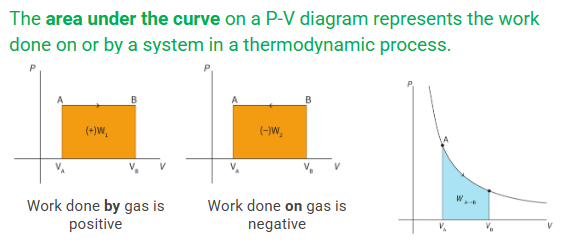
PV diagram
P is y axis
V is x axis
area under curve is work done on/by system in a thermodynamic process
Second Law of Thermodynamics
Kelvin ver: In a cyclic process, it is impossible to completely convert heat into work
Clausius ver: Thermal energy cannot spontaneously be transferred from a cold body to a hot body
Refers to the change in entropy of an isolated system
Entropy
measure of the disorder of a system
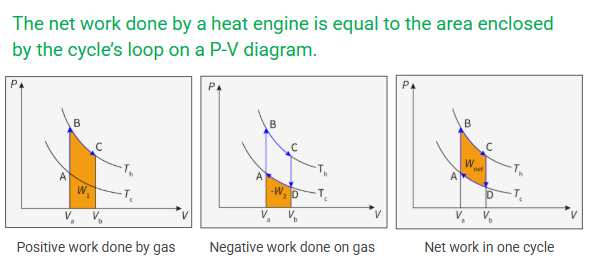
what is Heat engine
heat engine is a system that converts thermal energy into work
uses cyclical processes
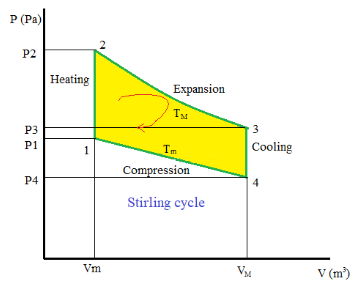
Stirling Cycle
Isovolumetric heating by hot resevoir
gas expands isothermally, doing work on piston
isovolumetric cooling by cold reservoir
work done on gas by piston in isothermal compression
how to find work done by a heat engine
equal to the area enclosed by the cycle’s loop on a PV diagram
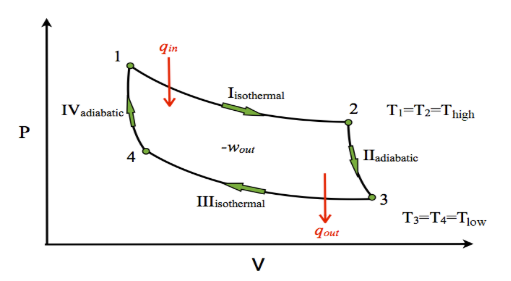
Carnot Cycle
idealized/hypothetical cyclical process that is more efficient than Stirling cycle (less waste heat)
uses reversible adiabatic processes
isothermal expansion at hot temp
adiabatic expansion from hot temp to cold temp
isothermal compression at cold temp
adiabatic compression from cold temp to hot temp
goes clockwise
SHM and Conditions
SHM is a type of oscillation that will create a pure sine/cosine wave
A restoring force (always directed towards equilibrium) causes this acceleration
Conditions for SHM:
Acceleration of object is proportional to its displacement from equilibrium
Acceleration of object is always directed towards equilibrium
How do PE, KE, and acceleration change at different points on the object’s path in SHM?
Acceleration is at maximum at maximum displacement or amplitude. Acceleration is zero at equilibrium.
Velocity is 0 at these maximum points. Velocity is greatest at equilibrium.
KE is 0 at maximum points, and greatest at equilibrium.
PE is greatest at maximum points, and 0 at equilibrium.
What affects period in spring-mass and pendulum systems?
mass, gravity, length of pendulum, and spring constant.
NOT DRAG, FRICTION, OR AMPLITUDE
What’s damping and what does it affect or not affect?
Damping is the decrease in an oscillating object’s amplitude over time due to energy losses.
DOES NOT CHANGE PERIOD
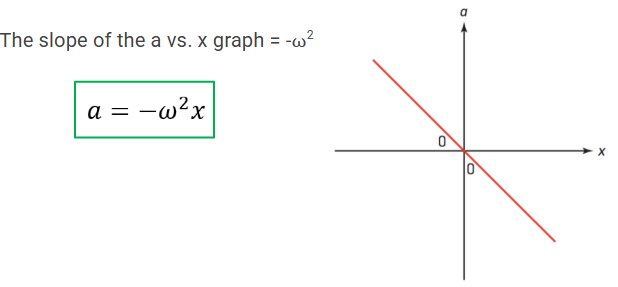
What does the a=-w²x graph look like??? (W IS NEGATIVE)
this
Transverse vs longitudinal waves
transverse waves oscillate perpendicular to the direction of travel of the wave. Crests and troughs are points of max/min displacement.
Longitudinal waves oscillate parallel to the direction of travel of the wave (sound waves, compressed slinky waves (slinky compressing and decompressing as medium oscillates). Compressions and rarefactions are points of max/min displacement.
Graphing waves: what are the two types of graphs?
Displacement-distance graph shows entire wave at a single instant in time. All particles are represented. USE FOR WAVELENGTH. CANNOT FIND PERIOD ON THIS GRAPH
Displacement-time graph represents displacement of a single particle in the wave. USE FOR PERIOD. CANNOT FIND WAVELENGTH
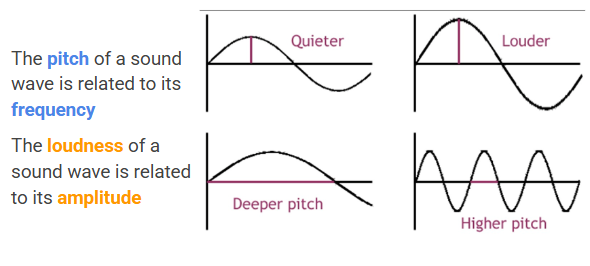
Pitch and Loudness of a sound
diagram
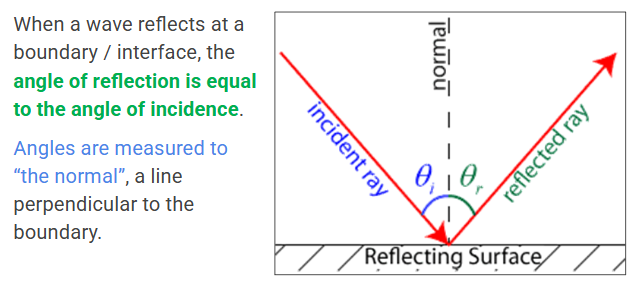
Reflection and Refraction (definitions)
Reflection is when some of the energy of a wave rebounds back into the original medium
Refraction is when some of the energy propogates into the new medium
What is diffraction!
When a wave passes through a narrow gap or slit, the waves spread out. Most extreme when the wavelength of the wave is close to the size of the opening/slit.
Waves can also diffract around obstacles.
Superposition + Interference
Principle of superposition: when two waves meet at a point in space, the total displacement is the vector sum of their individual displacements. (when two waves overlap and their displacements add together at the same point and time)
Interference is the result of superposition
Constructive vs Destructive interference
constructive is when waves meet in phase
destructive is when they meet out of phase
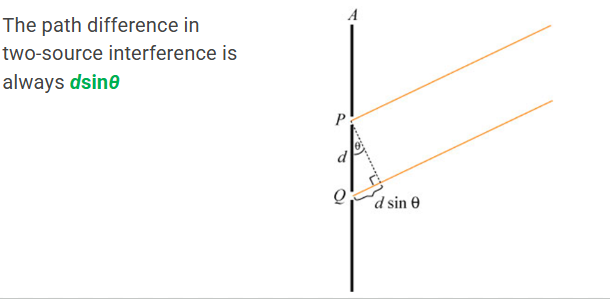
Path Difference
Difference in distance traveled by each wave from its source to the point of measurement
Integer = constructive
Half integer = destructive
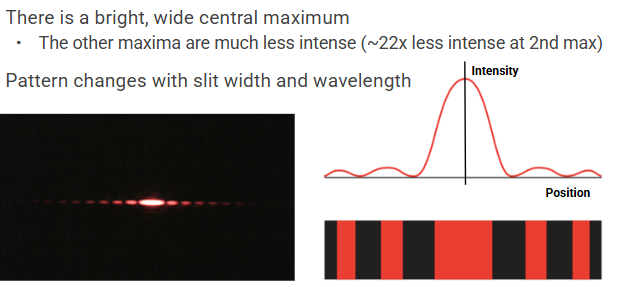
Single Slit Diffraction Pattern
Pattern of bright and dark fringes
NOT interference pattern
Young’s Double Slit Experiment
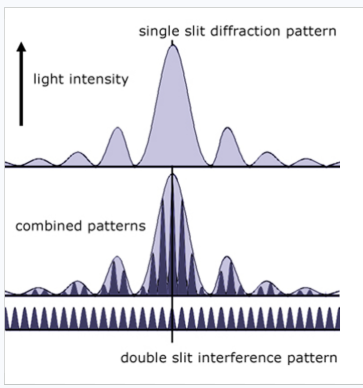
slits produce coherent light (constant phase difference) for interference (MUST)
Two source interference creates bright and dark spots.
Also a single-slit diffraction pattern due to diffraction of each slit
Combination of 2 source and single slit diffraction
What happens as # of slits increases?
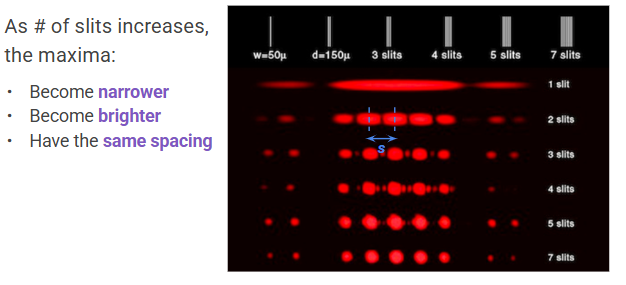
maxima become narrower, brighter, but have the same spacing.
diffraction grating
large number of equally spaced slits
when monochromatic, coherent light shines through a diffraction grating, a pattern of focused, bright maxima is seen.
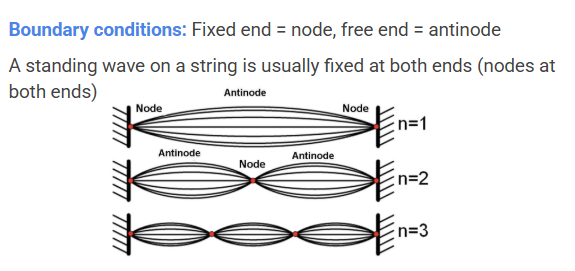
what do diff harmonics of standing waves on a string look like?
like this
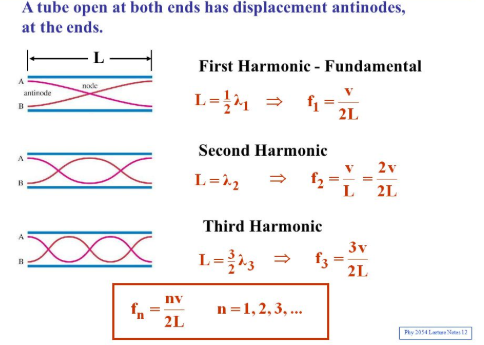
What do diff harmonics of standing waves in an open pipe look like?
this
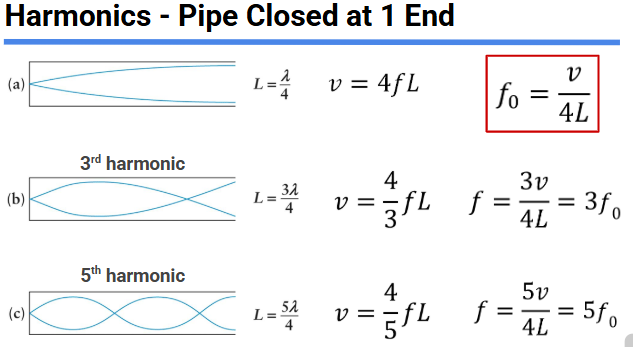
What do diff harmonics of standing waves in a closed pipe look like?
this, and NO EVEN NUMBERED HARMONICS
How do standing waves form?
When two waves of equal AMPLITUDE, FREQUENCY, and SPEED pass through each other in OPPOSITE directions, a standing wave is formed by the superposition of the two waves.
Differences between traveling and standing waves
TRAVELING:
transfers energy between two points
all particles have same amplitude
any phase difference is possible between particles
STANDING:
have energy, but none is transferred
particles have diff amplitudes
two particles can only be completely in phase or completely out of phase
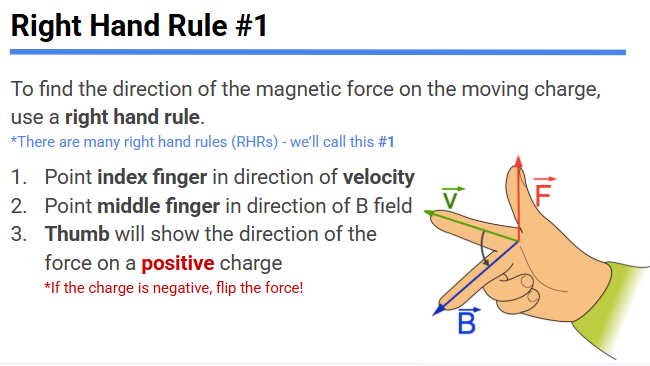
RHR #1: (the one w velocity)
Thumb= Force on a POSITIVE charge
Index= velocity
Middle= B field (magnetic)
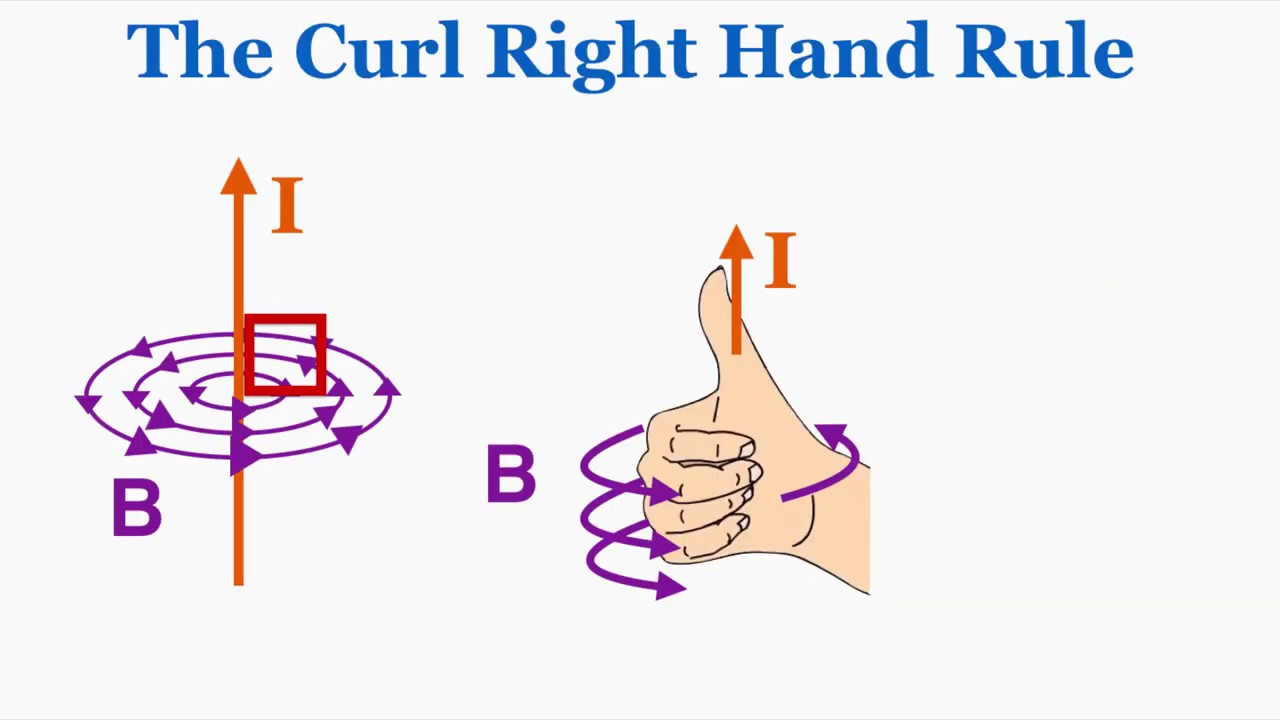
RHR #2: thumb curling thing
Thumb= direction of current
Finger curl direction= B field direction
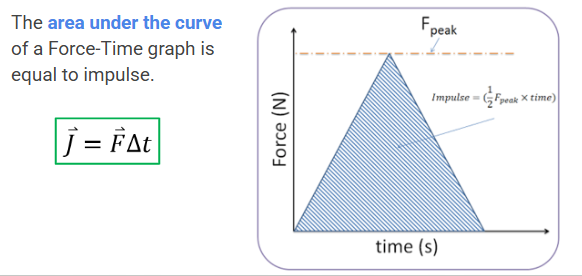
How to find impulse on a graph
area under curve on a Force-Time diagram
Law of Conservation of Momentum
Momentum of a system does not change so long as no net external force acts on the system.
Elastic vs. Inelastic collision
Elastic: kinetic energy is conserved
Inelastic: kinetic energy is NOT conserved (lost to heat, sound, etc.)
Momentum still conserved for both.
Explosions are REVERSE collisions. Initial momentum is usually zero.
What is work?
Energy that is added or removed from the system, when applying a force
aka change in E
unit: J
How to find work on a graph
Area under the curve of a force vs. displacement graph
What is power
the rate at which work is done (change in W)/(change in time)
unit is Watts.
W=J/s
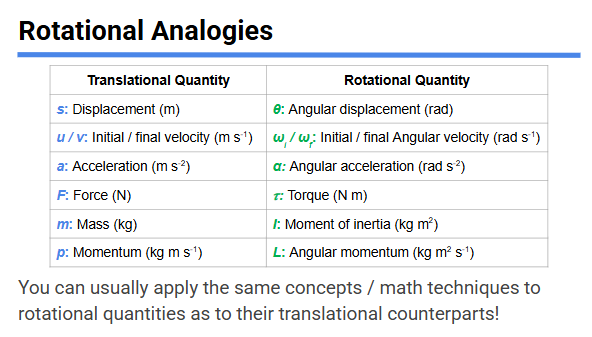
Rotational motion analogies (variables)
this
what is torque
torque is the rotational equivalent of a force. Will cause rotational acceleration about a pivot
Rotational equilibrium
in equilibrium if the net torque acting on the object is zero.
Wtf is inertia!
The moment of inertia describes an object’s resistance to rotation.
Based on how mass is distributed about its axis of rotation (closer = less inertia)
Conservation of Angular Momentum
The angular momentum of a system does not change unless a net external torque acts on the system.
What is impulse
A change in momentum
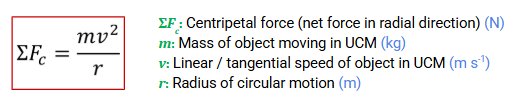
equation for centripetal force
RADIAL DIRECTIONS: towards center = positive, AND away from center = negative
Total Energy of an object in orbit, and what happens to it
if total energy is positive, object follows a hyperbolic path and never returns
If total energy is zero, object follows parabolic path, where it just about stops. Never returns.
If total energy is negative, object goes into circular or elliptical orbit (or crashes into planet if launch speed is too low)
Gravitational Potential
work done per UNIT MASS (J/kg) to move a SMALL TEST MASS to a point from infinity
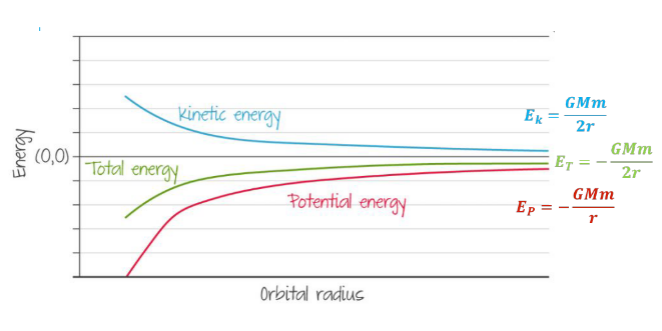
Graph of Energy for an orbiting mass
this
Total orbital energy
The total orbital energy is negative—-the object is bound by the grav. field of the planet
Gravitational potential energy (of an object)
Energy that an object has due to its position in a grav. field.
Defined as 0 at r = infinity
Grav. Potential energy is negative everywhere else
Electric potential energy (of a particle)
Energy stored in a charged particle based on its position in an electric field
also 0 at r = infinity
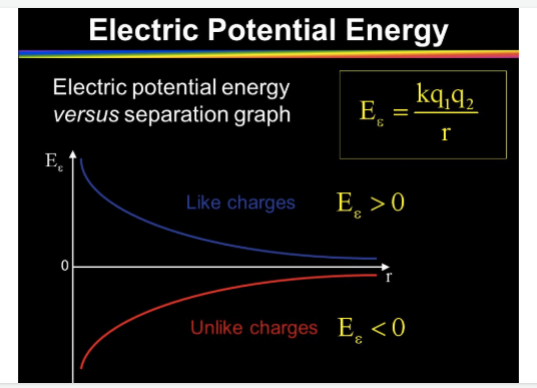
Electric Potential
Work done per UNIT CHARGE to bring a small TEST CHARGE to a point from infinity (J/C, aka Volt)
Electric field strength
Force per unit POSITIVE test charge at a specific point in an electric field
Gravitational field strength
Force acting per unit mass on an object at a specific point in a gravitational field
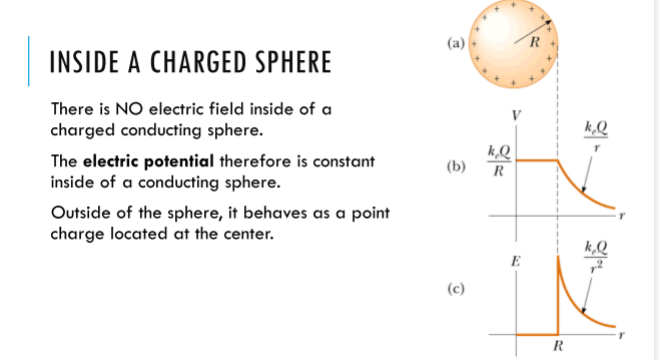
what happens inside a charged sphere?
ts
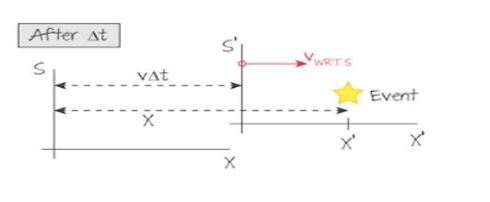
Galilean Relativity
Assumes that Newton’s laws of motion are the same in all inertial reference frames (frames that are not accelerating)
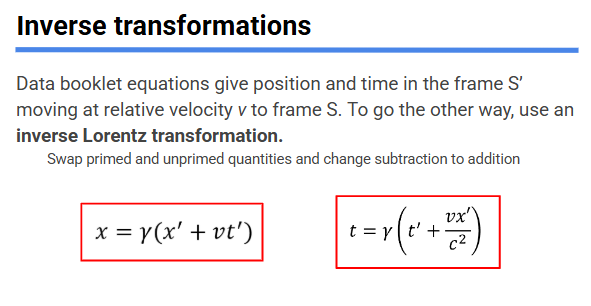
Inverse transformations (relativity)
this
Evidence for time dilation
Muons decay: and when they were moving at the speed of 0.994c relative to lab clocks, their average lifetime from the lab clocks agreed w the relativistic measurements.
Atomic clocks flown around the world also show evidence: time dilation is used to calibrate them when they move
Evidence for length contraction
Muons are produced when cosmic rays interact w the atmosphere. They should decay before reaching the Earth’s surface, according to classical physics, but we detect muons on the surface.
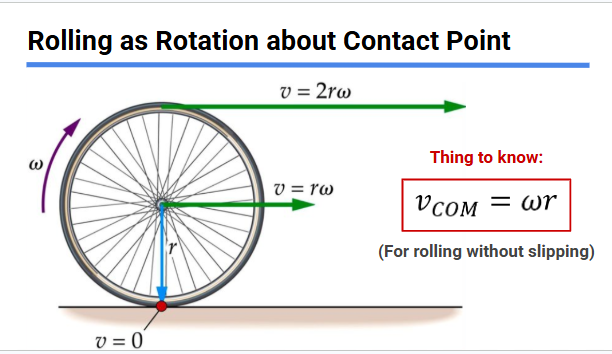
velocity when rolling
v = wr
0 at contact point, medium at center of mass, and fast at top
Electric Potential Difference
Work done per UNIT CHARGE to move a small POSITIVE test charge between TWO POINTS
V = W/q
Conductor vs insulator
the outer valence electrons of a conductor are very loosely bound to their nucleus. All electrons in an insulator are tightly bound to their nucleus.
Some materials can act as both, called semiconductors.
What is electric current
Rate of flow of charge (Amp, aka C/s)
ACTUAL flow of charge carriers (electrons) is opposite the direction of conventional current
What is resistance
A measure of its tendency to resist the flow of current
Ratio of the potential difference across a conductor to the current flowing through it (unit: Ohm)
What is resistivity
A property of a material that describes its natural resistance independent of its physical dimensions
Unit: Ohm x meter