18.3 Loanable Funds Theory of Interest Rates
 Call Kai
 Learn
Learn Practice Test
 Spaced Repetition
 Match
Match Flashcards
 Knowt Play
1/26

There's no tags or description
Looks like no tags are added yet.
Name | Mastery | Learn | Test | Matching | Spaced | Call with Kai |
|---|
No analytics yet
Send a link to your students to track their progress
27 Terms
What does the loanable funds theory explain?
The interest rate is determined by supply and demand for loanable funds in a specific loan market.
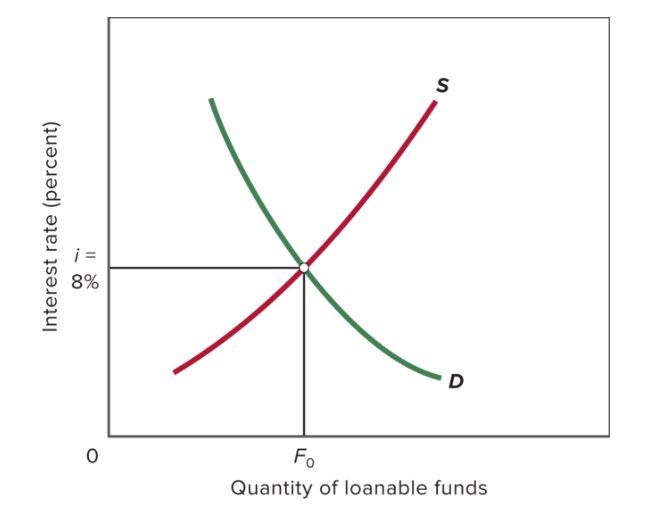
What is the equilibrium interest rate?
The rate where quantity supplied = quantity demanded of loanable funds.
Who supplies loanable funds in the simple model?
Households (through saving).
Why does the supply curve slope upward?
Higher interest rates encourage more saving (households must be “bribed” to delay consumption).
What does a higher interest rate mean for supply?
More saving → more loanable funds supplied.
Who demands loanable funds in the simple model?
Businesses (to buy capital goods).
What determines whether a business will borrow?
Compare expected rate of return vs. interest rate.
When will a firm borrow?
When expected return > interest rate
Why does the demand curve slope downward?
Higher interest rates → fewer profitable projects → less borrowing.
Are there many loanable funds markets?
Yes — each loan type (mortgages, car loans, student loans, bonds) has its own market and interest rate.
Do households lend directly to businesses?
Rarely. They save in banks, which then lend to businesses.
How do banks make profit?
By paying savers a lower interest rate and charging borrowers a higher rate.
What causes supply to increase (shift right)?
More saving — for example, tax‑exempt interest on savings.
What happens when supply increases?
Interest rate falls.
What causes supply to decrease (shift left)?
Less saving — for example, expanded government social insurance reduces need to save.
What happens when supply decreases?
Interest rate rises.
What increases demand for loanable funds?
Anything that raises expected rate of return on investment.
Example: How does technology affect demand?
Higher productivity → higher revenue → higher rate of return → demand shifts right.
Example: How does higher product price affect demand?
Higher price → higher revenue → higher rate of return → demand shifts right.
What happens when demand increases?
Interest rate rises.
What decreases demand for loanable funds?
Lower productivity or lower product prices → lower rate of return.
What happens when demand decreases?
Interest rate falls.
Do households only supply funds?
No — they also borrow (mortgages, car loans, etc.).
Do businesses only demand funds?
No — they may also supply funds if they have excess revenue.
Does government participate?
Yes — government demands funds when running budget deficits.
What role does the Federal Reserve play?
It controls bank lending activity, influencing interest rates across the economy.
Why did interest rates fall sharply during COVID‑19?
Demand fell — businesses stopped investing.
Supply rose — Federal Reserve increased loanable funds.