Emotion Regulation (Part 1)
 Call Kai
 Learn
Learn Practice Test
 Spaced Repetition
 Match
Match Flashcards
 Knowt Play
1/46

There's no tags or description
Looks like no tags are added yet.
Name | Mastery | Learn | Test | Matching | Spaced | Call with Kai |
|---|
No analytics yet
Send a link to your students to track their progress
47 Terms
What is Lewis (1992) and Tracy & Robins (2007) model of emotions?
There are primary emotions which develop very early on without need for self consciousness (18-24mth)
There are secondary emotions which develop later (0-9) that require self consciousness
What are proposed primary emotions? (Name at least 3)
Joy
Distress
Anger
Fear
Disgust
Surprise
What are proposed secondary (self conscious) emotions? (name 3)
Shame
Guilt
Pride
Embarrassment
What are characteristics of secondary (self conscious) emotions? (5)
Require self awareness and self-representation
Emerge later
Facilitate social goals
No universal facial expressions
More cognitively complex
Emotion is not just an affective feeling, but a?
Full body response
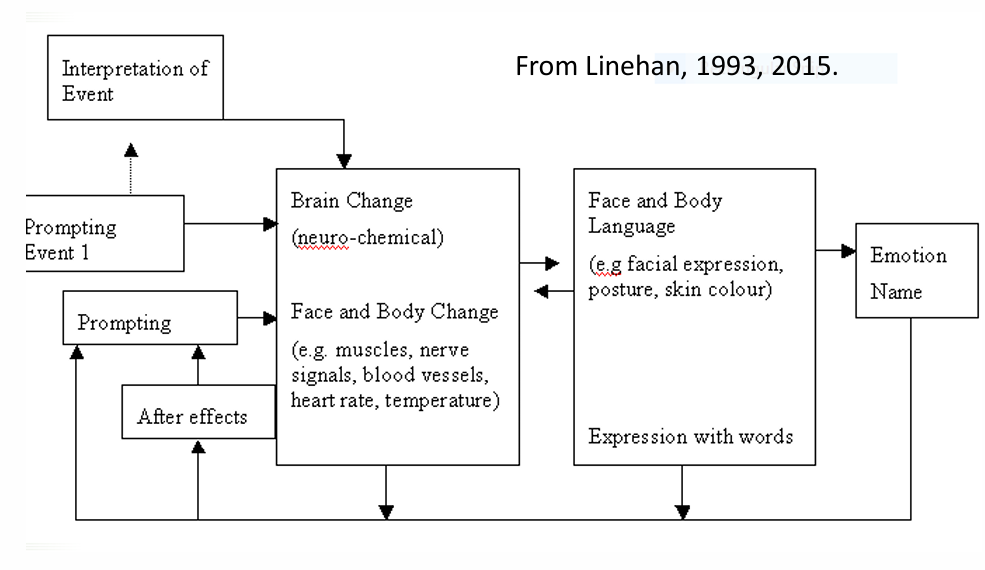
What is Linehan (1993)’s model for describing emotions? (non-visual) (5)
A process involving cascading interactions
First, we don’t even notice it, and our body responds first (affect)
Then, start to register what it is (feeling)
Then, can name it (emotion)
Can then lead to other experiences.
What is Linehan (1993)’s model for describing emotions? (visual)
Prompting event 1 → interpretation, brain change → face and body language → emotion name) → after effects → more prompting
What is Leahy’s definition of emotion regulation?
Any coping strategy (problematic or adaptive) that the individual uses when confronted with an unwanted intensity of an emotion
What is Gross’s definition of emotions?
Heterogenous set of processes by which emotions are themselves regulated. Can be intrinsic (of self) or extrinsic (of others)
Hill (2015) would argue that when we are regulated we are: (1 main point, name at least 3 of the other ones)
We feel safe.
Adaptive
Flexible
Self-possessed
All psychological resources are available
Available for interpersonal connection, play, exploration
Background of self-mastery
Self-experience: agency and authenticity
What is emotional dysregulation, according to Leahy? This can involve what?
Difficulty or inability in coping with experience or processing emotions. Can be undermodulated or overmodulated
What does under-modulation of emotions lead to? What is a disorder that possibly arises?
Over-aroused - excessive intensification of emotions; BPD
What does over-modulation lead to? What is a disorder that possibly arises?
Under-arousal - Excessive deactivation of emotional responding; Depression
To Hill (2015), dysregulation looks like what? (1 main point), name at least 3 others)
People do not feel in control of their behaviour, thoughts, feelings, and don’t feel like themselves
Decreased agency
Decreased availability for relating
Detached from experience of self and others
Sense of reality is ‘off’
Decreased reflective capacity
Perception narrowly filtered
Representational accuracy decreased and replaced with scripted versions of self and others
Decreased flexibility, spontaneity, increased reactivity
In the main, what are the problem?
Not emotions but defenses/coping strategies
How do coping mechanisms relate to therapeutic relationships?
Triangle of conflict - Feelings/impulses result in anxiety and defense strategies which need to be targeted
Triangle of person/relationships - Past (attachment relationships) relate to current self and therapy/transference.
What is Hill/Schores theory of affect regulation systems?
Hill theorised there are two systems thought to develop that are helpful for affect regulation, primary and secondary. Schore believed a secure attachment directly relates to an individual’s capacity to regulate emotions through neuropsychological influences.
What are key aspects of the Primary Affect Regulating System/ Implicit system? (4)
Automatic
Unconscious
Deep neurological level
Gut response to rising affect
Wuhat are key aspects of the Secondary affect regulation system? (5)
Top down
Deliberate
Conscious
Slower
Requires verbal, reflective capacity / mentalisation
What is Schore’s psychoneurobiological theory of the development of self regulation?
Primary Affect Regulating System (PARS) - secure attachment experiences facilitate optimal limbic system organisation
Implicit memories of secure regulatory experiences become the operating instructions for a balanced autonomic nervous system
Essentially, secure attachments have neurobiological effects on the limbic system, affecting capacity for effective PARS
Describe first phase of PARS
First, structures of limbic system come online. Circuits develop that connect the limbic system to the SNS, then PNS
Once achieved, infant’s LS can appraise body-based affect and socioemotional info linked to the system that regulates arousal. HPA and ANS.
Organisation depends on infant’s affect regulation experiences
12-14 months, limbic circuits regulating sympathetic arousal innervate, laying framework for upregulation.
12-14, 16-18 months, limbic circuits for PNS arousal innervate, lays framework for downregulation
What is the parasympathetic nervous system? (PNS)
NS responsible for calming down. If too much threat is reached, causes collapse
What is the sympathetic nervous system? (SNS)
Fight or flight system
What is the attachment relationship about while the limbic circuits regulating the SNS innervate?
Child’s increasing mobility and mother’s need to inhibit
What is the attachment relationship about while the limbic circuits regulating the PNS innervate?
Tasks related to the child’s mobility
What is the second phase of PARS development, according to Schore? (2, one shortened version of the former)
R orbito frontal cortex forms connection to subcortical LS structures. Allows ROFC to inhibit body-based urges mediated by subcortical structures and perform executive functions.
Basically, LS + ROFC = ability to appraise environment and up or down regulate as necessary
The limbic/socio-emotional brain is shaped by what?
Experiences in attachment relationships
Infant neurological development is dependent on?
Emotional capacities of caregivers
What is attunement?
Synchronicity of affect states
Shared experience amplifies experience and contributes to a sense of regulation
‘Experienced empathy’ offers reassurance and connectedness
Develops in attachment but also relevant down the line in the therapeutic relationship
According to Siegel, what does attachment allow?
The parent to help the infant organise its own mind
What is dyadic regulation/ the process of developing dyadic regulation?
Transmission of affect occurs first through touch, then moves to nonverbal implicit communication (facial expresion). W/ sufficient repetition of these patterns of communication, experiences become ingrained/internalised
What do Ainsworth’s Strange Situations show? (3)
Capacity to regulate affect. Strange Situation can be thought of as what happens within the child-carer relationship when the infant is afraid.
When afraid, the attachment system is activated. Role of the caregiver is to deactivate this.
So, in SS, not just looking at how the child reacted when the parent left the room, but how the carer and infant interacted during the dysregulation and how long it took to return to a regulated affect state.
What should ideally happen in an attachment relationship, according to Schore?
Caregiver and infant learn the rhythmic structure of the other through psychobiological attunement
What is the internal working model?
Structure of memory and expectation, particularly of an attachment caregiver
How does the internal working model of attachment affect later relationships?
Shapes an individual’s expectations of responses to his or her requests for care and comfort
What are characteristics of an avoidant attachment pattern in a therapeutic context? (5 - attentional deployment, relational behaviour, emotion regulation, means of regulating emotion, therapy behavior)
Attention directed away from stress source
Moving away from the therapist
Hypoarousal
Autoregulation
Might be slouched, show low engagement, and think others have the problem
What are characteristics of an anxious attachment pattern in a therapeutic context? (5 - attentional deployment, relational behaviour, emotion regulation, means of regulating emotion, therapeutic behaviour)
Hypervigilant for expected source of threat
Moves against therapist
Hyperarousal
Dyadic regulation
More gestures, energy, attempts to change subject, expectation of external regulation, moving against therapeutic effort when overwhelmed
When is the window of affect tolerance?
Not too aroused or hypoaroused — feel optimally aroused and safe
What is the difference between auto and dyadic regulation?
Dyadic regulation is co-regulation, which eventually turns into auto-regulation with repeated learning
The development of a Secondary Affect Regulating System (SARS) is dependent on what?
Development of PARS, enabling optimal development and functioning of SARS
Secondary affect-regulating system (top-down) is also known as what?
Mentalisation
What is mentalisation? (6)
Left brain dominant
Cortically based
Voluntary
Conscious
Slower system
Higher order cognitive assessment
Mentalisation is a _____ system, and therefore ____.
Slower; doesn’t provide for responses in the moment but allows for contemplation of past and future states
What are tasks to achieve mentalisation capacity usually in place by?
6 yrs
What are tasks to achieve mentalisation capacity? (4)
Sense the mind is representational in nature, and representation is distinct from the thing represented
Intentions can be represented and can indicate possible action
Others have minds too, and can be like-minded or not
We construct our representations w/ varying degrees of accuracy for ourselves and others
How does mentalisation regulate affect? (4)
Identifies it
Elaboration - fine-tuning meaning, involves effortful focusing and cognitive appraisal of situation
Thinking through of a feeling in the midst of ‘live’ affect
Sense of mastery emerges from mentalisation