Accounting Week 6 - Auditing
 Call Kai
 Learn
Learn Practice Test
 Spaced Repetition
 Match
Match Flashcards
 Knowt Play
1/23

There's no tags or description
Looks like no tags are added yet.
Name | Mastery | Learn | Test | Matching | Spaced | Call with Kai |
|---|
No analytics yet
Send a link to your students to track their progress
24 Terms
Principle Shareholders
Absentee Owners
Not involved in day-to-day operations
Agent Management
Involved in the day-to-day of the business
Responsible for financial statements, not accountants/auditors/audit committee, etc…
Information Asymmetry Gap
Time gap between Agent and Principal
due to principle not being involved in the day-to-day to see changes in bus ops
Auditor
Goal is to fill the asymmetry gap so shareholders have more reliable information
independent
free from bias
Big Dilemma
Who pays the auditors?
= The agent does
Why do we Audit?
Fosters Trust in financial information
Ensures Accuracy and Reliability for investors, lenders, & general public
Essential for business to Secure Investors
Vital for maintaining Operations
Definition of Auditing
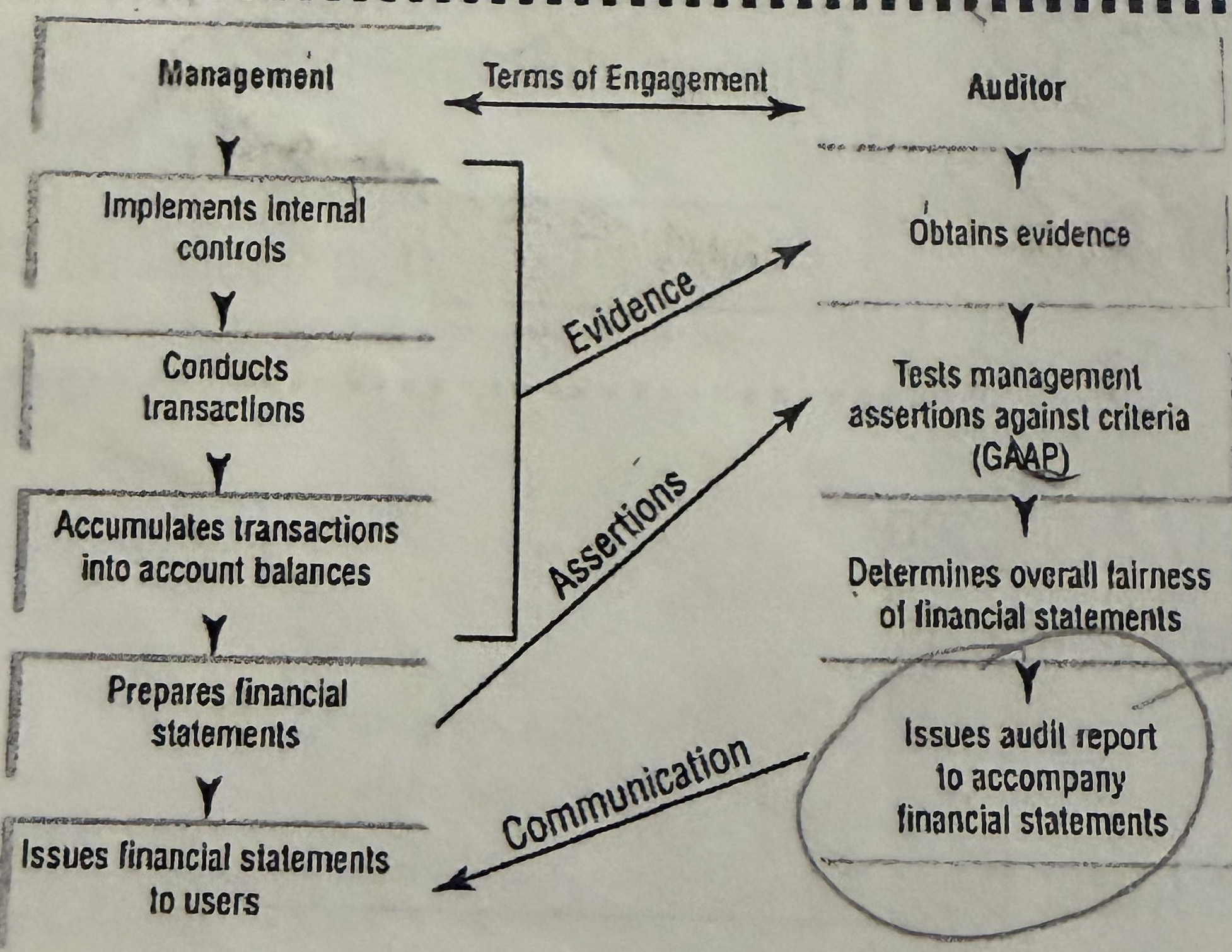
To objectively obtain and evaluate evidence regarding assertions made by management
Main Goal of Auditing
Ensure a business is free from material misstatements
They are NOT responsible for —>
Do NOT detect fraud
do consider that, but not their goal
Do NOT test every transaction
Do NOT certify statements, rather ensure reliability
Materiality Limit
Threshold above which any misstatement or omission in F/S is considered significant enough to potentially influence investors’ decisions
Do not share the materiality threshold with management or the company, as knowing this limit could encourage them to intentionally commit fraud up to that threshold.
Auditing accuracy based in accordance to GAAP
Systematic process (lots of planning)
GAAS (Generally Accepted Accounting Standards)
Risk-based approach to auditing by calculating the materiality limit
Objectively collect and evaluate evidence to support testing
auditors must be independent (objectivity)
must act with integrity and objectivity
Assertions made by management
Assertions: everything in the financial statement
ex) management asserted that the A/R balance is 500k
Assertions should conform to specific rules (GAAP & IFRS)
ex) “Financial statements is fair in all material aspects and in accordance with GAAP.”
Report results (auditing findings) to users - BOP, Debt & Equity & Equity Investors
Present and Audit Opinion: Report of independent registered accounts + found in 10k
Types of Assertions
Occurrence
Completeness
Accuracy
Cut-off
Classification
Existence
Valuation
Rights & Obligations
note: all are fairly self explanetory and can be understood by what the word means
Occurrence
Transactions actually happened/took place
Reporting a sale - auditor checks occurrence
Completeness
Did all transactions get recorded
makes sure that all sales/expense transactions are on F/S
Accuracy
Number & Details in F/S are correct
transactions are recorded in proper amounts
Cut-off
Ensures transactions are recorded in the correct accounting period
December expenses are not recorded in January’s #s
Classification
Transactions are recorded in the correct accounts
Existence
Ensures that the transaction really exists on the F/S date
Valuation
Assets/Liabilities on F/S at the correct value
inventory not recorded @ made up expense
Rights & Obligations
Owns assets and is responsible for liabilities
does company have the title for the asset
Audit Risk
Auditors do not audit every transaction. Therefore, audit risk can never be 0
Auditors grant reasonable assurance that the financial statements are free from material misstatements
Types of Opinions
Unmodified/Unqualified: “Clean” and free from material misstatements
Modified: Minor misstatements, and parts do not present fairly
Adverse: Do not present fairly (RUN!)
Disclaimer: ^
may not be independent
the auditor could not obtain enough evidence
Management ←→ Auditor
Types of Fraud
1) Misappropriation of Assets (stealing)
more common, smaller losses
2) Fraudulent Financial Reporting
less common, larger losses
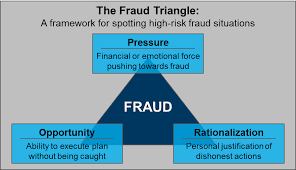
Fraud Traingle
Opportunity
the only point of the Fraud Triangle that management can control by using internal controls: activities to safeguard assets and minimize errors/fraud in financial reporting
Management/Company cannot control →
Rationalization
“I don’t get paid enough.”
“I was going to pay it back.”
Pressure
Financial medical bills
Expensive taste