Bio II_Final Module
 Call Kai
 Learn
Learn Practice Test
 Spaced Repetition
 Match
Match Flashcards
 Knowt Play
1/85

There's no tags or description
Looks like no tags are added yet.
Name | Mastery | Learn | Test | Matching | Spaced | Call with Kai |
|---|
No analytics yet
Send a link to your students to track their progress
86 Terms
Shoot system
Usually above ground
2 components:
vegetative (stems & leaves)
reproductive (flowers & fruits)
Photosynthesis
Root system
Usually underground
Physically supports the shoot system
Absorbs water + minerals
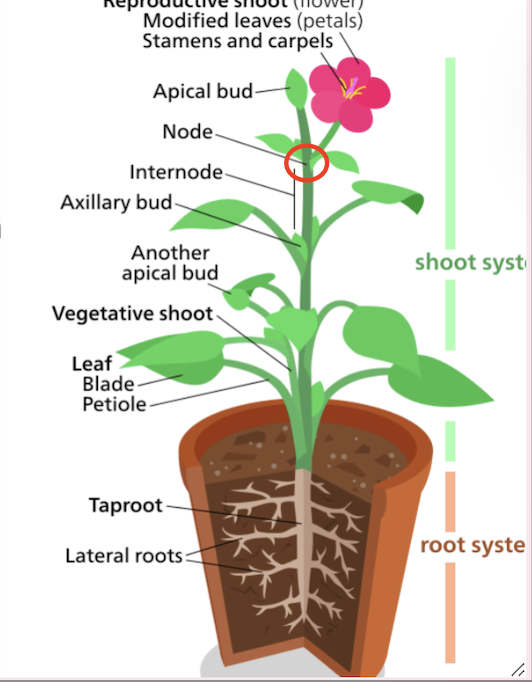
Node
Point of attachment
mostly for leaves and flowers
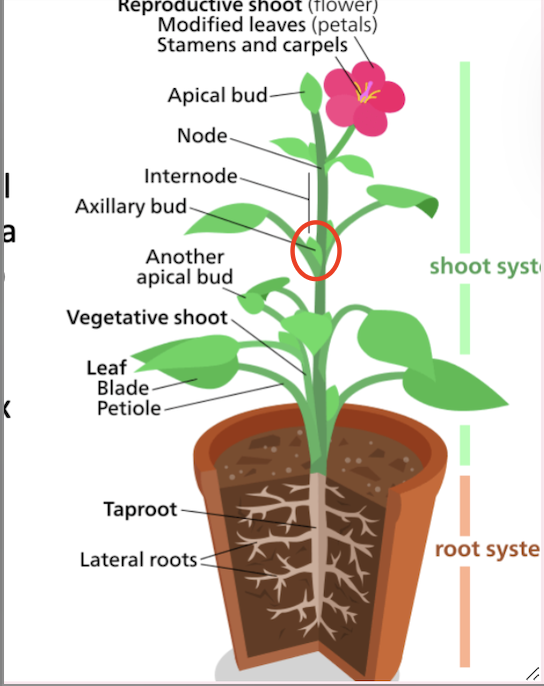
Axillary bud
Located in the axil (area between base of leaf and stem)
Gives rise to a branch or a flower
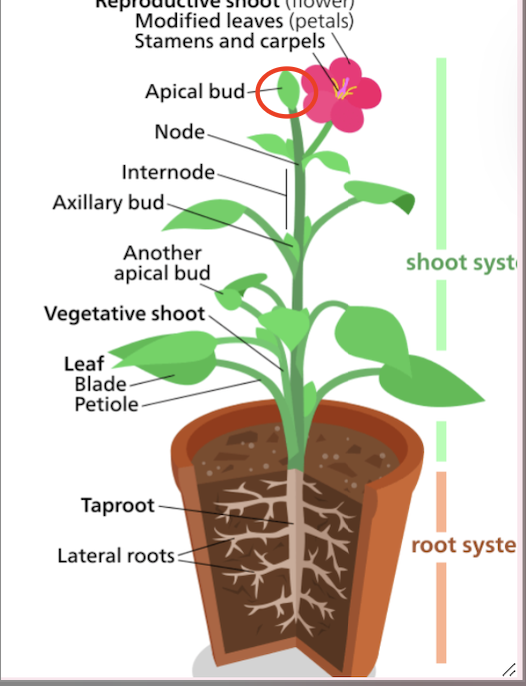
Apical bud
Located at the apex (tip) of the shoot
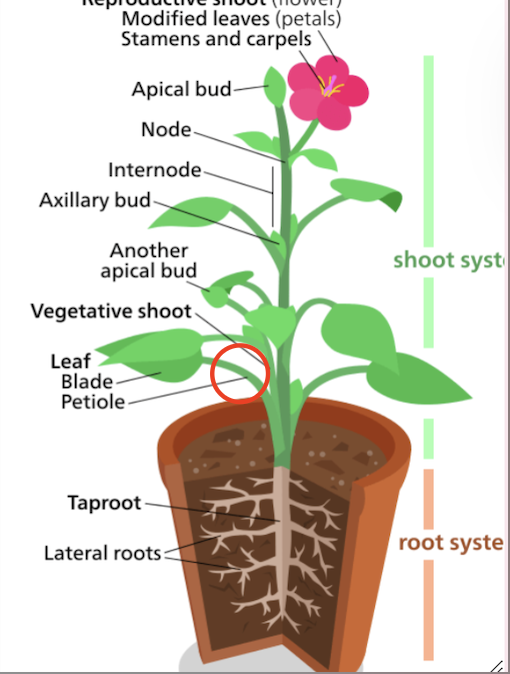
Petiole
The stalk that extends from the stem to the base of the leaf
Trichomes are …
Small hairs on the leaf surface
can reduce herbivory by hampering insect movement across leaves
can store herbivory-deterring chemicals
can reduce rate of water loss by disrupting airflow across leaf surface
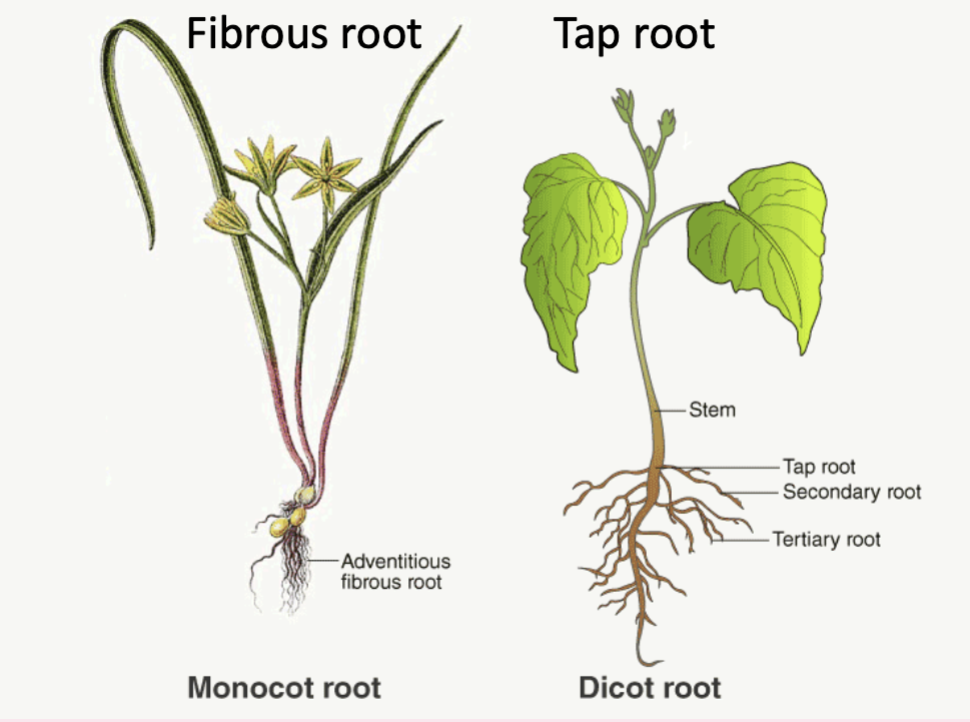
Two types of root
Fibrous root → monocot root
Tap root → dicot root
Primary growth
Lengthening of plant
Growth in length
Production of leaves
Production of branches
Secondary growth
Widening of plant
Growth in girth in stems and roots
Meristems
The sites of plant growth
2 types:
Apical meristems → causes primary growth
occurs at tips of shoots and roots
produces new leaves and flowers
Lateral meristems → causes secondary growth
occurs at the cambium
produces bark on trees
Plant hormones are transported throughout the plant via the _____ ______
Vascular system
Hormones are …
Chemical messengers produced by various parts of the plant
help regulate growth + development
Phototropism
Plants growth towards light
plants must respond as environment changes, but can’t move like animals
Auxin = plant growth hormone that causes plants to grow away from or towards light
Positive phototropism
Shoots exhibit this
Towards the light
Negative phototropism
Roots exhibit this
Away from light
Tree rings show …
Secondary growth
rings can be used to track annual growth + thickness provides info about environment conditions in past years
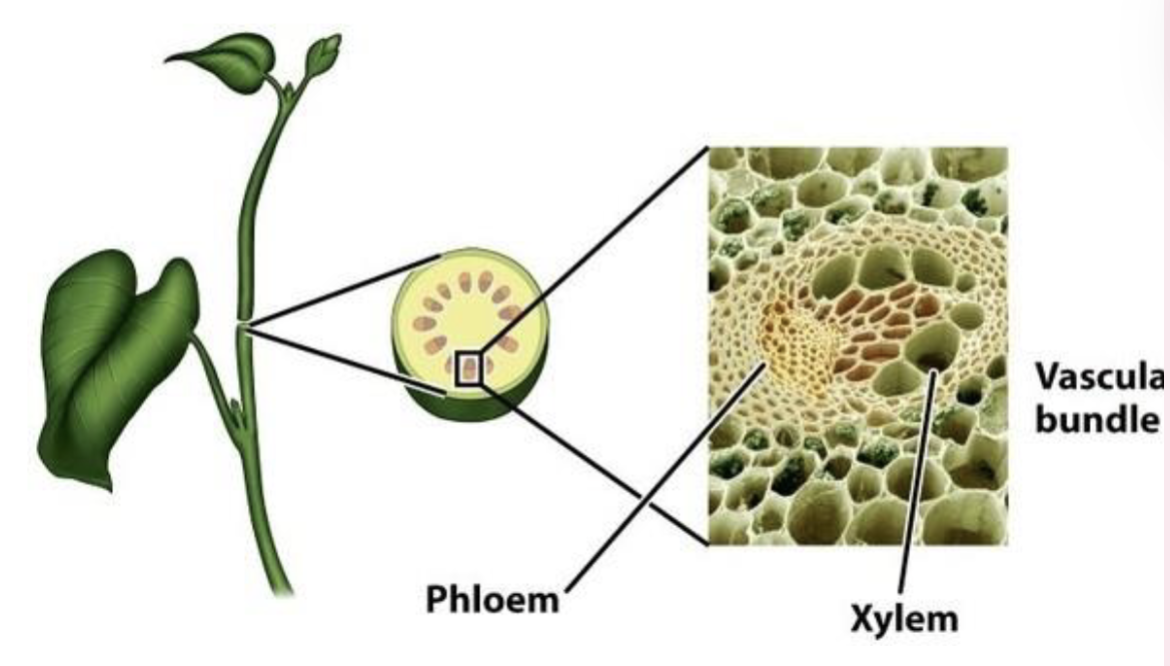
What moves water and nutrients around a plant?
Vascular tissues
Xylem
Phloem
Xylem
Carries water & nutrients through “dead” cells from roots to leaves
moves only in one direction (roots → leaves)
Phloem
Carries nutrients + hormones ( in water)
moves in both directions
Vascular bundles
Veins in the shoot system
plant stems vary in their arrangement of these
Water moves from areas of _____ to areas of ______
High water potential'; low water potential
Water potential
The potential for water to do work
is influenced by pressure & solute concentration
adding solutes = decreased water potential
adding pressure = increased water potential
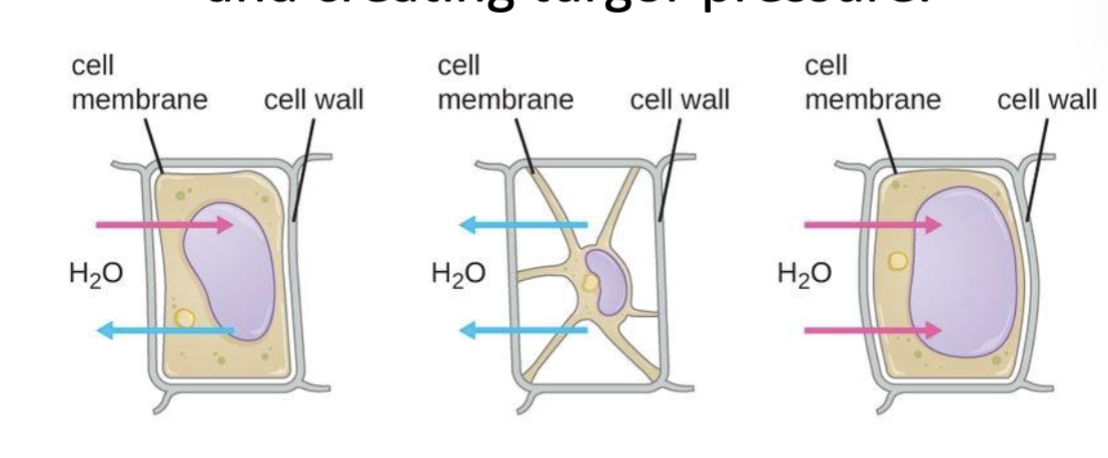
Water enters root cells causing …
The membrane to expand into the cell walls & creating turgor pressure
increases water pressure & turgor pressure
so watered plants are firm due to turgor pressure
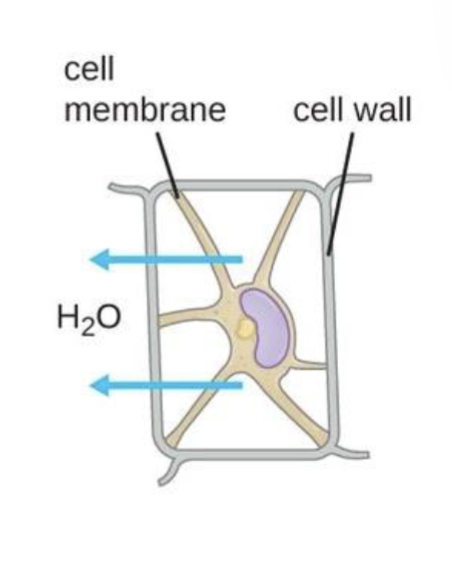
When dehydrated, plants …
Wilt due to lack of turgor pressure
From the roots, water is transported to the ….
Xylem
increased water pressure (from turgor pressure) in the root cell causes water to leave the root cell and enter the xylem
The Casparian strip helps keep ….
Absorbed water inside the roots
serves as a boundary layer separating the cortex from the vascular tissue, blocking diffusion of material between them → blockade forces water & solutes to pass through plasma membrane to reach xylem
Properties of water
Cohesion: water molecules “sticking” to each other
Adhesion: water molecules “sticking” to other materials
What is capillary action caused by?
Cohesion and adhesion working together
helps drive water up a plant through the xylem
The width of the vessel elements is under ____ ____
Selective pressure
Narrower vessels can better withstand …
Pressure from drought
Wider vessels can transport ….
A greater amount of water & carbon
Water is lost through …
Transpiration at the leaves
plants have to open stomata to bring in more CO2 and get rid of excess O2
Transpiration: water vapor is also lost when stomata are open
Water moves up a plant due to …
Combination of forces
positive water pressure in roots due to water entering
negative water pressure in leaves due to transpiration
capillary action through xylem
Sugars move from sources to sinks (translocation) via …
Water potential differences
source = where the photosynthates are coming from
sink = where the photosynthates are being delivered to
Unlike xylem, phloem flow direction changes based on …
The plant’s needs
Where photosynthates are directed to in ..
Early on: roots
Vegetative growth: shoots and leaves
Reproductive development: seeds and fruits
Highest leaves: send upward to growing shoot tips
Intermediate leaves: send products in both directions
Lower leaves: send downward to roots
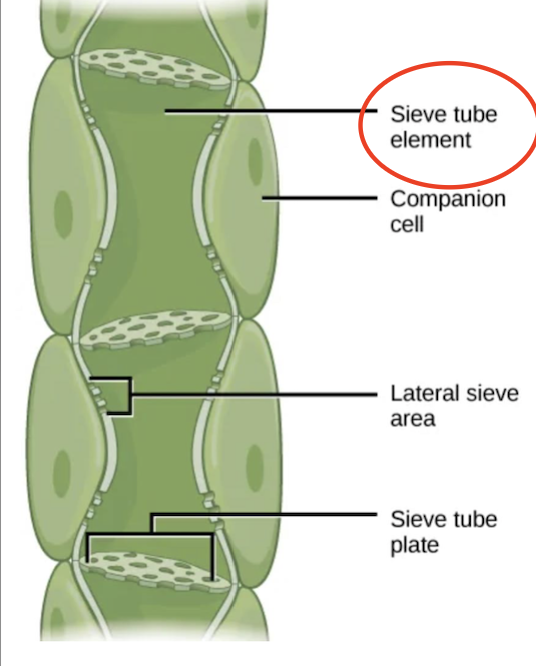
Sieve tube elements
The cell that primarily make up phloem
have reduced cytoplasmic contents
connected via sieve plates w/ pores to allow material to move
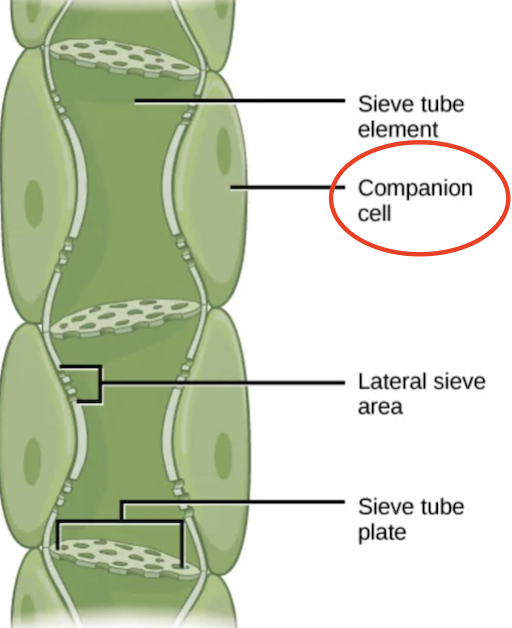
Companion cells
Keep sieve tube elements alive
Phloem sap
An aqueous solution that contains up to 30% sugar, minerals, amino acids, and plant growth regulators
Form follows function
If a structure is important for survival, then its physical features closely reflect its function
result of evolution: over time, individuals w/ structures that are more efficient for a specific function have an advantage over individuals w/ structures that are less efficient for that function
individuals w/ advantage are more likely to survive, reproduce, and pass on that efficient structure to offspring
efficient structure becomes more common in population (adaption)
Skin cells
Function: cover surface of body and line organs and cavities within the body
Structure: cells are tightly bound continuous layer
Neurons
Function: transmit electronic signals very rapidly over long distances
Structure: long extensions
Red blood cells
Function: bind and transport oxygen and other substances through narrow passages of circulatory system
Structure: shaped like a disk with indentation in middle
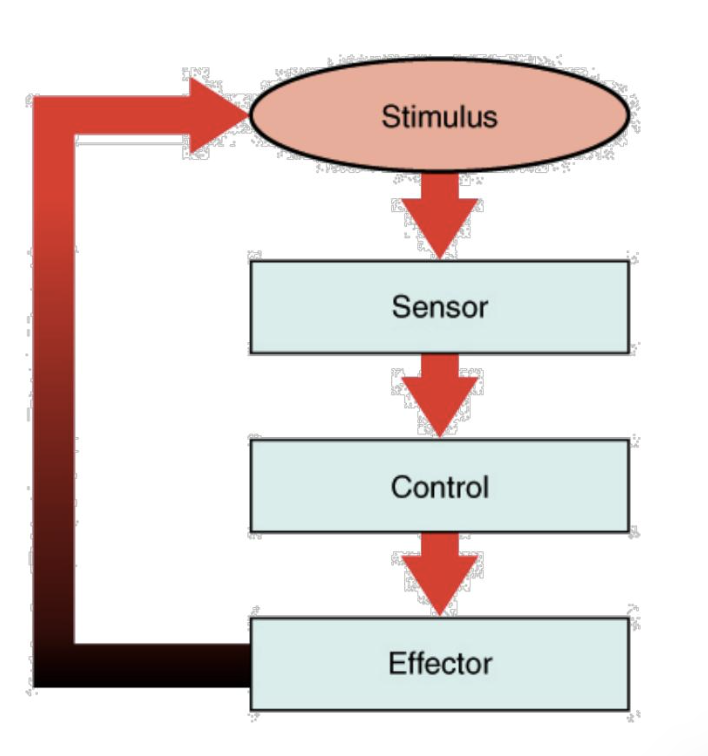
Homeostasis
The body’s ability to maintain a constant internal environment despite changes to the external environment or changes in activity
Components of homeostatic feedback loops
Stimulus
Set point
Sensor
Control center
Effectors
Thermoregulation
The body needs to maintain stable temperature
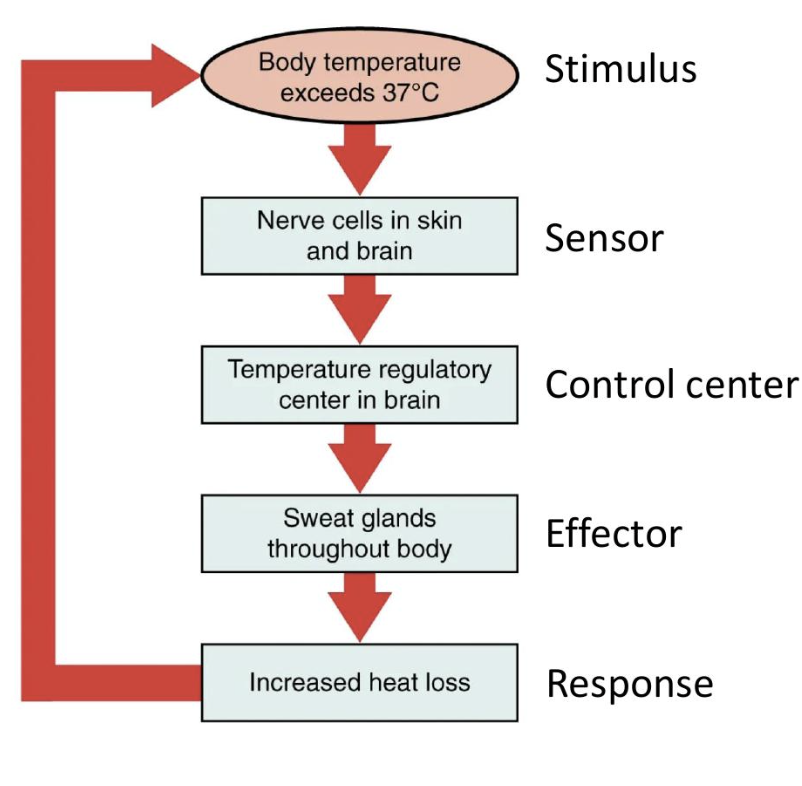
Stimulus
An external event occurs that shifts the body’s state away from the set point
Sensor
Monitors/detects the current state and sends that info to the control center
Control center
Compares current state to the set point
Effector
When the control center detects shift away from set point, it triggers an appropriate response
Blood glucose homeostasis
Sensor = glucose-sensitive neurons in brain, send messages to the control center
Control center = pancreas
Effector
a) When blood glucose is too high, pancreatic beta cells release insulin
insulin causes cells throughout body update glucose & liver uptakes glucose and converts it into storage form, glycogen
b) When blood glucose is too low, pancreatic alpha cells release glucagon
Response = when blood glucose is too high, pancreatic beta cells release insulin
when blood glucose is too low, pancreatic alpha cells release glucagon
What does insulin cause
Cells throughout body update glucose
Liver uptakes glucose and converts it into storage form, glycogen
What does glucagon cause
Liver breaks down glycogen and releases glucose into bloodstream
Negative Feedback
Counteracts changes to maintain steady state (equilibrium)
Typically maintaining status quo
i.e. Predator/Prey Dynamics
Positive Feedback
Changes promotes further change toward an extreme
Typically driving a process to completion
i.e. Contractions during delivery
Feedbacks
Agents of stability or rapid change
Negative feedback control
A change in a variable triggers a response that counteracts the initial change
“Negative” means response negates the stimulus that disrupted homeostasis
Positive feedback control
A physiological control mechanism in which a change in a variable triggers a response that reinforces or amplifies the change
Osmoregulation
Stimuli: dehydration or too much hydration/salt concentration in blood
Sensor: hypothalamus
Control center: hypothalamus
Effector: pituitary
Response: Kidneys reabsorb more or less water, feeling of thirst
Thermoregulation
The maintenance of internal body temperature within a tolerable range, despite changes in environment or activity
Endothermic
Warm blooded animals
Metabolically generate their body heat
Ectothermic
Cold blooded animals
Rely on environment to produce their heat
Animals exchange heat with the environment through 4 mechanisms:
Radiation
Evaporation
Convection
Conduction
Relationship between surface:volume ration and heat transfer
Smaller animals (which have higher surface:volume ratio), have more rapid heat transfer
Large animals (which have lower surface:volume ratio), have less rapid heat transfer
Within a species, larger individuals are found in _____, and smaller individuals are found in _____
Colder climates; warmer climates
Where are appendage length longer in populations vs. shorter?
Longer in populations of same species living in warm climates near equator
Shorter in populations living further away from equator in colder environments
Where is thermoregulation more challenging?
In aquatic environments
water wicks away heat faster than air (it has high specific heat)
Counter-current heat exchange
Conserves heat
reduces heat loss in extremities, maintains core body temp (found in many marine species, also in limbs of mammals)
Works by pairing arteries and veins in close physical contact to exchange heat
warm blood leaving the core (artery) warms the cold blood returning to the core (vein)
What happens when cells get really cold?
Cells have lots of water inside of them → when ice crystals form inside cells, the crystals puncture the cells, killing the organism
Why could organisms lose their nerves?
If metabolic cost of nerve net is high, losing neurons may have been selectively advantageous
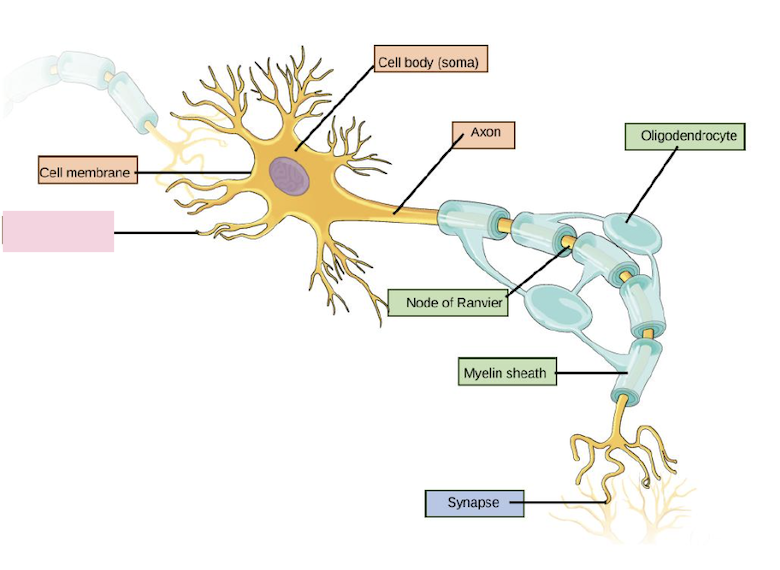
Dendrites Function
Receive signals from environments or other neurons
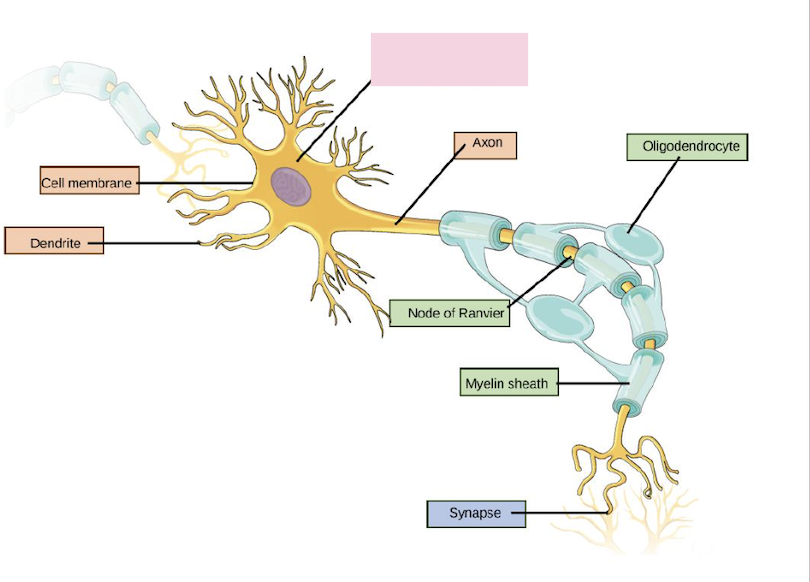
Cell body (soma) Function
Contains nucleus and organelles needed for cellular function
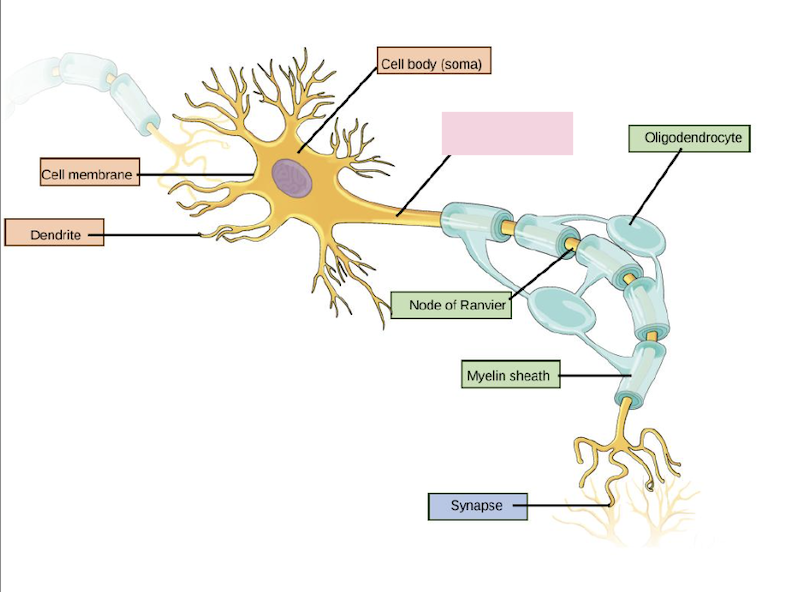
Axon Function
Propagates signal over physical space
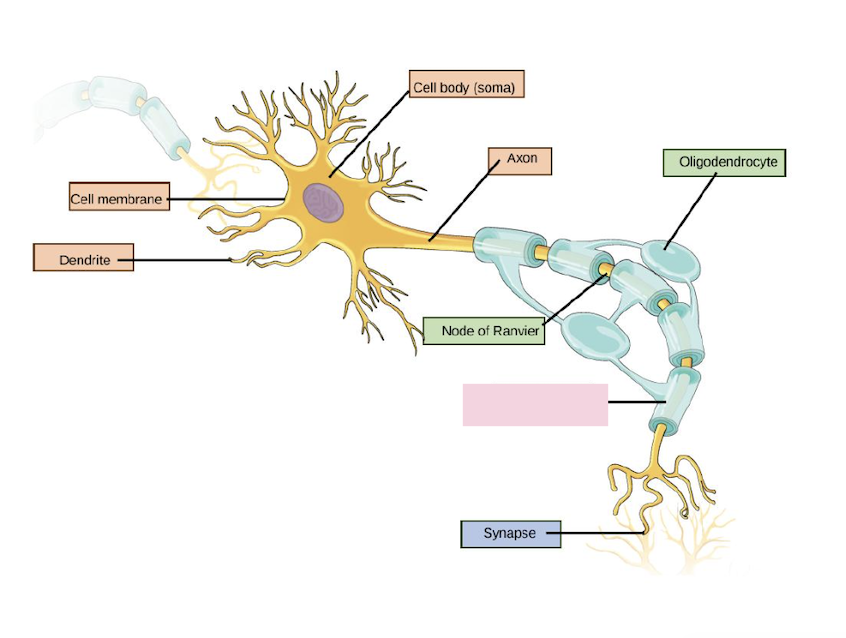
Myelin sheath Function
Insulates the axon to speed up propagation of the signal down the axon
signal is “recharged” at nodes of Ranvier
Axon terminal Function
When signal reaches it, it triggers chemical messages to be sent to dendrites of the next neuron across the synapse
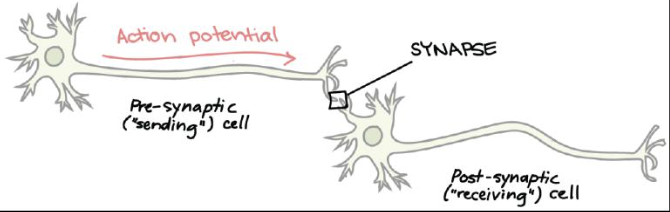
Synapse
Is between two neurons where neurotransmitters are released for cell communication
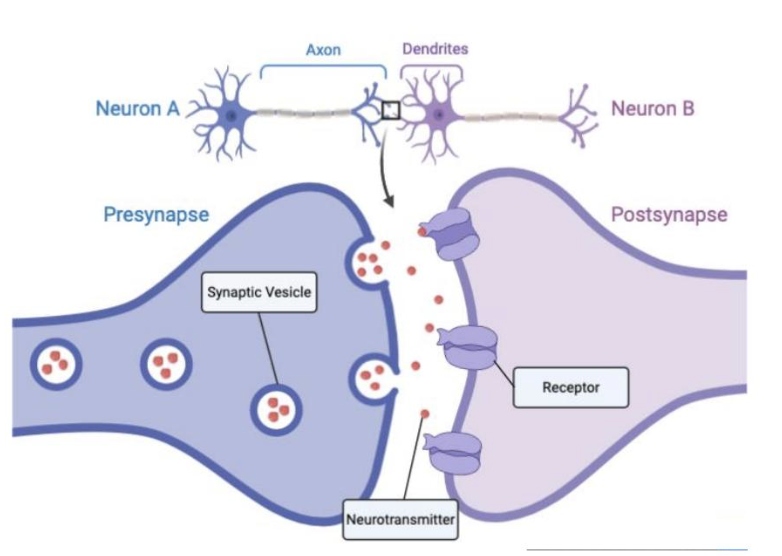
How are human neurons highly variable?
There are at least 40 different “types” of neurons
They vary in:
Morphology
Density
Size
Electrical properties
Microtubule scaffolding structures
How do neurons communicate?
Via action potentials
Neuronal axons
Contain transmembrane proteins that help regulate membrane potential
Ion channels
Help transport ions into or out of the cell in response to a stimulus
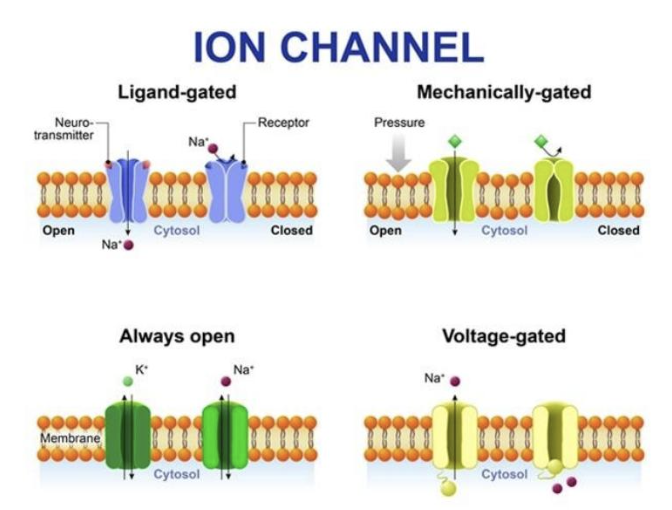
At resting potential, inside the neuron is …
Negative compared to outside the neuron
Negative inside due to:
anions are concentrated inside the cell
Na/K pump moves out more cations than it brings in
Potassium leak channels allow K+ to leave the neuron
Negatively charged proteins inside the cell
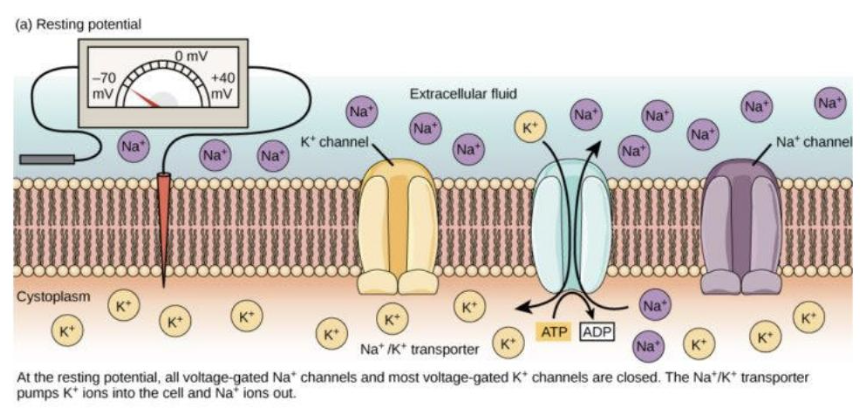
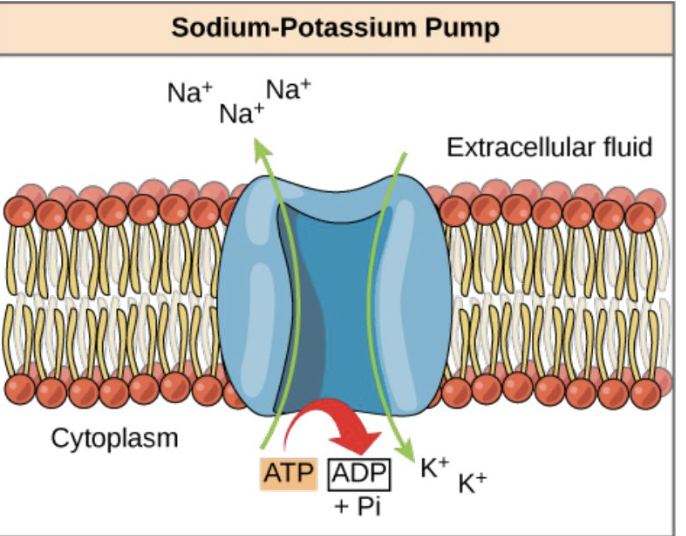
The Na+/K+ pump helps …
Maintain membrane potential through active transport
it continuously pumps 3 sodium (Na+) out of the neuron and 2 potassium (K+) into the neuron
At the resting state, all voltage gated channels are ____
Closed
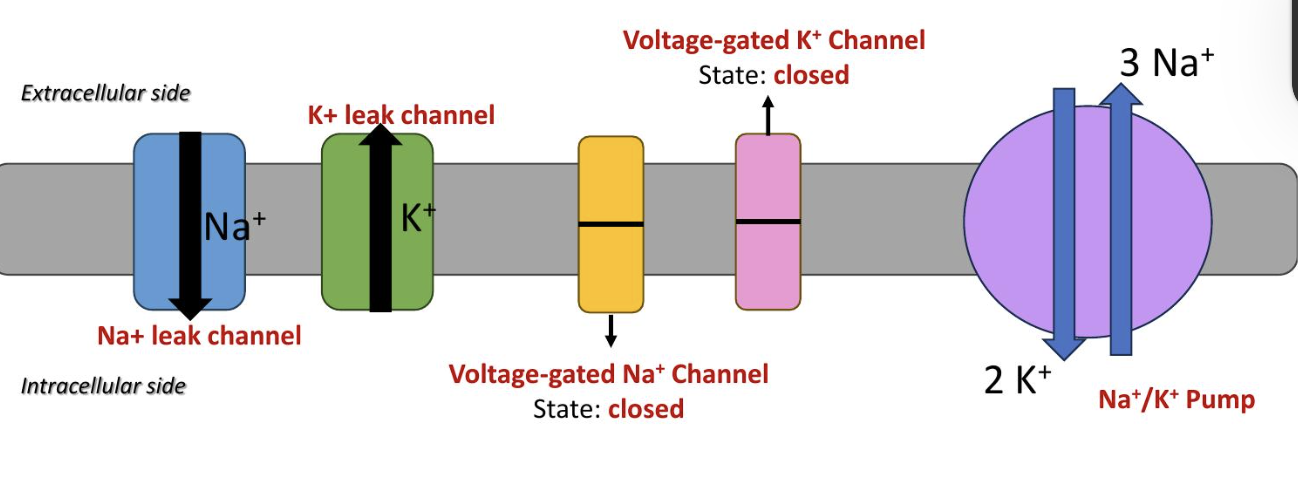
If the resting potential has a charge difference across the member, it’s ____
Polarized