micro preclass, in class, slides
 Call Kai
 Learn
Learn Practice Test
 Spaced Repetition
 Match
Match Flashcards
 Knowt Play
1/33

There's no tags or description
Looks like no tags are added yet.
Name | Mastery | Learn | Test | Matching | Spaced | Call with Kai |
|---|
No analytics yet
Send a link to your students to track their progress
34 Terms
Answer the following questions regarding revealed preference.
(a) If you observed a household choosing bundle A when bundle B was available, can you conclude that bundle A is revealed preferred to bundle B?
b) Suppose Dan chose to dine at a different restaurant each night. Assuming prices remain constant along with Dan’s income, does his choice violate the Strong Axiom of Revealed Preference?
(c) Priyanka is observed to purchase 𝑥ଵ = 1, 𝑥ଶ = 2 at prices 𝑃ଵ = 4, 𝑃ଶ = 8. She is also observed to purchase 𝑥ଵ = 2, 𝑥ଶ = 1 at prices 𝑃ଵ = 12, 𝑃ଶ = 6. Are her preferences consistent with the Weak Axiom of Revealed Preference?
a)Yes, it is, but only if we assume the household had the income necessary to purchase bundle B.
(b) Yes. If Dan’s preferences remain unchanged, then going to a different restaurant each night would result in cyclical preferences.
c)
Situation | P₁ | P₂ | x₁ | x₂ |
|---|---|---|---|---|
Bundle A | 4 | 8 | 1 | 2 |
Bundle B | 12 | 6 | 2 | 1 |
In Situation 1 — she spent £20 on Bundle A. Bundle B only cost £16. → Bundle B was affordable but rejected → she revealed she prefers A over B
In Situation 2 — she spent £30 on Bundle B. Bundle A would cost £24. → Bundle A was affordable but rejected → she revealed she prefers B over A
If bundle A is chosen when bundle B was affordable, then bundle B should never be chosen when bundle A is affordable.
Here we have:
A revealed preferred to B (Situation 1)
B revealed preferred to A (Situation 2)
This is a direct contradiction — a preference cycle: A ≻ B and B ≻ A simultaneously.
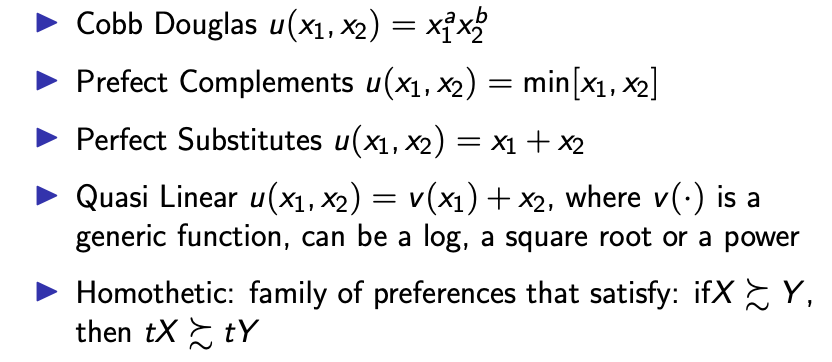
In economic theory, there are a few preferences/utilities which are widely used:
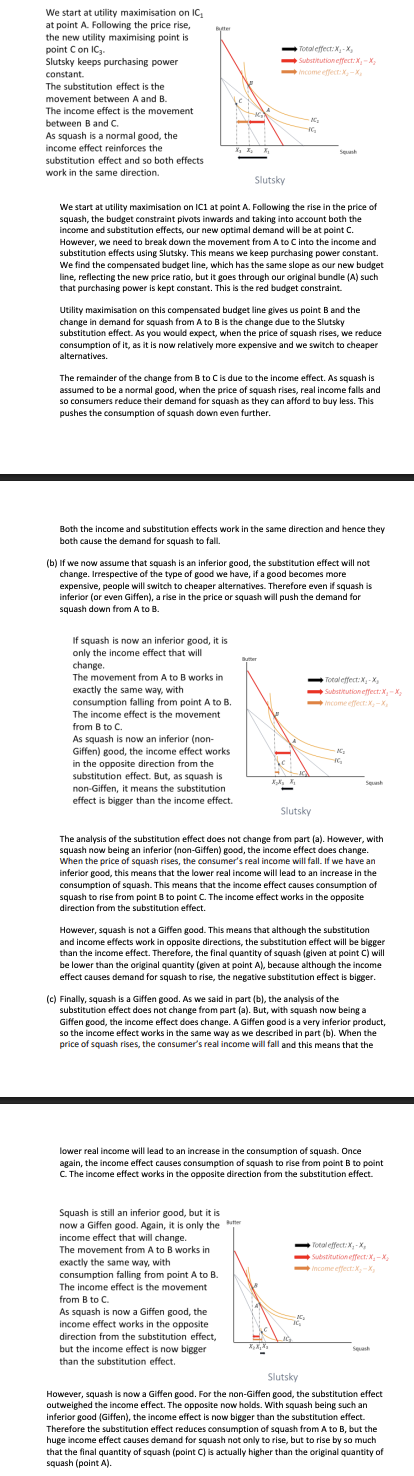
Consider a utility maximising consumer who is choosing the optimal bundle of butter and squash. There is a rise in the price of squash.
(a) Using a diagram, illustrate both the substitution and income effects if we use the Slutsky form of compensation and assume that squash is a normal good.
(b) How do the substitution and income effects change if squash is an inferior (nonGiffen good)?
(c) What about if squash is a Giffen good?
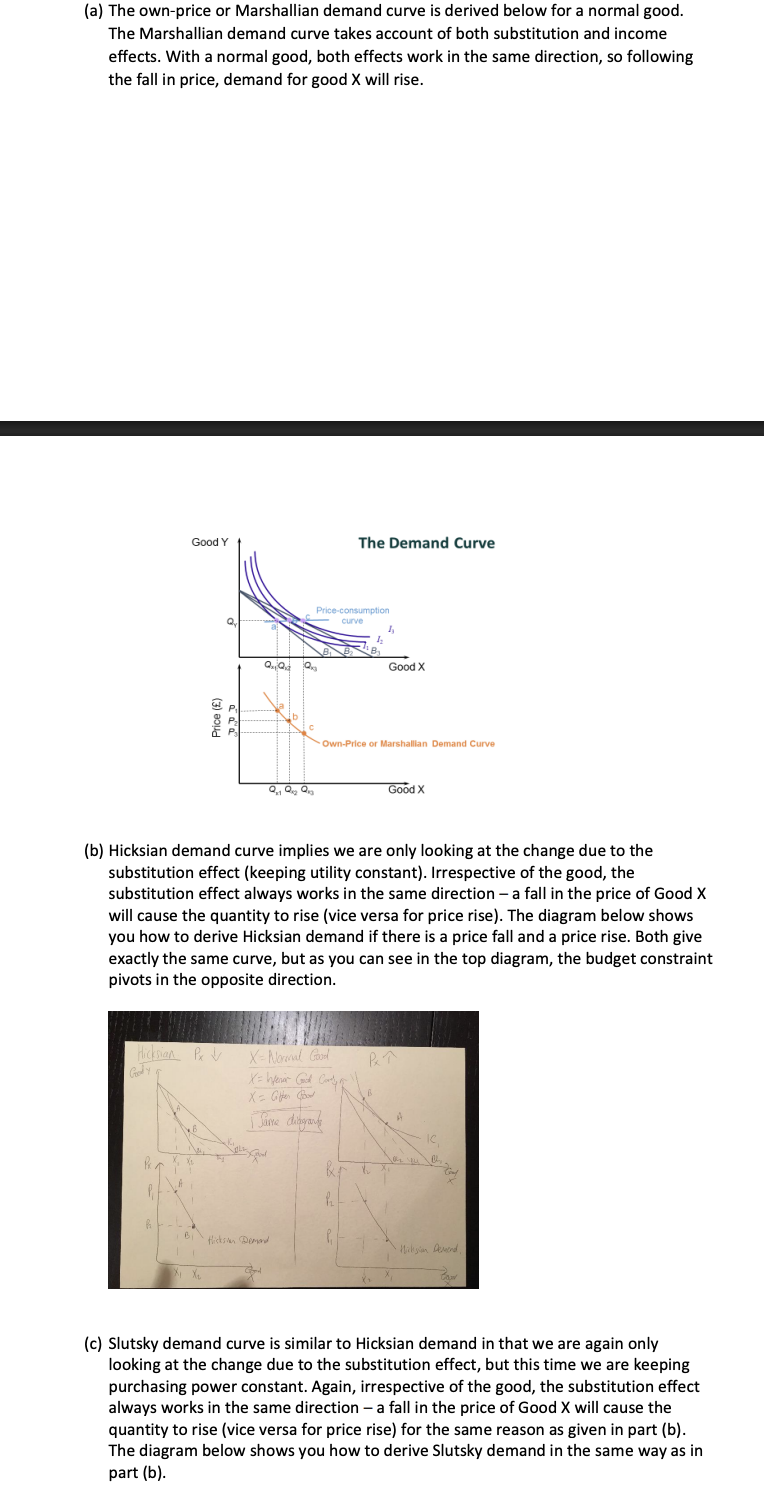
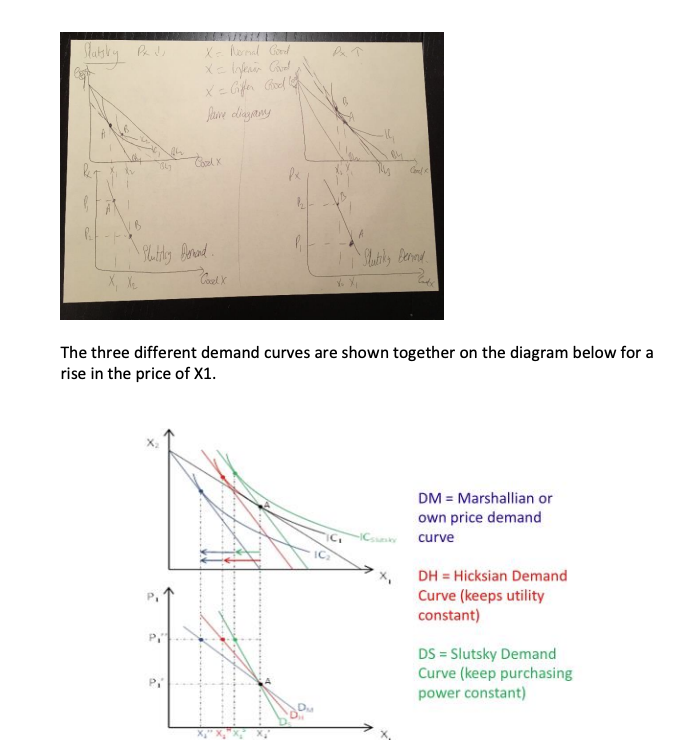
Consider a consumer who has preferences over goods X and Y that satisfy the normal assumptions and have a utility function of the form 𝑈(𝑋, 𝑌) = 𝑋 𝛼𝑌 1−𝛼 . Derive the following demand curves for good X, assuming that X is a normal good and explain the difference between them.
(a) Marshallian demand curve
(b) Hicksian demand curve
(c) Slutsky demand curve
how will the shape of each demand curve change if we had a different utility function such that good X is: (a) An inferior (non-Giffen) (b) An inferior (Giffen) good.
CV vs EV
The amount of income that is paid or taken from consumers under these two methods is typically not the same and hence the Compensating variation is typically not equal to Equivalent Variation. This is because the amount you’re willing to pay to avoid a price change is not equal to the amount you need to be compensated after a price change. £1 buys us different things depending on the price level. If prices are £1 and you have £10 of income, then you can buy 10 units. If prices now rise to £2 then that £10 of income is worth less. Compensating variation considers compensation at new prices, whereas equivalent variation considers compensation at old prices, hence the amount of compensation will be different, because prices are different and £1 of income is worth differing amounts at different prices. The only time when they will be the same is for quasilinear tastes, where the indifference curves are parallel and there is no income effect.
CV=EV for the good that enters non linearly under quasilinear preferences. this is cuz its not effected by incoe. also equals change in CS
Q1: What is the difference between risk and uncertainty?
Risk occurs when we know the probability distribution. Uncertainty occurs when we don’t know the probability distribution.
Q2: Why do we need to talk about expected utility and expected value separately?
Expected value looks at the outcome in terms of income based on the probability of the various events occurring. This gives a given level of income with risk attached to it. The utility from having that income with certainty is likely to be different from having that same level of income with risk. The expected utility looks at the utility from the risky outcomes and hence finds the expected utility from having a given outcome with risk attached to it.
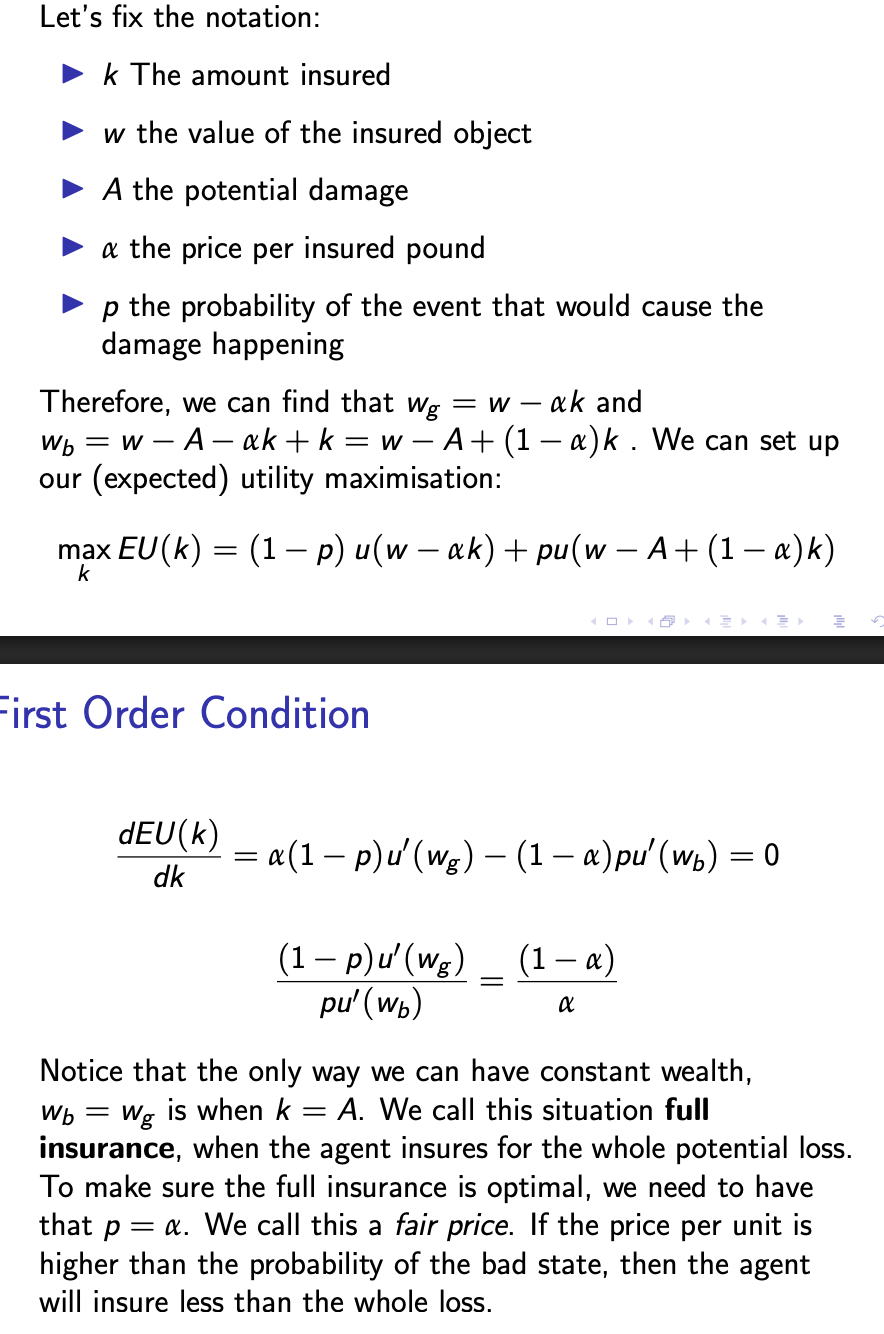
insurance general notation
What do we mean by asymmetric information and what are the two main problems that are created?
Asymmetric information refers to the idea that one side of the transaction has more or better information than the other side. The two main issues are moral hazard and adverse selection. Moral hazard refers to hidden action and adverse selection refers to hidden knowledge.
Asymmetric information can make insurance policies actuarially unfair. Explain the main problems that insurance companies face and why each of the issues is likely to cause premiums to rise.
The problems of asymmetric information are moral hazard and adverse selection. The first is hidden action and the second hidden knowledge. With adverse selection, consumers know better than the insurance company if they are a good or bad risk and can conceal this from the insurance company. Moral hazard occurs when you change your behaviour and do riskier activities knowing that someone else will cover your risk and any losses. The bad risks are the ones that buy and as the bad risks are buying the premium goes up. As the premium rises, more and more of the ‘less bad’ risks drop out, thereby pushing the premium up again. If the adverse selection was so bad, it could be that eventually premiums are so high that the market breaks down and insurance is no longer provided. If insurance companies anticipate moral hazard and believe that everyone becomes riskier, they will push up premiums to cover this added risk.
Explain how a signal can be used to successfully avert the problem of adverse selection. Is it possible that moral hazard and adverse selection could be consequences of a successful signal?
You can't simply say 'I am a good risk', because bad risks will also say that. A strong signal must have a lower cost for sellers of high quality goods than for low quality goods. For example, a full warranty is offered by high quality sellers. They will offer it, because they're confident that the car is good so it won't be needed. Bad quality sellers won't offer one, because the car is more likely to break down and hence it will cost them. But, a warranty may lead to moral hazard. The performance of the car after sale is partly determined by the quality of the car at the time of sale, but also determined by how it's driven once sold. If a full warranty is offered, this gives the buyer an incentive to drive poorly, as they'll be covered. A full warranty therefore leads to more bad drivers and this costs the seller, because a claim is made on them. So the seller has an incentive to only offer partial warranties to avoid the moral hazard problem. But if the warranty is only partial, it's sending a signal to the buyer that the car isn't as good a quality, so we're back to the adverse selection problem.
Using an example, explain why general equilibrium analysis is important, especially in terms of the effects of government policy.
A change in government policy in one area (say an increase in fuel duty) and how this might have knock on effects in other markets. General equilibrium is important because it considers spillover effects, which partial equilibrium analysis ignores. So if there is a change in fuel duty, partial equilibrium analysis would look only at the change in demand for fuel. It would ignore the impact on other markets due to changes in relative prices and also due to wealth effects, whereas general equilibrium looks at these effects and hence it ensure that we don’t miss these important spillover effects
Which of the following is true within exchange economies? (i) All efficient allocations lie in the set of core allocations. (ii) All core allocations are efficient. (iii) The set of efficient allocations can be defined without knowing individual endowments. (iv) In a 2-person exchange economy, the core is equal to the set of efficient allocations that is also mutually beneficial relative to initial endowments.
E. (ii), (iii) and (iv). Efficient allocations are allocations such that no change in the allocation can make someone else better off without making anyone else worse off is possible. The definition has nothing to do with endowments. A core allocation is one that cannot be “blocked” by a coalition that can do better on its own. All core allocations must be efficient because any inefficient allocation can be blocked by the coalition of everyone, but further efficient allocations may lie outside the core, but still on the contract curve.
Assume that the contract curve is equal to the line connecting the lower left and upper right corners of the box. (a) Begin with a depiction of an equilibrium. Can you change the shape of your indifference curve such that the equilibrium disappears (despite the fact that the contract curve remains unchanged)? (b) True or false: The existence of a competitive equilibrium in an exchange economy cannot be guaranteed if tastes are not convex. Provide an explanation to your answer. (c) Suppose an equilibrium does exist even thought my tastes are not convex. True or false: The first welfare theorem holds even when tastes are not convex. Provide an explanation to your answer. (d) True or false: The second welfare theorem holds even when tastes are not convex. Provide an explanation to your answer.
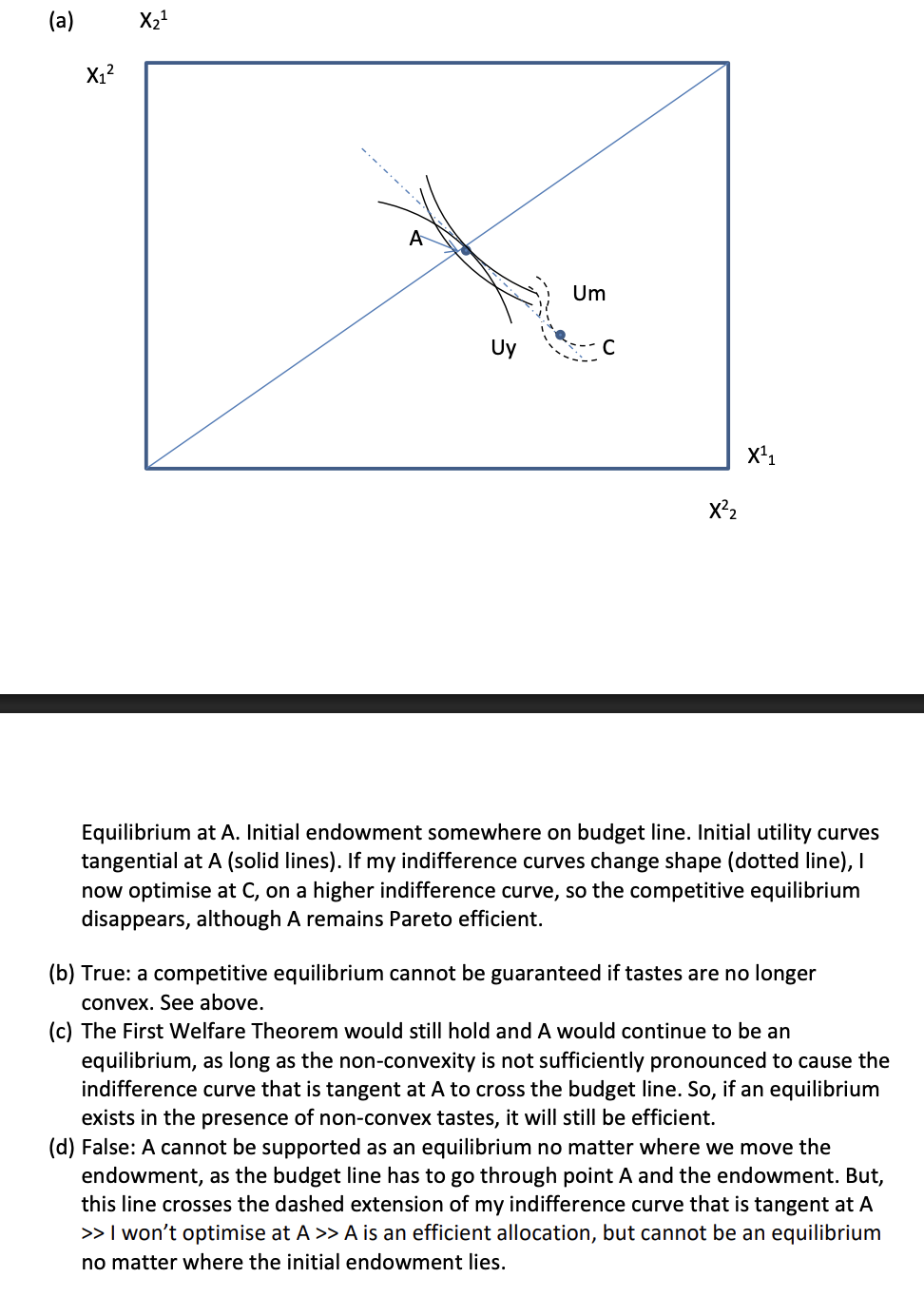
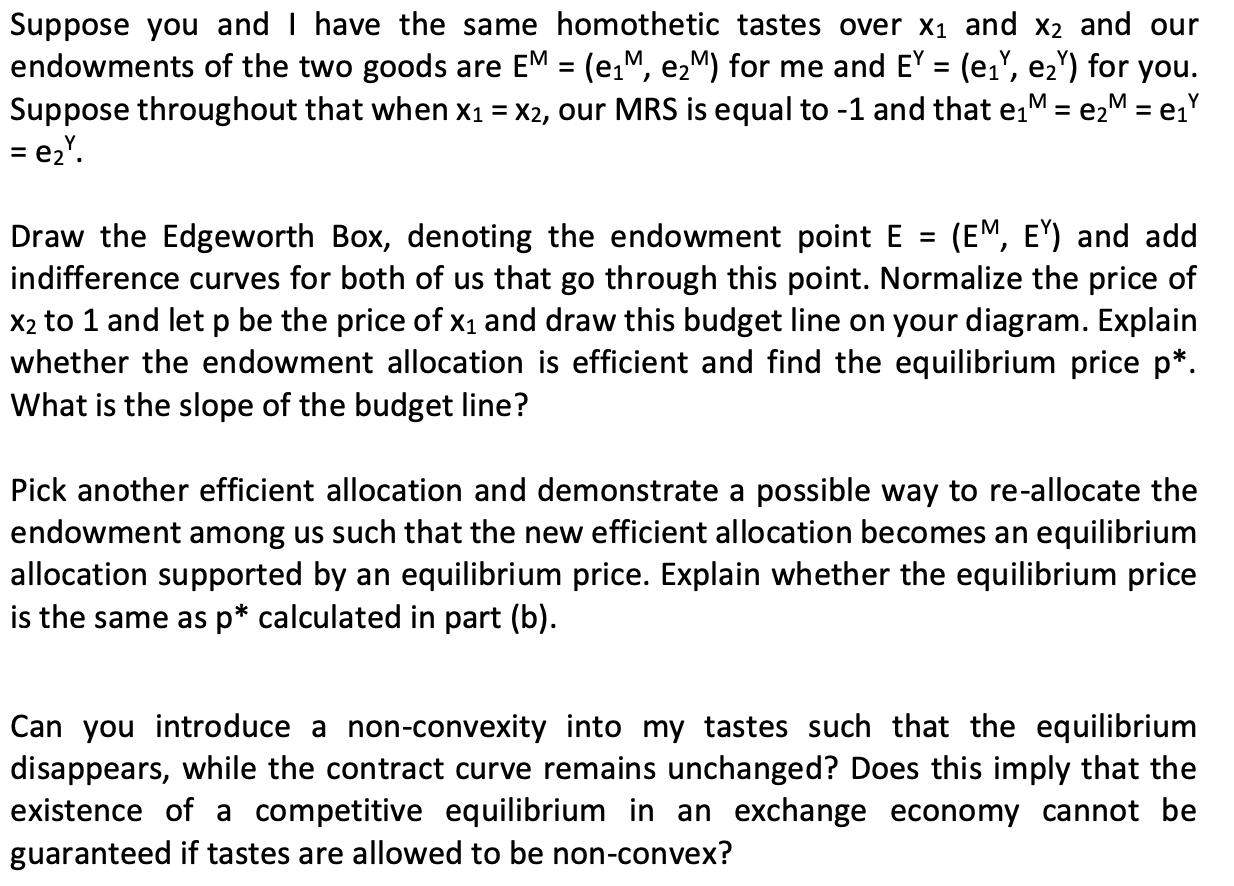
E is still efficient, but when faced with the budget line that previously supported E as an equilibrium, I now no longer optimize at E, as I can now get to a higher indifference curve and would want to optimise at point Z. Therefore if tastes are allowed to be non-convex the existence of a competitive equilibrium in an exchange economy cannot be guaranteed. The degree of convexity does mean that E could still be the competitive equilibrium, but it can’t be guaranteed.
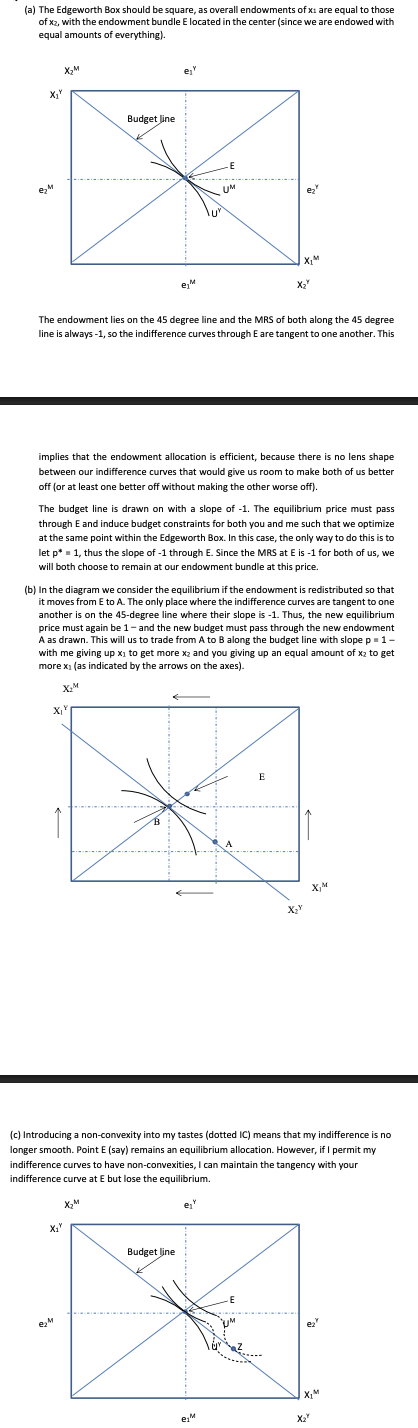
Consider an allocation of resources such that one person in our 2 person economy has all of both goods. Discuss the view that there will always be trade-off between efficiency and equity by re-allocating goods in this way. Does the Second Welfare Theorem necessarily break down?
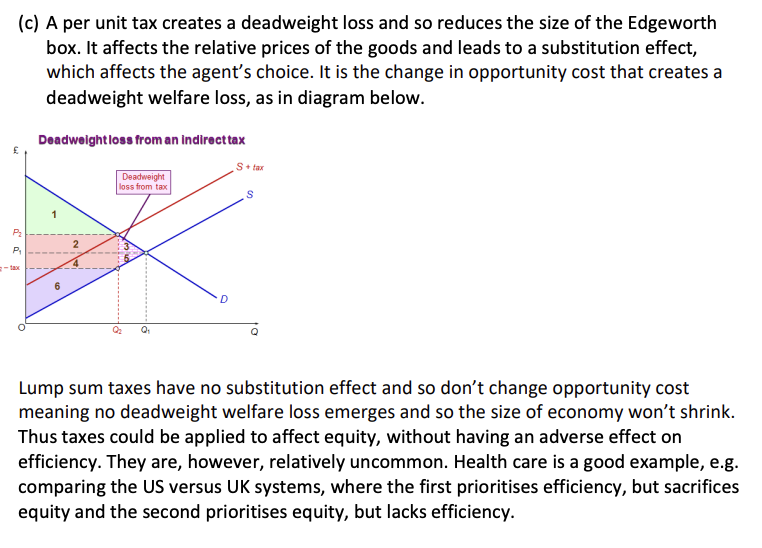
The initial endowment where one person (say Peter) has everything is still Pareto efficient, but it is certainly not what society would call equitable. If a per-unit tax is imposed on Peter, this will affect the relative price of the goods. Redistribution will move goods from Peter to the other consumer (say Jessica), thus improving equity, but a deadweight loss is likely to occur through taxation, hence reducing efficiency. The type of tax will have an impact – a lump sum tax won’t affect the opportunity cost of consuming, as it doesn’t change the price ratio and hence there would be no substitution effect. If we impose a tax on particular good then this affects the price ratio and hence agent’s choices and thus it will be distortionary, e.g. supply of labour and will create a deadweight welfare loss, thus reducing the size of the Edgeworth Box – the Second Welfare Theorem would now break down. If there is no deadweight loss, then the Second Welfare Theorem could continue to hold.
What role does information play in Akerlof’s paper?
Can the conclusions of Akerlof’s paper be applied to other markets?
What solutions exist to the problems that emerge from the lemons market? How effective are they likely to be?
As information asymmetries increase, will the gains from trade continue to decline?
Role of Information
Sellers know quality; buyers don't → adverse selection
Buyers offer average price → good sellers exit → market quality falls → prices fall → more exit → market collapse
Information absence destroys the price mechanism itself
Market | Asymmetry |
|---|---|
Labour | Workers know productivity; employers don't |
Credit | Borrowers know risk; banks don't |
Insurance | Policyholders know health; insurers don't |
Online retail | Sellers know condition; buyers don't |
Solutions & Effectiveness
Signalling — warranties, qualifications, brands ✅ effective if costly to fake
Screening — credit checks, medical exams ✅ but costly
Certification — third-party inspection (HPI, Kitemark) ✅ if enforced
Reputation — reviews, repeat trading ⚠ fake reviews undermine this
Regulation — consumer protection laws ⚠ enforcement varies
More asymmetry → lower willingness to pay → fewer trades → fewer gains
Extreme asymmetry → full market collapse
Not always linear — institutions and technology can slow decline
The typical Market for Lemons assumes that the buyers are uniformed, but that the sellers are informed. Akerlof states that: ‘After owning a specific car for a length of time, the car owner can form a good idea of the quality of this machine, i.e. the owner assigns a new probability to the event that his car is a lemon’ (p. 489). What might happen to Akerlof’s model and conclusions if all sellers are not necessarily fully informed? That is, some sellers may have owned a car for many years and thus be well informed, others may not have owned the car for long enough and hence share the buyer’s imperfect information. Is the problem of asymmetric information relevant in health insurance markets?
Some sellers (recent owners) barely know more than buyers
Uninformed sellers may accidentally sell peaches → market doesn't collapse as fully
But buyers face compound uncertainty — quality and seller knowledge unknown
Warranties lose credibility — can't distinguish confident good seller from unknowingly bad seller
Independent inspection becomes more valuable
Classic adverse selection: healthy people opt out → pool deteriorates → death spiral
Solutions: Mandatory coverage (ACA mandate, NHS), community rating, guaranteed issue
Moral hazard: Once insured, people take less care — separate but related problem
Doctor-patient asymmetry: Doctors know more → risk of supplier-induced demand
NHS solves adverse selection by design — everyone in the pool by default
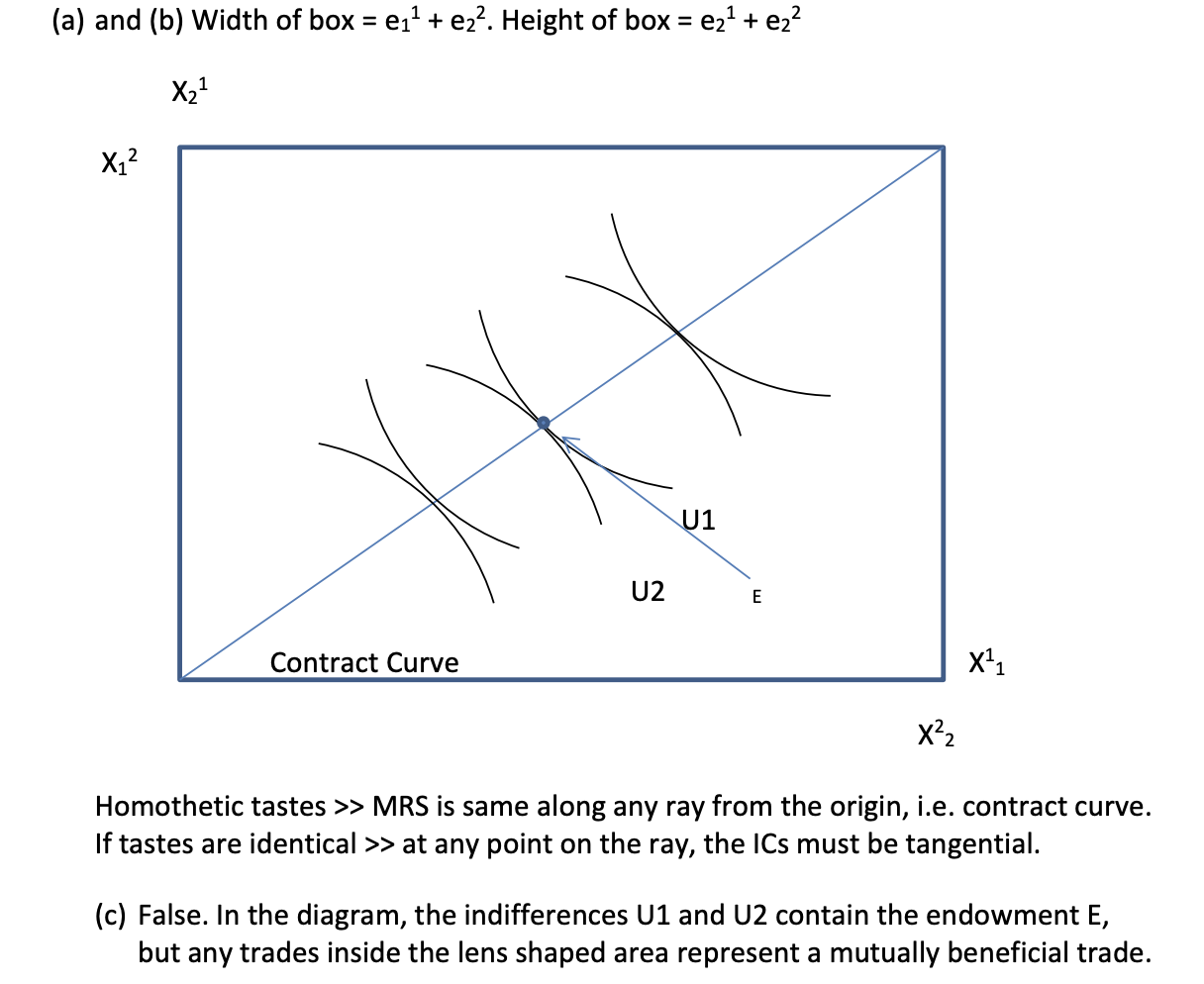
Consider a 2-person/2-good exchange economy in which person 1 is endowed with (e1 1 , e2 1 ) and person 2 is endowed with (e1 2 , e2 2 ) of the goods x1 and x2. Suppose that tastes are homothetic (ratio of MRS depends only on ratio of 2 goods) and convex for both individuals. (a) Draw the Edgeworth Box for this economy, indicating on each axis the dimensions of the box. (b) Suppose that the two individuals also have identical tastes. Illustrate the contract curve – i.e. the set of all efficient allocations of the two goods. (c) True or False: Identical tastes (not necessarily homothetic) in the Edgeworth Box imply that there are no mutually beneficial trades.
Outline the First and Second Welfare Theorems. (b) How can we use them to analyse the trade-off (if one exists) between efficiency and equity?
(c) The Second Welfare Theorem relies on redistribution having no adverse effect on the size of the economy. Why would a lump sum tax and a per unit tax have differing results on the size of the economy and thus on the usefulness of the Second Welfare Theorem? Use a diagram to support your answer.
(a) The First Welfare Theorem says that competitive equilibria are efficient. In the Edgeworth Box all allocations on the contract curve are efficient. The 1st theorem must hold, because equilibrium allocations will lie where both individuals optimise on the same budget line at the same point and thus their indifference curves are at a tangent, meaning we have Pareto efficiency. Second Theorem says any efficient allocation can be competitive if government can redistribute endowments and not shrink the economy in the process.
(b) The government may choose a particular Pareto efficient outcome, perhaps that is more equitable than the endowment or than another allocation of the goods. Therefore, the government is choosing a particular outcome for equity objectives. However, to get to that outcome, the government may need to redistribute resources and in doing so may cause the size of the economy to shrink. When government redistributes endowments a deadweight loss is likely to occur. This is especially true when a per unit tax is imposed, as it affects the relative prices of the goods and thus the opportunity cost >> it will be distortionary. So a more equitable allocation could be achieved but only by sacrificing efficiency. Thus, if the government wants to improve equity by taxing one individual and redistributing to another, efficiency may have to be sacrificed. Examples of this trade-off are evident in many areas of government policy, such as education and health care.
Q1: Why can monopolists sustain supernormal profits in the long run?
A monopolist will be protected by barriers to entry. This prevents new firms from entering the market and so if a monopolist makes supernormal profits in the short run, they can be sustained in the long run as well.
Q2: Why does a monopolist produce on the elastic portion of the demand curve?
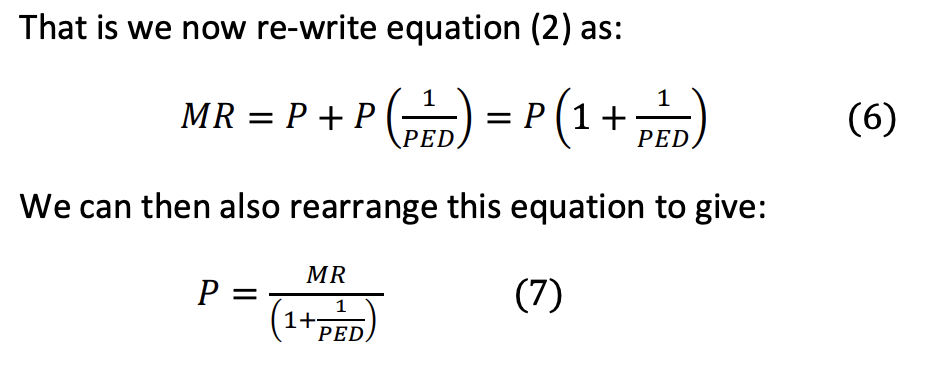
A monopolist faces a downward sloping demand curve and hence marginal revenue is also downward sloping and twice the gradient of demand. When MR = 0, PED is unitary elastic. At lower quantities than this point, demand will be relatively elastic. At points to the right of unitary elastic, demand will be relatively inelastic. This means that the monopolist must produce on the elastic portion of demand as it is only at these quantities when marginal revenue is positive. If a firm maximises profits when marginal revenue equals marginal cost, then marginal revenue and marginal cost must be positive and thus, profit maximising quantity must occur when demand is relatively elastic.
MR in terms of PED
To define a game, we need:
A set of players: who is actually playing the game
▶ A set of strategies for each player: what each player can do
▶ Timing: when each player is asked to play
▶ Information: what each player know at each stage
▶ Payoffs: a function that for each player, given some stategies played by each agent, tells a numerical value for their outcome;
In the Prisoners dilemma case, we have a Nash Equilibrium in dominant strategies. So, why is it that interesting?
Inefficiency: the Nash equilibrium is not Pareto Efficient (actually quite common in many games, why?)
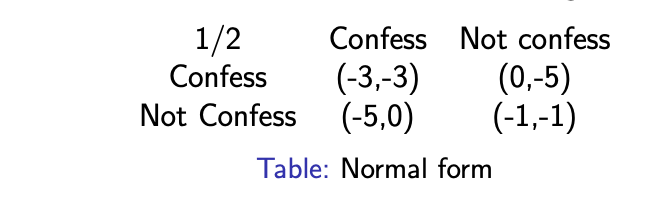
applying sequerntiality to prisoners dilemma, finite vs infinite
Let’s apply subgame perfection to this case. If we consider the last repetition in isolation, we know that players won’t cooperate. At the second last stage, ”future is written” (we know they both won’t coordinate tomorrow), so they will defect today as well. Repeat this up to the beginning, and the only SPE is always non cooperating. There is no further reward for cooperating at any stage, and therefore we can’t find any device that would sustain cooperation.
Here things get trickier. If we repeat the game infinitely many times, we can’t use the subgame method. Moreover, the number of strategies explodes. To give some insights into the problem, here are Ginger breads. Few of the strategies that can be played here:
▶ Always Cooperate / Always Defect
▶ Tit for Tat: copy what your opponent has done in previous turn
▶ Grim Trigger: Cooperate as long as the other cooperates. After one deviation, punish forever.
What is the difference between the Cournot Model, the Stackelberg Model, the Bertrand model and the model of price leadership?
Under the Cournot model, quantity is the strategic variable, but firms set quantity simultaneously. Under the Stackelberg model, quantity remains as the strategic variable, but this time firms are setting quantity sequentially, so we have a first mover. Under the Bertrand model, it is now price that is the strategic variable and prices are set simultaneously; whereas under the price leadership model, prices are set sequentially, so again we have a first mover.
If, as a government, we can’t rely on marginal benefits, then we might want to elicit preferences from individuals. How can aggregate them?
1. Voting: we ask individuals to rank alternatives, and then choose a rule to aggregate individual preferences into one social choice/ranking. Issues: results are not independent of the method (tie breaking rules), Arrow Impossibility theorem
2. Construct Social preferences: take individual utility functions and aggregate them. For example, we can derive a utilitarian/benthamian social welfare ( weighted sum of utilities) or a rawlsian social welfare (pick the minimum utility each agent get) for each alternative and choose the one that maximise the social welfare function.
Consider the case of a positive consumption externality.
a)same demand curve but one that has a fairly inelastic and one that has a fairly elastic supply curve. In which case is the market output closer to the optimal output?
b) Does the Pigouvian subsidy that would achieve the optimal output level differ across your two graphs that you drew in the first part to this question?
(c) True or false: While the size of the Pigouvian subsidy does not vary as the slopes of the demand and supply curves change, the level of under-production increases as these curves become more elastic.
d) in each case who benefits more producers or consumers
a) inelastic supply
b) No, it does not. In each case, the marginal social benefit associated with externality is k for all output units, which implies the optimal Pigouvian subsidy is s = k in both cases. Elasticity affects quantity produced but not the size of the subsidy needed
c) TRUE — both parts are correct. more inelastic, closer to qopt
d) This result always holds for subsidies: the side of the market that behaves relatively more inelastically will get the bulk of the benefit of a subsidy.
The Coase Theorem is often applied in court cases where the parties seek to clarify who has the right to do what in the presence of externalities. Consider the case of an extension to my house that will cast a shadow over your swimming pool. Suppose that my benefit from the extension is b and the cost you incur from my shadow is c. Also, suppose that transaction costs are zero. (a) Suppose that both you and I know what b and c are. If this is the case, why don’t we just get together to settle the matter over a coffee rather than going to court?
(b) If the judge (who has to decide whether I have the right to build the extension) also knows b and c, propose a sensible and efficient rule for him to use to adjudicate the case.
(c) Judges rarely have as much information as plaintiffs and defendants. It is therefore reasonable for the judge to assume that he cannot easily ascertain b and c. Suppose he rules in my favour. What does Coase predict will happen?
(d) What if instead the judge rules in your favour?
(e) In what sense will the outcome always be the same as it was in the second part of this question – and in what sense will it not?
(a) We end up going to court (according to Coase) because of the ambiguity as to who has the right to do what. If we don’t know who has the rights, we need someone to clarify the property rights and hence end up going to court.
(b) The judge might simply follow the rule that he will adjudicate in my favour whenever b > c and in your favour whenever b < c. This implies that the efficient solution will emerge. This is the case because it is efficient for me to build the addition when b > c and it is efficient for me not to build it if b < c.
(c) What will happen depends on whether b > c or b < c. If b > c, it is cheaper for you to incur the cost c than to try to convince me to not build the addition – because you would have to pay me at least b to stop building whilst the cost of my addition to you is only is only c. Thus, you will simply go home and let me build my addition. If, on the other hand, b < c, then you can offer me an amount between b and c that will be worth more to me than the addition while costing you less than the cost c you would incur if the addition were built. Thus, you will offer me an amount sufficient to get me to stop building the extension.
(d) If he rules in your favour then no extension can be built unless I obtain your consent. If b < c, I will not be able to offer you enough for you to give your consent and for me to be better off than simply not building the addition. This is because I would have to give you at least c but the addition is worth only b < c to me. Thus, if b < c, the extension will not be built. If b > c, then I can offer you an amount between b and c with the amount higher than the cost you incur from the shadow on the pool but lower than the benefit I get from the extension. Thus, if b > c the extension will be built after I make a payment to you to get your consent.
(e) The outcome will be the same in the sense that the extension will be built when b > c and is not built when c > b. The outcome is not the same however for the participants. If the judge rules in my favour and it is efficient not to build the addition (because b < c) then you incur a cost of at least b to prevent me from building. But, if the judge had rules in your favour when b < c, you would have made no such payment. The opposite would also hold.
What are the assumptions that we use to give us rationality? Explain the meaning of each.
Rationality requires preferences to be continuous, complete and transitive. • Completeness means that we can always compare or rank bundles. It is not possible to say that you cannot compare 2 bundles. Thus, X is preferred to Y, or Y is preferred to X, or you are indifferent between bundles X and Y. • Continuous means that tiny changes in bundles will not change the ordering of preferences. • Transitivity means that if bundle A is preferred to bundle B and bundle B is preferred to bundle C, then it must be the case that bundle A is preferred to bundle C
What assumptions do we use to give us well-behaved preferences? Explain the meaning of each.
Well-behaved preferences require preferences to satisfy the assumptions of convexity and monotonicity. • Convexity means that averages are better than extremes. Take two bundles of goods, which are ‘extreme’ bundles: that is one bundle has lots of one good but little of the other and the second bundle has the opposite. The consumer would prefer an average of these two bundles to either of these bundles – any bundle on the chord that joins the two average bundles would lie in a preferred area. • Monotonicity means that more is better. A consumer will always prefer to have more goods in a bundle. If a consumer is offered a choice between two bundles of goods and both bundles have the same quantity of one good, but different quantities of the second good, then the consumer will prefer the bundle that has more of the second good, because more is always better
can cooperation in infite game always be sustained
15. False. Cooperation in infinitely repeated games can be sustained only if the discount factor δ is sufficiently high — specifically if the gain from defecting today is outweighed by the discounted cost of future punishment. If δ is below the threshold (e.g. δ < 1/2 in a standard Prisoner's Dilemma with cooperate=3, defect=5, punish=1), cooperation breaks down. With δ → 0 (players care only about today), cooperation cannot be sustained regardless of the punishment strategy.
why cant lagrange work for perf subs
lagrange finds points of tangecy but there are no such point for perf subs as indifference curves are linear. lagrange assunes differentiability, this isnt the case for perfect substitutes. there will always be either a corner solution for perfect substitues or in the case that slope of indifference curve equals budget constraint, prices r equal, infiite solutions