Ions
 Call Kai
 Learn
Learn Practice Test
 Spaced Repetition
 Match
Match Flashcards
 Knowt Play
1/12

There's no tags or description
Looks like no tags are added yet.
Name | Mastery | Learn | Test | Matching | Spaced | Call with Kai |
|---|
No analytics yet
Send a link to your students to track their progress
13 Terms
What are the three kinds of bonding?
Ionic, covalent, and metallic.
Define ‘ion’.
An atom or group of atoms with a positive or negative charge. This results from imbalanced numbers of protons and electrons.
Define ‘cation’ (cat-eye-on)
A positively-charged ion formed by a metal losing electrons.
(Theory: This is because many metals have few outer shell electrons.)
Define ‘anion’. (Onion/an-eye-on)
A negatively-charged ion formed by a non-metal gaining electrons.
What is the protocol for drawing an ion?
You can only show the outer shell electrons if you like. Atoms with no valence electrons left AFTER A REACTION can be left blank.
A bracket MUST be put around the ion and labelled with the ion symbol (e.g: 1+).
IF A BOND IS BEING SHOWN, an arrow MUST be drawn from the top of the outer shell of the atom losing electrons to the shell of the atom gaining electrons.
What would happen if sodium reacted with fluorine?
Electron configurations:
Sodium = 2, 8, 1
Fluorine = 2, 7
The two would react as sodium has one valence electron to lose, and fluorine has one valence electron to gain – which is easier for both as fluorine is highly reactive. This reaction would form an ionic bond. HOW TO WRITE IONS IS BELOW!
Symbols = Na1+ (one electron lost) AND F1- (one electron gained). This ionic bond formed a cation (sodium) and an anion.
What is an ionic bond?
A bond formed when electrons are transferred to a non-metal from a metal.
Sodium chloride would be an ionic bond because sodium is a metal but chlorine is not.
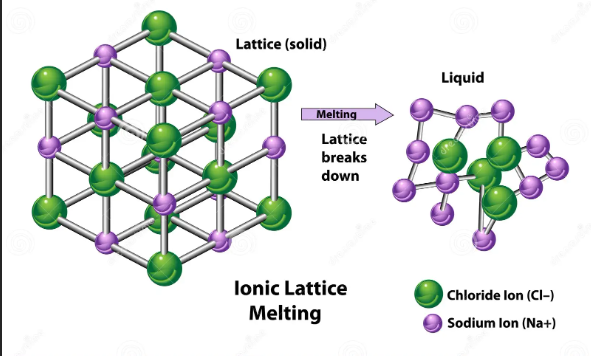
What is an ionic lattice?
A structure formed by a repeating arrangement of ions (NO TWO LIKE CHARGES TOUCH) held together by the strong electrostatic forces between the oppositely-charged ions.
IONIC LATTICES ARE MOST OFTEN SOLID!
What state do ions need to be in to conduct electricity?
They need to be able to move freely to allow an electric current to flow through. Solid ionic compounds do not conduct electricity.
What does ‘molten’ mean?
Melted. Water is molten ice.
Why is sodium chloride not able to conduct electricity as a solid but able to as a liquid?
Because the particles in a solid are in fixed positions, meaning that they cannot move to let an electrical current flow through as is required of ionic compounda that conduct electricity. Liquids, however, have particles that can move more freely, meaning that ionic compounds can conduct electricity in a liquid form.
Why do ionic compounds have higher melting points than their separate components?
Because the electrostatic forces are very strong; breaking them requires more energy.