CPrac D - Gas collection
 Call Kai
 Learn
Learn Practice Test
 Spaced Repetition
 Match
Match Flashcards
 Knowt Play
1/13

There's no tags or description
Looks like no tags are added yet.
Name | Mastery | Learn | Test | Matching | Spaced | Call with Kai |
|---|
No analytics yet
Send a link to your students to track their progress
14 Terms
Gas collection of data…
Mass of empty tube
Mass of tube + contents before heating (to determine amount of sample used)
Initial reading and final reading on the measuring cylinder (volume of gas collected)
Mass of tube + residue after heating (to determine mass loss)
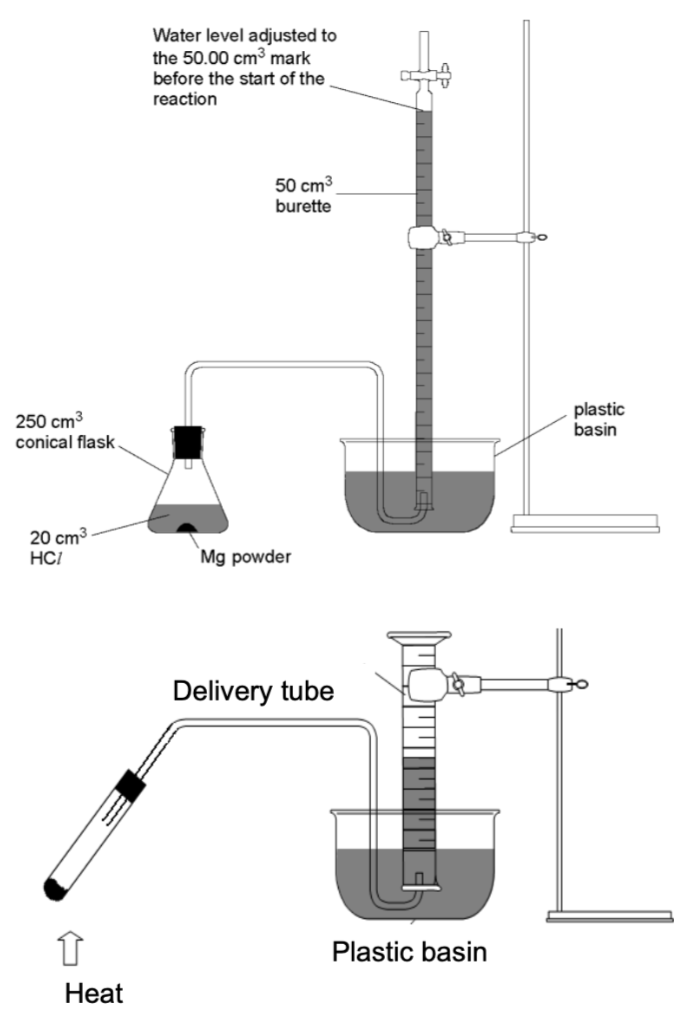
Why no squeeze the delivery tube while connecting the delivery tube to the tip of the burette
Prevent introduction of air bubbles -> volume of gas higher than actual
Describe and draw downward displacement
Slightly soluble or almost insoluble gases
Almost same density as air
Eg. O2, N2, CO, CO2, H2
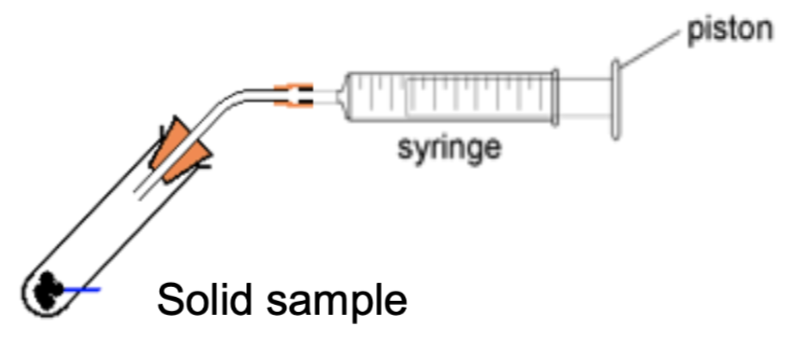
Describe and draw gas syringe
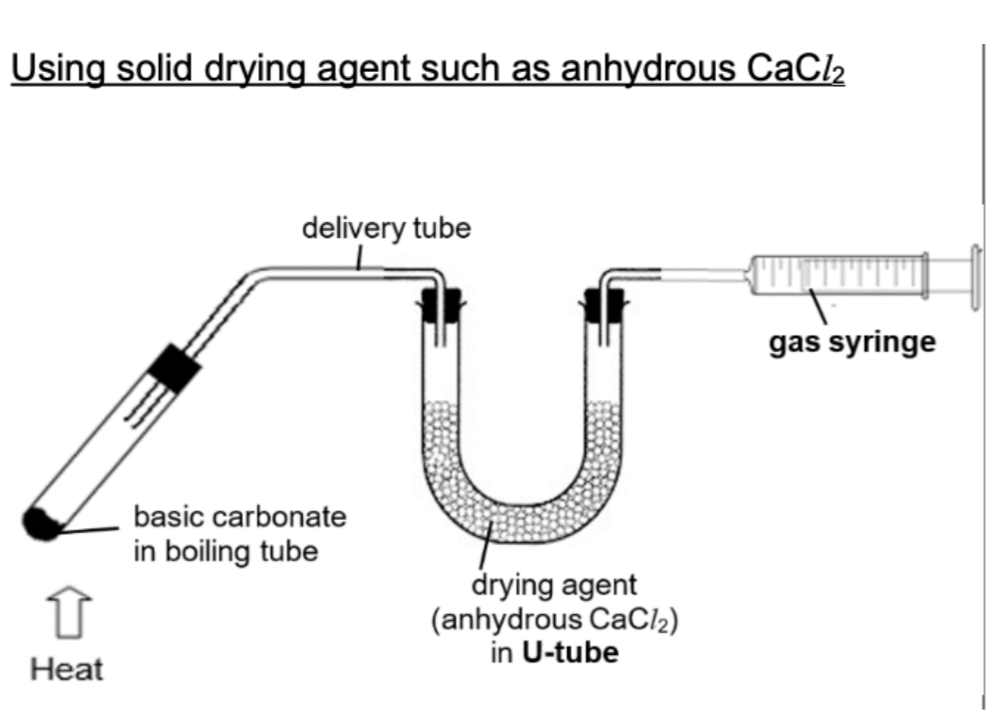
Collecting dry gases (almost same density as air)
Collecting and measuring volume of gases at regular time intervals (measure ROR)
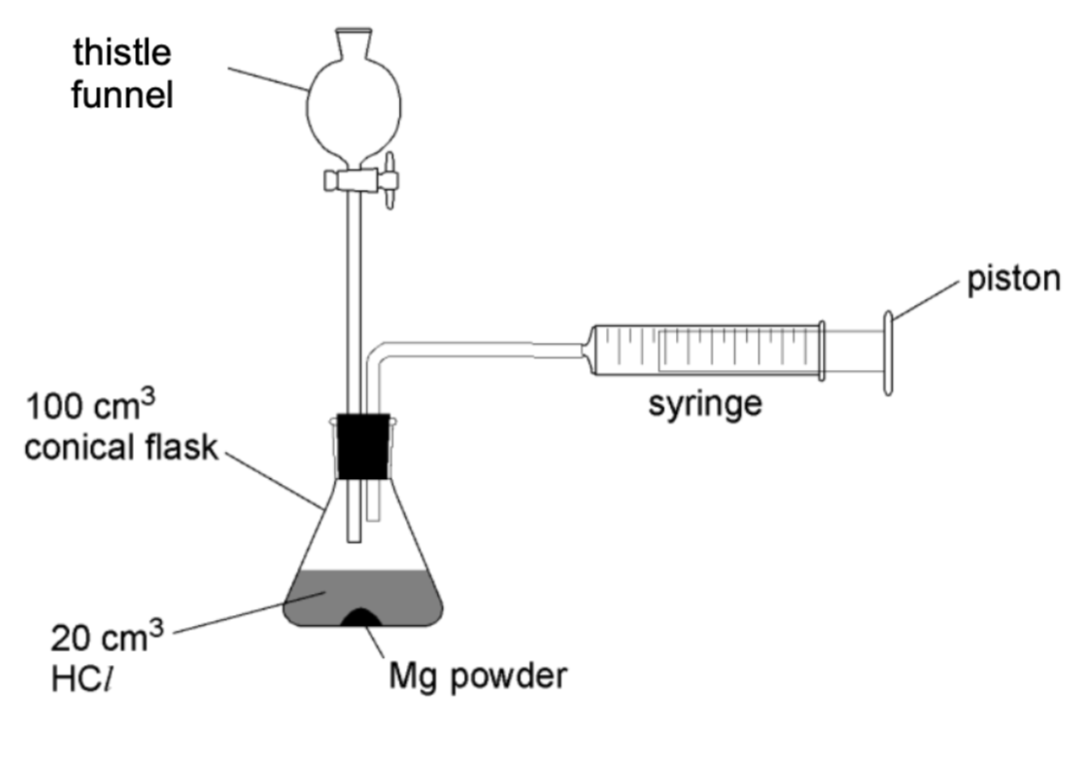
Use of thistle funnel
Ensures closed system at start of reaction -> no change of gas escaping
Even if you open and close stopper quickly, some gas will still escape
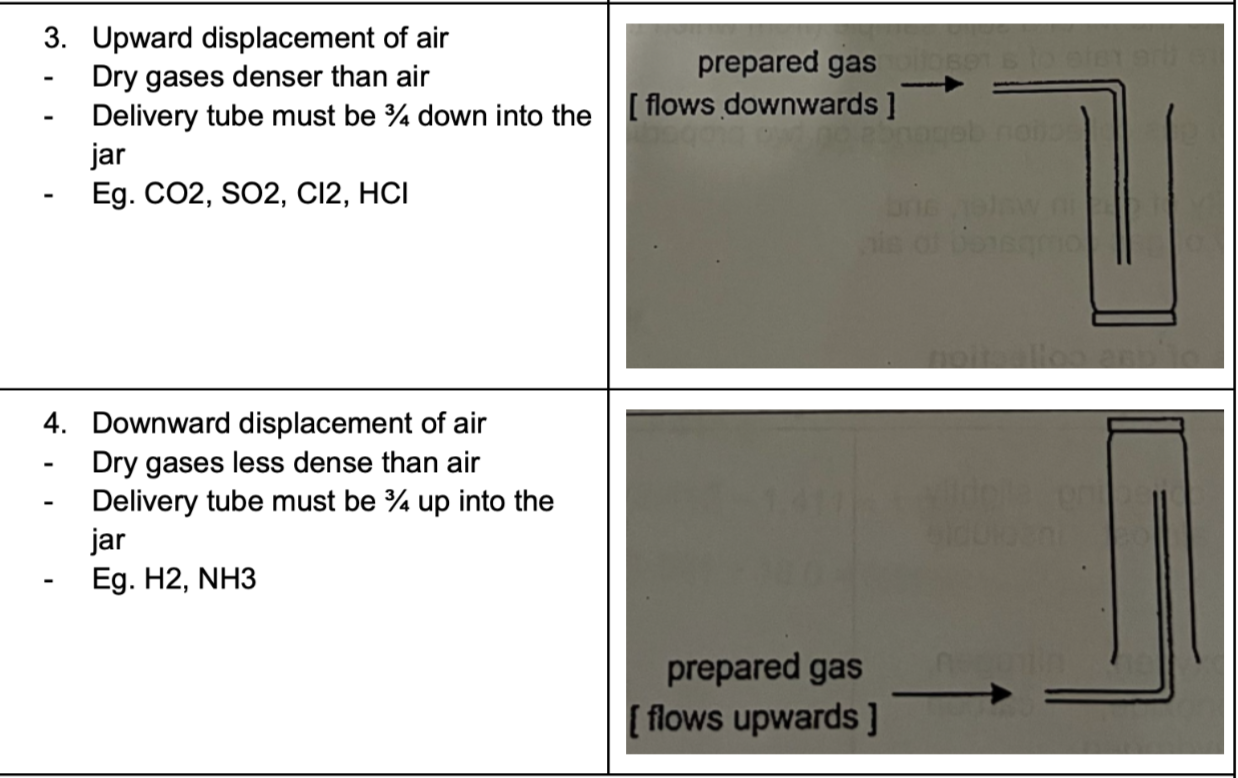
Describe upward and downward displacement of air
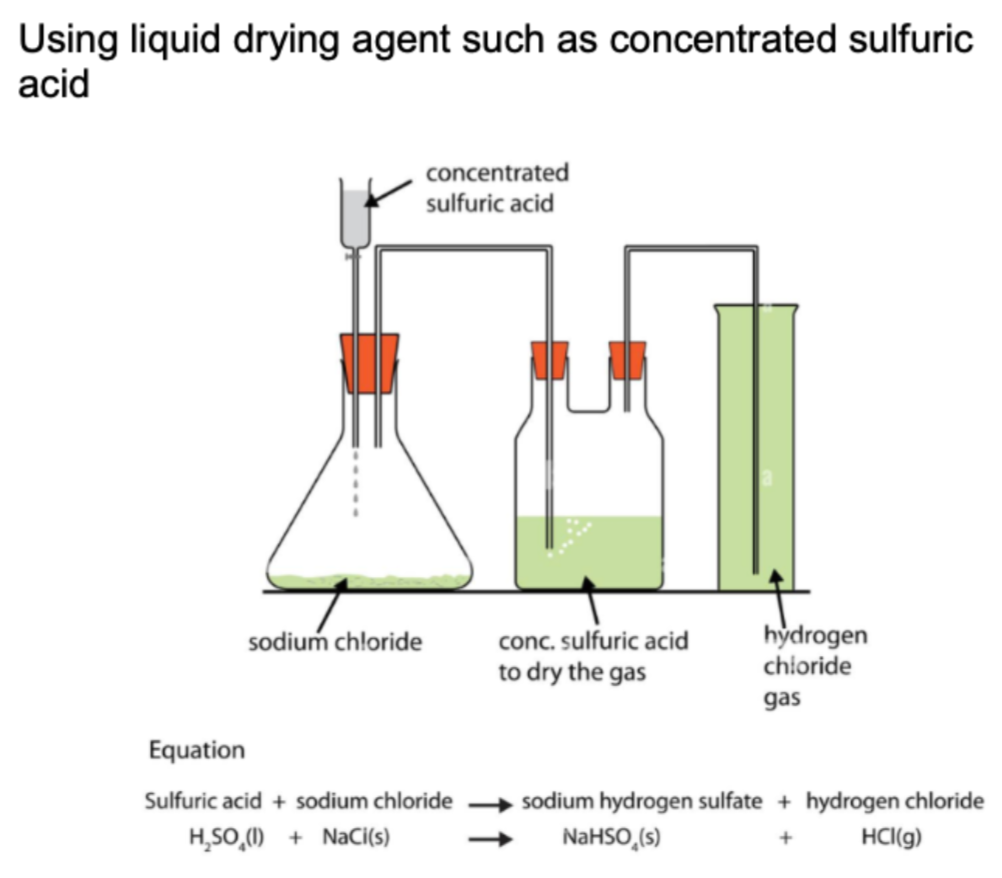
Draw drying agent (H2SO4)
Draw drying agent (andhydrous CaCI2)
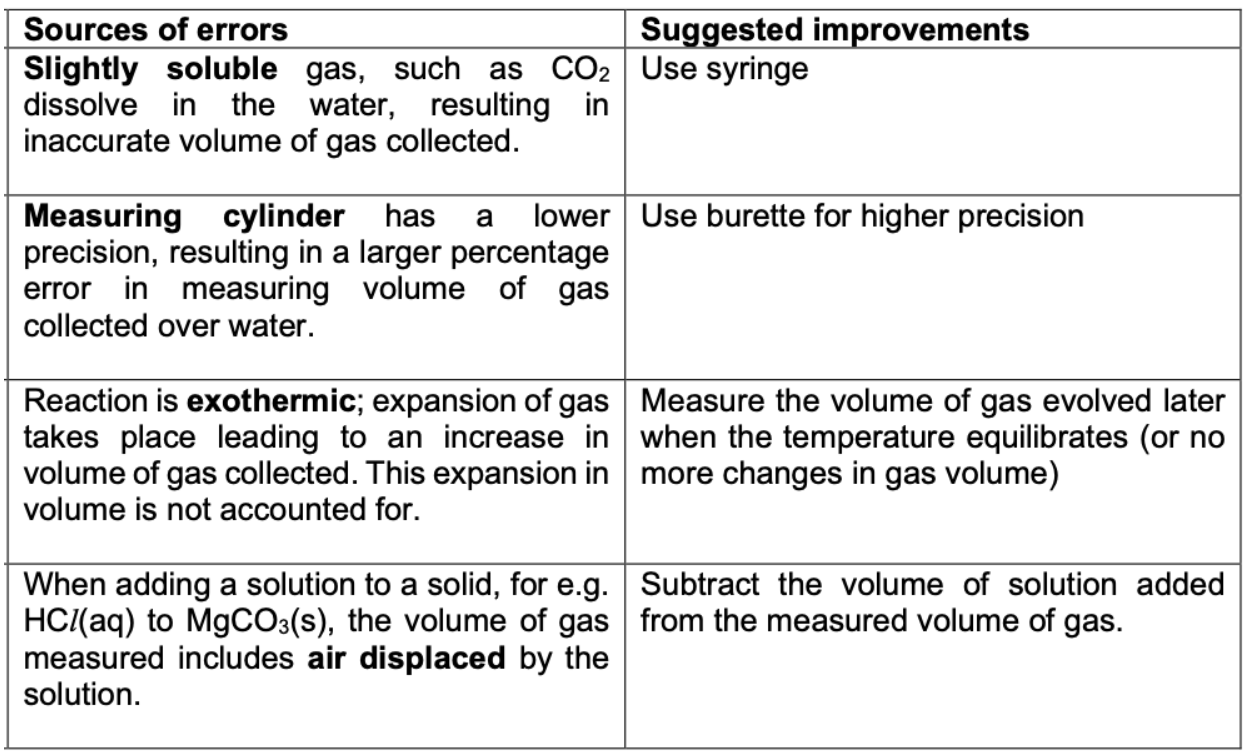
Describe gas collection errors
Describe gas syringe answering
Volume of gas evolved should be about 50% to 80% of the capacity of gas syringe
Accurately weigh XXX g of the sample in a boiling tube
Record the initial reading of the syringe
Start heating the solid gently then strongly until the plunger of the syringe does not move
Allow time for the volume of the gas to equilibrate to room temperature and pressure, or until no more movement of the piston is observed
Record the final reading of the syringe
Repeat the experiment to improve reliability of results
Draw gas syringe
Describe gas syringe with thistle answering
Weigh accurately about 0.905 g barium sulfite in a weighing bottle.
Record the total mass of the weighing bottle and the sample, m1. Transfer this into a 250 cm3 conical flask. Reweigh the weighing bottle after transfer, and record its mass, m2. The mass of barium sulfite sample used = m1 − m2
Measure the volume of acid used (ensure it is in excess) with appropriate equipment (pipette or burette or measuring cylinder) and record it as Vacid
Measure the maximum volume of gas collected by reading off the graduated gas syringe when the piston stops moving
Record Vbefore = volume reading before experiment, Vafter = volume reading after experiment. V = Vafter − Vbefore (−Vacid if thistle funnel is used)
Record temperature and pressure reading of the collected gas at the end of the collection using thermometer and barometer respectively

Explain why dilute sulfuric acid should not be used
Dilute sulfuric acid should not be used because the impervious layer of insoluble salt BaSO4 forming around the barium sulfite could stop the reaction prematurely
Explain clearly why there is a discrepancy between the value of the molar gas constant obtained in this experiment with the theoretical value of 8.31 J K–1 mol–1
SO2 is not an ideal gas (since the molecules experience a greater intermolecular force of attractions) OR SO2 is soluble in water -> Use H2 instead which is deviates less from ideal behaviour OR less soluble in water