L1: Basic aspects of sound
 Call Kai
 Learn
Learn Practice Test
 Spaced Repetition
 Match
Match Flashcards
 Knowt Play
1/60

There's no tags or description
Looks like no tags are added yet.
Name | Mastery | Learn | Test | Matching | Spaced | Call with Kai |
|---|
No analytics yet
Send a link to your students to track their progress
61 Terms
What is sound
small fluctuations in air pressure
As any vibration can be hear as sound, what must the ear do?
resolved complex vibrations into the sum of individual sinusoidal vibrations
Frequency
Pitch
number of cycles per second
1/period
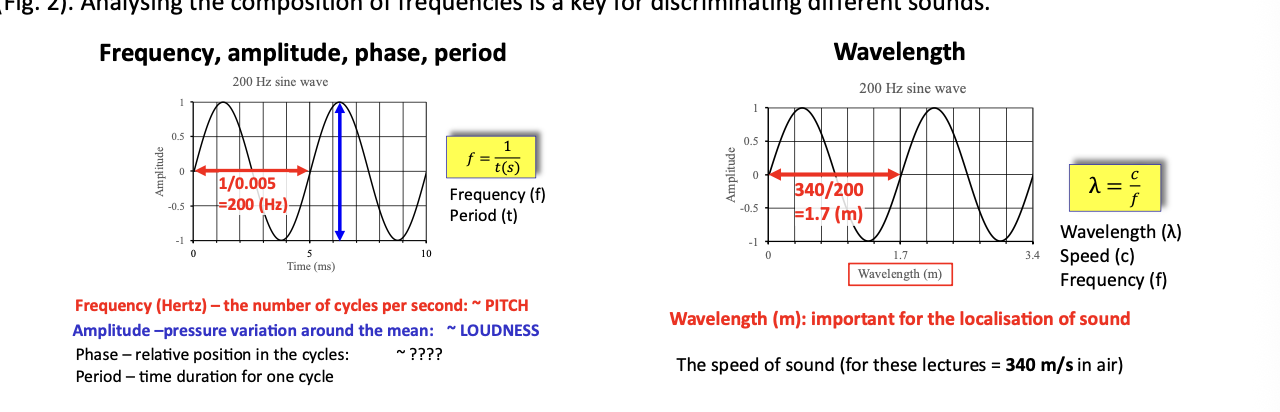
Ampltitude
pressure variations around the mean
LOUDNESS
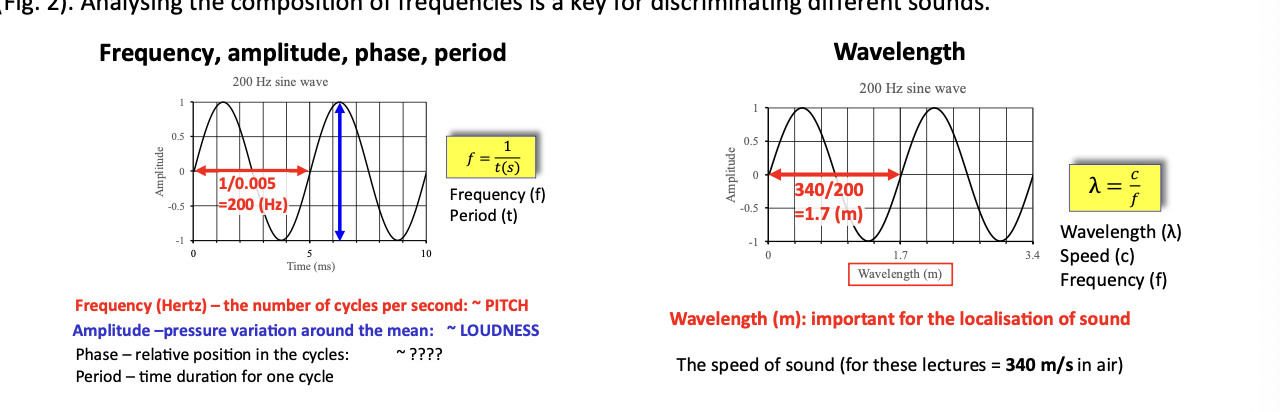
Phase
Relative position in the cycles
cannot really detect
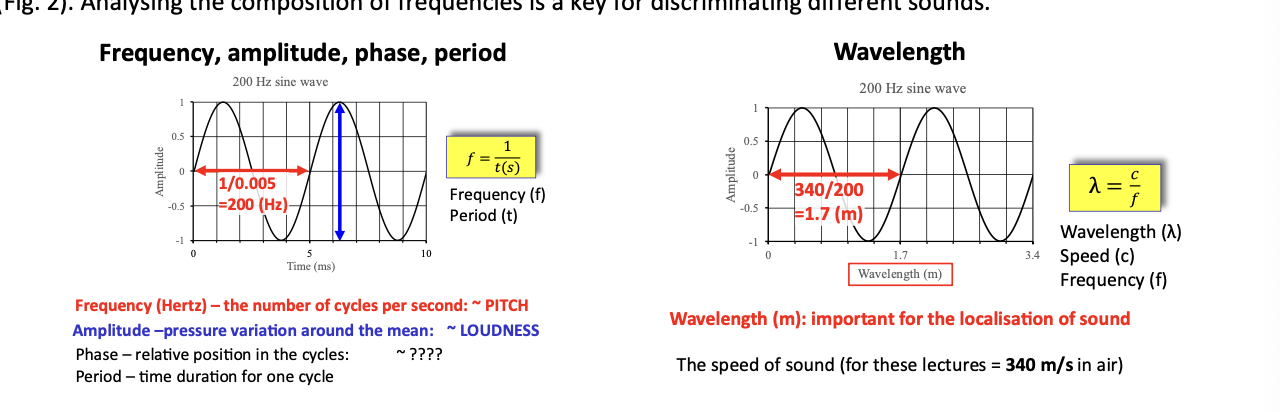
Wavelength
important for the localisation of sound
lambda = c/f
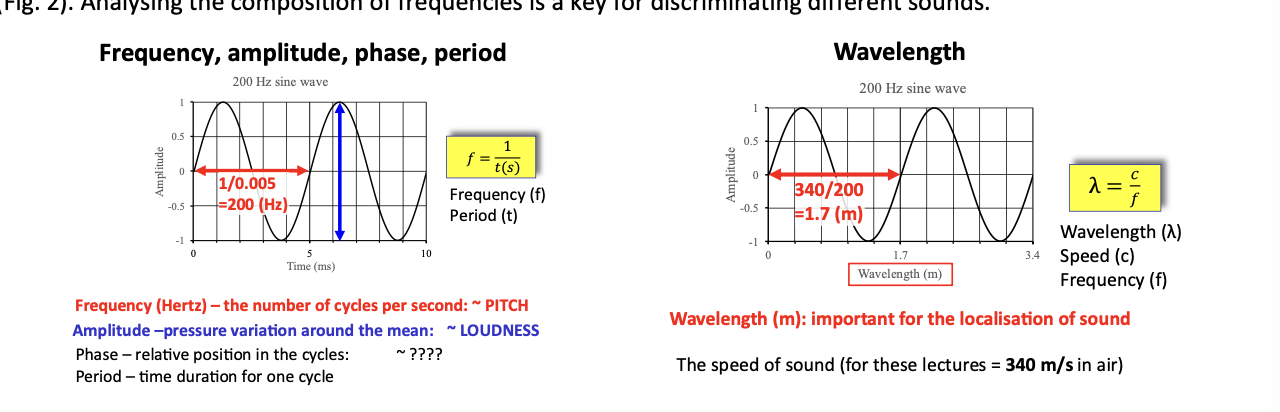
What is the speed of sound
340 m/s in air
Period
time duration for one cycle
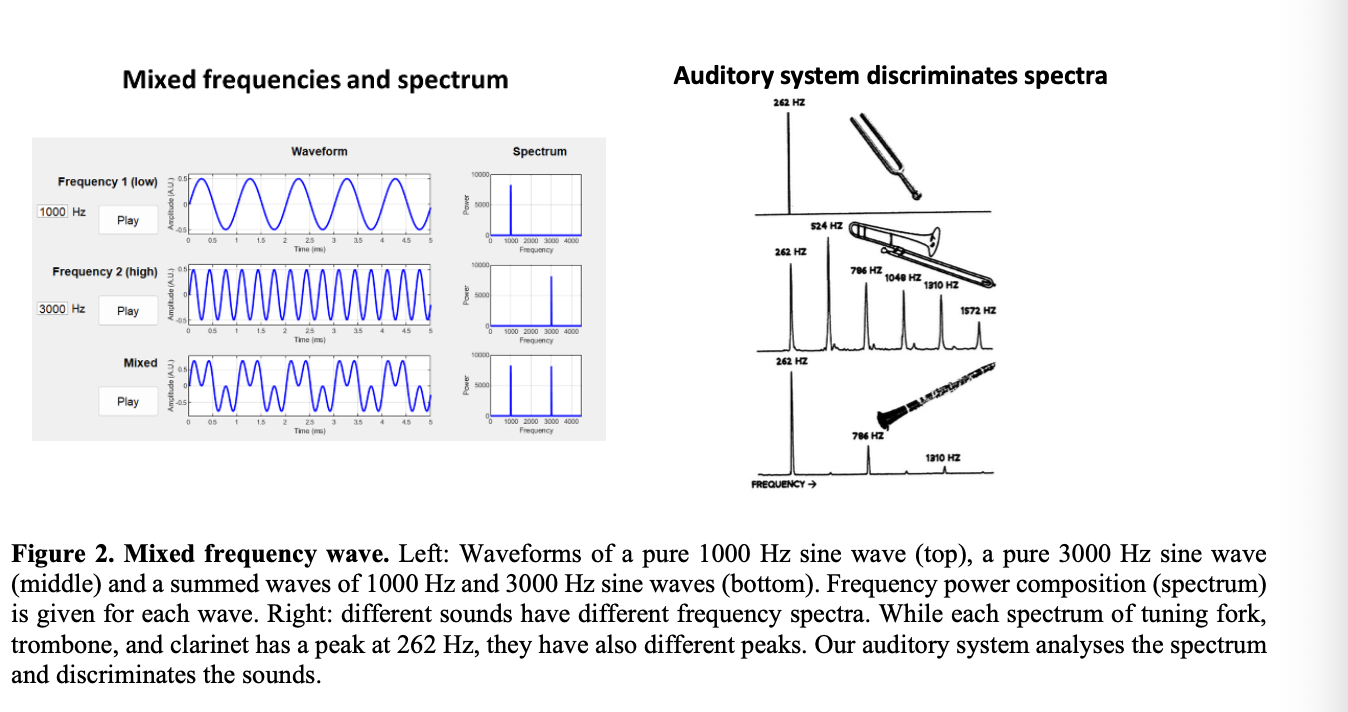
Different sounds usually involve what
sets of multiple frequencies
at different ampltitudes
Why is sound intensityexpressed on logarithmic scale
we can hear immense range of intensities
Unit of power of sound
Decibel
What are decibels
Ratios
strength is indicated relative to reference value
What is the reference value for huamsn
20 uPa
this is close to the threshold of human hearing at 2kHz
How much is 1Pascal in N/m²
1 N/m²
All signal levels expressed relative to this 20uPa standared are known as what
Decibels sound pressure level
dB SPL
Equation for dB SPL
dB SPL = 20 Log10(Pressure/20uPa)
0 dB: sound has the same pressure as reference signal
Cannot have level of 0 sound (log 0 infinite)
Negative values of dB are LESS than the reference
Pa and SPL of normal conversation
Pa: 2 ×10^-2
SPL: 60
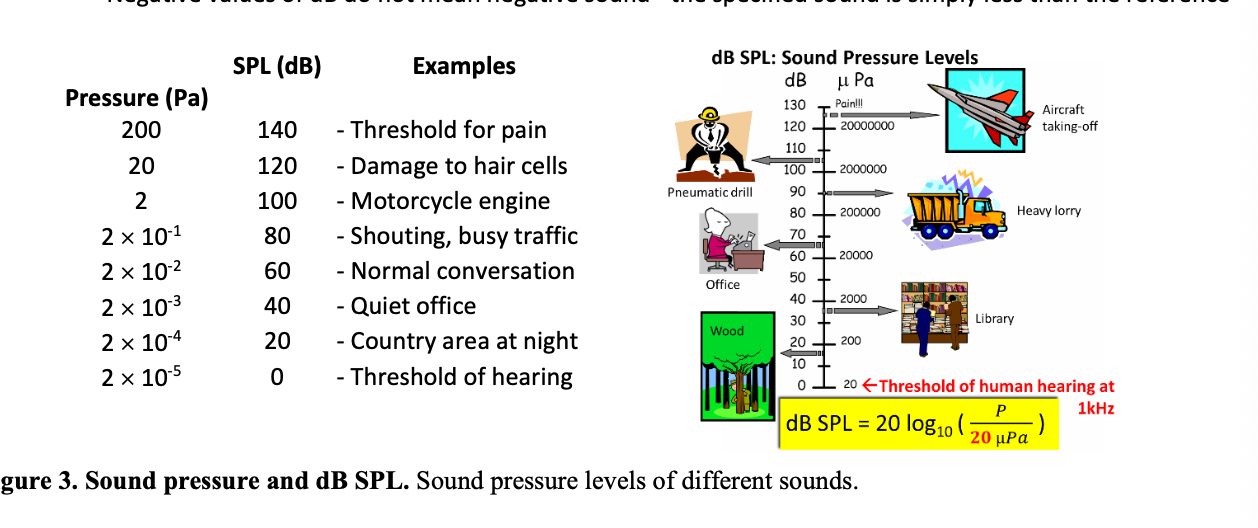
Threshold of damage to hair cells
120SPL
20Pa
What is the human frequency range
20 - 20k Hz
depends on the animal
Filtering
Low pass: cut off higher freq
Band pass: specific freq range
High pass: cut off low freq
Band stop: only passes freq outside restricted bandwidth
What is the freq range for speech
300 - 3,400 Hz
What is human speech loudness
55-65 dB
What is sound spectrum
graph representing a sound based on its freq compoistion
acts as a recipe that dhows amount of vibration at each indivudal freq
What is the wavelength of 200Hz tone
wavelength = 340/ f
340/200 = 1.72 metres
Three parts of the ear
Outer ear
Pinna
External auditory meatus (ear canal)
Middle ear
Tympanic membrane
ossicles
middle ear cavity
Inner ear
cochlea (with vestibular apparatus)
External meatus (EAM) ear canal (what is it)
open ended tube
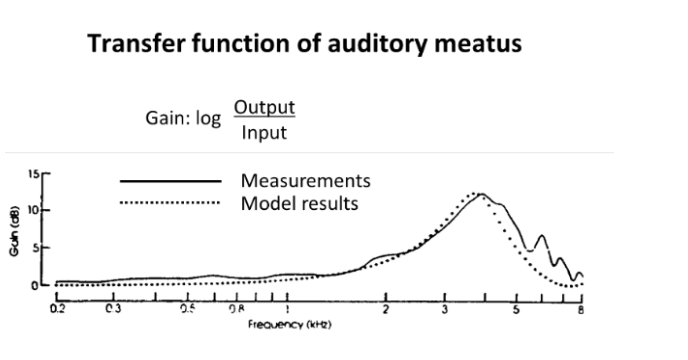
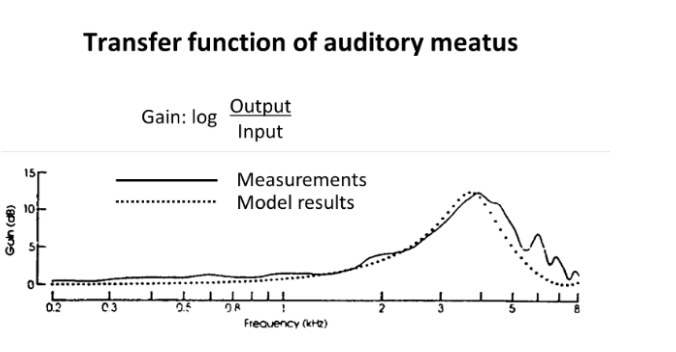
has resonant peaks that are predictable from knowing its length
EVIDENCE: measured gain matches calculated gain
peaked at around 3-5 kHz
coincides with human speech frequency range
HOW MEASURED: sound pressure measured at the entrance (input) and end (tympanic membrane: output)
Length of ear canal
2-3 cm
What does the ear canal do
Conducts sound waves from outer eat to eardrum
passage for sound to each tympanic membrane (ear drum)
amplifies speech freq sounds
protects inner ear from debris, foriegn objects and bacteria
akes ear wax
Pinna what is it
visible cartilaginous outer part of ear
What does Pinna do
assists sound localisation
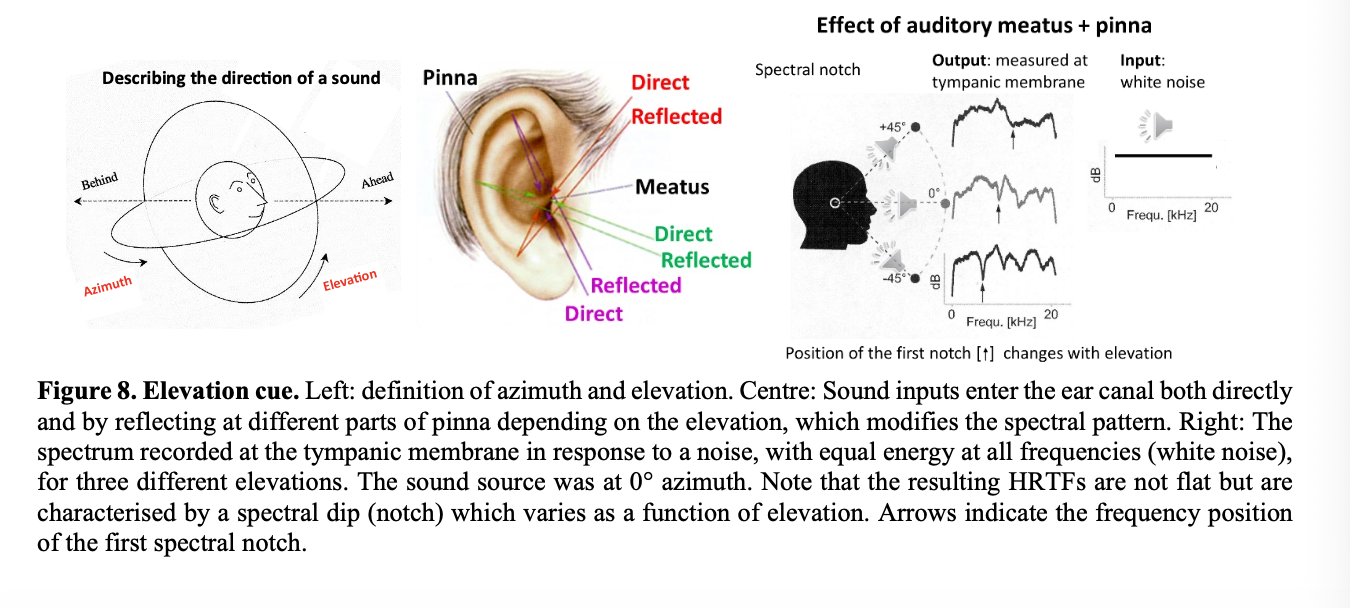
modifying the spectra in space-dependent manner
can detect the azimuthal location
HOW:
sound to ear
sound input enter the ear canal directly AND reflecting at different parts of pinna
depends on their elevation
the elevation modified the spectral pattern
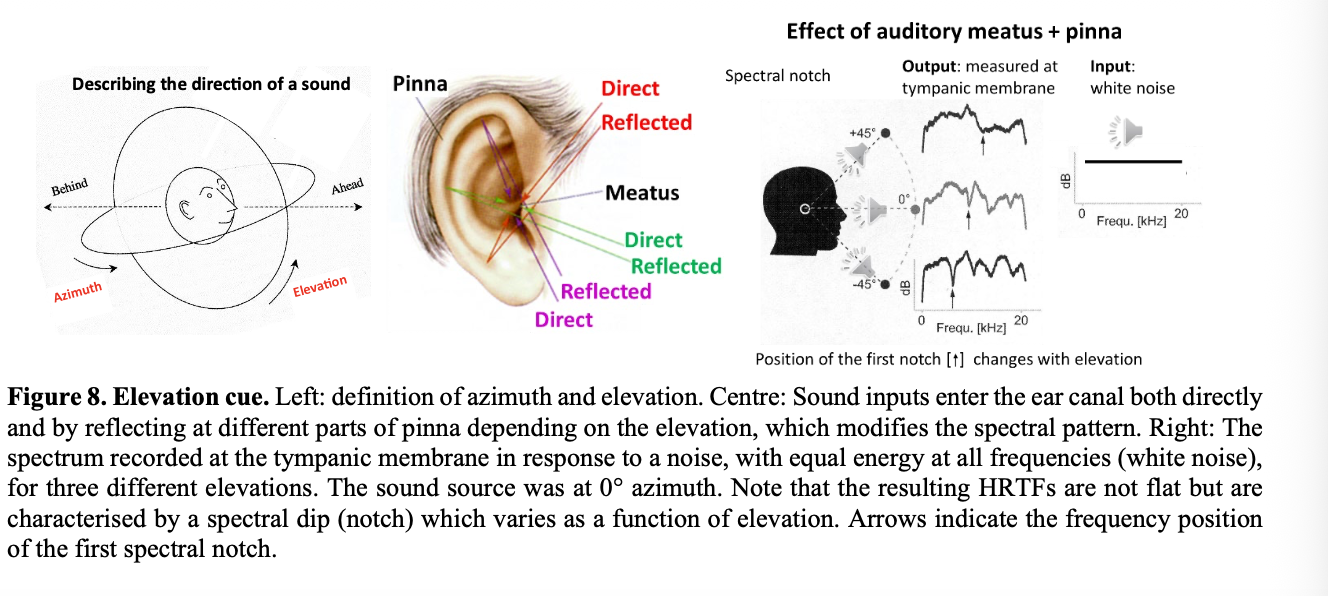
When the sound is at 90 degrees what does the sound spectrum look like?
directly in line with the left pinna
What happens to the spectral pattern at different locations?
the input wave has a wavelength that is equal or shorter than that of the head
RESULT: different spectra seen at the end of the ear canal
this is the Head related transfer function:
how sound is altered by the head and pinnae BEFORE entering the ear canal on to the tympanic membrane
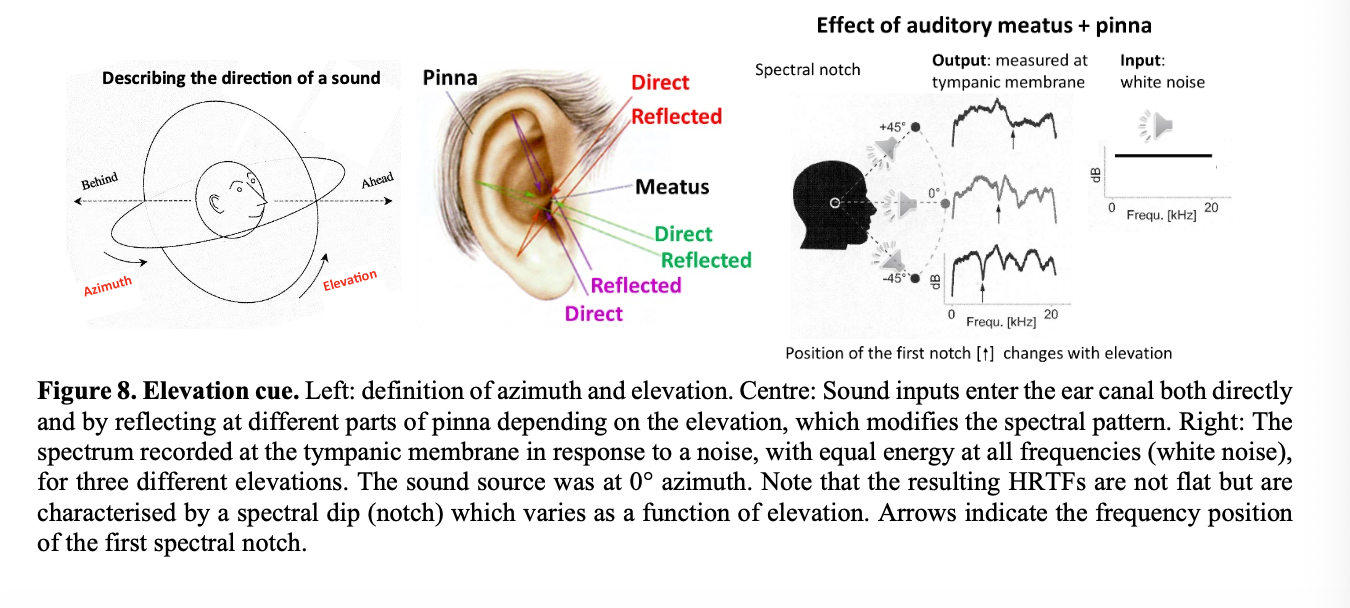
How does the Head related transfer function change with azimuth
The functions are not flat
just characterised the FIRST spectral dip (NOTCH)
this varies with the rotation
and particularly in the vertical plane
Notches are over 5 Hz
Evidence that there is plasticity in sound localisation
EXP: molds fitted to external ear
disrupt the pinna shape
RESULT
at first: lost localisation
With time: regained it back
If removed the mold: still had localisation preserved from before (did not deteriorate)
THERFORE: plasticity:
neural growth
novel synaptic connections
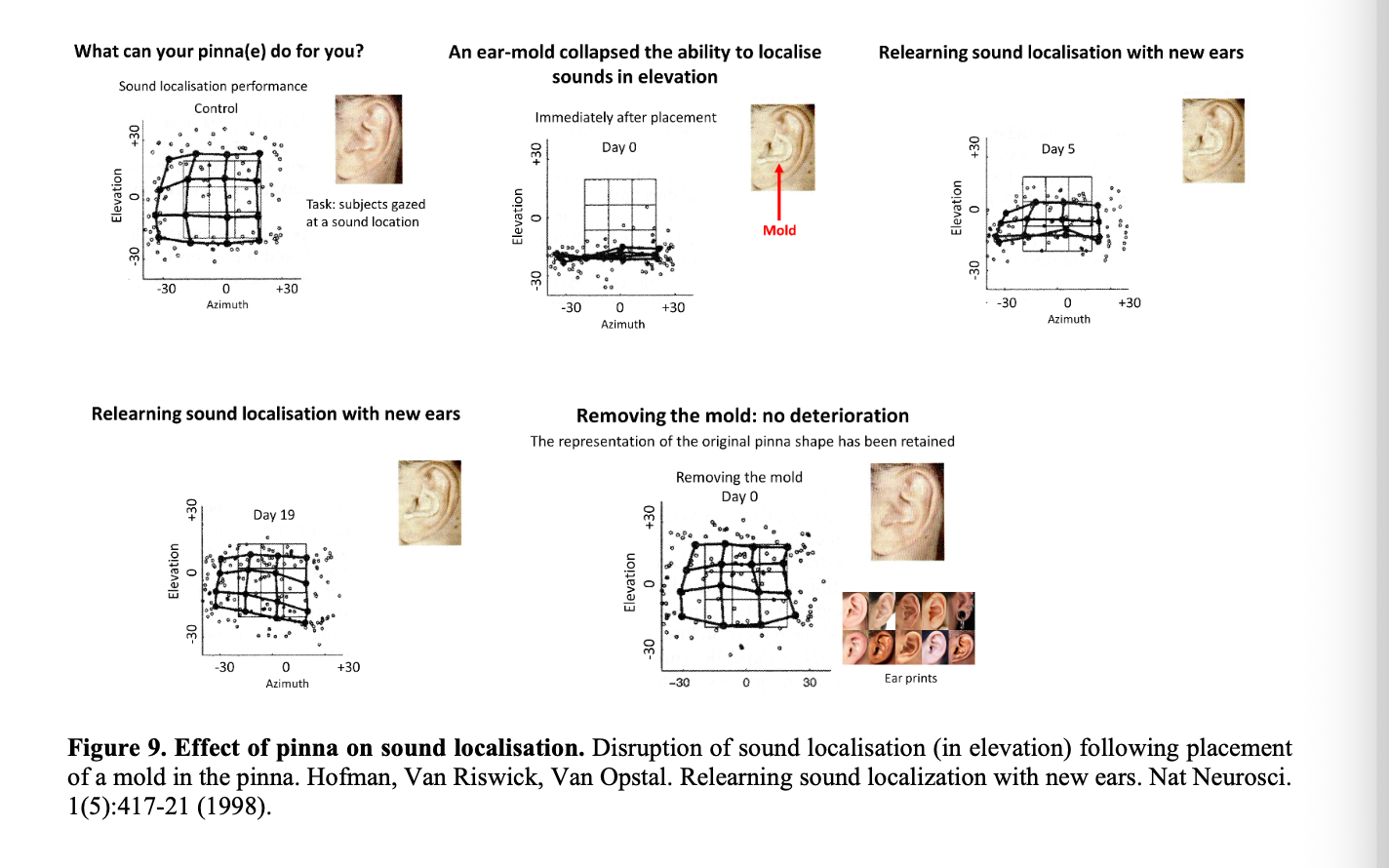
What does the thirst result suggest?
multiple representations of auditory space can co-exist
How does the ear canal change the sound inputs?
natural resonator
ampltifying sound waves between 2-5 kHz
funneling the sound waves in
How does pinna change the sound inputs?
reflect sounds
creates HRTF
different notches to signify localisation
How does the outer ear contribute to hearing?
collect sound wave
channel them
amplify specific frequencies before reach eardrum
Protection
sound localisation
What are the functions of the Middle ear
Impedance matching
so the sound from the air does not get absorbed by the high resistance in the cochlear fluids
Protection from loud sounds
including own vocalisations
Anti-masking of high-frequency sounds by low-frequneecy sounds
particulalry at high sound levels
what are the oscicles
Three ear bones
Malleus: hammer
Incus: anvil
Stapes: stirrup
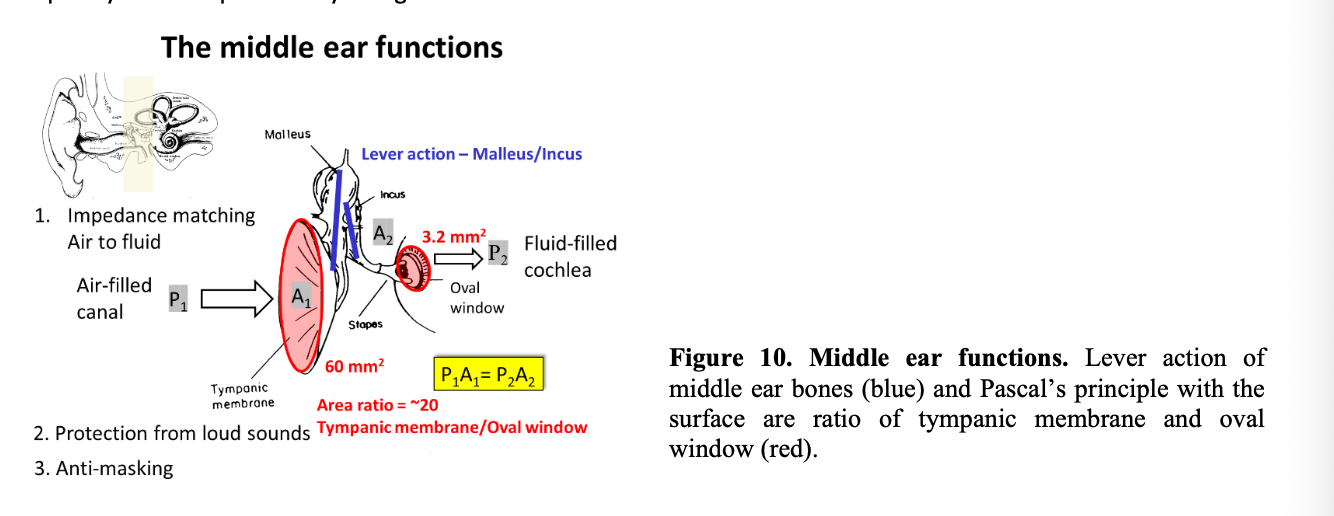
How do the ossicles work to transmit the sound from the canala to the fluid filled cochlea
Sound in air
vibrates the tympanic membrane (ear drum) (60mm²)
Causes Malleus and Incus lever action
Connects to the stapes which is connected to the oval window (3.2mm²)
Pascles principle P1A1= P2A2 means that pressure to a smaller area will INCREASE and thus AMPLIFY the vibration/ sound when it gets to the fluid
Therefore the sound is not just absorbed once it reaches the high resistance fluid in the chochlea
What do the middle ear muscles do? (MEM)
PROTECTION
dampen the vibrations of the ossicles
reduce the acoustic signal that reaches the ears
Via the MEM reflex
they are the smallest skeletal muscle in the human body
When do middle ear muscles contract
100ms after exposure to loud sound
before a person vocalises
Why are they absent in frogs?
they do not vocalise
What frequencies do they attenuate more?
Low
What are the two middle ear muscles and where are they connected
Tensor tympani
connects the neck of the malleus
Stapedius
connected to the neck of the stapes
Which muscle is active when exposed to loud sounds in humans
Stapedius
What level of sound activates the MEM reflex
sounds 80-90 dB above a person’s hearing threshold
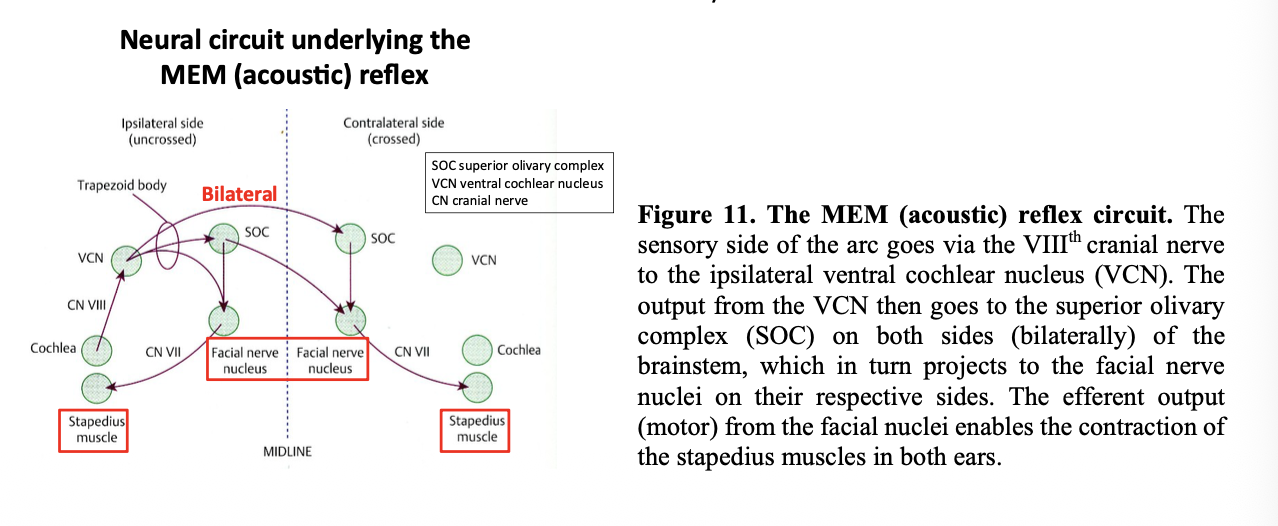
What happens in the MEM acoustic reflex circuit (i.e how does sound cause the stapedius to contract)
Ipsilateral side: Where sound is heard
Sound heard at cochlea
Cochlea sends signal to the central cochlear nucleus
goes to the superior olivary complex ON BOTH SIDES
projects to the facial nerve nuclei on both sides
Effect output from the facial nuclei
enables contract of stapedius muscles IN BOTH EARS
THEREFORE: DAMPENS the vibrations of the osccislces to PROTECT from loud sounds
OVERALL: contracts the stapieus (and sometimes the tensor tympani) at high intensity sounds
stiffens the ossicular chain
reduces sound transmission
THEREFORE: proteective
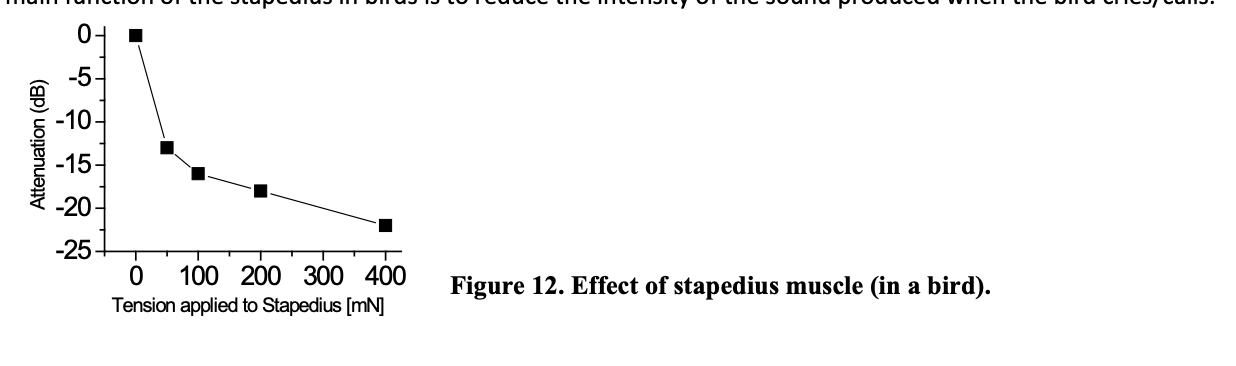
Evidence 1: Bird stapeisus put under tension
RESULT: decrease attenuation to sound with increased stapieus contraction
SUGGESTS: birds reduce intensity of sound produced when the bird cries/calls
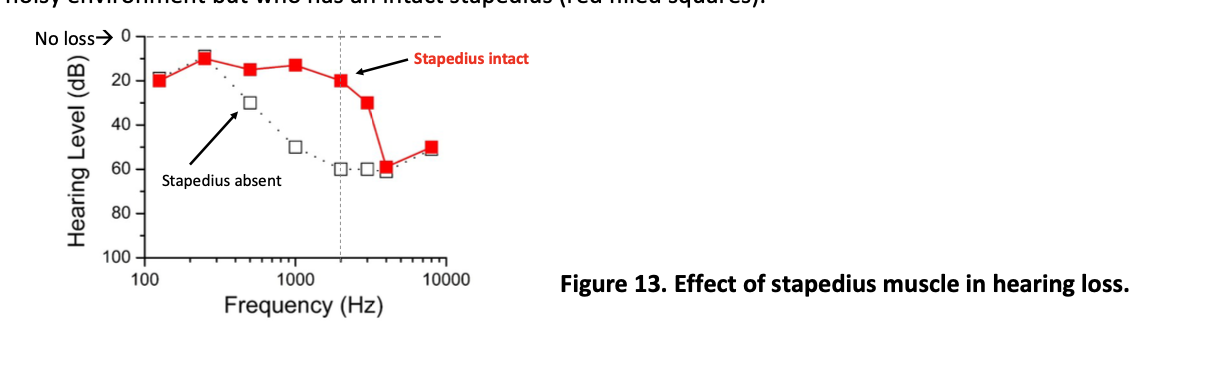
Evidence 2: Effect when stapidus is absent
Intact stimulus→ hearing lat lower dB levels
Keeps the amplitute of soundheard at relatively constant level
Inactive stapedius due to hearing loss→ hearing at higher levels
What happens in conductive hearing loss
middle ear cavity fills with fluid
low frequnecy hearing loss of 30dB or greater develops
What is sensorineural hearing loss
cochlea or autitory pathway is damaged
How to distinguish between the conductive and sensorinueral hearing loss
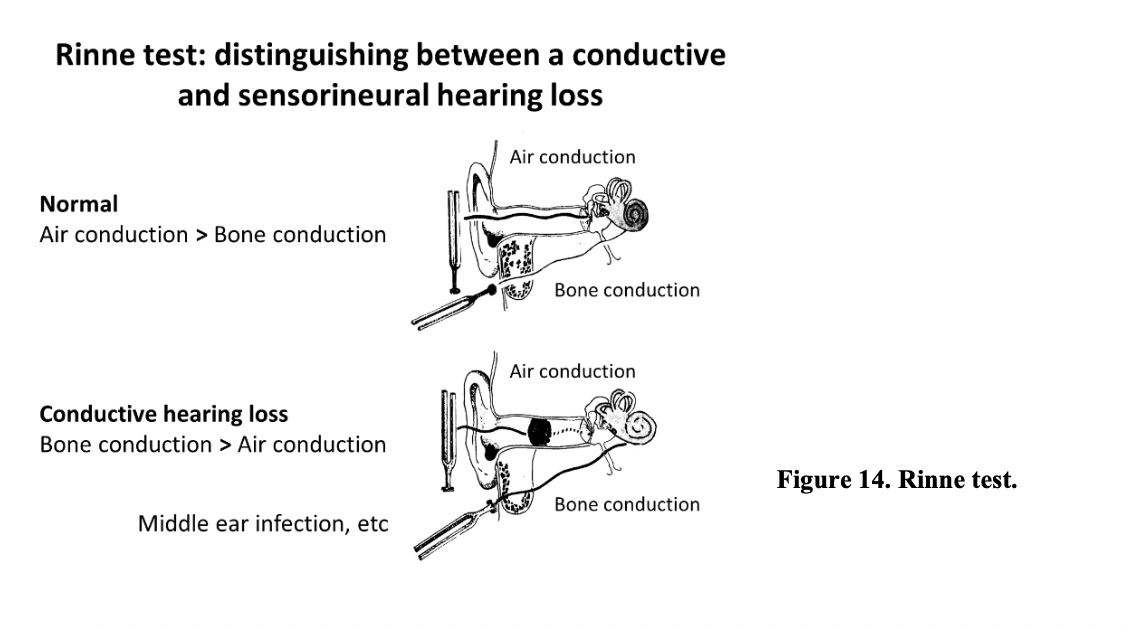
Rinne test
place a vibrating tuning fork on the mastoid process
Patient indicates when they can no longer hear sound
Indicates Bone conduction of sound
(transmission of sound to the cochlea via the skull)
Fork at the entrance of the external auditory meatus (EAM)
Tests for air conduction
RESULT:
Conductive:
bone conduction is unimpaired
response to sound conducted by the EAM is reduced
Bone > Air
Sensorineural (or normal):
Bone conduction impaired
Greater sensitivity to air conduction at the EAM
Air > Bone
Inner ear: What is the cochlea + structure
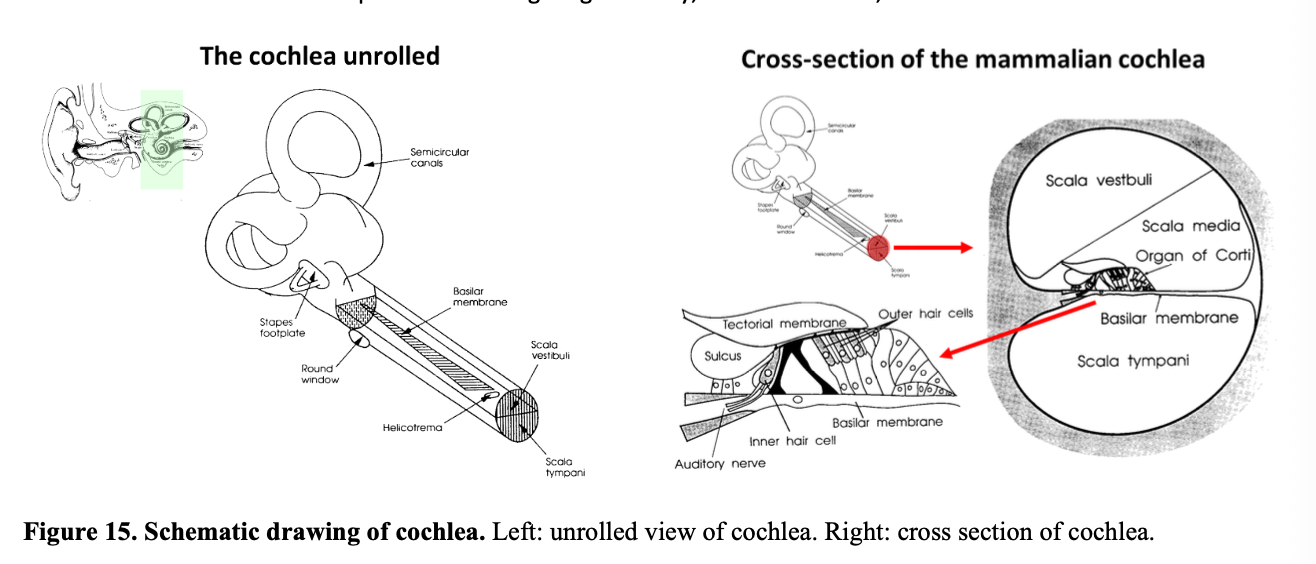
Snail-shaped fluid-filled cavity
3 Chambers + 2 Partitions
Scala tympani
Scala vestibuli
(not always partitioned from one another, can meet at the end at the helicotrema)
Scala media
partition that runs longitudinally
between the two scalae
contains the organ of corti
NEXT TO THIS: Stria vascularis
makes the K+ high endolymph fluid
converts sound vibrations into neural impulses: Transduction
When unravelled:
straight tube
compartmentalised longitudinally
Contains spiral ganglion (auditory nerve cell bodies)
Connects to VIII cranial nerve fibres (Auditory nerve)
Modiolus
porous bony central axis
around which canal makes 2.75 turns
Why need the helicotrema
allow fluid to pass between the chambers
pressure equalisation
detecting low-frequncing sounds
What is the principle function of the cochlea
Decompose the acoustic signal into component frequencies
sight of sound transduction
What is the organ of corti
receptor structure for hearing
Structure of the organ of corti
Basilar membrane at the bottom (33mm)
Inner hair cells
Outer hair cells
Tectorial membrane
Sulcus
Connecting auditory nerve
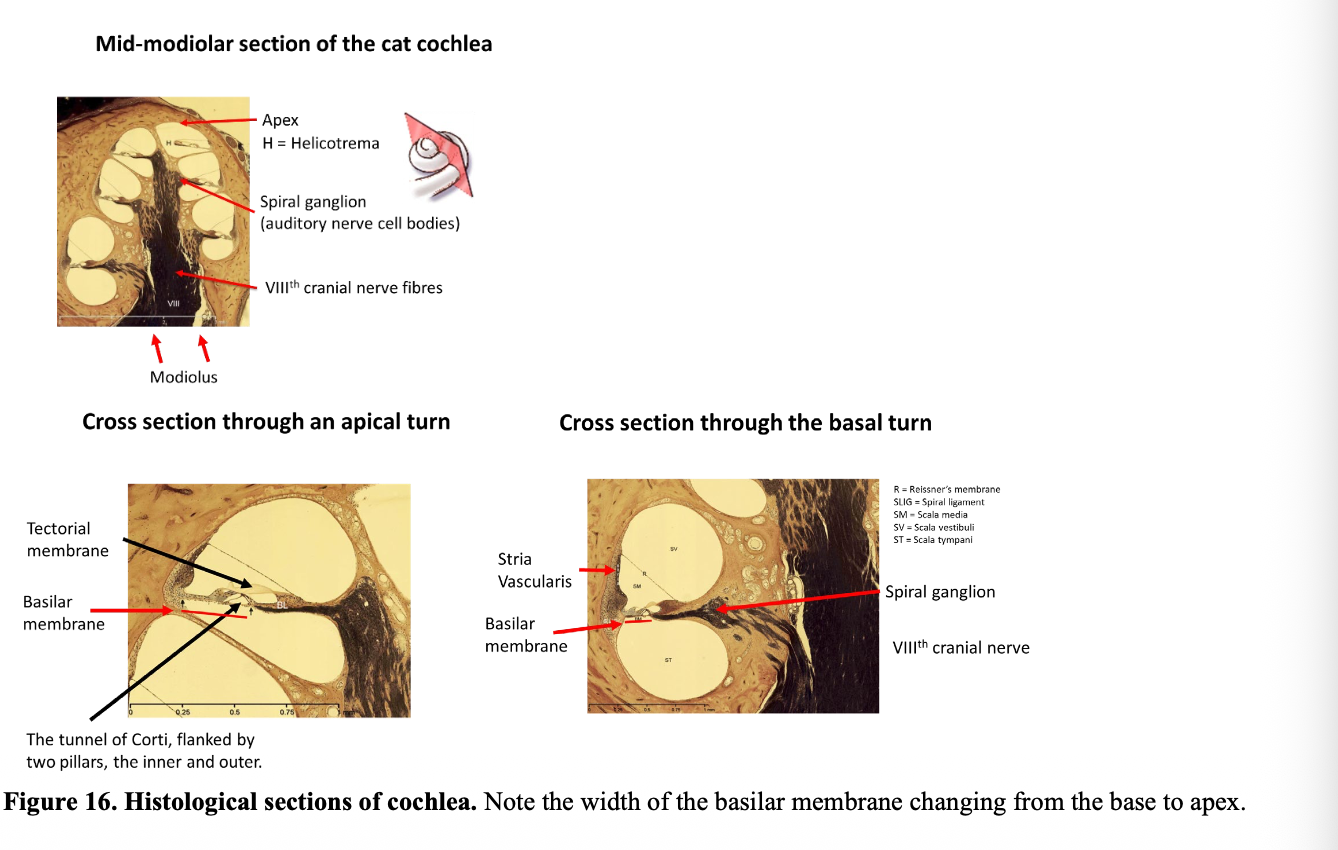
How does the width of the basilar membrane change from base to apex
Base: where sound comes in thinnest AND stiffer
Apex: widest
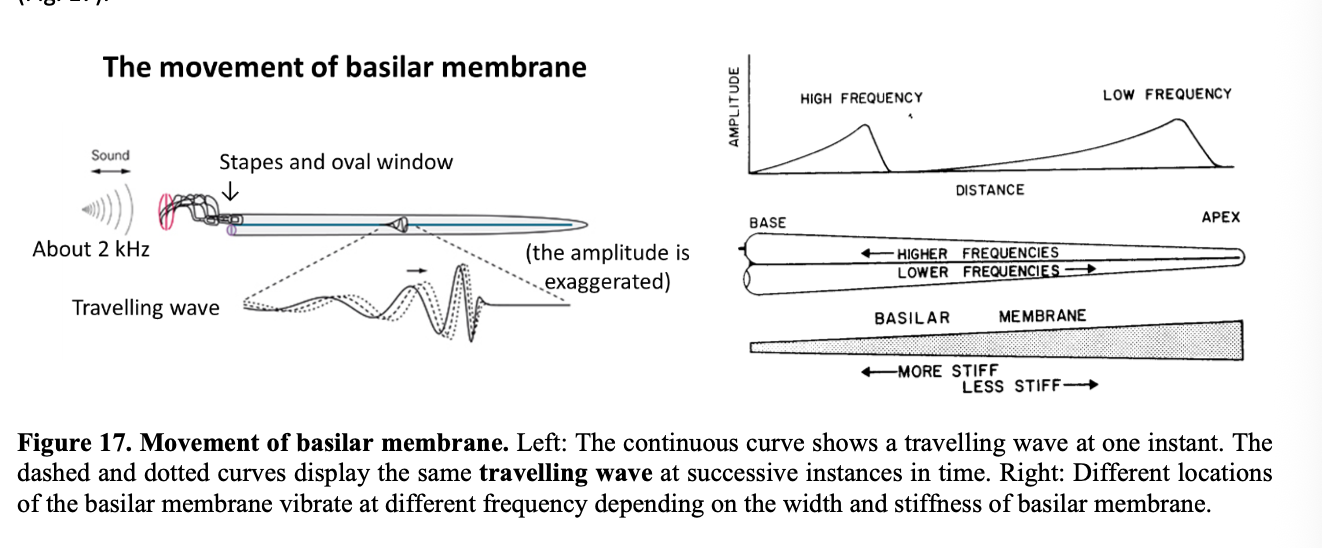
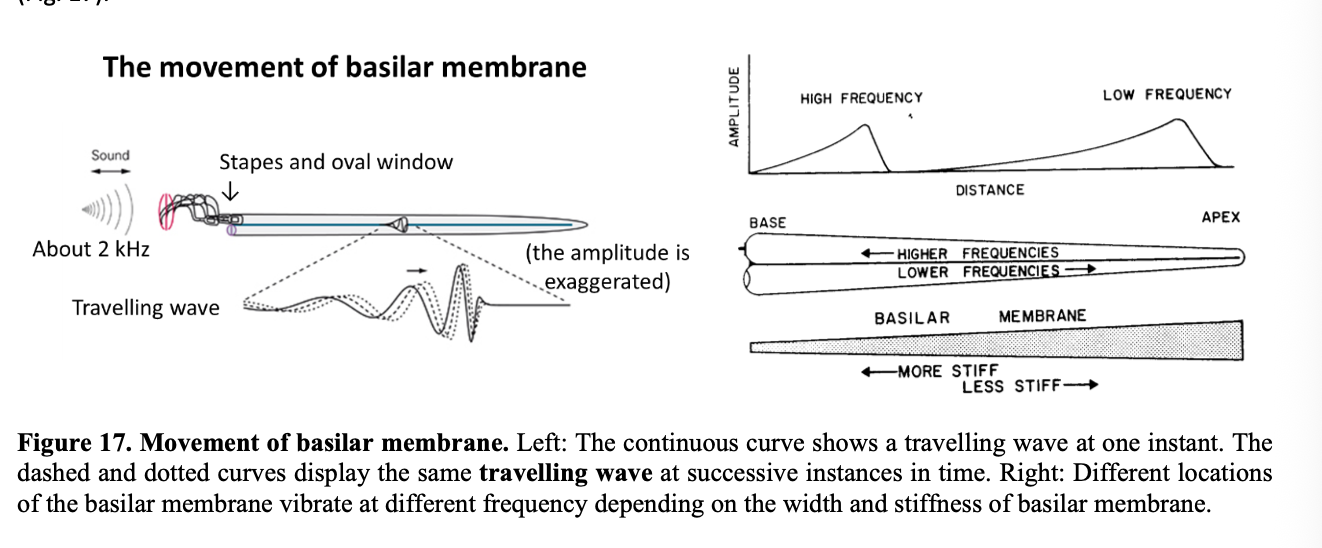
How is sound made into its different components
Stapes vibrates oval window
incompressible fluids in cochlea vibrate
cause round window to bulge outwards
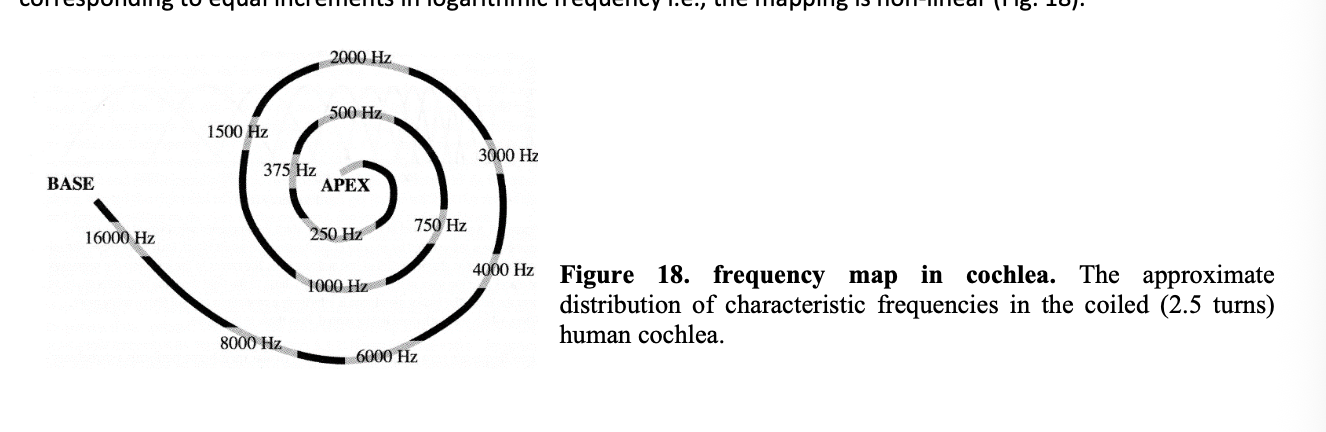
At the base: stiffer and narrow→ only high freq sounds vibrate here
At the apex: less stiff and wider→ only LOW freq sounds vibrate here
Therefore components of the same sound are separated out be frequency
Mapped tonotopically along its length
note: the distance corresponds to equal increments in logarithmic frequency: NON-LINEAR MAPPING