GCSE Physics: P10 - Force and motion
 Call Kai
 Learn
Learn Practice Test
 Spaced Repetition
 Match
Match Flashcards
 Knowt Play
1/96

There's no tags or description
Looks like no tags are added yet.
Name | Mastery | Learn | Test | Matching | Spaced | Call with Kai |
|---|
No analytics yet
Send a link to your students to track their progress
97 Terms
What is acceleration?
the change in an object's velocity over a given time
State the equation for calculating acceleration
acceleration (m/s^2) = change in velocity (m/s) / time (s)
a = Δ v / t
OR
a = v - u / t
v = final velocity
u = initial velocity
When does deceleration occur?
- when the value for acceleration in m/s^2 is a negative number below 0 ,
- deceleration has occurred
Explain how the acceleration of an object can be calculated using a velocity-time graph
- the gradient of a velocity-time graph shows us the acceleration of the object
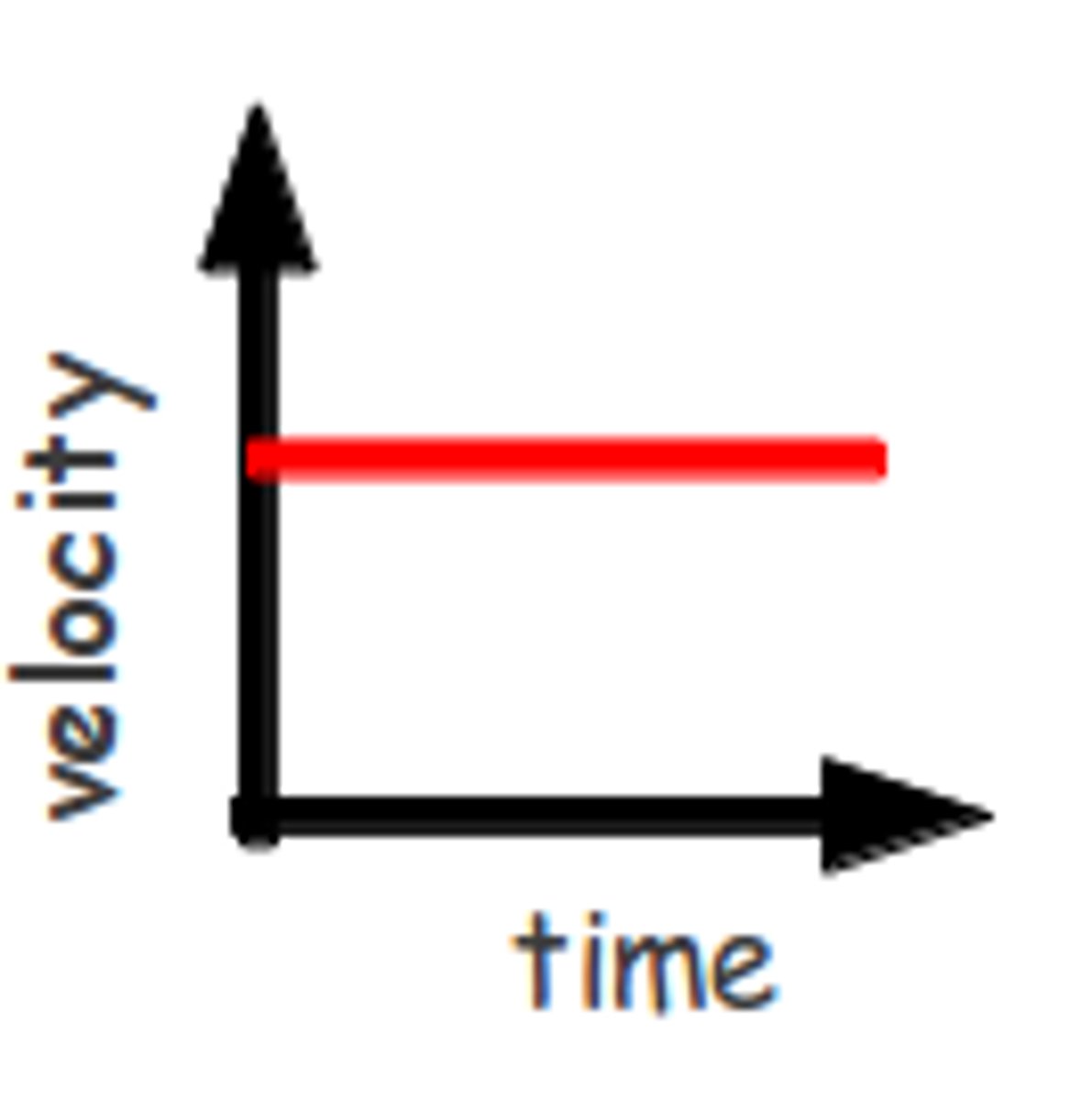
What does a horizontal line on a velocity-time graph tell us?
- a horizontal line shows the object is travelling at a constant velocity
What does an upward sloping line on a velocity-time graph tell us?
- an upward sloping line shows that the object is accelerating
What does a downward sloping line on a velocity-time graph tell us?
- a downward sloping line shows that the object is decelerating
State the equation for calculating the acceleration of an object using a velocity-time graph
acceleration = final velocity (m/s) - initial velocity (m/s) /
(m/s^2) time (s)
Explain how the displacement can be found using a velocity-time graph
- total area under a velocity-time graph tells us distance travelled in a specific direction (displacement)
- to calculate displacement from a velocity-time graph with constant acceleration or deceleration,
- divide graph into shapes and calculate their areas and add them together to gain the total area
State the equation for the area of a triangle
area of a triangle = 1/2 X base X height
Explain how to work out displacement for velocity-time graphs where the acceleration and deceleration are not constant
- to calculate total area, count squares
- estimate total of parts of squares incomplete
- add these squares to number of complete squares to get a total number of squares under the graph
- multiply number of squares by the area of one square to calculate the total displacement or distance in m
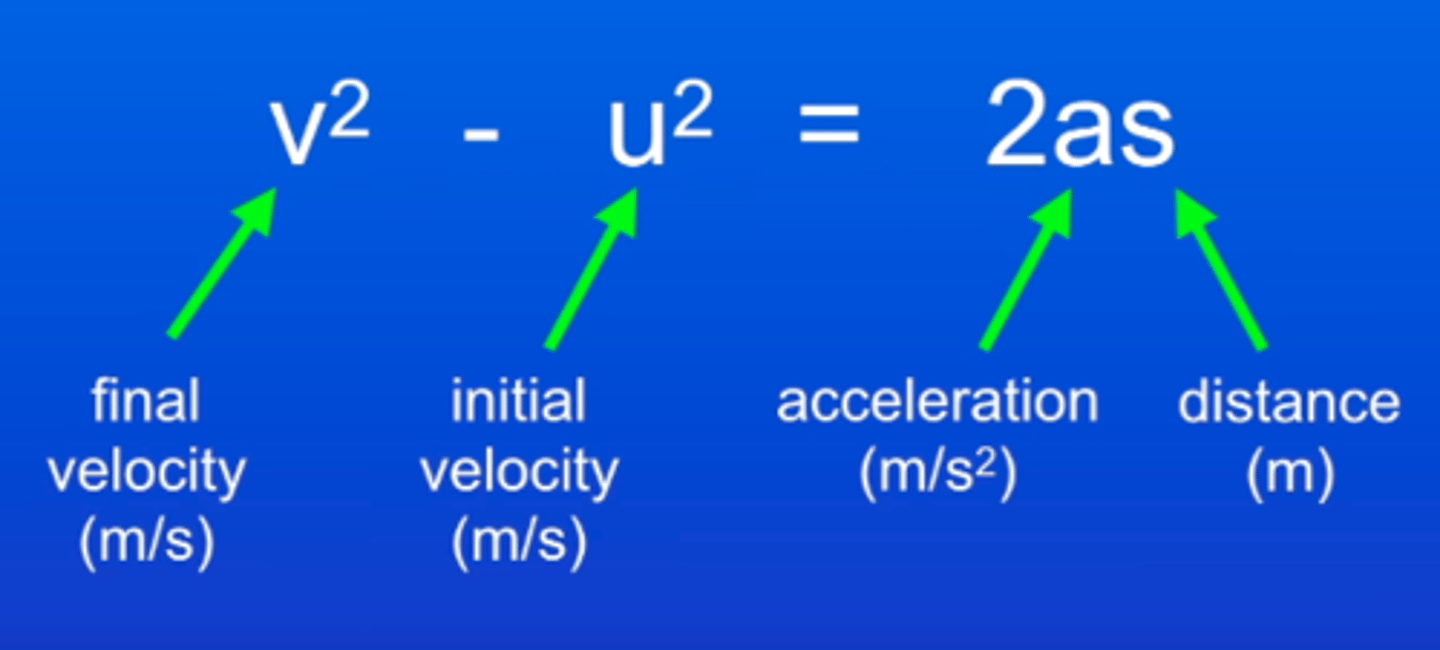
State the equation for calculating the velocity of an object accelerating at a constant rate
Describe the acceleration of an object falling towards the Earth's surface
- when any object falls towards the surface of the Earth,
- it initially accelerates at around 9.8 m/s^2
- due to the force of gravity acting on the object
In what direction does the force of weight act?
- weight always acts downwards
In what direction does the force of upthrust act?
- upthrust acts upwards in a liquid
- opposite to the downwards force of weight in the liquid
In what direction does the force of air resistance act?
- air resistance acts upwards
- due to upward force of friction with air particles
Describe the acceleration of an object falling through a liquid
- as object falls, it experiences an upward force of friction with air particles known as air resistance
- after some time, force of air resistance balances force due to gravity
- object stops accelerating and moves at a constant velocity
- scientists call this terminal velocity, which applies to any object falling through a liquid
- terminal velocity reached by an object depends on the object
- some objects experience a greater force of friction due to their shape, so they will have a lower terminal velocity
What is terminal velocity?
the constant velocity of a falling object when the force of air resistance is equal in magnitude and opposite in direction to the force of gravity
What does terminal velocity apply to?
- terminal velocity applies to any object falling through a liquid
Why do some objects have a lower terminal velocity than others?
- some objects experience a greater force of friction due to their shape,
- so they will have a lower terminal velocity as gravity and air resistance are not balanced
State Newton's First Law of Motion
If the resultant force acting on a stationary object is zero, then the object will remain stationary.
If the resultant force acting on a moving object is zero, then the object will continue moving in the same direction at the same speed (with the same velocity)
What does Newton's First Law of Motion mean?
- the velocity of an object will only change if a resultant force is acting on the object
Apply Newton's First Law of Motion to a car travelling at a constant speed
- a car is travelling at a constant speed with driving force of the engine acting to the left
- as the car is travelling at a constant speed, there must be an equal force acting to the right
- scientists call these resistive forces
Name some examples of resistive forces that act on vehicles
- friction with the air
- friction with the road
Describe what happens to a stationary object when a resultant force acts on it
- if a resultant force acts on the stationary object in a certain direction,
- this will cause the object to accelerate in the certain direction with a change in speed
Describe what happens to an object moving at a constant speed if a resultant force acts on it
- if a resultant force is applied to a constantly moving object in a certain direction,
- the object will decelerate with a change in speed
Explain how the resultant force can also change an object's direction
- if an object moving with a constant speed has a resultant force acting on it at the bottom of the object,
- the bottom of the object will accelerate upwards
State Newton's Second Law of Motion
The acceleration of an object is proportional (∝) to the resultant force acting on the object and inversely proportional to the mass of the object.
What does Newton's Second Law of Motion mean?
- if the force is greater, there is a greater acceleration
- the higher the mass, the lower the acceleration
State the equation for calculating the force needed to accelerate an object
Force (N) = mass (kg) X acceleration (m/s^2)
F = m a
What is the speed of a car on a main road in the UK?
Cars travel at ~ 13 m/s on a main road in the UK
What is the speed of a car on a motorway?
Cars travel at ~ 30 m/s on a motorway
What is the acceleration needed for accelerating from a main road to a motorway?
Accelerating from a main road to a motorway involves an acceleration of ~ 2 m/s
What is the force needed for a typical family car to to accelerate by
2 m/s from a main road to a motorway?
A typical family car would require a force of ~ 2000 N for accelerating 2 m/s from a main road to a motorway
What is inertia?
- an object will stay stationary or continue moving at the same speed and direction unless a resultant force is applied
- scientists call this property of objects inertia
What is inertial mass?
the ratio of the force needed to accelerate an object over the acceleration produced
What is inertial mass a measure of?
- inertial mass is a measure of how difficult it is to change the velocity of an object
Explain the relationship between force and size of inertial mass
- an object with a larger inertial mass will require a larger force to produce a given acceleration,
- than an object with a smaller inertial mass
State Newton's Third Law of Motion
Whenever two objects interact, the forces they exert on each other are equal and opposite
What does Newton's Third Law of Motion mean?
- when two object interact, their forces are equal in magnitude,
- but opposite in direction to each other
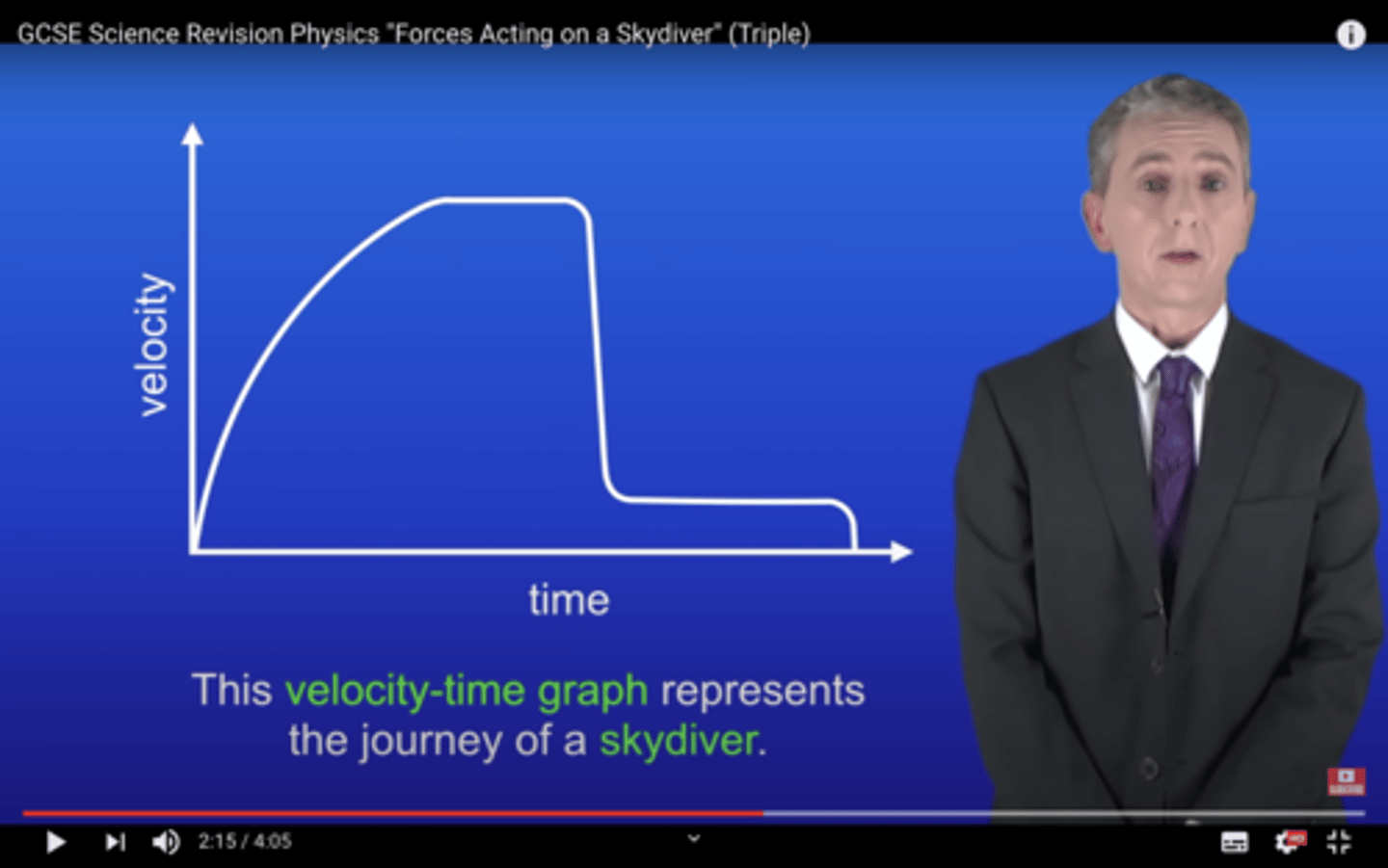
What is the first force to act on a skydiver
- weight, which is due to gravity, is the only force acting on skydiver as soon as they jump out of the plane
Describe the forces acting on a skydiver as velocity changes
- as soon as skydiver jumps out of plane, weight acts due to gravity and does not change during journey
- skydiver experiences resultant force acting downwards due to weight
- so they accelerate towards the ground
- skydiver experiences air resistance acting upwards due to friction with air molecules during fall
- weight still greater than air resistance so skydiver continues to accelerate toward ground
- skydiver's velocity increases as air resistance increases
- air resistance balances weight at some point so velocity stays constant as no resultant force present
- skydiver reaches terminal velocity at which they would die if they hit the ground
- skydiver opens parachute, increasing surface area so air resistance increases greatly
- air resistance now greater than weight so resultant force acts upwards and skydiver decelerates as their velocity decreases
- velocity decreases so air resistance decreases
- air resistance balances weight at some point so resultant force zero
- so velocity stays constant and skydiver is at a lower terminal velocity so can safely hit the ground
Velocity and air resistance are ....
proportional, so they increase and decrease with each other
Interpret the velocity-time graph for the journey of a skydiver
Required Practical 7: Acceleration
Describe a practical investigating how varying the force affects the acceleration of an object of constant mass
1) Hold toy car at starting point and let go when ready
2) Car accelerates along bench due to resultant force acting through the string
3) Record times that car passes through each distance marker
4) Record practical on a mobile phone and replay it to record times more accurately as car is moving too rapidly to record the times accurately
5) Repeat practical several times, but decrease mass on end of each string each time so force decreasing
6) Keep mass constant as object of the practical is toy car, string and the mass on end of each spring attached together, so it mass taken way from one of the objects, it is transferred to another part of the object
7) Results show acceleration of toy car is proportional to weight of the mass on other end of the string
Required Practical 7: Acceleration
Describe a practical investigating how varying the mass of the object affects the acceleration produced by a constant force
1) Keep force constant using a mass on end of the string
2) Attach a mass to toy car
3) Record car as it accelerates along bench
4) Repeat practical while increasing mass attached to toy car each time
5) Results show that increasing mass of toy car causes acceleration to decrease, matching Newton's Second Law of Motion
What is stopping distance?
the total distance travelled from when the driver first spots the obstruction to when the car stops
What is the stopping distance made up of?
Stopping distance = thinking distance + braking distance
What is thinking distance?
the distance travelled by the car during the driver's reaction time
What is reaction time?
time taken fro the driver to spot the obstruction, make a decision and then move their foot to the brake
What is braking distance?
the distance the car travels from when the driver applies the brakes to when the car stops
Describe the relationship between the speed of a vehicle and the stopping distance
- the greater the speed of the vehicle, the greater the stopping distance,
- assuming that the same braking force is applied
What is a common speed limit in the UK?
- a common speed limit in the UK is 30 mph
How long does a typical family car take to stop at 30 mph?
- at 30 mph, a typical family car takes around 23 m to stop
What is typical reaction time for humans?
- typical reaction time is between 0.2 s and 0.9 s
Explain why drivers should have short reaction times
- drivers should have short reaction times as it is very important for them to react quickly to an obstruction
Describe the factors affecting a driver's reaction time
- a tired driver will have a longer reaction time than a driver who is alert
- alcohol and certain drugs increase reaction time
- distractions in the car increase driver's reaction time
- these factors increase reaction time, so also increase thinking distance
Describe the factors affecting a driver's braking distance
- wet or icy conditions reduce friction between tyres and road, so increase braking distance
- worn tyres on a car increase braking distance as they reduce friction between tyres and the road
- worn brakes also increase braking distance
Describe the relationship between the driving force of a car engine and the frictional forces in order for it to travel at a constant speed
- in order to travel at a constant speed,
- the driving force of a car engine must balance the frictional forces
What type of energy is stored in moving objects?
- kinetic energy is stored in any moving object
Describe the relationship between the speed of a car and braking distance
- as the speed of a car increases, braking distance increases greatly
How does velocity affect kinetic energy?
- kinetic energy depends on the velocity squared (v^2)
- if we double the velocity of the car, the kinetic energy quadruples
Describe the energy transfers when a vehicle brakes
- during the braking of a car, the brake presses against the wheel
- force of friction acts between the brake and the wheel
- kinetic energy of car transfers to thermal energy in the brakes,
- causing temperature of the brakes to increase
- so the car slows down as it loses kinetic energy
Explain the potential dangers of large decelerations
- greater the speed, the greater the braking force needed to stop the car in a certain direction
- if a car travels at high speeds and driver needs to brake, they need to apply a very large braking force
- large braking force causes car to decelerate rapidly
- large amount of kinetic energy transferred to thermal energy in the brakes due to deceleration
- car then overheats and the driver can lose control of the vehicle
State the equation for estimating the forces involved in the deceleration of road vehicles
Force (N) = mass (kg) X acceleration (m/s^2)
F = m a
Which objects have momentum?
- all moving objects have momentum
What is the momentum of an object that is not moving?
- if an object is not moving, its momentum is zero
State the equation for calculating momentum
Momentum (kg m/s) = mass (kg) X velocity (m/s)
p = m v
What does the conservation of momentum state?
- in a closed system, the total momentum before an event is equal to the total momentum after an event
Describe an example of the conservation of momentum
- before a cannon containing a cannonball fires, both the cannon and cannonball are not moving
- so total momentum before firing equals 0
- when cannon fires, cannonball is moving at a very large velocity
- so cannonball has momentum in forward direction
- at the same time, the cannon recoils,
- so cannon has momentum acting in the backwards direction
- backwards momentum of cannon now equals forwards momentum of cannonball
- so total momentum after firing is zero so momentum has been conserved
When is momentum conserved?
- momentum is always conserved
A car is stationary, what is its momentum?
- the car is stationary,
- so its momentum is 0
Total momentum before an event =
total momentum after an event
Are changes in momentum dangerous?
- rapid changes in momentum can be extremely dangerous
Why do car manufactures use crash tests?
- car manufacturers use crash tests to design safety features such as seat belts
Describe the changes in momentum during a car crash
- during a car crash, momentum of the passengers falls from a large amount to zero in less than a second
- this places huge forces on the passengers and that can be lethal
Explain how car crashes are dangerous for passengers
- the momentum of the passengers in the car crash reduces from a large amount to 0 very rapidly,
- and this can be lethal due to huge forces being placed on the passengers
Name the two equations that combine for the equation to calculate the force acting on an object due to the change in momentum?
acceleration (m/s^2) = change in velocity (m/s) / time (s)
a = Δ v / t
Force (N) = mass (kg) X acceleration (m/s^2)
F = m a
State the equation for calculating the force acting on an object due to the change in momentum
Force (N) = mass (kg) X change in velocity(m/s) / change in time
F = m Δ v / Δ t
Change in momentum =
change in momentum = mass X change in velocity
Explain how the dangers of rapid changes in momentum can be reduced
- rapid changes in momentum lead to huge forces applying and these are extremely dangerous
- this danger can be reduced if we make the change in momentum happen over a longer time
Describe how safety features in cars are designed to reduce the dangers of changes in momentum
- safety features such as seatbelts slow down momentum change
- this reduces the forces acting and reduces the risk of serious injury
Name some examples of safety features
- airbags
- seatbelts
- crashmats
- bike helmets
- cushioned surfaces
State the equation for calculating average velocity or speed from a distance-time graph
- select two points from the distance-time graph or use the points given in the question
average velocity = distance 1 + distance 2/ time 1 + time 2
State the equation for calculating the distance using both initial velocity, acceleration and time
s = ut + 1/2 at^2
distance = initial velocity X time + 1/2 X acceleration X time^2
SUVAT
s = displacement
u = initial velocity
v = final velocity
a = acceleration
t = time
State the equation for calculating the distance using velocity and time, but acceleration is not given
s = (u + v) t / 2
distance = (initial velocity + final velocity) X time / 2
Explain how to interpret what the speed or velocity is using a distance-time graph
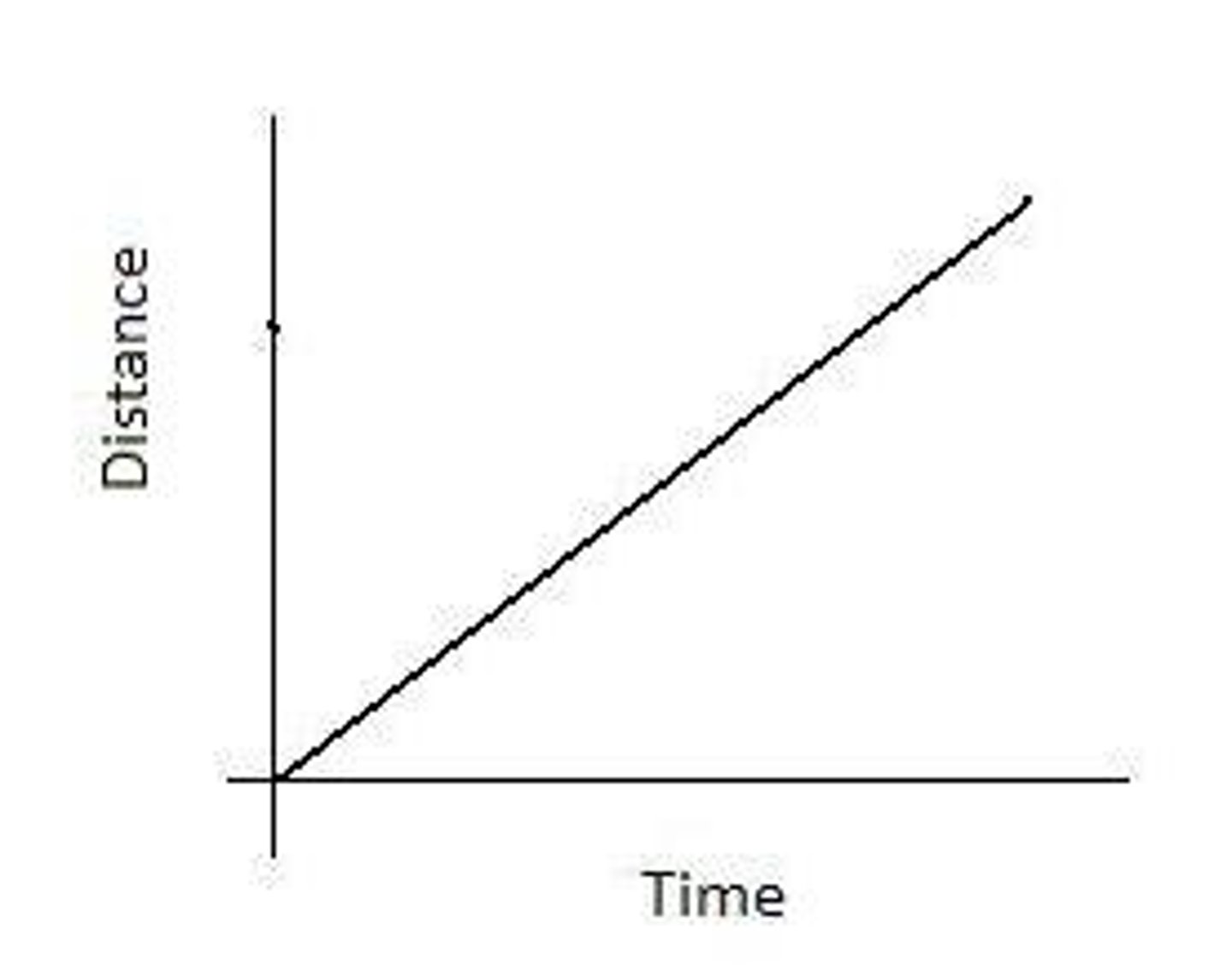
- on a distance-time graph, an upward slope means velocity is increasing
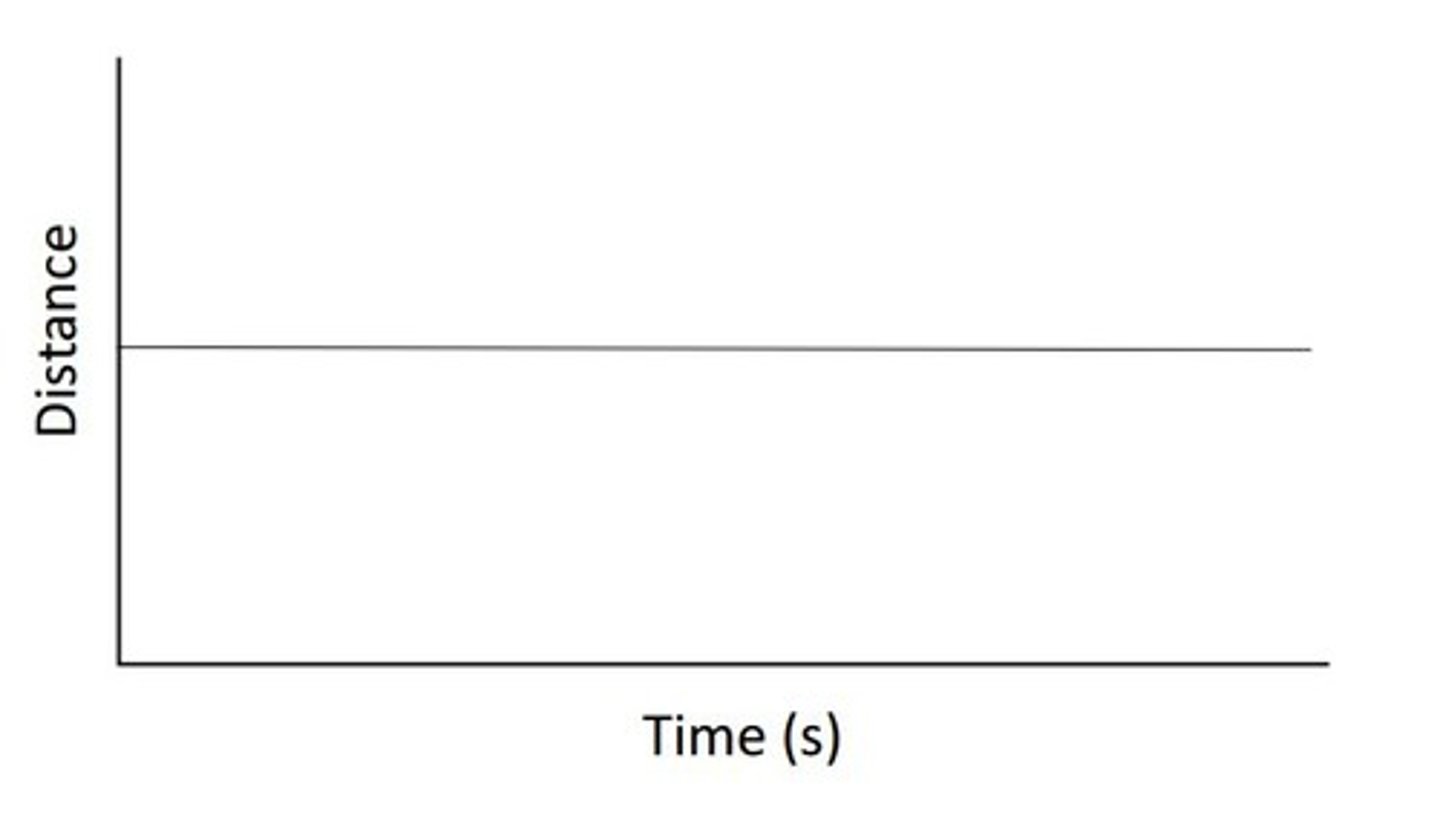
- a horizontal line on a distance-time graph means the object has suddenly stopped moving
- a downward slope on a distance-time graph means the velocity is decreasing
Explain how to interpret what the acceleration is like using a velocity-time graph
- an upward slope on a velocity-time graph means the acceleration of the object is increasing
- a horizontal line on a velocity-time graph means the acceleration is 0 m/s^2 as the velocity is at a constant rate so there is no change in velocity
- a downward slope on a velocity-time graph means that the deceleration of the object is occurring, with a change to a slower velocity
If the clockwise moments and anticlockwise moments are equal, the object will .....
- if the clockwise moments and anticlockwise moments about an object are equal,
- the object will not turn
What is terminal velocity in simple terms?
- terminal velocity is essentially when a falling object moves at a steady speed due to forces acting in opposite directions on the falling object becoming balanced
Explain how an object's speed changes as it falls through a fluid from rest to a terminal velocity
- object initially accelerates due to gravity
- as object's speed increases, frictional forces increase to balance forces due to gravity,
- so a resultant force of zero acts on the object
- this causes object to move at a terminal velocity (steady speed)
Interpret the distance-time graph for a stationary object
Interpret the distance-time graph for an object moving at a constant speed
Interpret the velocity-time graph for stationary object
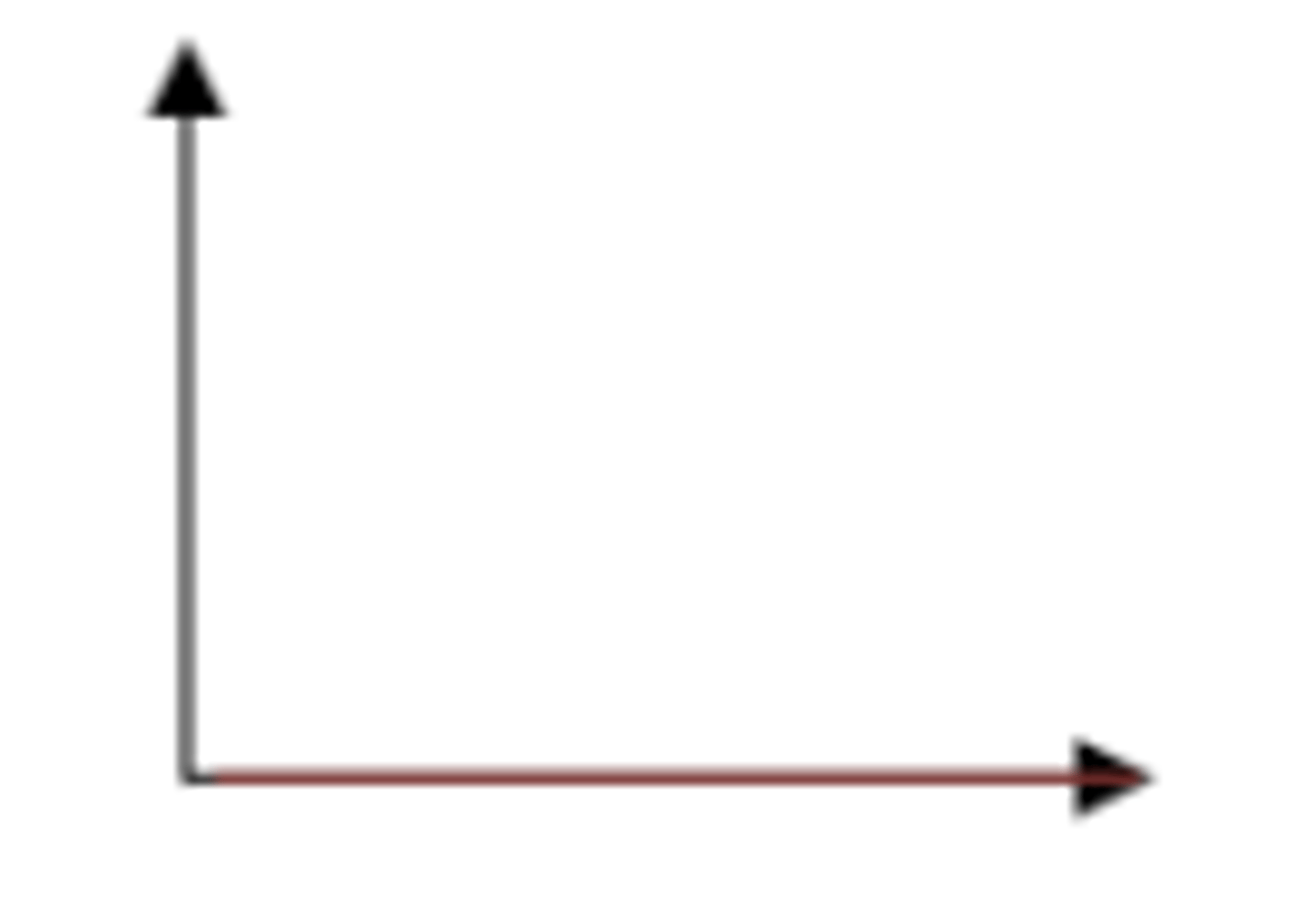
Interpret the velocity-time graph for a constantly moving object
What does a steep gradient on a distance-time graph tell us?
- a steep gradient on a distance-time graph tells us an object's speed is increasing more quickly, as the distance rises in a smaller amount of time