PE Paper 2 : Exercise Physiology
 Call Kai
 Learn
Learn Practice Test
 Spaced Repetition
 Match
Match Flashcards
 Knowt Play
1/54

There's no tags or description
Looks like no tags are added yet.
Name | Mastery | Learn | Test | Matching | Spaced | Call with Kai |
|---|
No analytics yet
Send a link to your students to track their progress
55 Terms
Give three sporting examples of how a swimmer can reduce drag during a race.
(3)
• Ensuring they’re in a streamlined position (accept appropriate examples of a streamlined position) (1)
• Wearing a swimming hat. (1)
• Wearing specialised swimwear. (1)
• Removing body hair. (1)
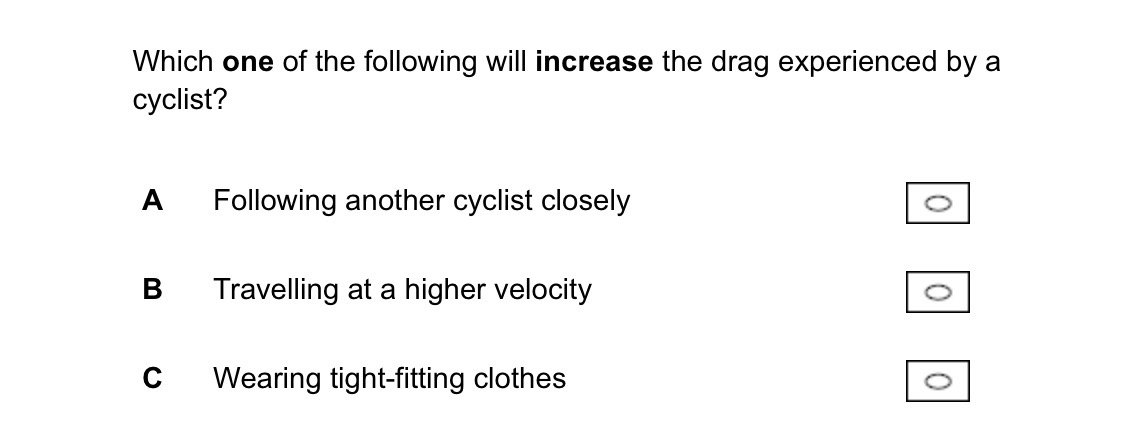
B
Explain how a lift force is imparted to a discus during flight and its effects on the flightpath of the discus.
(4)
• Discus is an aerofoil shape
• Takes on an appropriate angle of attack to the direction of motion
• Air has to travel further over the top of the discus
• Air travels faster over the top of the discus
• This creates a low pressure area on top of the discus called the Bernoulli principle
• Air tries to move from high to low pressure (creating the lift force)
• Makes flight path non parabolic/asymmetrical
• Lengthens flight path/discus travels further / is in air for longer
Explain the methods used to reduce the forces acting on a cyclist whilst racing.
(4)
• Reduce friction by using thin / high pressured tyres
• Reduce friction by streamlining
• Creating smooth flow around cyclist / reducing turbulent flow / drag reducing profile drag / turbulence behind
• Reduce frontal / forward cross sectional area
• Reduce surface friction of air on cyclist / specialist smooth clothing / helmet
• Reduce turbulence behind cyclist / change body shape to smooth airflow behind cyclist
Explain a cyclist's use of the Bernoulli effect to increase downwards lift force.
(4)
• Body forms an aerofoil shape, creating angle of attack
• Air travels further under cyclist so travels faster
• Air travels a shorter distance over the cyclist so travel slower
• Creates low pressure under cyclist and high pressure above
• (Bernoulli) Force formed from high to low pressure
Explain how a lift force can be generated by a discus in flight.
(4)
• Air molecules striking the under surface of the discus are accelerated (1)
• This causes a pressure difference between the upper and lower surfaces of the discus (1)
• This creates a pressure gradient (1)
• creating a lift force/Bernoulli effect (1).
Explain how a high angle of attack will affect the distance travelled by the discus.
(3)
• The discus does not travel as far/stalls (1).
• A high angle of attack will mean the discus produces less lift /more drag (1).
• As a result, air begins to flow less smoothly over the top of the discus (1).
• Meaning that air flow over the top of the discus becomes more and more separated (1).
Identify one vertical force and one horizontal force acting on a performer when running in a 100 metre sprint.
(2)
Vertical force : Gravity
Horizontal Force : Air resistance
The final stage of an endurance race often involves a sprint finish.
Explain how an athlete is able to accelerate towards the finish line.
Refer to Newton’s Second Law of Motion throughout your answer.
(3)
m
Newton’s Laws of motion explain how a performer moves.
Analyse how a footballer will move towards the ball from a stationary position.
Refer to Newton’s First and Second Laws of motion in your answer.
(4)
m
During the race, a swimmer has to dive off the starting blocks as quickly as possible.
Explain how the swimmer dives off the starting blocks.
Refer to ‘Newton’s First and Second Laws of Motion’ in your answer.
(4)
m
Explain how a player uses Newton’s Laws of Motion to move towards the ball during a rally.
(4)
m
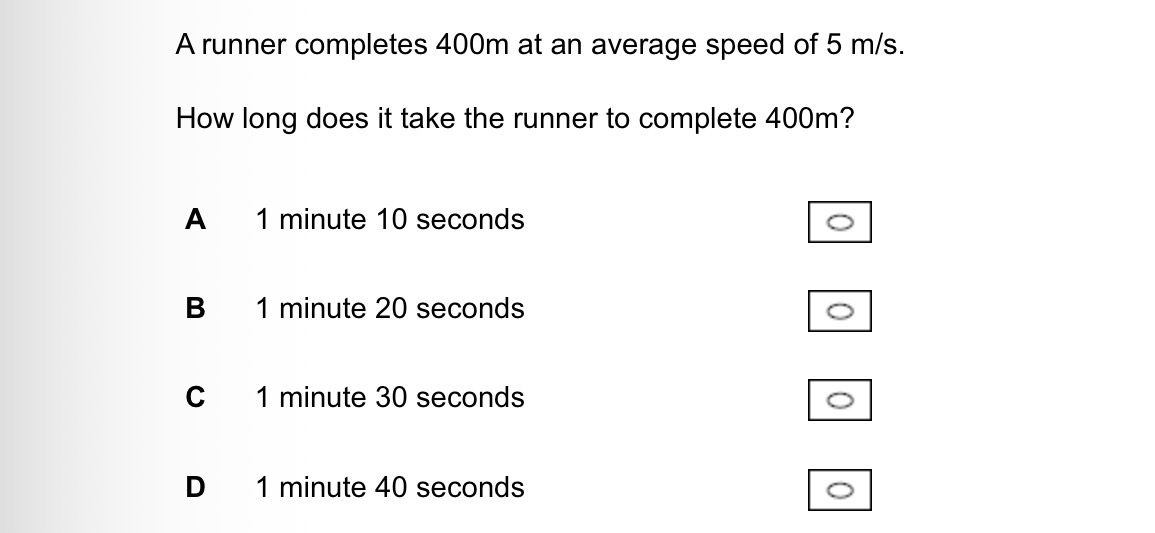
B
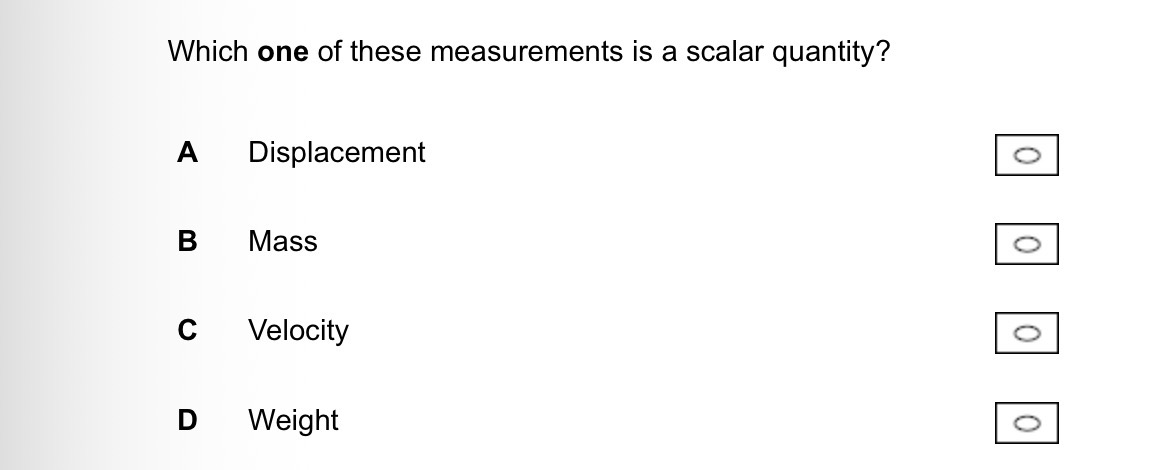
B
Calculate the average speed of a performer who runs 200 metres in 20 seconds.
(2)
• 200 ÷ 20
• m/s or ms-1
= 10m/s
Below is a distance time graph for a cycle sprint.
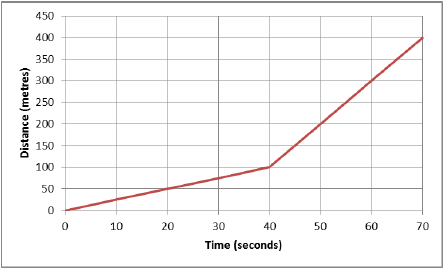
Calculate the speed of the cyclist between 40 and 70 seconds.
(2)
• 300m/30s (1)
• 10m/s / m.s–1 / metres per second (1)
The diagram below shows a gymnast holding a headstand.
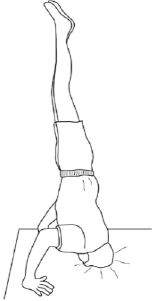
State two factors that affect the stability of a gymnast holding a headstand.
(2)
• Height of centre of mass of the gymnast (1).
• Area of base of support for the headstand (1).
• Position of line of gravity and body mass (1).
Outline the concept of centre of mass in relation to forces.
(3)
• CoM - unique point of object where its weight can be considered to act
• Object of uniform shape and density - CoM = centre of shape
• Force applied through CoM / concentric force - body moves in straight line / linear motion
• Force not applied through the centre of mass / eccentric force - rotation / angular motion produced
A
The photograph below shows an athlete performing the long jump.
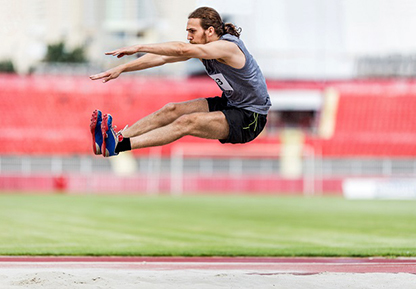
In the photograph, a third-class lever is operating at the hip to allow flexion.
Explain the mechanical advantage of the third-class lever operating at the hip for the athlete.
(2)
AO1
(mechanical advantage) Large range of movement / resistance or load can be moved quickly (1).
AO3
By moving the legs forwards in front of them / flexing at the hip / lifting their legs higher to allow them to jump further / so legs are thrown forwards quickly to gain forwards movement and jump further (1).
The ankle operates as a lever as an athlete pushes off the ground to clear a hurdle.
Identify the class of lever operating at the ankle and explain the mechanical advantage of the class of lever for the athlete.
(3)
Second class lever system (1)
Longer effort / force arm (1)
Therefore, the hurdler provides minimal effort to generate height to clear the hurdle (1)
The diagram below shows a football player kicking a ball.
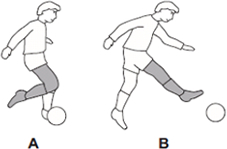
Name, sketch and label the lever system operating at the knee of the football player in the diagram.
(3)
AO2
• Third class lever (system) (1)
• Correct order / labelling: Effort / force positioned in the middle (positioning of resistance / load and fulcrum / pivot can be either side). Fulcrum / pivot, effort / force and resistance / load (1)
• Correct drawing of the lever system: Fulcrum below the line, resistance above the line, arrow(s) pointing in the correct direction (1)
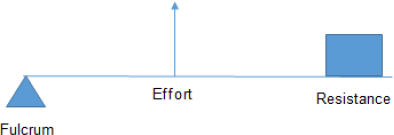
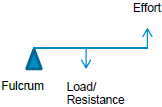
Lever systems allow movement at joints.
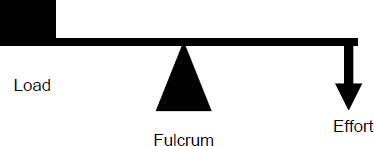
Sketch and label a third class lever system.
(2)
A Resistance/Effort/fulcrum
Also accept pivot (fulcrum), load (resistance), force (effort).
B Drawn in correct order
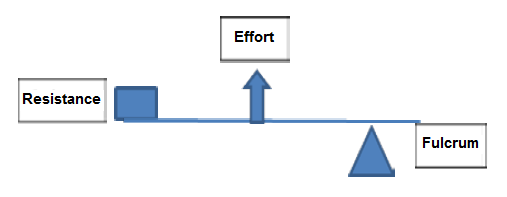
Sketch the lever system operating at the ankle joint from position A to position B.
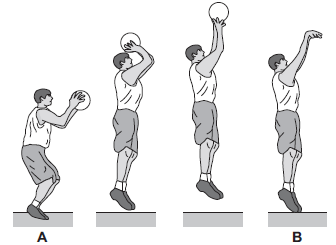
(2)
2nd order / class lever
(Correct order) fulcrum / load / effort (1)
(Correct sketch) arrows pointing in the right direction / fulcrum under the line / resistance above if shown as a box etc (1)
The figure below shows the drive phase of the leg action while running.
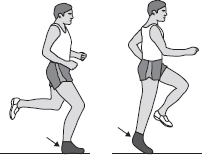
Position A Position B
State one mechanical advantage and one mechanical disadvantage of the lever system that is being used at the right ankle as the runner in the figure above moves from Position A to Position B.
(2)
Advantages
Larger forces generated / longer force / effort arm
Easy to move heavy / large weight
Disadvantages
Limited range of movement
Limited / reduced speed of movement
The image below shows the movements involved as a player throws the ball on to the field of play during a game of rugby.
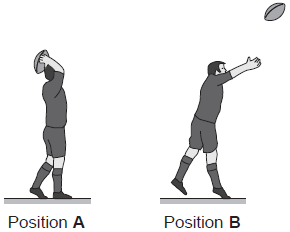
Sketch and label the lever system operating at the elbow during the movement from Position A to Position B.
(3)
Correct order – Fulcrum in middle (1)
Correct labels – resistance / fulcrum / effort. (1)
Correctly drawn – Arrow in the correct direction / fulcrum below the line etc. (1)
Other way around is still correct.
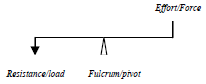
The figure below shows how a gymnast pushes up from a headstand to a handstand.
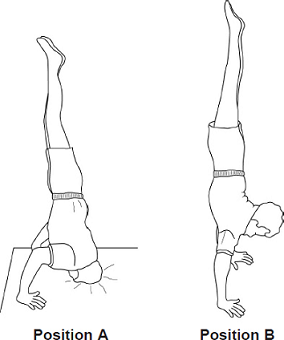
Name, sketch and label the lever system that is operating at the elbow during the movement from A to B.
(3)
First class / order / lever / system;
Correctly labelled – fulcrum / pivot; effort / force; load / resistance / weight;
Correct order – Fulcrum / pivot in middle.
Newton’s laws of linear motion can be adjusted to explain the movement of rotating bodies, known as angular motion.
State Newton’s first law of angular motion.
(1)
1
Newton’s laws of linear motion can be adjusted to explain the movement of rotating bodies, known as angular motion.
The figure shows a figure skater rotating in the air during a jump.
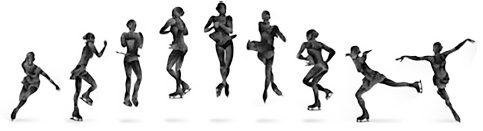
Analyse how Newton’s laws of angular motion can account for the figure skater’s speed of rotation throughout the movement.
(3)
2
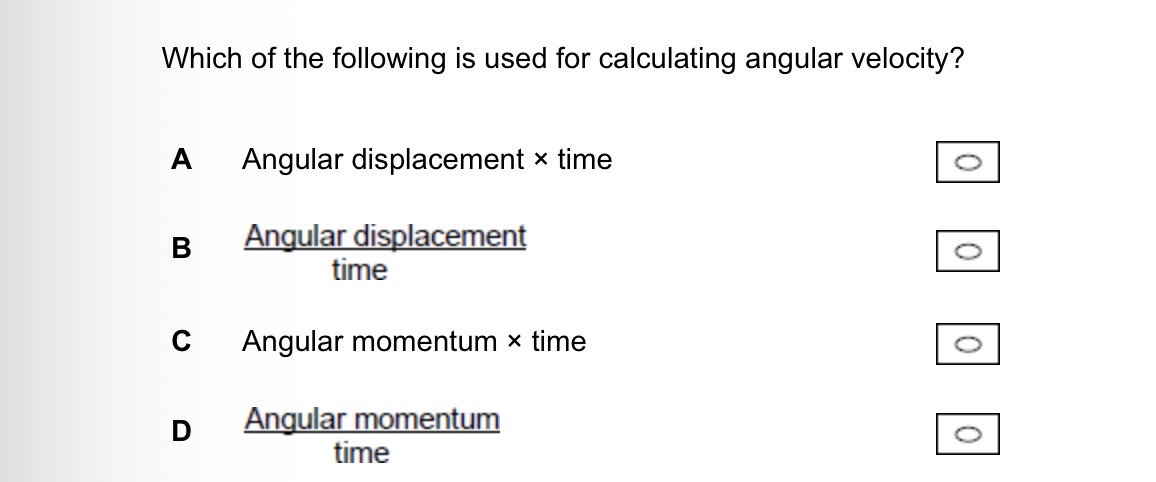
B
Gymnasts have to change the position of their body when performing a somersault during a gymnastic floor routine.
Explain how a gymnast alters their angular velocity by changing their moment of inertia.
(4)
6
Explain how a gymnast can alter the speed of rotation during flight- cons of angular motion.
(4)
7
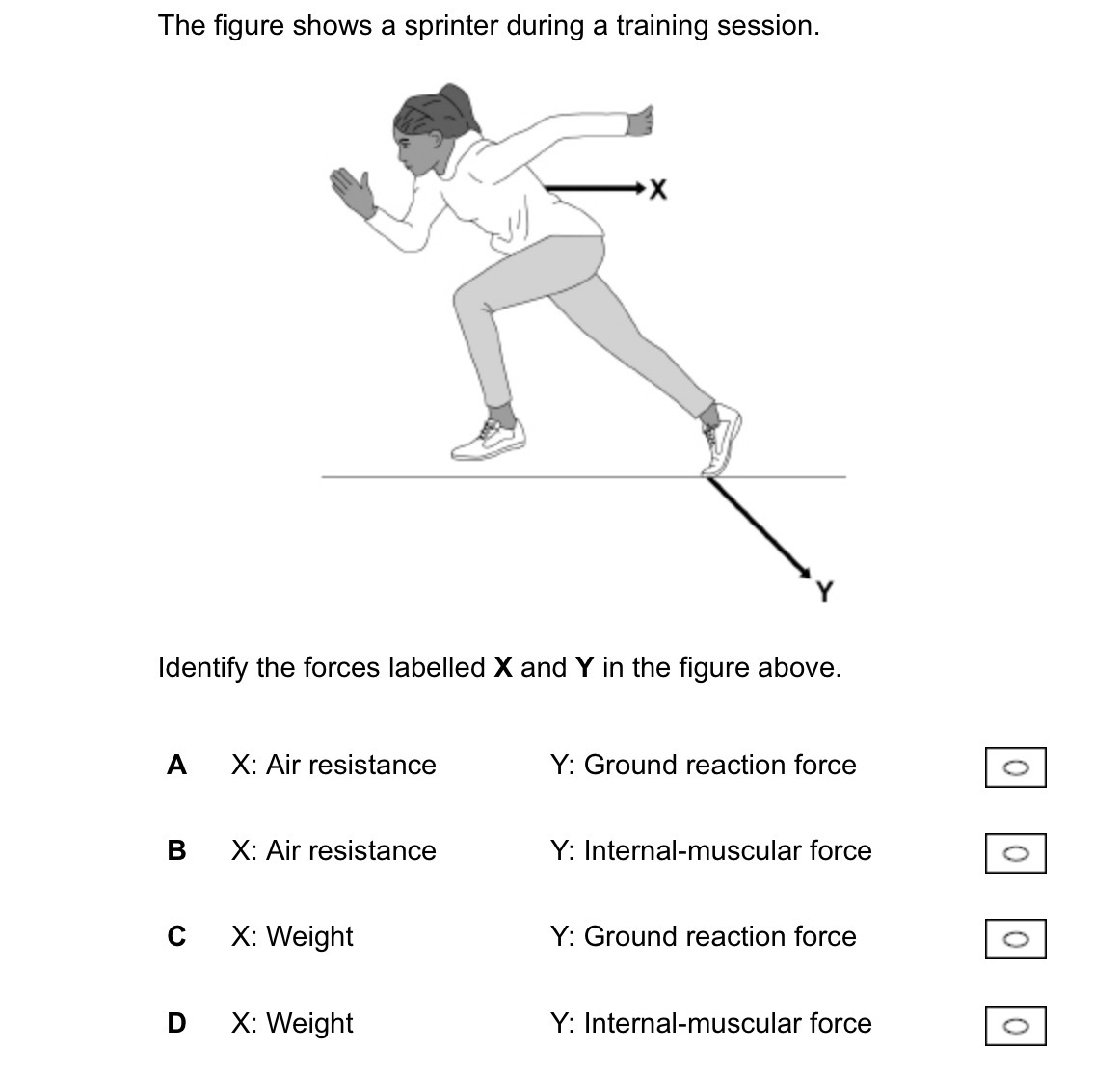
B
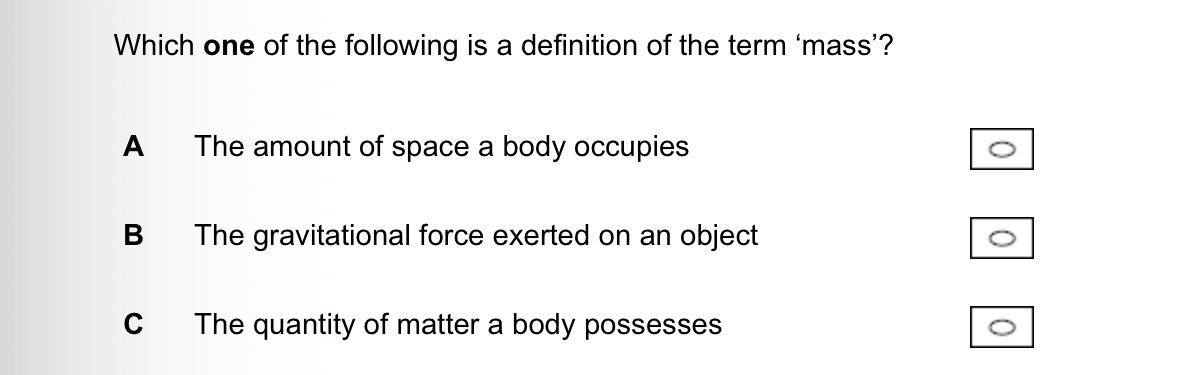
C
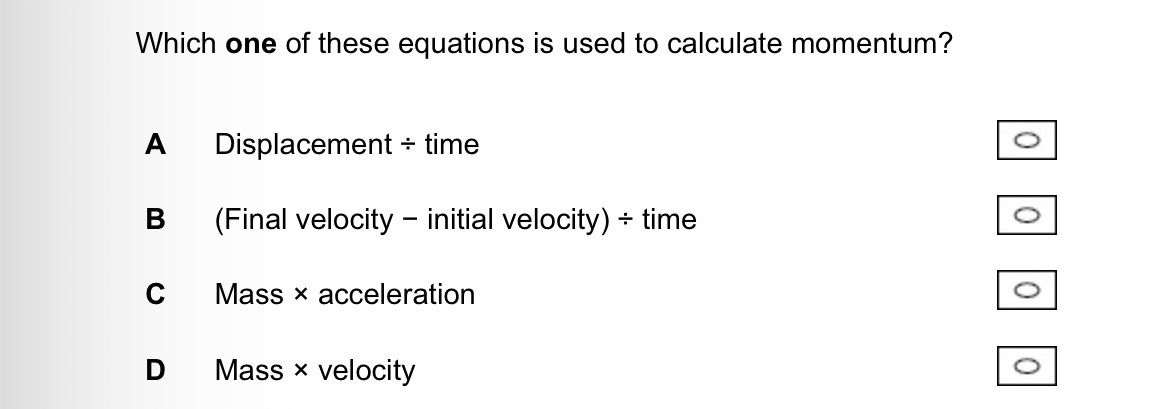
D
The graph below shows a distance-time graph for Clare sprinting 100 metres.
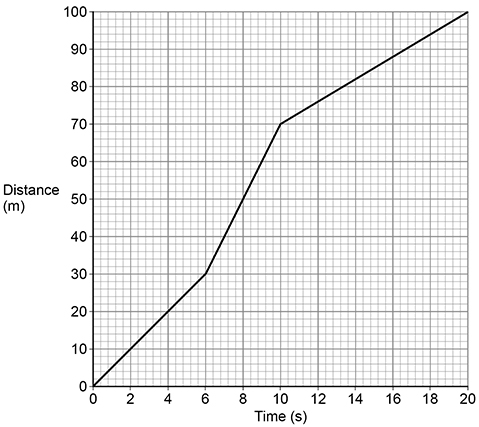
Identify how many second Clare maintained her highest speed for
(1)
4 / four (seconds) (1)
Define what is meant by a vector quantity.
(1)
A vector quantity has both magnitude/size and direction. (1)
Cyclists need to be able to accelerate at the start of a race.
The figure below shows a velocity–time graph of a cyclist at the start of a road race.
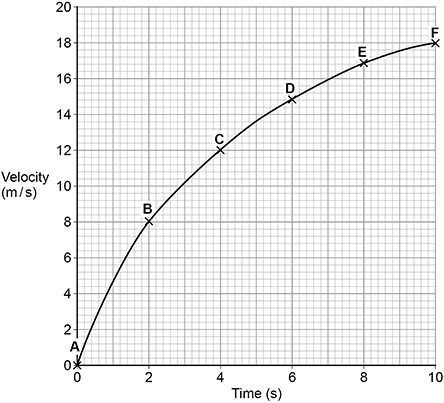
Identify the two points in the graph above between which the cyclist was accelerating at the greatest rate.
Points A and B (1)
Distance at end of 10 m split (m) | 10 | 20 | 30 | 40 | 50 |
Split time (s) | 2 | 1.5 | 0.9 | 0.8 | 0.8 |
Velocity at the end of the split (m/s) | 4 | 10 | 11 | 12 | 12 |
Calculate the sprinter’s acceleration between 10 and 20 m using the data in the table above.
Give the correct units in your answer.
• 4 (1)
• m/s2/ms−2/metres per second squared/metres per second per second. (1)
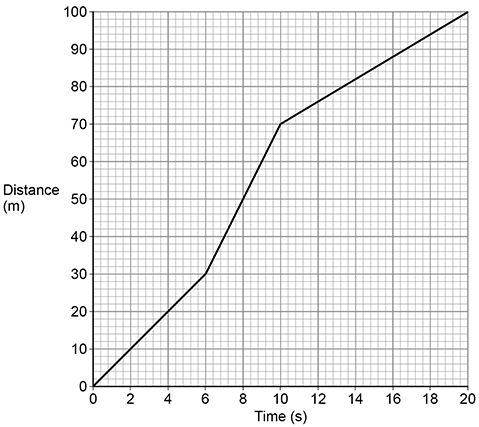
Calculate the average speed Clare was travelling over the 100 metres.
Average speed = 100/20 = 5m/s (metres per second/ms-1).
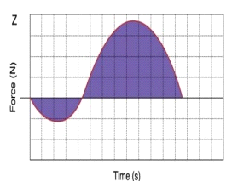
Sketch and label a graph to show the impulse generated during the acceleration phase of a 200 metre race.
(3)
X Axis – (time) / milliseconds / seconds
Y Axis – (force) / Newton’s
Axis must be labelled with correct units to be credited. Accept with just units
During sporting events performers have to apply force to execute skills correctly.
The graphs below show three impulse graphs of a sprinter at different stages of a 100 metre race.
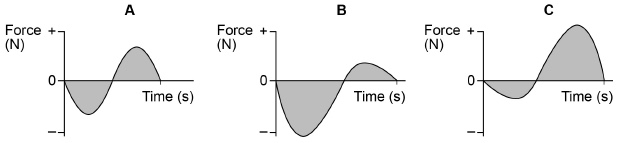
Identify which impulse graph represents the start, middle and end of the race.
(3)
(start of the race) Graph C
(middle of the race) Graph A
(end of the race) Graph B
Define impulse. State the units of measurement.
(2)
• A measure of force applied over time / Impulse = force x time (1)
• Measured in Newton seconds / Ns (1)
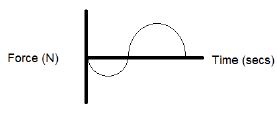
Sketch and label a graph to show the impulse generated at the start of a 100m race.
(3)
• X axis: time s / seconds, Y axis: force N / Newtons (1)
• Negative and positive components of force shown with negative first (1)
• Positive impulse larger than negative impulse (1)
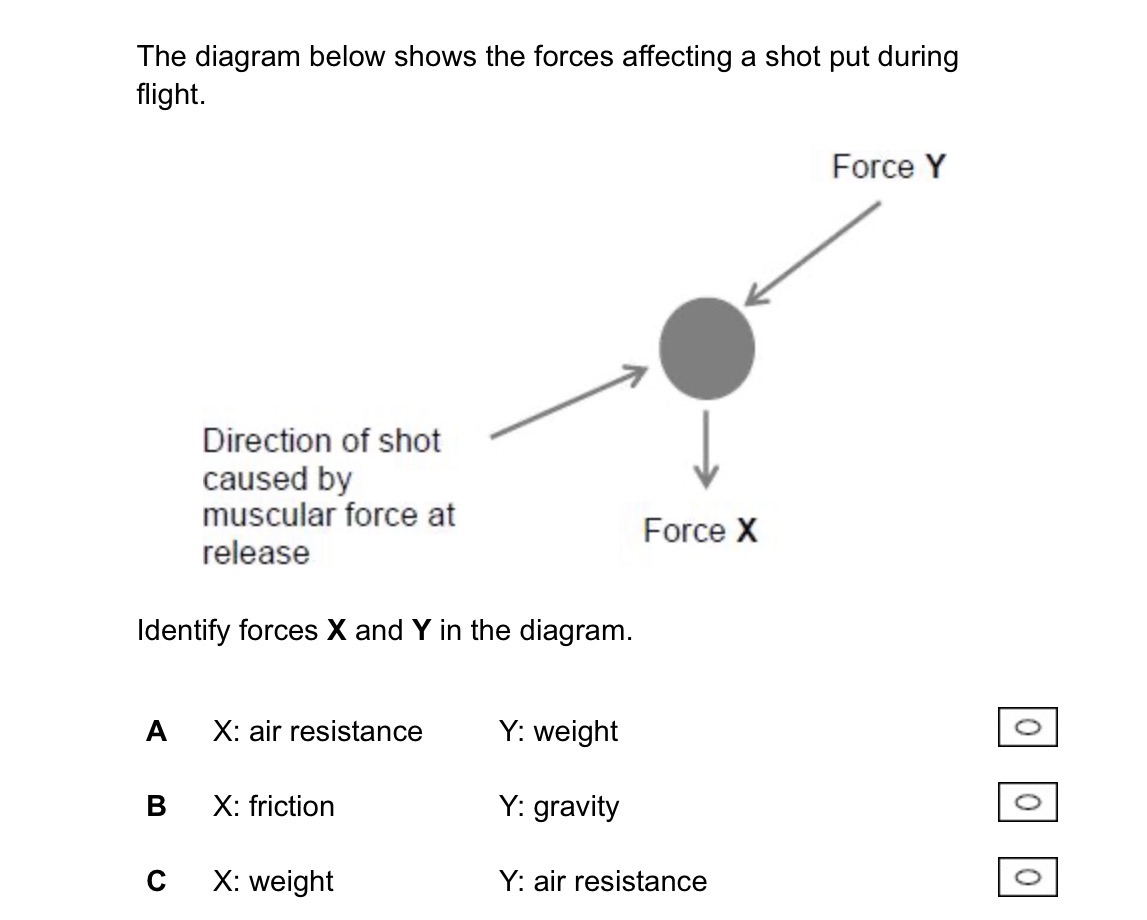
C
One event in the heptathlon is the shot put. This involves one powerful, explosive movement.
State three factors that affect the distance the shot travels.
(3)
• Height of release
• Speed of release
• Angle of release
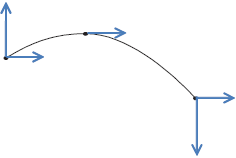
The figure below shows the flight path of a shot.
Label the diagram to show the changing vertical and horizontal vectors at the following points:
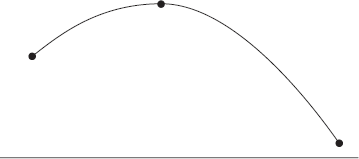
• the point of release
• the highest point of flight
• the point immediately before landing.
(3)
Point of release
Positive vertical component (1)
Arrows only required on diagram
Highest point
No vertical component (1)
Specific points of flight path do not need to be identified
Before landing
Negative vertical component (1)
Equal horizontal component at all three points in flight (1)
Vector arrows must be present and attached to the correct point on the parabolic curve