9.3 - Chemical control in plants
 Call Kai
 Learn
Learn Practice Test
 Spaced Repetition
 Match
Match Flashcards
 Knowt Play
1/26

There's no tags or description
Looks like no tags are added yet.
Name | Mastery | Learn | Test | Matching | Spaced | Call with Kai |
|---|
No analytics yet
Send a link to your students to track their progress
27 Terms
What is tropism?
The growth movement of a plant in response to a directional stimulus:
tropisms are important as they maintain the roots & shoots of flowering plants in a favourable environment
What is phototropism?
A growth response towards sunlight:
plant shoots are positively phototropic (towards sunlight), whereas plant roots are negatively phototropic (away from sunlight)
this puts shoots in the best position to absorb light energy to maximise the rate of photosynthesis
this allows roots to absorb water & minerals, & anchor plants in the soil
What is geotropism/gravitropism?
Growth in the direction of gravity:
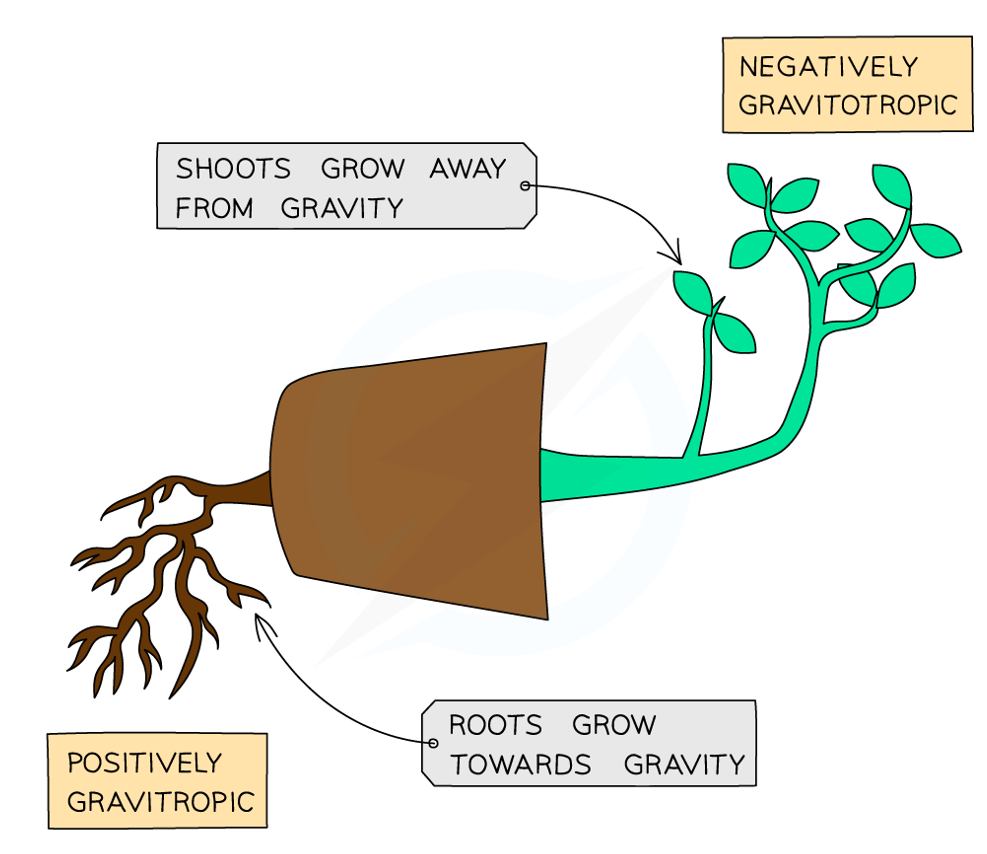
plant roots are positively geotropic (grow downwards in the direction of gravity)
plant shoots are negatively geotropic (grow upwards away from gravity)
What is hydrotropism?
Growth towards water:
plant roots are positively hydrotropic
Plants do not have a nervous system, but still must respond to changes in their internal & external environment to survive. What do they use to enable them to response to external stimuli?
Plant growth hormones
What are two differences between animal hormones & plant growth factors?
Animal hormones are made in glands, whereas plant hormones can be made in any part of the plant
Animal hormones are transported in the bloodstream, whereas plant hormones diffuse from cell to cell & have local effects (they can also be transported in the xylem & phloem)
What are three types of plant hormones?
Auxins - indoleacetic acid (IAA)
Cytokinins (made in meristem)
Gibberellins
What are some functions of gibberellins?
They stimulate:
germination & fruit growth
elongation at cell internodes
rapid growth/flowering
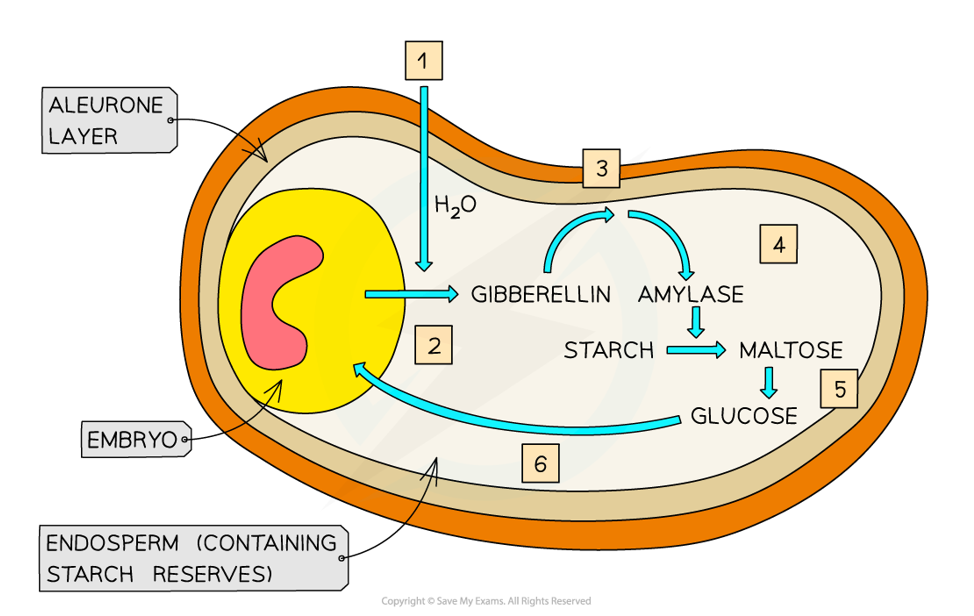
How is germination stimulated?
The seed absorbs water, activating the embryo to secrete gibberellins
Gibberellins diffuse to the aleurone layer, stimulating it to produce amylase
Amylase diffuses to the endosperm layer & hydrolyses starch to form maltose, which is converted to glucose
Glucose acts as a respiratory substrate to produce ATP & is transported to the embryo, providing energy for growth
What are the 2 ways plant growth hormones interact?
Synergistically: to achieve the same effect (e.g. auxins & gibberellins)
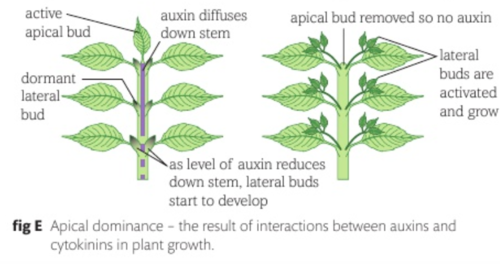
Antagonistically: with opposite effects → e.g. auxins (suppress lateral buds) & cytokinins (stimulate lateral buds)
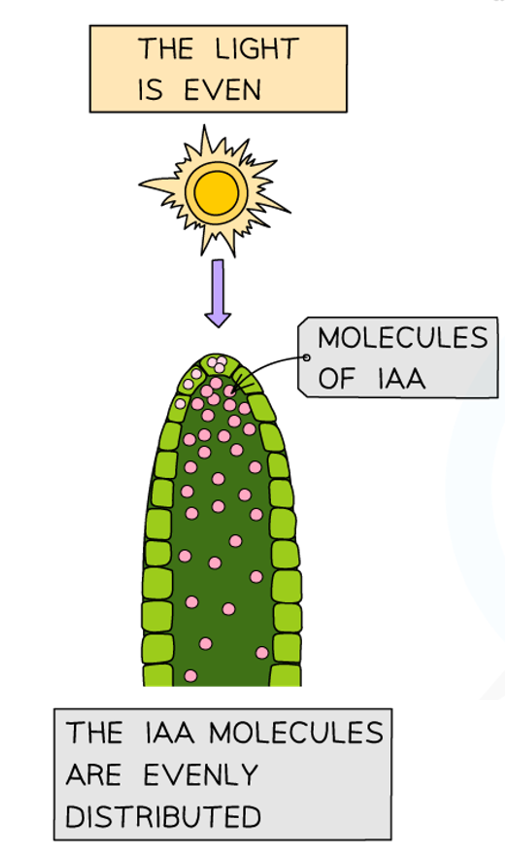
Describe the distribution of auxin in the shoot when light falls evenly on the shoot & explain how this affects the growth of the shoot
The auxin is evenly distributed & the growth on all sides of the shoot is equal, meaning the shoot grows straight up
(auxins are made in the tip of the root tip)
The plant is moved so that light falls on the shoot from one direction. Explain what happens to the distribution of auxin in the shoot
Light causes the auxin to move to the non-illuminated side of the shoot tip
This means there is now an uneven distribution of auxin (there is a higher concentration of auxin on the non-illuminated side)
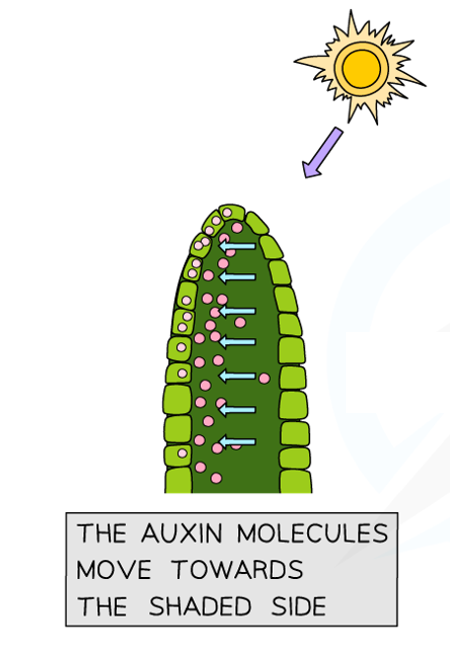
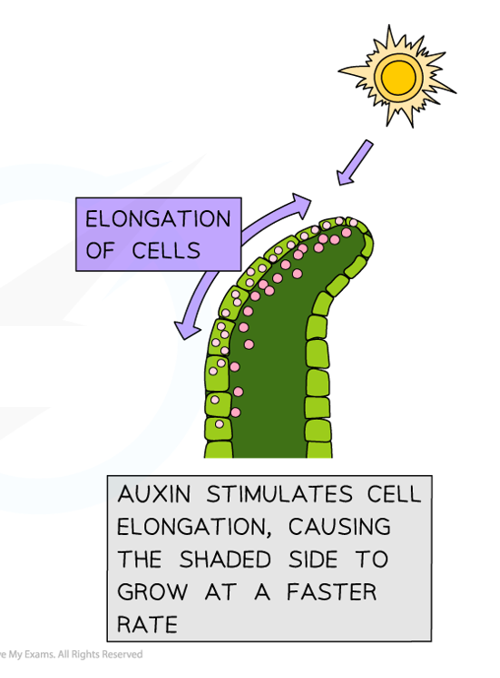
Explain how the distribution of auxin affects the growth of the shoot in this diagram
Auxin causes the cells of the shoot to elongate
There is a higher concentration of auxin on the non-illuminated side (sun is on the right, so left side is shaded), meaning the cells on the non-illuminated side elongate more
There is an unequal growth rate, with more growth on the non-illuminated side, causing the shoot to bend & grow towards the sunlight (positive phototropism)
A young plant is laid on its side. Describe the distribution of auxin in the root & the shoot
The force of gravity causes the auxin to accumulate on the lower side of the root & shoot, meaning there is an uneven distribution of auxin
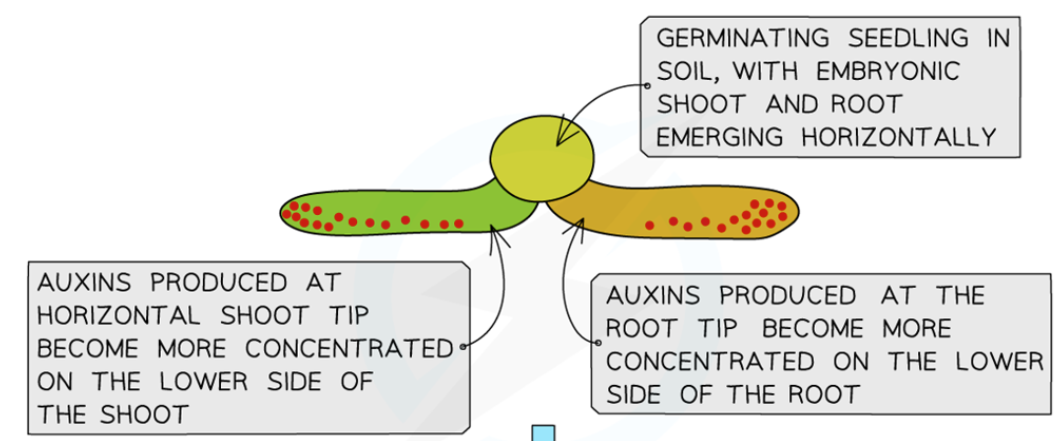
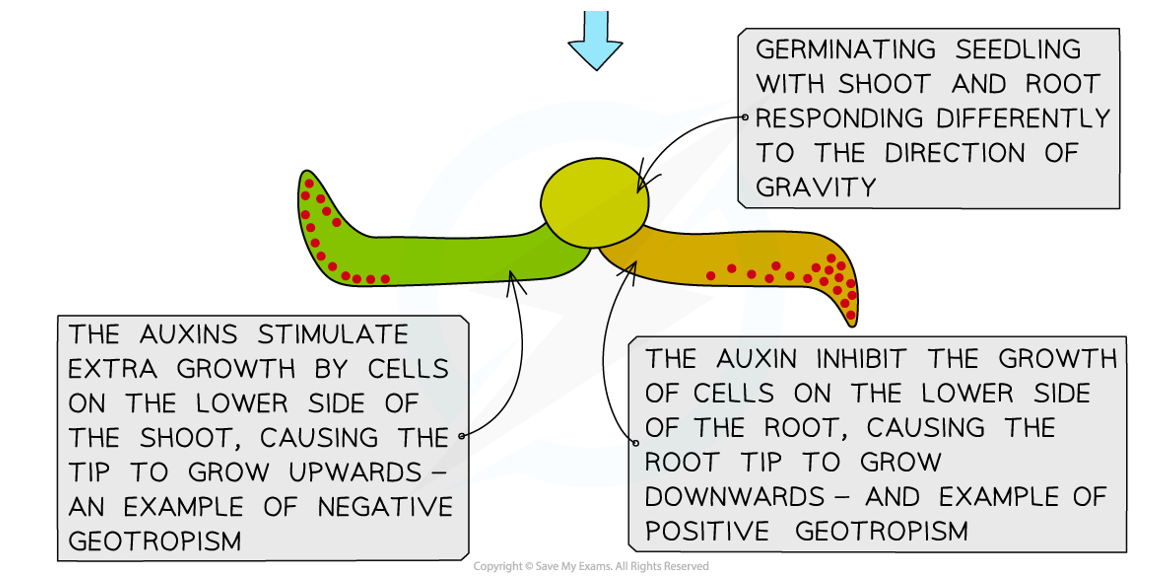
Explain how the auxin affects the growth of the root & shoot in this diagram
Auxin has the opposite effect on root & shoot cells; it stimulates cell elongation in shoot, but inhibits cell elongation in roots
In the shoots, the lower side with more auxin, grows more than the upper side, causing it to bend & grow upwards away from the force of gravity
In the roots, the cells grow more on the upper side with less auxin, causing bending & growth downwards
Explain what happens once the root & shoot are growing in the desired direction
The auxin becomes evenly distributed again & the growth on all sides of the root & shoot will now be equal
Outline the mechanism of how auxins work
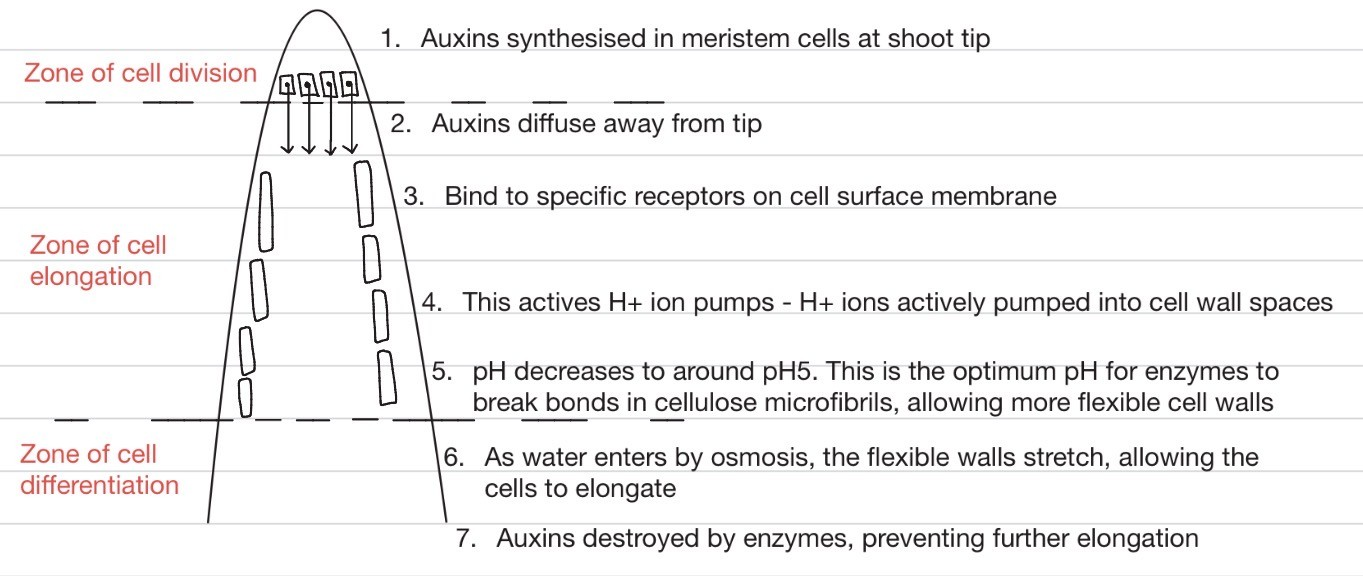
The auxins are synthesised in meristem cells at the shoot tip, then diffuse away from the tip
They bind to specific receptors on the cell surface membrane
This activates H+ ion pumps, causing H+ ions to be actively pumped into cell wall spaces
The pH decreases to around pH 5, which is the optimum pH for enzymes to break bonds in cellulose microfibrils, allowing more flexible cell walls
As water enters by osmosis, the flexible walls stretch, allowing the cells to elongate
The auxins are destroyed by enzymes, preventing further elongation
What is the definition of a phytochrome?
A blue-green photoreceptor pigment in plants that reacts with different forms of light & changes between two inter-convertible forms: Pr & Pfr (active form)
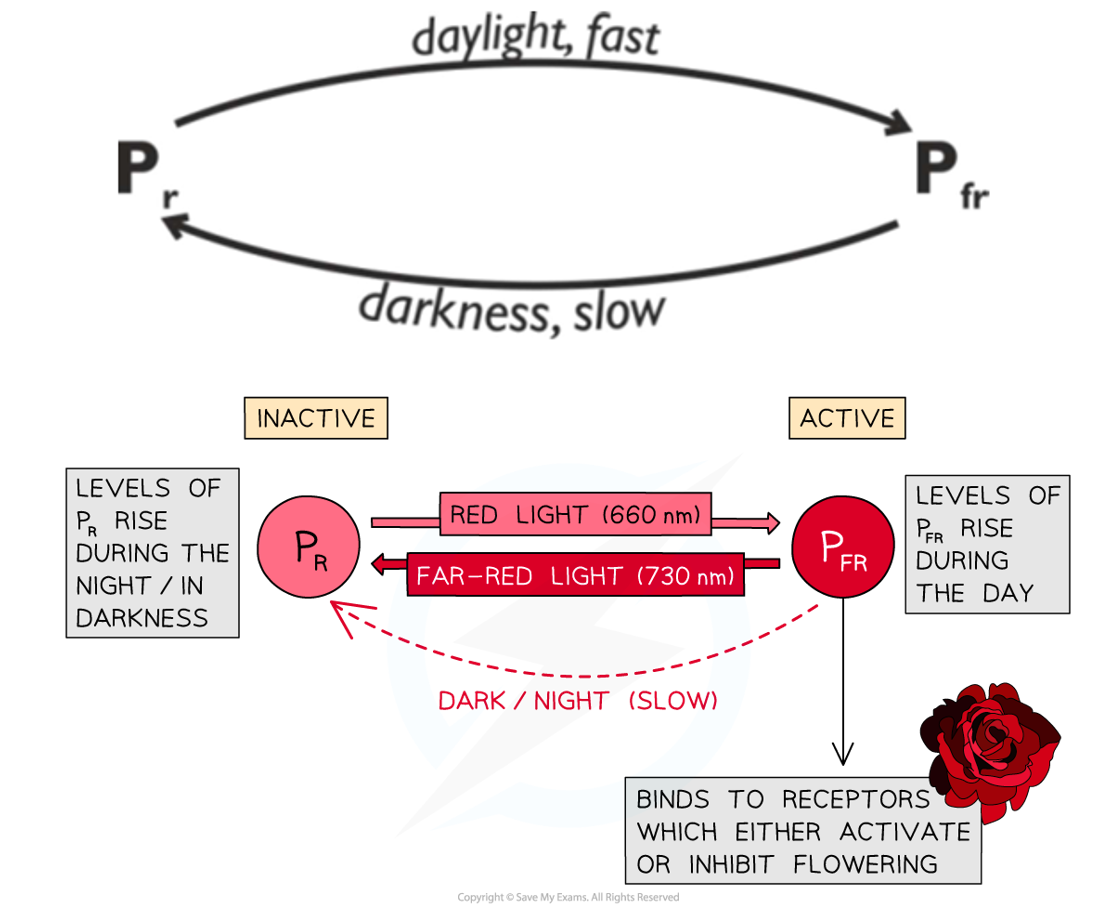
What time of day is each form of phytochrome most abundant?
The ratio of Pr:Pfr enables plants to detect how long days are:
in darkness → Pr abundant (red light)
in sunlight → Pfr abundant (far red light)
What is the definition of photoperiod & photomorphogenesis?
Photoperiod: the amount of time that an organism is exposed to light during a 24-hour period
Photomorphogenesis: the process by which plant development is controlled by the levels & type of light
How does phytochrome control photomorphogenesis?
Transition from Pr to Pfr controls:
localisation of proteins within cells
transcription of certain genes
phosphorylation of proteins
Therefore, affects:
germination
circadian rhythm
flowering
What is the definition of short day (long night) plants & long day (short night) plants?
Short day plants: flower when days are short & nights are long (spring & autumn)
flower when darkness hours exceed a critical value
Long day plants: flower when days are long & nights are short (summer)
flower when sunlight hours exceed a critical value
What is the definition of florigen?
A hypothetical plant hormone, which is involved in the photoperiodic response (it may be the molecule, FTmRNA)
How does phytochrome control flowering?
Pr absorbs red light & converts to Pfr, which stimulates flowering (signifies that light intensity is high enough for photosynthesis)
the last flash of light determines whether a plant flowers or not
What is the relationship between cytokinin & auxin?
If cytokinin = auxin, then cells form an undifferentiated cell mass, called a callus (stay undifferentiated & don’t become specialised)
If cytokinin > auxin, then cells differentiate into shoot cells
If cytokinin < auxin, then cells differentiate into root cells
Where do plants grow from & how do auxin & cytokinin work antagonistically?
Plants grow from meristem tissue in buds → found at the apex (tips) of shoots & roots (apical buds) & at branches (lateral buds)
Auxin & cytokinin work antagonistically to control bud growth:
auxins inhibit lateral buds
cytokinin stimulates lateral buds
(lateral means side; apex means top)
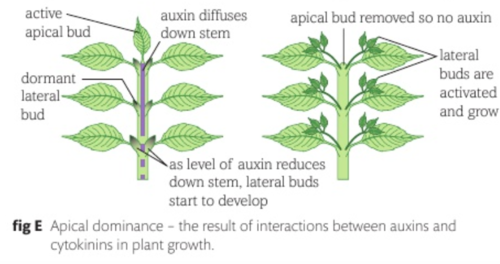
What is apical dominance?
It is important for plants to grow tall, so they can out-compete their neighbours & absorb more sunlight for photosynthesis:
to achieve this, the apical buds produce auxin, which passes down the phloem & inhibits the growth of lateral buds below → so, most of the plant’s sugars are used for growth at the apex
further down the stem, the concentration of auxin decreases, so lateral buds can start to grow