Physiology Ch.3 Part 1 Metabolic Reaction and Enzymes
 Call Kai
 Learn
Learn Practice Test
 Spaced Repetition
 Match
Match Flashcards
 Knowt Play
1/48

There's no tags or description
Looks like no tags are added yet.
Name | Mastery | Learn | Test | Matching | Spaced | Call with Kai |
|---|
No analytics yet
Send a link to your students to track their progress
49 Terms
Ligand
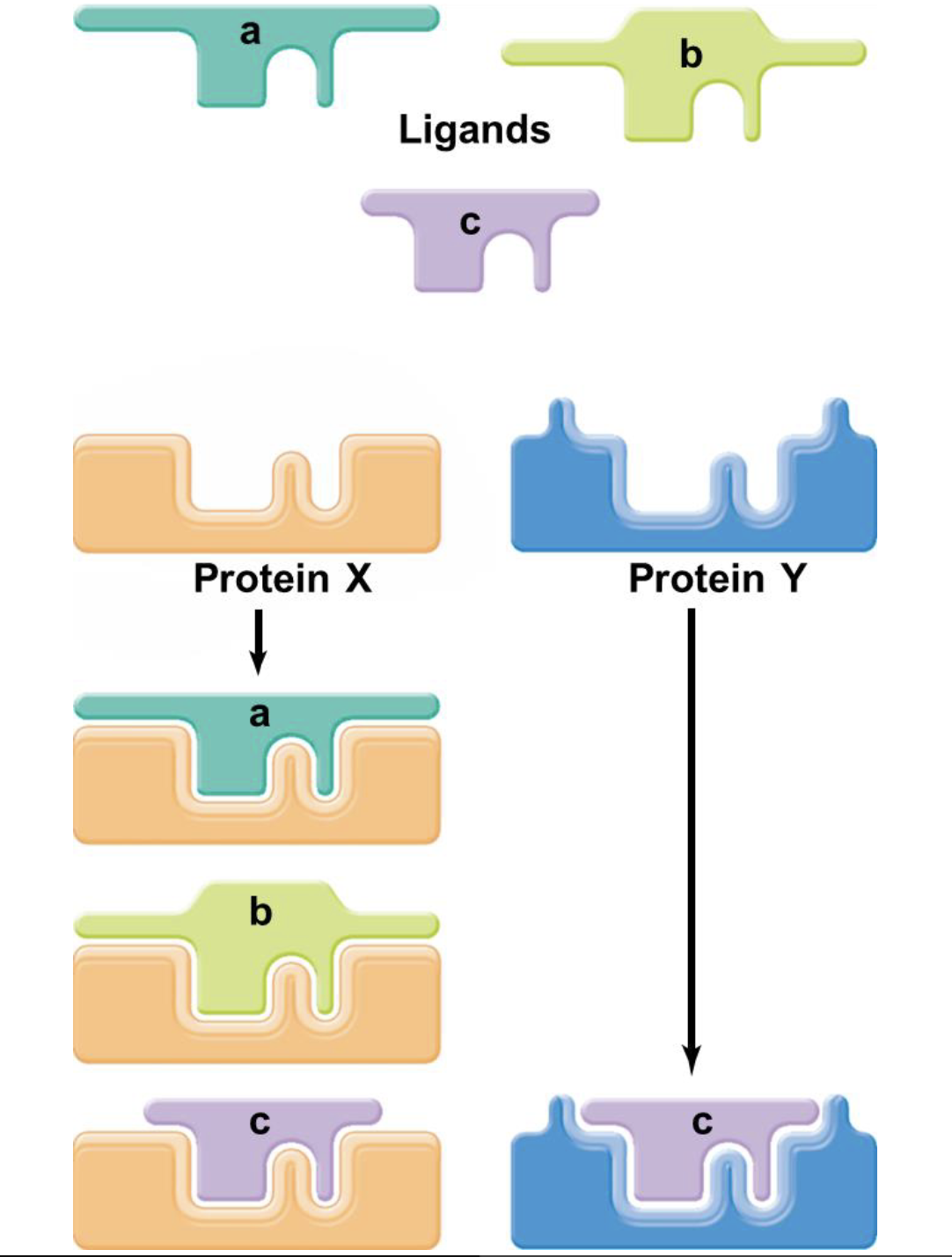
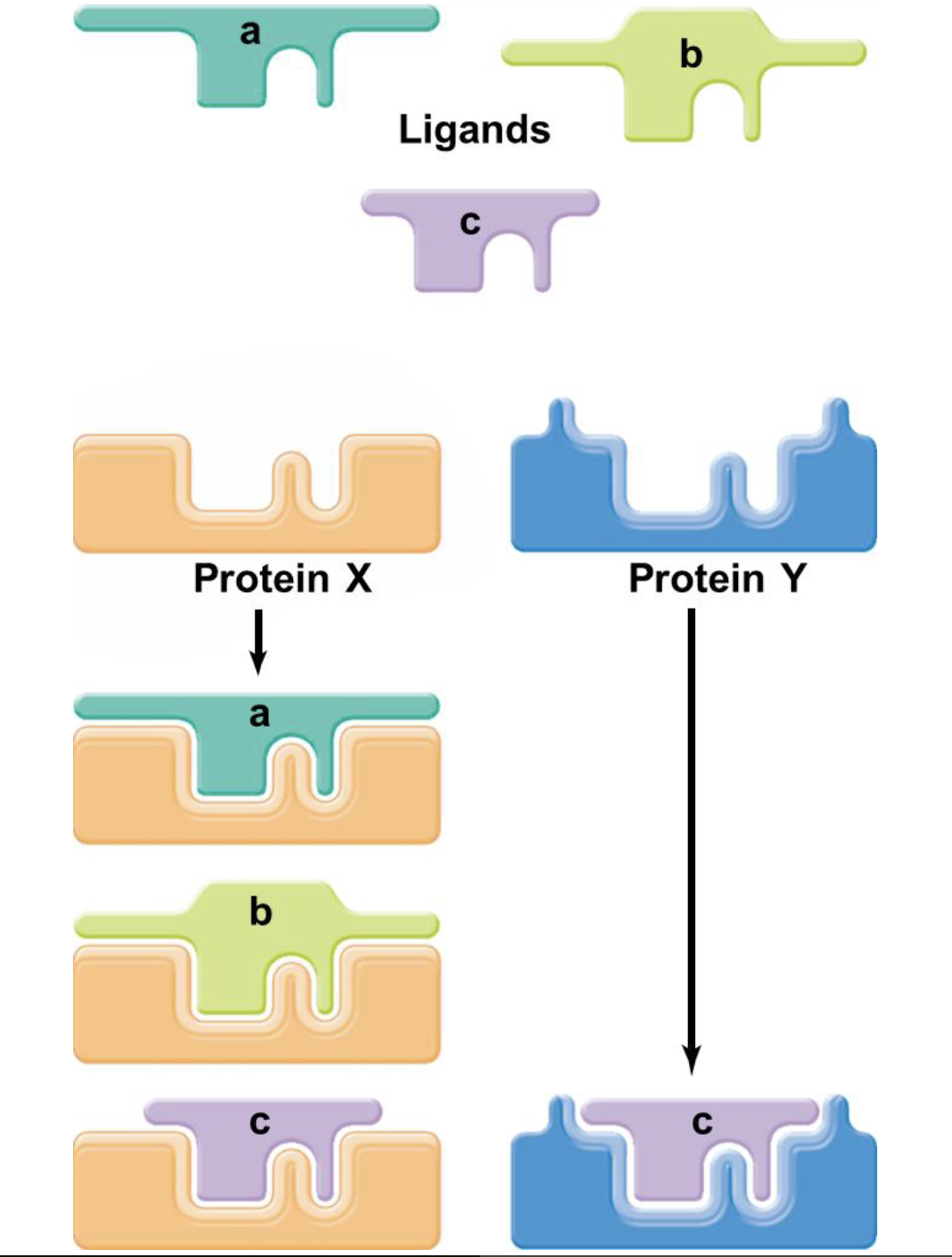
A molecule or ion that is bound to a protein with one of the weak physical forces
- H-bond
- Ionic bond
- van der Waals forces
- hydrophobic forces between non-polar regions
Binding site
Region of the protein where a ligand can bond
- Binding typically changes protein function by activating or inhibiting
Affinity
Strength of interaction between ligand and protein
High affinity = less ligand needed to bind
Based on shape and chemical specificity
Chemical specificity
How exclusive a protein is with ligands to accepts
- Determined based off amino acids in binding site and shape of binding site
High chemical specificity = few kinds ligands can fit into the binding site on the protein
Low chemical specificity = many kinds of ligands can fit into the binding site on the protein
Saturation
How many binding sites are occupied at one time
- Measured in % with 100% being the max
Determined by amount of unbound ligand and affinity of binding towards available ligand
Competition
Different ligands compete with one another for the same binding sites
Some ligands are inhibiters that stop a reaction from happening at all
Metabolism
The sum of all chemical interaction in the body
Subdivided into anabolism and catabolism
Anabolism
Synthesis of organic molecules
Does not happen spontaneously
- Products have more energy than reactants
Memory hack: An = add
Catabolism
Destruction of organic molecules
Happens spontaneously
- Reactants have more energy than products
Memory hack: Cat = catastrophe
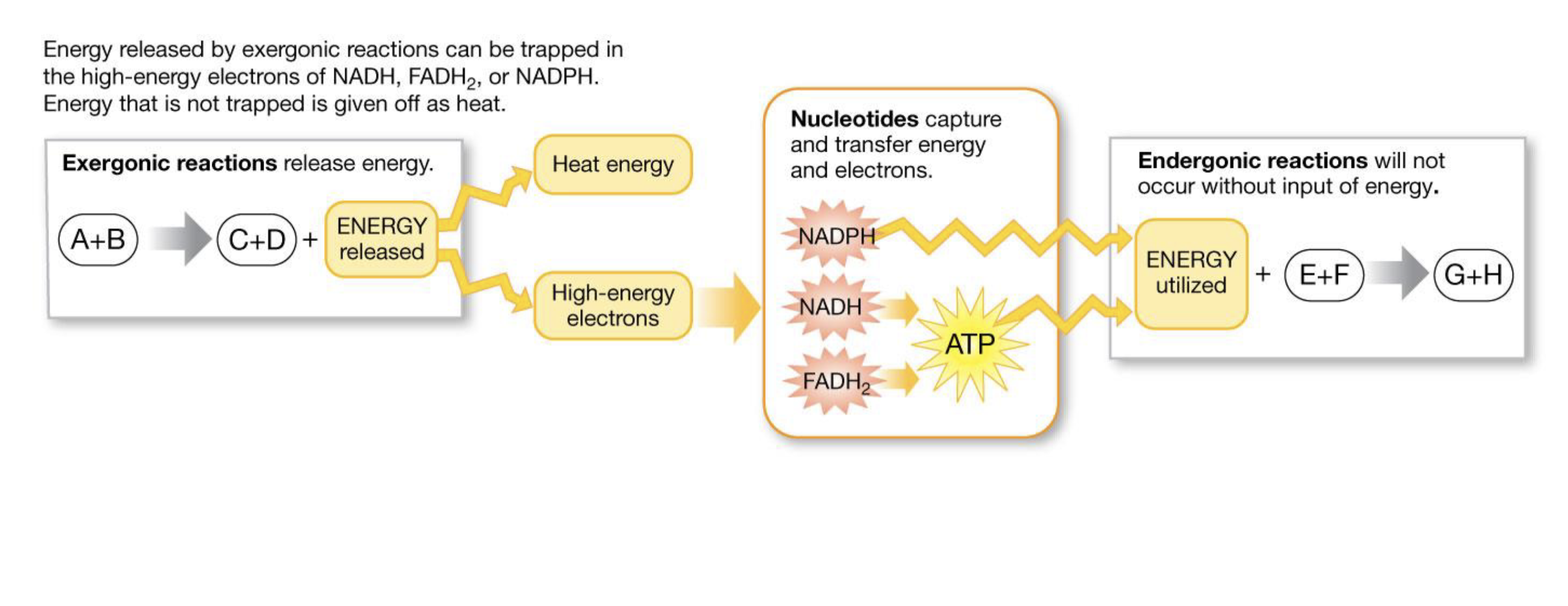
Exergonic
A chemical reaction that gives off energy in the body
Endergonic
A chemical reaction that takes in energy in the body
Relation between exergonic and endergonic reactions
Energy from exergonic reactions can be transferred to endergonic reactions to power them
- Energy transported through high energy electrons, if not trapped it is given off as heat
Catabolic / decomposition
Type of chemical reaction
Molecules break down into smaller molecules
AB turns into A and B
Anabolism / synthesis
Type of chemical reaction
Molecules add together into bigger molecules
A and B turn into AB
Exchange
Type of chemical reaction
Parts of large molecules exchange themselves with parts of other large molecules to make different large molecules
AB and CD turn into AD and BC
Dehydration Synthesis
Combine molecules by taking an OH off of one and an H off of the other
Gets its name from the fact that it pulls water out of the molecule
- A–B + H2O → A–OH + H–B
Hydrolysis
Breaks up a molecule using water
Gets its name from the fact that water “hydro” is lysing “cutting apart” a molecule
- A–OH + H–B → A–B + H2O
Reactions using water
Hydrolysis
Dehydration synthesis
Reactions using phosphorus (P)
Phosphorylation
Dephosphorylation
Phosphorylation
Change the same of a protein or transport energy in the phosphate bond
ADP + Pi → ATP + H2O
Dephosphorylation
Change the same of a protein or transport energy in the phosphate bond
ATP + H2O → ADP + Pi
Oxidation-reduction reactions
Made up of oxidation and reduction, both will always happen together
Oxidation
Part of a Redox-reaction
An electron is transferred to another molecule
A• + B ⇌ A + B•
Reduction
Part of a Redox-reaction
An electron is gained from molecule
HA-BH ⇌ A=B + 2H
Equilibrium
Products are turning into reactants and reactants are turning into products at an equal rate
There is no noticeable change in matter
Possible when the reactants and products are at equal energy levels
Reversible Reaction
A chemical reaction that can be performed in both directions
- The energy requirements to reverse the reaction fall in practical range
Irreversible Reaction
A chemical reaction that can’t be performed in both directions
- The energy requirements to reverse it fall out of the practical range
Reaction rate
How fast a reaction is happening
- Based on concentration of reactants and products
- Based on activation energy
- Based on temperature
- Based on the presence of a catalysis
Law of Mass Action
Reaction rate based on the concentration of both reactants and products
More will be made of the least concentrated half of the reaction
- If product are less concentrated than reactants more products will be made
- If reactants are less concentrated than products more reactants will be made
Activation energy
Amount of energy needed to destabilize the reactants
Reaction can’t happen unless reactants are testable destabilized
Lower activation energy = more reactions
- Enzymes lower activation energy
Enzymes
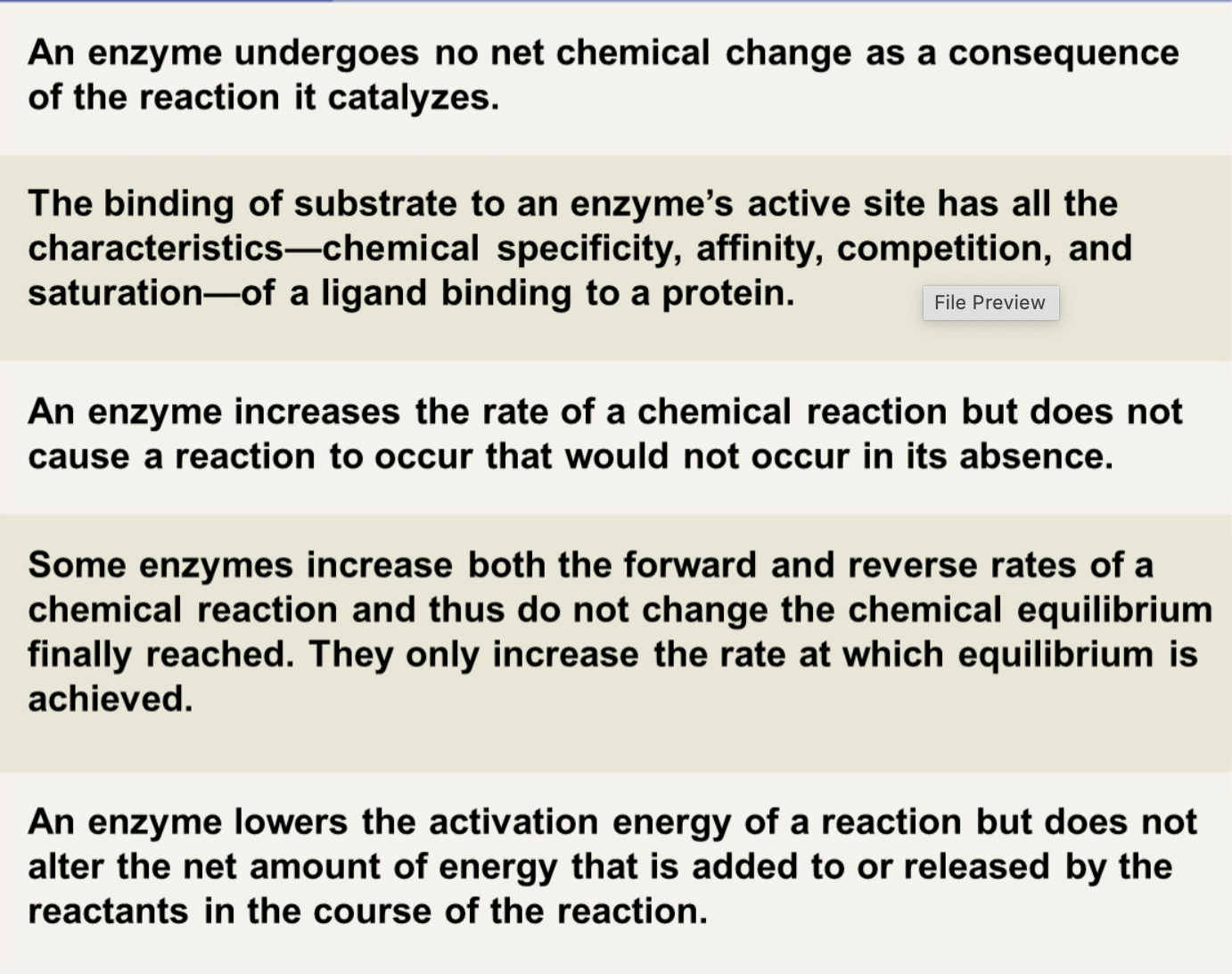
Reduce the activation energy required
Able to be re used in many different reaction
Have no chemical effect on the reaction
Substrate Specificity
Based on how the shape of an enzyme and site it’s binding to
Shown in two different models
- Lock-in-key model
- Induced-fit model
Lock-in key model
The shape of the protein is ridges
Induced-fit model
The shape of the enzyme changes in order to fit enzymes
Cofactor
Substances that bind to an enzyme and are needed for the enzyme to function
- Trace metals are these
Coenzymes
Organic vitamins-derived cofactors that directly participate in a reaction by transferring chemical groups during reaction
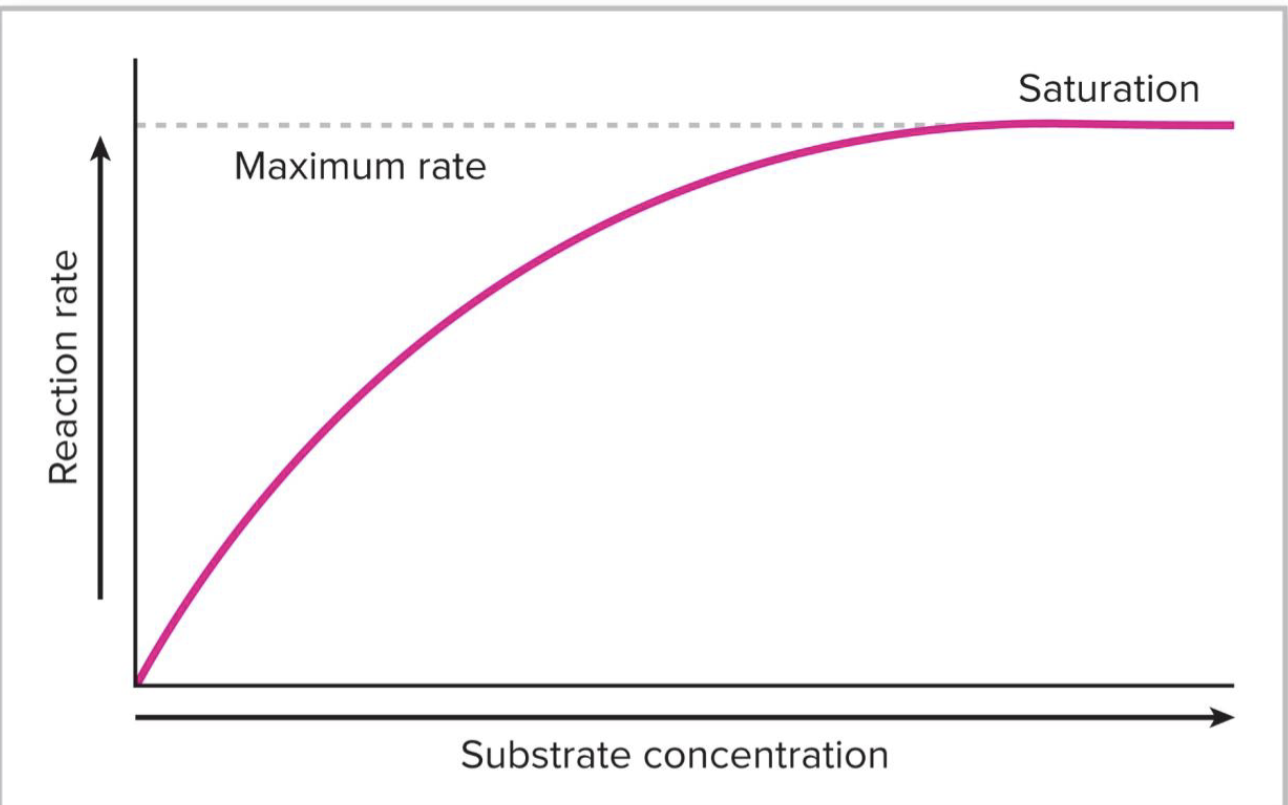
Substrate Concentration
Factor in enzyme-catalyzed reactions
Rate of reaction increases until enzymes are at maximum saturation
Regulating factors of enzyme-catylized reactions
Catalytic rate of enzyme
Substrate concentration
Enzyme concentration
Affinity
Temperature
pH
Enzyme concentration
Higher enzymes concentration mean higher reaction rate
- Enzyme concentration regulated by changing the amount of proteins that are available
Affinity
Higher affinity means between enzymes and reactants means the reaction rate will increase faster
- Less enzyme concentration required for same result
Allosteric regulation
Protein must contain more than 1 binding site
When a ligand binds to a regulatory / allosteric site can alter the shape of the active site
Can increase or decrease activity
Covalent regulation
When a protein bonds to an amino acid side chain it alter the protein shape and therefore the enzyme activity
Phosphorylation: Phosphate group transferred from one molecule to another
- Can both increase or decrease activity
Protein kinase
Enzymes that catalyze the transfer of phosphate from ATP to a protein side chain
Protein phosphatase
Enzymes that remove phosphate groups
Metabolic Pathways
A sequence of enzyme-mediated reactions that lead to a formation of a specific product
The rate-limiting reaction has the slowest reaction rate of all reactions in the pathway and limits the reaction
Feedback Regulation
An intermediate or end enzyme regulates a previous enzyme in the metabolic pathway
Holds reactions at a steady rate, maintaining body’s needs
Regulation is done to the first enzyme at a branch point
Inborn errors of metabolism
A mutation in a single gene that codes for an enzyme pathway causing it to fail
Causes disorders from not having needed end product or an unhealthy accumulation of intermediate products
Intermediate products
Products in an enzyme chain that aren’t starting or ending products
End products
The final result product of a metabolic pathway