information
 Call Kai
 Learn
Learn Practice Test
 Spaced Repetition
 Match
Match Flashcards
 Knowt Play
1/26

There's no tags or description
Looks like no tags are added yet.
Name | Mastery | Learn | Test | Matching | Spaced | Call with Kai |
|---|
No analytics yet
Send a link to your students to track their progress
27 Terms
asymmetric information
the seller may not know information than the buyer, the buyer knows this and has uncertainty about buying the good. this causes a issue with allocating resources efficiently
incomplete information
one agent has more information than the other before the interaction has taken place
asymmetric information in the job market
applicants have better information about their own capabilities compared to the firm
adverse selection
situations where individuals have hidden characteristics and in which a selection process results in a pool of individuals with undesirable characteristics
adverse selection in insurance market
an insurance company will raise its prices, the only people who are willing to pay higher are those that know they are more likely to make accidents, good drivers would not be willing to pay this ask they know they are not likely to benefit much from the insurance
signaling
a method to mitigate the problem of adverse selection, an informed party sends an observable indicator of their characteristics or hidden actions to an uniformed party
example of signaling
firms signal the quality of the product, money back guarantee, free trial periods ect
for effective signaling
observable
reliable indicator
difficult for other parties with other characteristics to easily mimic
moral hazard
where one party to a contract takes a hidden action that benefits him or her at the expense of another party, cannot be observed by the other party
eg if a manager cannot monitor a workers effort then the workers effort is a hidden action
incentive contract
mitigates moral hazard probability by providing financial ties to indicators
contracting
mitigating adverse selection through screening, an attempt by an uninformed party to sort individuals according to their characteristics
screening
performed through a self selection device, informed parties are presented with a set of options, the options they choose reveal hidden characteristics
measuring uncertain outcomes
known as a random variable x, this could represent profits price of output, consumer income, the true value of x is always unknown but we do know the probability of x
information about uncertain outcomes
can be summarised by the mean or expected value and the variance of a random variable
mean or expected value
eg the probability is any number between 1 and 6 1/6
the expected value is
E(x) = 1/6 (1) + 1/6 (2) + 1/6 (3) + … + 1/6 (6) = 3.5
they do not know for certain by on average they will earn 3.5
the mean of a random variable
if x1 ×2…xn denotes the outcome of random variable q1 q2.. qn
E(x) = q1×1 + q2×2 + qnxn which = 1
the mean and risk
does not provide information about the degree of risk associated with the random variable
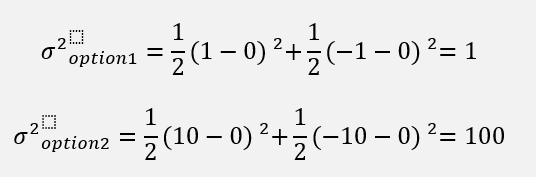
Eoption1 (x) = ½ (1) + ½ (-1) = 0
variance
the sum of all probabilities that different outcomes will occur multiplied by the squared deviation form the mean of resulting pay offs

example of variance
option 2 is now more risky because it has a higher variance
risk aversion
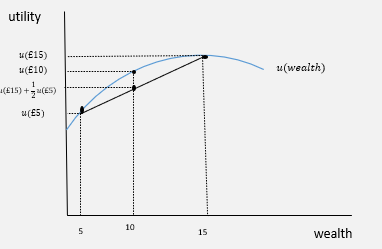
when the expected utility is less than the utility of expected wealth, has greater utility from a sure outcome than a gamble
risk loving
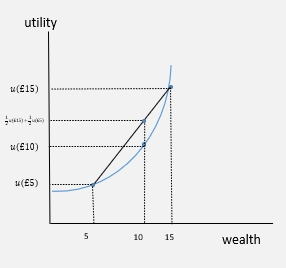
prefers a risky prospect, with a greater expected value of m than a sure amount of m
risk neutral
is indifferent between a risky prospect with an expected value of m and a sure amount of m
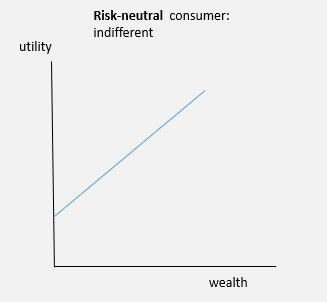
consumer search
a consumer observing the lowest price at 40 should stop there as this is the lowest price
a risk neutral consumer search
a risk neutral consumer sees a price of 100 and does not know any other prices
¼ of the time there is a cheaper product and saves 100 - 40 = 60
but ¾ of the time the consumer will save nothing as the actual price is 100
so a consumer should search for a lower price as long as the additonal benefits are greater than the cost of earching

reservation price
a price where a customer is indifferent between purchasing at that price and searching for a lower price
where EB (additional serach) = cost (additional search)
firm diversification
by investing in multiple projects risk has potential to be reduced, whether this is optimal depends on the risk preference and incentives provided to the manager
profit maximisation and uncertainty
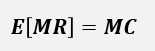
if demand is uncertain and the manager is risk neutral, then the manager will want to maximise expected profits by producing the output where expected MR is equal to MC