Lipids
 Call Kai
 Learn
Learn Practice Test
 Spaced Repetition
 Match
Match Flashcards
 Knowt Play
1/14

There's no tags or description
Looks like no tags are added yet.
Name | Mastery | Learn | Test | Matching | Spaced | Call with Kai |
|---|
No analytics yet
Send a link to your students to track their progress
15 Terms
What are lipids?
Hydrophobic molecules made mostly out of Carbon and Hydrogen Chains
Why are lipids hydrophobic?
Their long carbon-hydrogen chains have no polar bonds, so they repel water molecules
→ this property is central to how lipids behave in and around cells!
What are the four main types of lipids?
Triglycerides
Phospholipids
Steroids
Waxes
What is a triglyceride made of?
1 glycerol molecule + 3 fatty acid chains
→ If fatty acids are saturated: solid fat (e.g. butter)
→ if unsaturated → liquid oil (e.g. olive oil)
What is the difference between saturated and unsaturated fats?
Saturated: no double bonds → solid at room temp.
Unsaturated: one or more double bonds → liquid at room temp.
→ double bonds create kinks in the chain, preventing tight packing
How do phospholipids differ from triglycerides
One fatty acid is replaced by a hydrophilic phosphate group
→ this makes phospholipids amphiphilic - one hydrophilic head, two hydrophobic tails.
what does amphophilic mean?
Having both a water-loving (hydrophilic) part and a water-fearing (hydrophobic) part
→ Phospholipids are amphiphilic, which is why they can form membranes.
What is the structure of a steroid?
4 fused carbon rings - completely different from fats or phospholipids.
Three examples of steroids in the body
Cholesterol
Oestrogen
Testosterone
(Cortisol and Vitamin D are also steroids)
What are waxes and where are they found?
Very long-chain lipids that are highly water-repellent
→ Found on plant leaves, bird feathers, in earwax. Provides waterproof coating.ow much energy do fats store per gramH
How much energy do fats store per gram?
9 kcal/g - roughly twice as much as carbohydrates (4kcal/g)
→ this makes trigycerides the body’s most efficient long-term energy store.
Name four functions of lipids
energy storage
insulation/ protection
hormone signalling
fat-soluble vitamin transport
(also structural component of membranes (phospholipids) - but that’s covered under Fluid Mosaic Model!)
Which Vitamin requires fat to be absorbed?
Vitamin A, D, E, K - the fat-soluble vitamins
→ without dietary fat, these vitamins cannot be properly absorbed from the gut
What role does fat play in insulation?
Subcutaneous fat insulates the body agains heat loss, myelin (a lipid sheath) insulates nerve fibres
→ Myelin is 70% lipid and speeds up nerve signal transmission
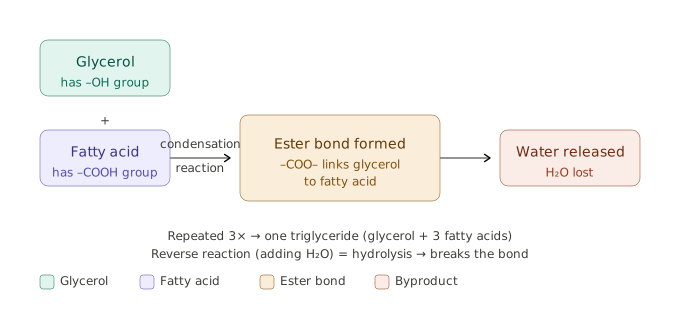
How is an ester bond formed, and what does it connect in a triglyceride?
Via a condensation reaction between -OH (glycerol) and -COOH (fatty acid)
the -COO-ester bond links to glycerol to each fatty acid chain
One water molecule is released per bond
this happens 3x to form one triglyceride
(the reverse - adding water - is hydrolysis, whcih breaks the bond)