cell bio - exam
 Call Kai
 Learn
Learn Practice Test
 Spaced Repetition
 Match
Match Flashcards
 Knowt Play
1/18

There's no tags or description
Looks like no tags are added yet.
Name | Mastery | Learn | Test | Matching | Spaced | Call with Kai |
|---|
No analytics yet
Send a link to your students to track their progress
19 Terms
what are 5 unique features of the plant cell
(chloroplast)
organelle that carries out photosynthesis to create sugars, transforming light energy into chemical energy
(cell wall)
major upgrade of the plasma membrane
helps to provide structure and stability for plant cells, under force and tension
(plasmodesmata)
holes in the cell walls, that connect neighbouring plant cells (to have continuous cytosols)- so some plant organs are like one big cell
(vacuole)
animals have tiny vacuole bodies, but plant ones are giant
these contain lots of liquid, stored starch / sugar (chloroplast products), defense toxins (seperate from harming the cell, but when eaten will harm the attacker)
these can store toxins absorbed from the environment / created in the cell, to maintain seperation
the vacuole provides plant cells with a rigid and sturdy (turgid) shape (providing lots of tension on the cell wall) VS animal cells which are squishy and easily pop (cannot withstand much tension)
(peroxisomes involved with photorespiration)
peroxisomes exist in animals too, which do the same main function of oxidating fatty acids
however in plant cells they have the additional function of photorespiration (not in animals, they dont do photosynthesis)
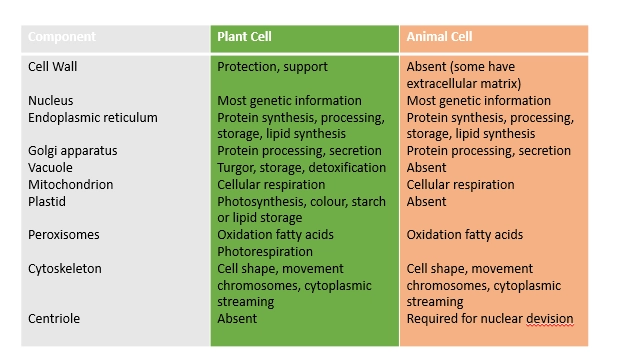
name 2 unique feattures of the animal cell, and what the plant cell uses for these functions instead
(centriole)
a MTOC, creates and organises MT, and controls and houses the formation of the mitotic spindle
plants instead rely on MFs for cell divison rather than MTs
(lysosomes)
organelles that break materials down, vesicles formed by the golgi body
typically small but can be larger in cells who need that function more (e.g. white blood cells - lots of engulfing)
plants instead use lytic vesicular bodies, which are variations of the vacuole, that get modified by the golgi
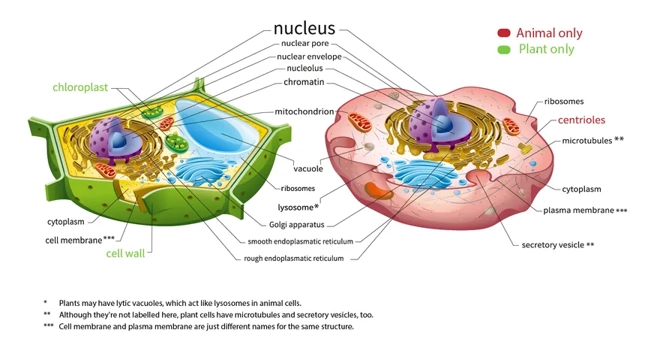
what are considered organs in animals?
tissue with one specific function
e.g. liver, heart, lungs, brain
connected via blood
what are considered organs in plants?
and what are the functions & importance of each?
tissue with one specific function
e.g. shoot system (above ground components) & root system (below ground components)
connected via vascular tissue (phloem - sugars, xylem - water)
(shoot system)
green unless specialised / aging, as they carry out photosynthesis, gathering energy for the plant by transforming light energy into chemical energy
(root system)
storage, mineral and water absorption, physical support - anchoring the plant in place
structural support allows them to be terrestrial, to gather water from the ground as they are no longer floating in water & minerals
e.g. early plants have no roots - only rhizoids (hair-like potrusions, shallow and not fully developed), and some bryophytes have no proper roots either
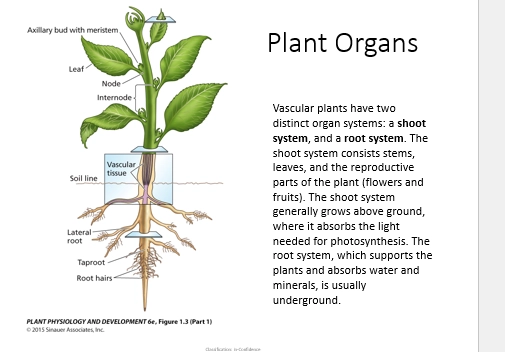
what are the stem cells?
what are the equivalents in plants?
(stem cells)
undifferentiated cells, they rapidly divide, then are programmed by internal & external multicellular environment, to differentiate and function in the plant
these are in animals, the plant equivalent is meristematic tissue
(meristematic tissue)
the shoot apical meristem produces undifferentiated cells that go on to form all above-ground tissues, that specialise for speicifc functions as required
the root apical meristem is the same but for below-ground tissues
these cells are a collection of a few in the centre of the plant cross-section, as they are well protected, but very important as they go on to form everything else
removing them causes branching out as meristems on the side of the plant are activated
most plant cells can actually reverse back to meristematic tissue (chloripotent), undiffentiated cells that divide (our stem cells cannot - unless cancers turn them back on - plants also have cancers)
important in cases like if the plant is cut, and needs to develop indifferentiated tissue again, so that the shoot can reform (redo the startup process, vs in animals we dont grow back an arm)
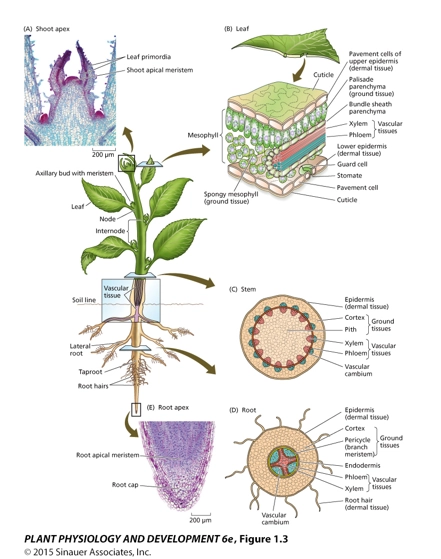
what can we do with stem cells / meristematic tissue, in the lab?
we can isolate them, and put them on a slide, and grow new plant cells - as they divide into more undifferentiated cells
can add different hormones to form different cell types
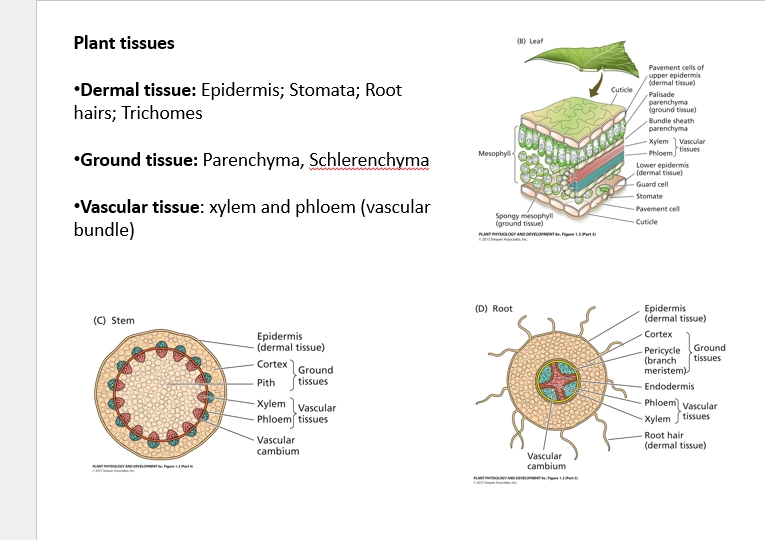
name the 3 types of plant tissues, and where they are found
dermal tissue (epidermis, bringing in resources / protecting the plant)
ground tissue (biggest mass of tissue, connects everything else)
vascular tissue (involbed with material transport, starch & sugars, and water)
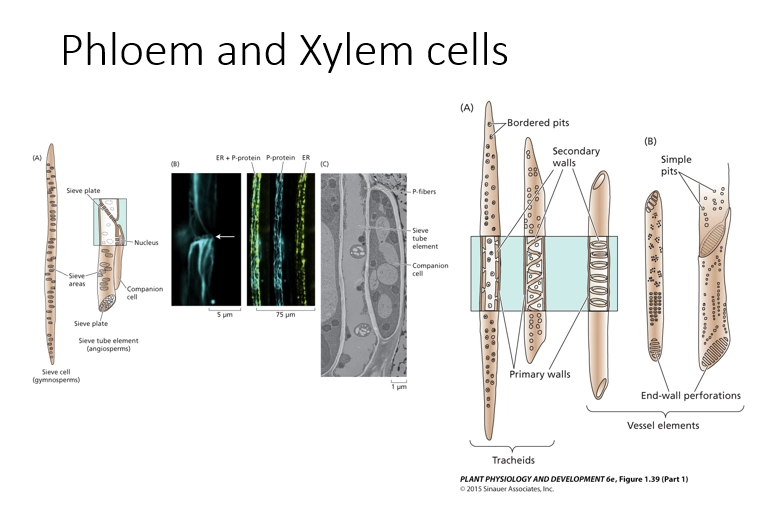
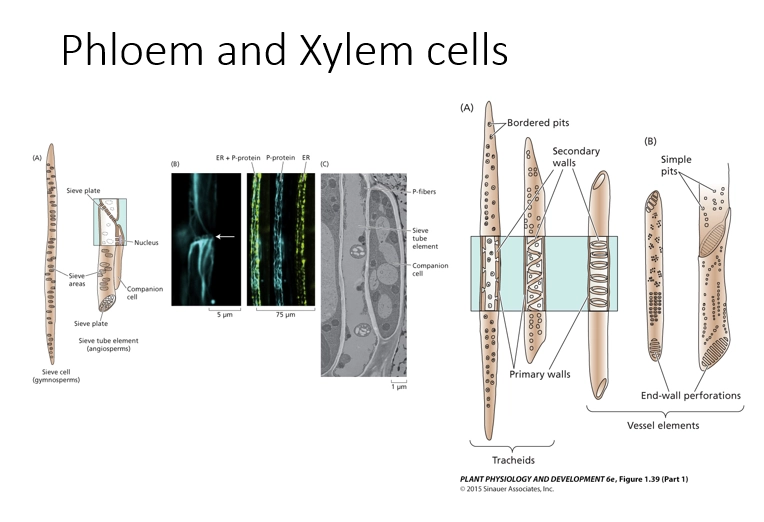
name the 4 types of vascular tissue cells
describe each
different species may have more or less, or some but not others
(Tracheids)
cells associated with the Xylem (transport of water)
elongated hardened cells (alike sieve tube cells), due to secondary cell walls underneath their primary ones, that form helix / ring structures in to the middle of the cell (aiding with transport)
contain pores (bordered pits) that originate from plasmodesmata from when the cell was alive, that have solidified to enable transport of water throughout the Xylem (between neighbouring cells)
these pores also enable the water / solution to move out to the rest of the plant tissue, to actually deliver the water they transport
(Vessel Elements)
cells associated with the Xylem (transport of water)
look similar to Tracheids (elongated hardened cells, with secondary cell walls underneath the primary ones, that form rings into the cell)
to distinguish, they have End Wall Perforations (long striped structures at each end of the elongated cell, to let water flow through)
they also are typically more pointed at the end, and have simpler pits (also same function as Tracheids - flow water through neighbouring cells to transport, allow delivery of water to tissues)
(Sieve Tube Cells)
cells associated with the Phloem (transport of sugars)
elongated cells, containing sieve tube plates between neighbouring cells, that have pores - to enable their transport function
these cells have hardened cell walls (stiff, generally dont further expand), with the pores being the remenants of plasmodesmata (allowing flow between neighbouring cells in a tube)
not 100% alive (rely on companion cell) but not 100% dead (still have proteins, ER - just no nucleus. are regulated by the companion cell)
cannot turn back to a meristematic stem cell, as they are very specialised and dont contain genetic info
(Companion Cells)
cells associated with the Phloem (transport of sugars), but not directly involved in transport - they instead regulate Sieve Tube Cells, which are the tubes that sugars flow through
they do however help the transport of sugars between neighbouring sieve cells horizontally (Efficiency)
these are alive, and contain additional genetic info for the Sieve cell to regulate it
more typical cell walls (not super hardened like Sieve), so can turn back to a meristematic stem cell
how can we observe vascular cells / tissue in plants?
different types of microscopy
typically use fluroescent dyes that attach to cell walls and using fluoresdcent microscopy to look at the different elements (e.g. shows primary cell walls for shape, and shows secondary cell walls for structures within, pores, etc)
can also use electron microscopy, to visualise the components based on their density vs empty space (from electron refraction or absorption)
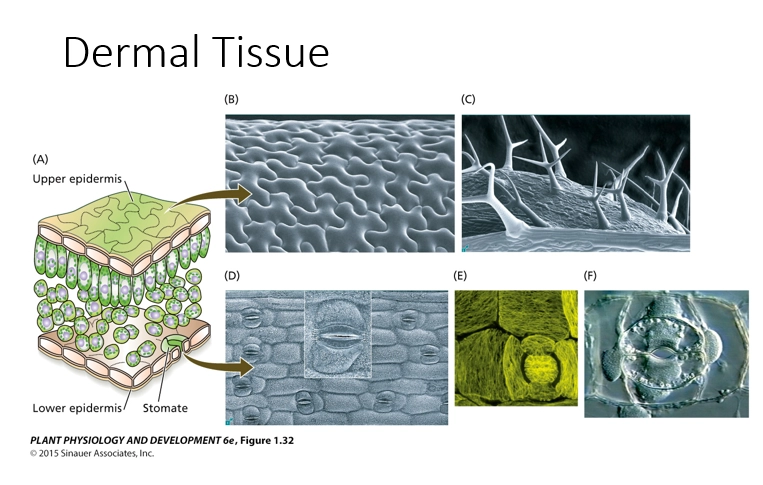
name and describe the 3 types of dermal tissue cells
large amount of cells, defined by the outer part of the plant
(Epidermal Cells)
forms the upper and lower epidermis (waxy coverying of the plant)
upper epidermis is made of puzzle-shaped cells due to secondary cell wall structures, that enable efficient organisation and protection of the plant
found on both organs - above ground elements of the plants on leaves and stems, and on below ground root systems
(Stomata / Guard Cells)
allows exchange of gases and water between the plant and outer world - these are pore structures that span through the epidermal layers
more accurately, these are the guard cells - as stomata is the whole structure (the pore), while guard cells are the actual living cells that regulate and form these pores
(Trichomes)
tiny potrusions of the upper epidermis, hair-like structures, elongated
may have one tip or branching, may have a round tip or pointed, may have metabolic compounds contained for protection (e.g. if broken, will release toxins - e.g. nettle)
name and describe the 3 types of ground tissue cells
largest amount of cells, everything inside the plant body that isn’t facing the environment nor acting as vessels
these cells have differences, but the whole tissue is typically just a mass of cells, bdoy and volume
each have different structures to perform different functions
(Parenchyma)
form the mesophyll - palisade (tightly packed, elongated - less chloroplasts but still heaps around the outside), and spongy (more spread, rounded - lots of chloroplasts around the outside, but spread allows for gas exchange)
caqn continue divison and differentiation, or revert back to stem cells, even though they arent meristematic tissue, depending on environmental sterssors (e.g. can form additional cell wall structures and lose photosynthetic functions, and die, to form structural elements)
typically have very thin primary cell walls, with a large single vacuole - to make up volume and mass (water collected to exert pressure, so they respond strongly to loss of water - shrivel)
are all living
(Collenchyma)
elongated cells, with slightly thicker primary cell walls
can be used for more stabilising functions (e.g. celery enriched collenchyma), or to secrete things that would clog the vascular system (e.g. laticifers forming latex in rubber trees)
can die if their cell wall gets too thick (prevents resource & water transport in and out), after which they become cyber cells (dead but still part of ground tissue)
(Schlerenchyma)
one type of schlerenchyma cells, are elongated cells with even thicker cell walls - so they become sclerenchyma fibres (provide structural rigidity while still being flexible)
e.g. grass bend with wind (more schlenerenchyma), trees break with wind (less schelerenchyma, instead have tertiary growth)
another type of schlerenchyma cells, are sclereids, which are also elongated but have even thicker cell walls, and form clusters - they are almost entirely cell wall, so arent alive (cannot get resources in or out)
both are lignified, increasing their cell wall thickness/strength
this aids their function in providing mechanical support - they originate as ground tissue, but then go on to support xylem & phloems (surround these tissues, to help them last longer) - so technically differentiating twice
they are therefore found in the xylem and phloem tissues, but are technically a type of ground tissue
what does a plant’s cell wall tell you about the cell?
its function!
cell wall and function are closely linked
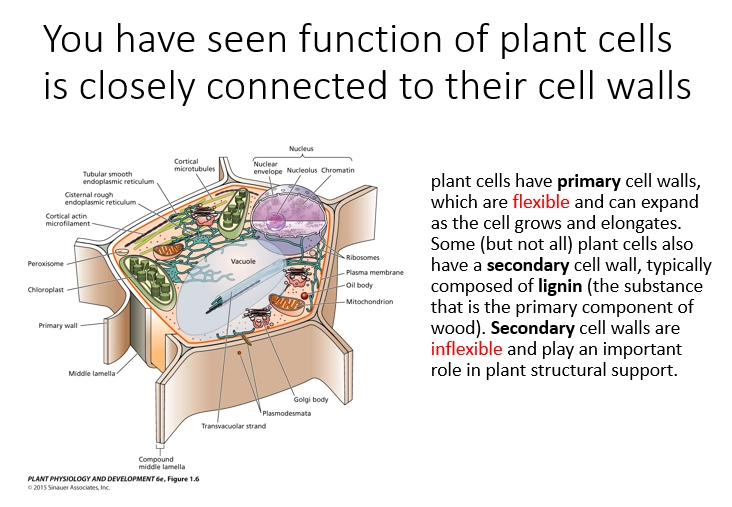
what are the general functions of the seconday cell wall
how does this differ from primary cell walls
(primary cell walls)
all plant cells have these, they enable the cell to be flexible, grow, elongatev
vacuoles can exert turgor pressure, and so they can be turgid or flaccid
(secondary cell walls)
only some plant cells, in some plants, have these (those with functions requiring them)
e.g. some single celled euks lack them to move fast and flexibly (Eugelinia, using cillia)
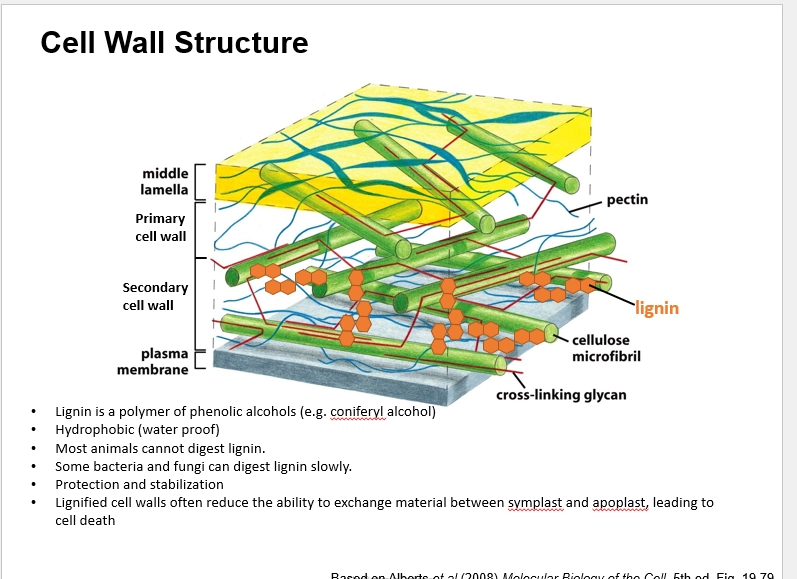
typically inflexibile (composed of lignin), and hydrophobic (they dont ABSORB water, but it can flow through them like in xylem)
this enables the cell to be more rigid, so can aid in structural support, stability, weather / water support (e.g. cuticle), stabilisation of the xylem/phloem
can be thicker or thinner (e.g. grass vs tree, both have them), but if too thick they die (limits resource transport in and out)
can protect against insects & pathogens, being hypersenstive to induce cell death when under attack, to limit pathogen invasion to the rest of the leaf/plant
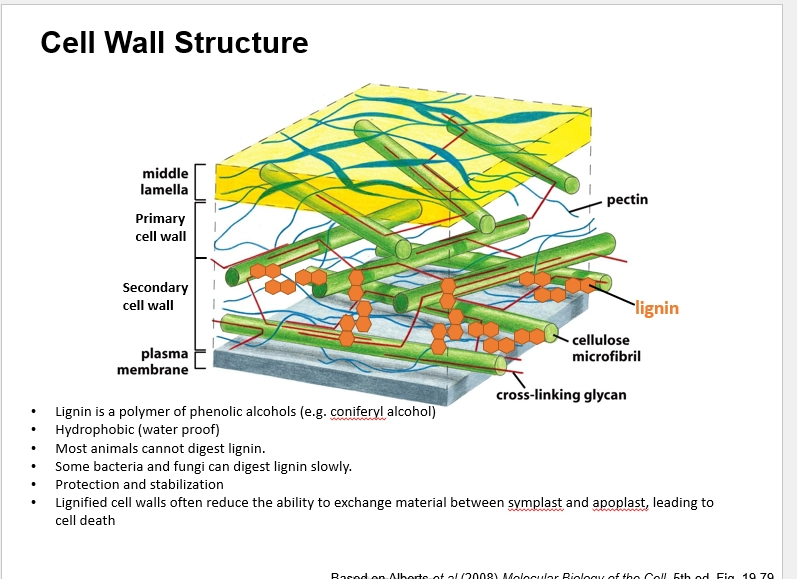
describe the middle lamella
what
structure
function
(what)
formed from the cell plate during cell divison, so all cells have these
(structure)
around the very outside of the cell (outside of plasma membrane, P, and S cell walls)
made of pectin with limited cellulose, so is quite flexible and gel-like
(function)
links things together (the rest of the cell wall), and provides the cell with flexibility
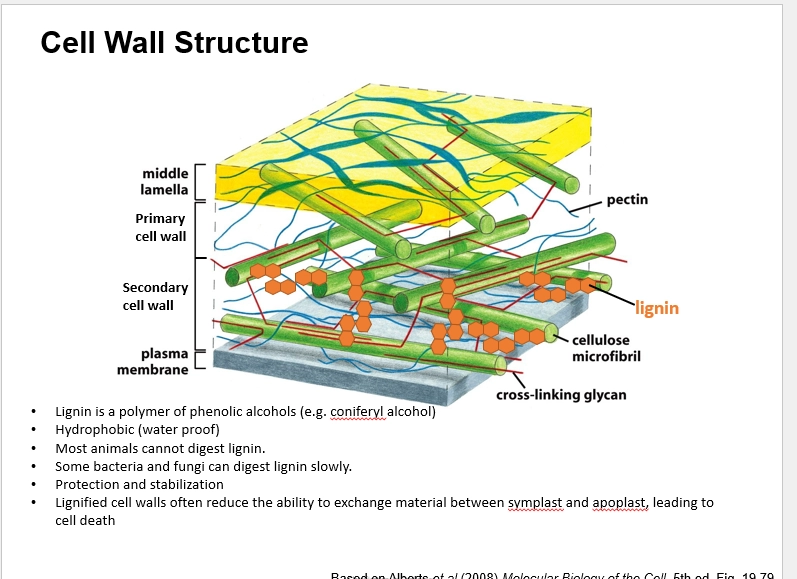
describe the primary cell wall
structure
function
(structure)
below the middle lamella, above the plasma membrane - found in almost all plant cells
contains some pectin, and some hemicellulose, but mostly cellulose - so is less gel-like but still flexible
the cellulose forms the load-bearing part of the cell wall, and hemicelulose fibriles link them
(function)
provides protection for the plant cell, but is generally there to allow the cell to have flexibility and grow - the vacuole can exert pressure against it etc
allows cells to connect to neighbours also
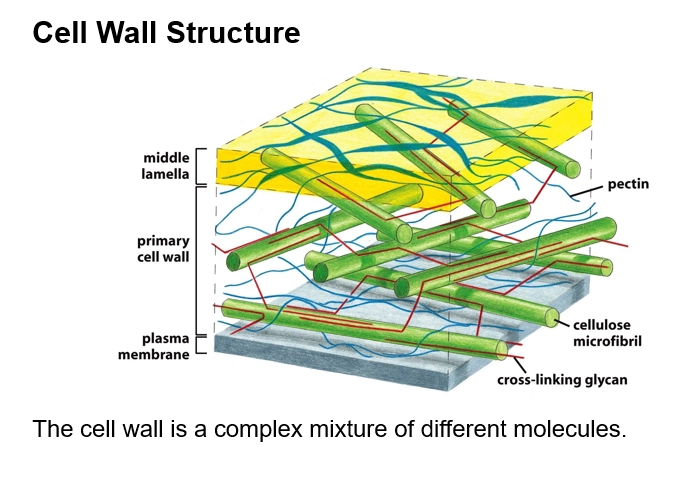
describe the secondary cell wall
structure
(structure)
made of some hemicellulose, some lignin, but mostly cellulose (some plants also lack lignified SCWs e.g. algae)
the lignin gives it its hydrophobic character - being made up of polyphenolic alcohols (hydrophobic)
some lignin still allows material transport with the environment (symplast - neighbours & apoplast - environment), acting as a wall rather than a barrier
too much lignin however prevents this, and will lead to cell death (important for functions to do with providing structural support)
animals typically cannot digest these - making up the fibre in our food (bacteria can however partially, and some insects & fungi - e.g. termites, rot)
cellulose
structure
how is it synthesised
major component of the cell wall (both primary and seconday are mostly made of this)
(structure)
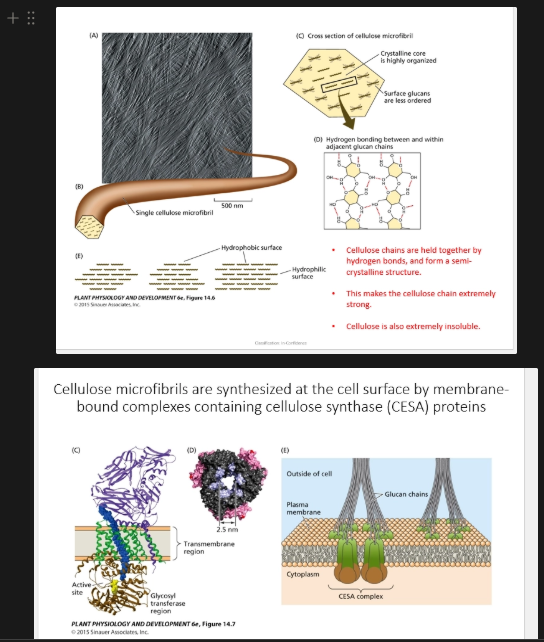
exist as microfibrils, linear & unbranched fibre structures that form cables, that form a framework around the cell
are polymers of b-glucose, 1-4 beta-linked glucose monomers (linked between the 1 & 4 positions on the sugar), of 2000-25000 units
this linkage is highly unsoluble (cannot digest in animals)
polymers associate with H bonding, to form microfibrils - with overall stability and flexibility due to their ordered crystalline core (of H bonded glucan chains), and less ordered glucans around their outer
depending on the organisation of their polymer chains (can be synthesised differently as needed), they can have different surfaces on the polymer being hydrophobic or hydrophilic
(synthesis)
synthesised at the plasma membrane, from components from inside the cell, to produce these fibres to the outside of the cell to form the cell wall
done by the CesA (Cellulose Synthase) protein complex, membrane bound - 3 subunits associate that each form 1 chain, then 6 of these trimers associate - forming the overall complex
this enables glucan chains to be formed, and twist all together to form microfibrils with H bonds, outside of the cell
they are then layered onto eachother to form the cell wall
CesA complexes are reorganised, rather than the cellulose itself, to reorganise where cellulose is deposited in the cell wall
what are the variations of the CesA proteins that exist?
why?
(cellulose synthesising)
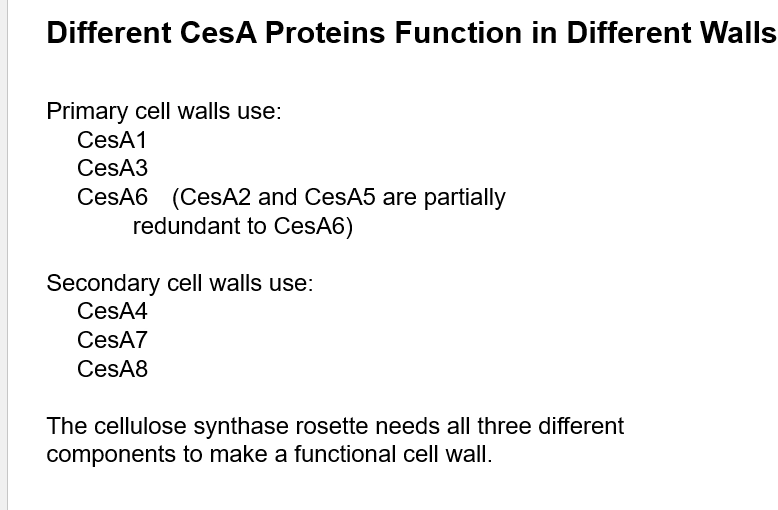
only CesA proteins actually synthesise celluloes - their family contains CSLs (cellulose-synthase-like proteins), but they dont actualy make cellulose
(versions)
a number of types
different CesAs have different functions, some form primary cell walls, some form secondary (have different promotor factors, so growth of the cell / cell wall is regulated on the transcript level)
but overall large variety is due to redundancy being desired - cell walls are very important for plants survivals, so having multiple versions protects against mutations and inhibition
what is the typical organisation of cellulose in growing cells
how does altering this in the lab change their structure
(typical)
in a growing cell, microfibrils of cellulose are transverse to the direction of expansion (horizontal), to restrict / dictate the directin of elongation (plants want cells to be