7.8 Differing objectives and policies of firms
 Call Kai
 Learn
Learn Practice Test
 Spaced Repetition
 Match
Match Flashcards
 Knowt Play
1/87

There's no tags or description
Looks like no tags are added yet.
Name | Mastery | Learn | Test | Matching | Spaced | Call with Kai |
|---|
No analytics yet
Send a link to your students to track their progress
88 Terms
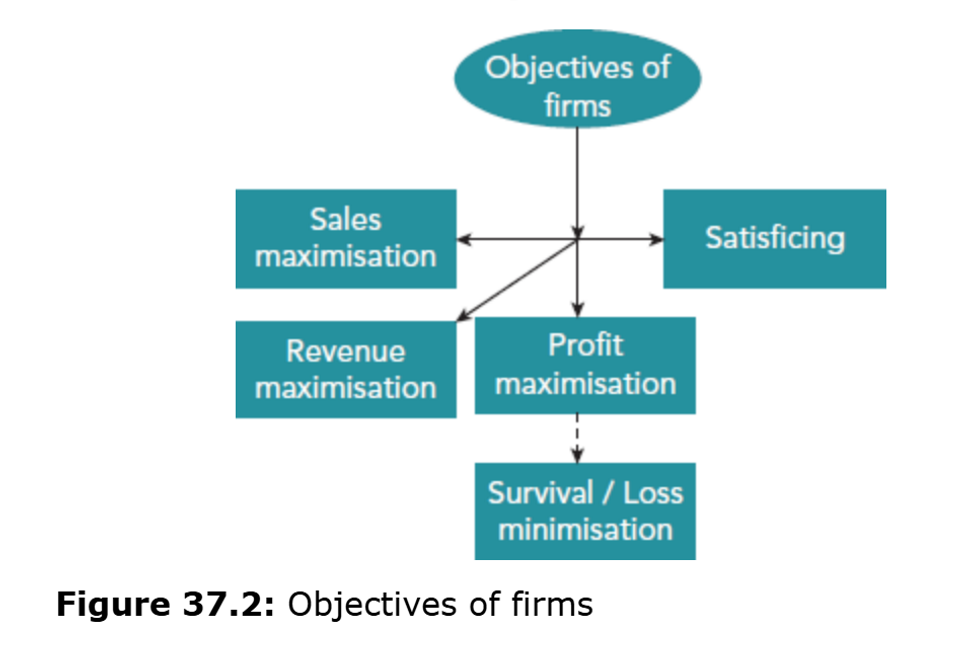
What are 4/5 main objectives of firms
What is the most realistic objective when a firm is facing intense competition
Survival or loss minimisation - There would be no point in pursuing any other obectives
What is profit maximisation
Profit maximisation involves achieving the greatest difference between the total revenue and total cost (including normal profit).
What is the profit-maximising condition for a firm + diagram
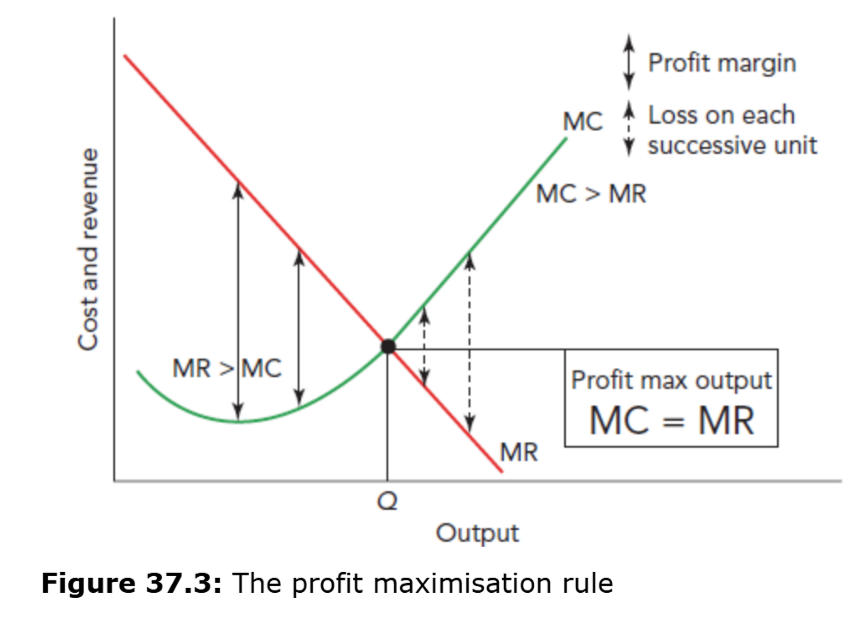
A firm maximises profit where marginal revenue equals marginal cost (MR = MC).
What is normal profit and when is it earned
Normal profit is the minimum profit needed to keep a firm in its current use.
- The minimum level of normal profit is said to be produced at break-even output.
Why do most firms seek to make supernormal profit
Most firms will seek to make supernormal profit as a reward for taking risks, even if it is only in the short run.
How does profit maximisation relate to “decision-making at the margin”
In a perfectly competitive market, firms will produce up to the point where the revenue generated by an extra unit of output is equal to the cost of producing it.
In the profit max diagram, what happens if a firm produces to the left (less) of profit max output
A firm producing an output to the left of Q is sacrificing potential profit; it can raise total profit by increasing output because each further unit sold adds more to revenue than it does to costs (MR > MC).
In the profit max diagram, what happens if a firm produces to the right (more) of profit max output
A firm producing to the right of Q is making a loss on each successive unit, which will lower total profit (MC > MR). It would be better off cutting output back to Q where MC = MR.
How is profit shown on a cost and revenue diagram
Profit is the vertical distance between average revenue and average cost at the profit-maximising output.
Why do firms not always operate at the profit maximisation level of output (5 reasons)
Difficulty identifying (MR = MC)
Firms may lack accurate cost and revenue data. Pricing methods such as cost-plus pricing are unlikely to achieve true profit maximisation.Avoiding government regulation
Very high profits may attract investigation from competition authorities or lead to price controls.Deterring entry
Large supernormal profits can attract new firms (especially with low barriers to entry), increasing competition and reducing long-run profit.Maintaining stakeholder relationships
Excessive prices may damage goodwill with consumers, employees, or suppliers, harming long-term stability.Managerial objectives (principal–agent problem)
Managers may prioritise sales revenue maximisation, growth, job security, or bonuses rather than pure profit maximisation. High profits may also provoke rival retaliation or takeover bids.
What assumptions underlie profit maximisation (3)
Perfect information; rational decision-making; shareholder control over managers.
Why may profit maximisation be unrealistic in practice (3)
It is difficult to identify the profit-maximising output
Firms face uncertainty
Management may have different objectives from shareholders.
Why do economists consider objectives other than profit maximisation
Dissatisfaction with the traditional assumption of profit maximisation has led to alternative objectives based on empirical or real-world investigation (managerial/behavioural objectives).
What is the survival objective of a firm
The survival objective is a short-run aim where the firm seeks to minimise losses and remain in operation, rather than maximise profit.
When is survival most likely to be a firm’s objective
When the firm faces serious external shocks such as:
• Loss of a major customer
• A recession or economic downturn (e.g. covid-19)
• Sudden increases in costs
• Structural changes in demand (e.g. growth of online sales)
Why is there a limit to survival through loss minimisation
Because firms cannot sustain losses indefinitely — they face financial constraints, limited cash reserves, and pressure from creditors.
When would closure be the only rational decision
When the firm cannot cover its variable costs (TR < TVC).
At this point, continuing production increases losses, so shutdown minimises losses.
When can a firm continue operating despite losses
If total revenue covers variable costs but not total costs (TR ≥ TVC but < TC).
The firm can operate in the short run while attempting recovery.
Give an example of an industry where survival has been a key objective.
High-street retail (e.g. fashion, books, electronics), where firms have struggled due to the rise of online competitors.
What is profit satisficing
Profit satisficing is when a firm aims to achieve a minimum acceptable level of profit, rather than maximum profit, sufficient to satisfy shareholders while balancing the interests of other stakeholders such as the workforce or consumers.
It contrasts with strict profit maximisation (MR = MC).
Why might profit satisficing lead a firm to sacrifice some short-term profits (3)
Because firms may:
• Pay higher wages or improve conditions to maintain workforce morale
• Keep prices lower to maintain customer loyalty
• Avoid risky strategies that could increase profit but threaten stability
This reduces short-term profit but may protect long-run stability.
How does separation of ownership and control encourage profit satisficing
Where shareholders are separate from control of the firm, there may be a conflict of interests (Principle-agent problem).
- Managers may prioritise:
• Sales growth
• Market share
• Job security
• Firm expansion
rather than pure profit maximisation, leading to satisficing behaviour.
How can managerial preferences raise costs under profit satisficing
Managers may increase expenditure on:
• Comfortable offices
• Administrative staff
• Fringe benefits (e.g. company cars, pensions)
• Overstaffing to reduce workload
Time and money spent on these can increase average costs and reduce potential profit.
Why can strong competition make managers more cautious + the result of this (3)
If the firm has close rivals, management may be more cautious because the risk of failure threatens job security and career advancement prospects.
As a result, managers may:
• Avoid risky high-profit strategies
• Prefer steady, acceptable profits
• Focus on stability over maximisation
How can profit satisficing become a problem in long-established firms
Firms with long-term market dominance may become complacent, leading to:
• Cost inefficiency
• Lack of innovation
• Failure to respond to changing demand
This can reduce competitiveness over time.
Give an example of how failing to innovate can cause loss of profits.
If a firm fails to adapt to technological change, demand for its product may fall.
For example, firms producing physical music CDs lost market share with the rise of streaming services.
What is sales maximisation
An objective to maximise the volume of sales (quantity of output) rather than the total revenue from sales.
How does sales maximisation affect output compared with revenue maximisation
Sales maximisation results in higher output than revenue maximisation.
• Revenue maximisation occurs where MR = 0.
• Sales maximisation pushes output beyond this point, increasing quantity sold even if marginal revenue becomes negative.
Where will a firm produce under sales maximisation
In the standard model, the firm produces at the break-even level of output, where:
Total Revenue = Total Cost
This ensures zero profit (normal profit) while maximising sales volume.
Why can sales maximisation lead to losses, and when could it occur
If output expands beyond the break-even point, the firm makes a loss because:
Total Cost > Total Revenue
This may occur when:
• The firm prioritises market share over profit.
• Losses in one area can be covered by profits elsewhere (cross-subsidisation).
What is cross-subsidisation
Cross-subsidisation occurs when a firm uses profits from one product, service, or division to offset losses in another part of the business.
It allows firms to maintain high output or low prices in loss-making segments.
Give the textbook example linked to cross-subsidisation and sales objectives.
A state-owned local bus service may:
• Use profits from busy urban routes
• To subsidise loss-making rural routes
This reflects broader objectives such as:
• Maintaining service provision
• Keeping prices affordable
• Achieving social rather than profit-maximising goals
How else can sales be maximised
Through growth maximisation, where the firm seeks to:
• Increase market share
• Expand output
• Merge with or acquire competitors
Growth may generate economies of scale, reducing average costs and strengthening long-run market power.
What is revenue maximisation
Revenue maximisation is an alternative theory of firm behaviour where the firm aims to maximise total revenue (TR) rather than profit.
It is often linked to the principal–agent problem, where managers prioritise revenue growth over profit maximisation.
Why might managers prefer revenue maximisation
Managers may prefer revenue maximisation because:
• Salaries and bonuses are often linked to turnover or sales revenue, not profit.
• Revenue is easier to measure and monitor than profit.
• Higher revenue increases firm size, prestige, and managerial power.
Where will a firm produce under revenue maximisation
Production will continue to the point where MR = 0.
How does output under revenue maximisation compare to profit maximisation
A firm with a revenue maximising objective will produce a higher output than a firm with a profit maximising objective.
Why might a revenue maximising firm produce where MC > MR
A revenue-maximising firm may produce where MC > MR, provided MR is still positive, because:
• Total revenue is still increasing.
• Profit is not the primary objective.
However, this reduces profit compared to the profit-maximising output.
Tip: How do learners confuse revenue maximisation and sales maximisation
The clue to their difference is in revenue (total money received from sales) and sales (a measure of the physical amount that has been sold).
What is price discrimination (as a pricing policy)
Charging different prices for the same product to different consumers, with the aim of increasing profits by reducing consumer surplus and converting this into producer surplus.
Which firms can use price discrimination
Price discrimination can be used by any firm with some control over price; it will not work in perfect competition.
What must be true about the demand curve for price discrimination to be possible
The demand curve must be downward-sloping.
What are the recognised types of price discrimination
First degree; second degree; third degree.
What is first-degree price discrimination
A situation where the firm sells each unit of a product to a different consumer, charging each the price (ideally the maximum) that they are willing to pay.
Why is first-degree price discrimination difficult in practice
In practice, it is difficult for firms to know exactly what each consumer is willing to pay.
Give examples of first-degree price discrimination mentioned in the textbook (3).
A private doctor charging each patient according to what the doctor believes they can afford; a car dealer pricing a second-hand car; an estate agent selling a property (the price is unique to that transaction).
Why is resale unlikely in first-degree price discrimination examples
There is no immediate chance of a resale and the price is unique to that transaction.
What does first-degree price discrimination imply about the demand and MR curves in the textbook
The demand curve is the same as the marginal revenue curve; this indicates that marginal revenue is equal to the price.
What is second-degree price discrimination
Consumers are only willing to purchase more of a product if price falls as more units are bought: a higher price is charged for the first unit followed by a lower price as successive units are purchased.
Give examples of second-degree price discrimination mentioned in the textbook (3).
Progressive discounts as more is purchased; certain food items; car tyres; season tickets to watch a Premier League football team.
What is third-degree price discrimination
The most common form of price discrimination, where the firm actively discriminates between consumers based on the presumption that groups have different price elasticities of demand.
How does PED determine who pays higher prices in third-degree discrimination
Consumers with a low price elasticity of demand can be expected to pay a higher price than consumers whose demand is more price elastic.
Give an example of third-degree price discrimination mentioned in the textbook.
Air fares (flights booked earlier tend to have a lower price than those booked closer to departure);
What is the key requirement for price discrimination to work (market separation)
The firm must split the market up into different segments and charge different prices, with a mechanism for keeping the markets separate.
Why must resale be prevented for price discrimination to work
The firm must avoid the possibility of consumers buying at a cheap price and then selling on the product at a higher price.
What is the overall outcome required for price discrimination to be worth doing
The firm’s revenue and profits should increase; otherwise there is no point in discriminating.
What is one consequence of price discrimination for a monopolist who cannot cover costs with single pricing
Price discrimination can make it possible for a monopolist to produce at a profit when charging a single price would not cover costs.
How does the textbook describe the effect of price discrimination on consumer surplus and producer surplus
The monopolist has effectively taken the consumer surplus and turned it into producer surplus or profit.
What is the equity viewpoint on price discrimination
From an equity standpoint this is a disadvantage to consumers, as it converts consumer surplus into profit.
- But as long as the consumers are prepared to pay the higher price, there is no consumer exploitation.
What is limit pricing
A pricing policy applied in monopolies and oligopolies, involving firms setting a lower short-run price to deter new firms from entering their market.
Why might limit pricing occur after supernormal profits
New firms may have been attracted by the supernormal profits that were being earned, so the established firm sets a lower price to deter entry.
How does limit pricing act as a barrier to entry
The lower price acts as a barrier to entry so that a new firm is not in a position to make a profit.
What must a monopolist/oligopolist do for limit pricing to work
It needs to increase output or the services provided to such a level that a new firm cannot make a profit.
Give the textbook example of limit pricing.
In an unregulated taxi market, a firm might reduce rates and at the same time increase the number of its vehicles, making it impossible for a new entrant to make an impact.
What is predatory pricing
When an established firm feels threatened by a new firm entering a market and responds by setting a price that is so low that the new firm has no alternative but to match it.
What happens under predatory pricing when the lower price is set
The new firm cannot make a profit and, in time, will be forced out of the market.
- When this happens, the established firm will put its prices back to their former level.
How can predatory pricing occur between established firms
If one firm believes its rival is gaining market share, it can cut prices to protect its own market share; if cuts are deep enough and sustained over time, the rival firm may be forced to leave the market.
What is price leadership
A common feature of oligopolistic markets where all firms accept the price that is set by the leading firm (often the firm with the largest market share or the brand leader) and then alter their own prices in line with the leader.
Why is price leadership used in oligopoly
It is seen as a way of avoiding price competition yet maximising total profits for all firms while allowing various forms of non-price competition to prevail.
Give examples of markets where price leadership occurs (from the textbook) (2).
Petroleum retailing in many countries (market leader is a well-known multinational company); markets for certain types of retail goods or branded fast food.
What happens when the leading firm changes price (price leadership)
When the leading firm announces a price increase, all others quickly follow (sometimes in hours); it is the same when a price fall is announced—smaller rivals are forced to follow to retain market share.
What is a downside of price leadership for smaller rivals
If their costs are higher, matching a price decrease could result in sustained losses and the eventual exit of smaller rivals from the market.
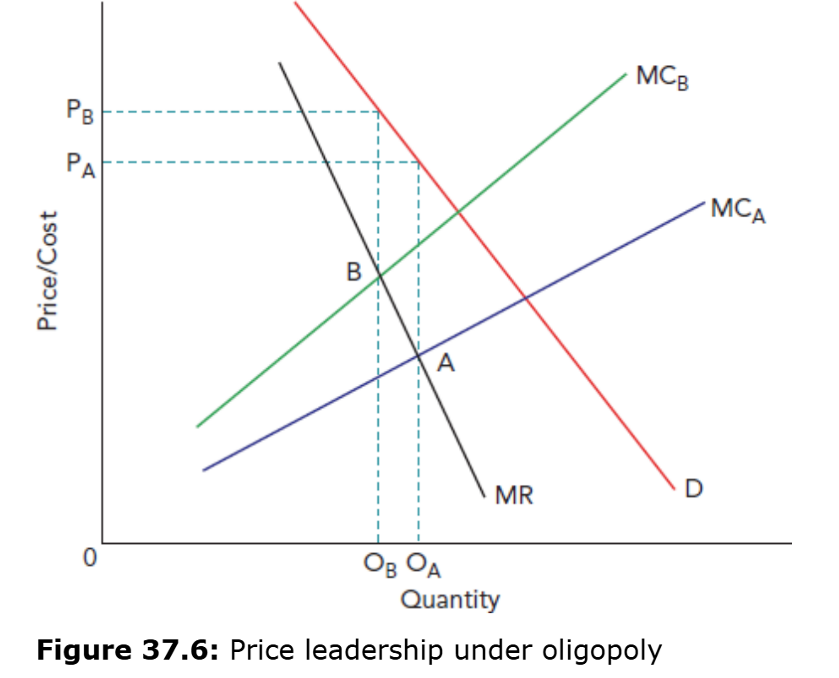
Explain Figure 37.6 (price leadership under oligopoly diagram) in words.
Firm A is the lower cost producer and price leader, maximising profits where MC = MR and selling output at price PA. Firm B’s ideal price is PB, but it cannot compete with A’s lower price, so it is compelled to lower its price to PA, with lower profits due to its higher costs of production.
Tip: How can price leadership also be explained
Price leadership can also be explained by the kinked demand curve model; the firm taking the first step to alter price is the price leader.
Why is the most important factor to consider when a firm changes price
When a firm decides to change its price, the price elasticity of demand for its product is the most important factor in estimating the consequent change in output and sales revenue.
What is the relationship between PED and a firm’s total revenue on a downward-sloping demand curve
The impact of a price change on total revenue depends on PED:
• PED > 1 (elastic): A fall in price increases total revenue.
• PED = 1 (unit elastic): Total revenue is maximised.
• PED < 1 (inelastic): A fall in price decreases total revenue.
Why does total revenue increase when price falls if demand is elastic
Because the percentage increase in quantity demanded is greater than the percentage decrease in price, so overall revenue rises.
Why does total revenue decrease when price falls if demand is inelastic
Because the percentage increase in quantity demanded is smaller than the percentage decrease in price, so overall revenue falls.
When is total revenue maximised on a demand curve
Total revenue is maximised when PED = 1 (unit elastic). At this point marginal revenue (MR) = 0.
Why does PED change along a straight-line downward-sloping demand curve
Because price and quantity change along the curve, so the responsiveness of quantity demanded to price changes varies at different points.
How are PED and marginal revenue linked (+ diagram)
In the elastic part of the demand curve (PED > 1), marginal revenue is positive and total revenue increases as output increases; when PED = 1, MR = 0 and total revenue is maximised; when PED < 1, MR is negative and total revenue falls.
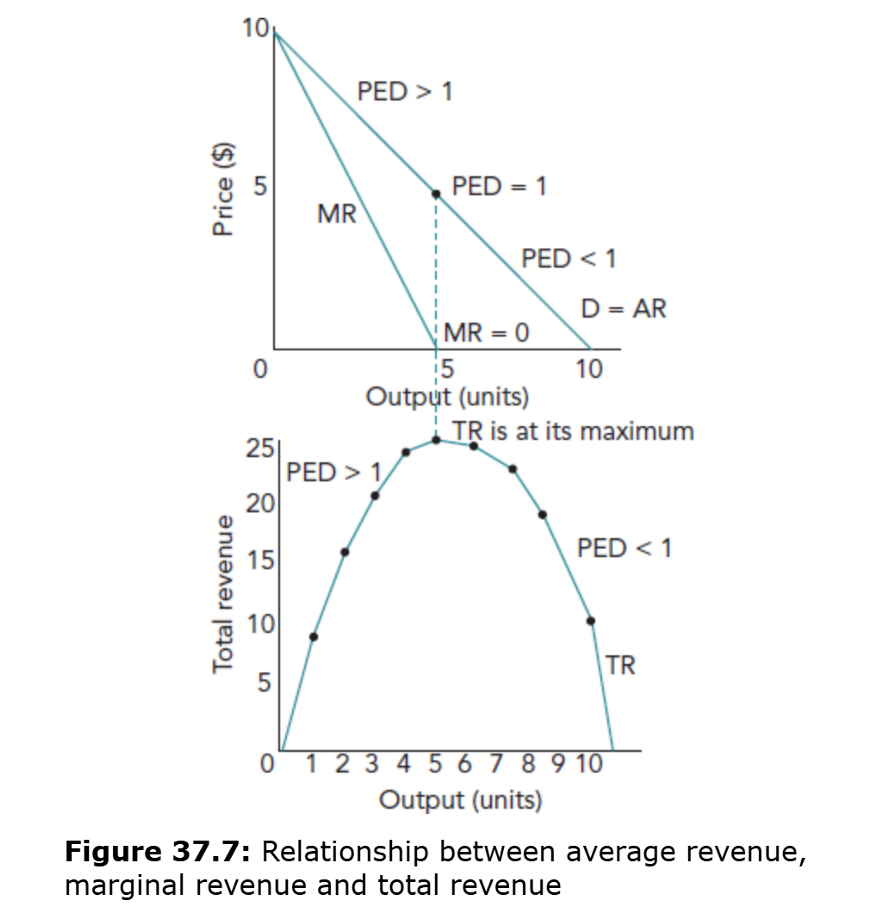
From the firm’s viewpoint, how does PED guide price changes to raise total revenue
In the elastic part of the demand curve the firm should reduce price to boost total revenue; in the inelastic part, the firm should raise its price if it wants higher revenue.
Why is revenue maximisation not the same as profit maximisation
Revenue can be maximised at MR = 0, which is not the same condition as profit maximisation (MR = MC).
How does a firm maximise revenue using output decisions
A firm choosing to maximise its revenue would raise output beyond MC = MR until MR had fallen to zero; extra sales after this contribute nothing to total revenue.
Can revenue maximisation still involve supernormal profit
There may still be supernormal profit if total revenue is higher than total cost, but this is not always the case.
How does the kinked demand curve affect the relationship between PED and revenue (diagram)
In oligopoly, the demand curve is relatively elastic above the kink point K and relatively inelastic below K, affecting how revenue changes with price.
- If an oligopolist increases price above K, there will be a relatively large decrease in sales and total revenue as consumers switch to competitors’ products whose price has not changed; profits may fall.
- If an oligopolist decreases price below K, there will be only a very small increase in sales and revenue; if one firm decreases price, others will follow; profits may fall.
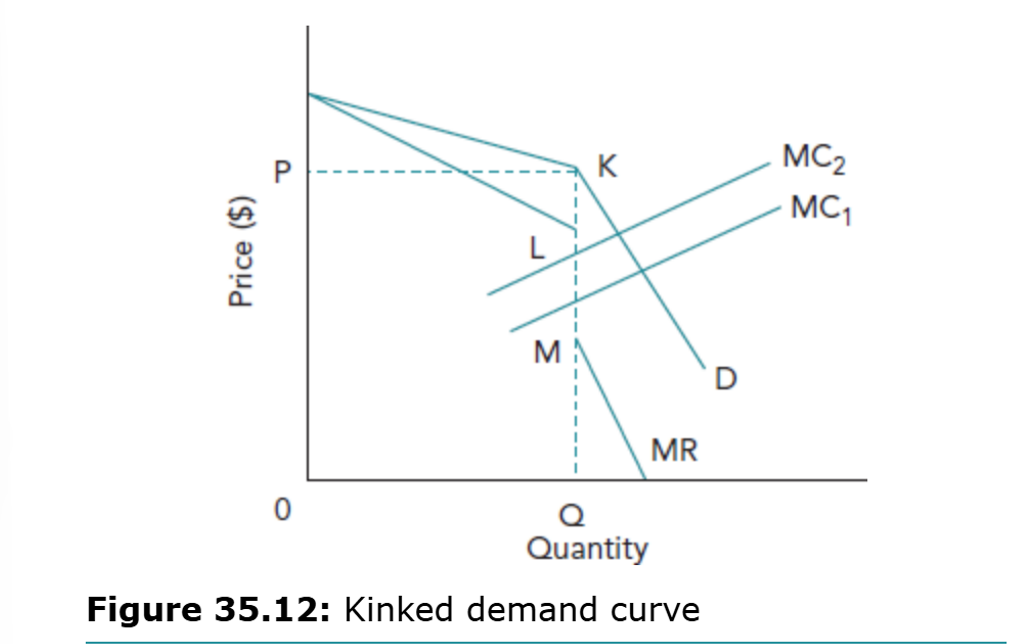
What strategy does the kinked demand curve suggest firms follow
The obvious strategy is to leave price at P: revenue is maximised at P × Q and firms could remain at point K for a considerable length of time (price rigidity).