Lecture 10 (CMT & Plagio)
 Call Kai
 Learn
Learn Practice Test
 Spaced Repetition
 Match
Match Flashcards
 Knowt Play
1/55

There's no tags or description
Looks like no tags are added yet.
Name | Mastery | Learn | Test | Matching | Spaced | Call with Kai |
|---|
No analytics yet
Send a link to your students to track their progress
56 Terms
What is torticollis?
How does it present?
A Posture, Not A Diagnosis
IPSI LAT FLX & CONT ROT
How many torticollis patients are non-muscular?
1 in 5 Children
What are the types of torticollis?
Acquired
Traumatic (3)
Non-Traumatic (6)
Congenital (CMT)
Postural (1)
Muscular (1)
SCM Nodule (1)
What are the 3 Traumatic Acquired Torticollis?
Soft Tissue Injury
Cervical or Clavicle Fx
C1-C2 Rotary Subluxation
What are the 6 Non-Traumatic Acquired Torticollis?
Which of these will tend to resolve on its own?
Inflammatory MSK Conditions
Juvenile RA, Tonsilitis, & Mastoiditis
Oculomotor Weakness / Ocular Lesions
Superior Oblique Palsy, Congenital Nystagmus, & Diplopia
Neurologic Cases (10% Of Non-Muscular)
Tumors, Chiari, & Syringomyelia
Bony Deformities
C/S Fusion & Hemivertebrae
“Sandifer Syndrome” - GI Linked
Paired w/ Hiatal Hernia & Gastric Reflux
Benign Paroxysmal Torticollis
Paired w/ Vomiting, Ataxia, & Seizures
Resolved In 3-5 Days w/o Tx
What is Postural CMT?
How does it present?
How severe is this?
Unilateral SCM Tightness
AROM Tight, PROM Not
Mild Severity
What is Muscular CMT?
How does it present?
How severe is this?
Unilateral SCM Fibrosis
AROM & PROM Tight
Moderate Severity
What is SCM Nodule CMT?
How does it present?
How severe is this?
Unilateral SCM Fibrotic Node
AROM & PROM Tight
Highest Severity
How is SCM Nodule CMT classified?
When does it typically appear by?
Classified Using US
By: 2-3 Weeks Old
What is the incidence of CMT?
0.3 - 16% of Live Births in USA
3rd Most Common Congenital Anomaly
What are the causes of CMT?
Prenatal
Icshemic Injuries To SCM
Intrauterine Cramping
Muscle Rupture
Perinatal
Birth Trauma (Breech?)
What are common accompanying diagnoses of CMT?
Congenital Hip Dysplasia
Clubfoot
Metatarsus Adductus
Brachial Plexus Injuries
What are the 8 CMT Severity Classifications?
At what age do they typically present?
How does muscle tightness present?
Early Mild
Postural Preference (<6 Months)
OR Ms Tightness <15º (<6 Months)
Early Moderate
Ms Tightness 15-30º (<6 Months)
Early Severe
SCM Mass (<6 Months)
OR Ms Tightness >30º (<6 Months)
Late Mild
Postural Preference (7-9 Months)
OR <15º Ms Tightness (7-9 Months)
Late Moderate
Postural Preference (10-12 Months)
OR <15º Ms Tightness (10-12 Months)
Late Severe
>15º Ms Tightness (7-12 Months)
AND 15-30º Ms Tightness (10-12 Months)
Late Extreme
SCM Mass (7-12 Months)
AND >30º Ms Tightness (10-12 Months)
Very Late
ANY Of The Above (> 1 Year)
What is the standard duration of CMT intervention?
Minimum → 1.5 Months
Maximum → 4-6 Monnths
What can occur if CMT is failed to be treated?
Persistent Neck Tilt (Eyes Not Level)
C/S v T/S Scoliosis (Eyes Now Level)
Structural Deformities:
“CD” - Skull Flattening
Mandibular Asymmetry
Orbital Fissure Asymmetry
Feeding Problems
Motor Skill Impairments
Ex) Head & Body Must Turn Together
What are recommended GM Tests for CMT?
If <4 Months → Use TIMP
If 4-12 Months → Use AIMS
If >12 Months → Use PDMS
What are recommended Strength Tests for CMT?
<2 Months → Not Indicated
>2 Months → MFS
What are recommended PROM Tests for CMT?
Any Age → Arthrodial Protractor
Any Age → Goniometer / Inclo
What are recommended AROM Tests for CMT?
<3 Months → Arthrodial Protractor
>3 Months → Seated Swivel Test
What positions are recommended for CMT ROM?
<4 Months → Supine
>4 Months → Seated
What is normal PROM for those <1 year?
LAT FLX - 70º
ROT - 110º
Using visual estimates for resting lateral flexion, what do different landmarks indicate?
Chin to Nipple → 40º
Chin To Armpit → 70º
Chin To Shoulder → 90º
Chin Over Shoulder → 100º
What is MFS Testing Protocol?
Infant’s Held Horizontally → No Head Support
Grading Per Position: Must Be >5 Seconds
What are MFS Grades?
Head Below Horizontal
Head At Horizontal
Head Slightly Above Horizontal
Head Far Above Horizontal, But <45º
Head Far Above Horizontal, And >45º
Head Very Far Above Horizontal, Near Vertical
What are MFS Norms?
At 2 Months → MFS 1
At 10 Months → MFS 3-4
What MFS scores are seen in CMT?
2-3 Point Difference Between Sides
Involved Side Should Be Higher
How do postural reactions change with CMT?
Decreased: Righting Rxns
Decreased: Protective Rxns
Diminished: Equilibrium Rxns
What is average tx time for CMT?
If <3 Months At Start OR Mild CMT:
Tx: 1.5 - 3 Months
If >3 Months At Start OR Mod-Sev CMT:
Tx: 3 - 6 Months
If >6 Months At Start (Any Severity):
Tx: >6 Months
What determines “good” vs “excellent” prognosis for CMT?
Assuming PT Starts In <1 Year:
“Good” → < 50º PROM Asymmetry
“Excellent” → < 10º PROM Asymmetry
During CMT tx, what is considered to be a “natural” pattern?
What can this phenomenon be attributed to?
Alternating Progression / Regression
Due To: Growth Spurts, Teething, v Illness
What does the CPG suggest for CMT tx?
Neck & Trunk AROM / PROM (When Limited)
Motor Control (Midline Symmetry & Milestones)
Environmental Adaptations
Patient / Caregiver Education
What are the 3 Steps for effective CMT tx?
What are main tips for each one?
Stretching (HEP)
Low Intensity, Sustained, & Pain Free
Desensitize Neck w/ Heat & Massage
Generally: Stretch Every Diaper Change
Position & Strength
Could Do Tummy Time / Crawling
Examine & Adjust Seat Positions
Use Theratogs For Symmetry
Posture & Motor
Begin Upright Control At 4 Months
Focus On Age-Based Milestones
What are contraindications for CMT stretching?
Down Syndrome
Spina Bifida
Spinal Cord Abnormalities
Circulatory Abnormalities
When are we allowed to discontinue tx for CMT?
Only When All Are Met:
C/S PROM <5º Difference
Symmetrical Active Mvmt
Age-Appropriate Motor Skills
No Visible Head Tilt
CG Understands What To Monitor
When are we allowed to discharge tx for CMT?
3-12 Months After Discontinuation v When Walking
When is any non-conservative tx for CMT indicated?
Infants Not Progressing After 6 Months Of Conservative PT
OR
Children > 1 Year & Grade 7 Severity
When is surgical SCM lengthening indicated?
How long does PT take afterwards?
General Rules & >15º Residual Tightness
Post-PT: 4 Weeks - 10 Months
What is Craniosynostosis vs Cranial Deformation (CD)?
What is frequency associated with each?
Craniosynostosis - Rare
Premature Closure Of ≥1 Cranial Sutures
Cranial Deformation - 1 in 3
Shape Changes Due To External Stressors
What are common risk factors of CD?
CMT
Intrauterine Contraints (Commonly 1st Born)
Males (3x) > Females
Supine Sleeping w/ Unilateral Pressure
What are the three types of CD?
Plagiocephaly (Asymmetry)
Brachycephaly (Wide Head)
Scaphocephaly (Long Head)
How is CI Deformation measured?
What is the average value of it?
Cephalic Index = (Head Breadth / Head Length) x 100
Mean CI (Depending On Age & Gender) → 79% - 84%
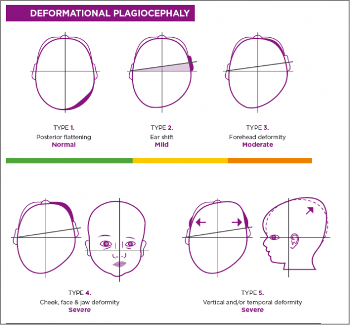
What are the Plagiocephaly Grades?
Argenta Classification
1 - Normal Head Shape
1 Quadrant Impacted
Mild Posterior Flattening
2 - Mild Deformity
2 Quadrants Impacted
“1” + IPSI Anterior Ear Shift
3 - Moderate Deformity
2 Quadrants Impacted
“2” + IPSI Forehead Prominence
4 - Severe Deformity
2 Quadrants Impacted
“3” + Face-Jaw Asymmetry
5 - Very Severe Deformity
≥ 3 Quadrants Impacted
“4” + Vertical / Temporal
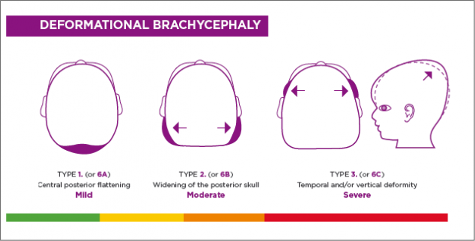
What are the Brachycephaly grades?
Argenta Classification
1 - Mild Deformity
Central Posterior Flattening
2 - Moderate Deformity
“1” + Posterior Widening
3 - Severe Deformity
“3” + Vertical / Temporal
What are Scaphocephaly risk factors?
Premature <32 Weeks
After NICU Malpositioning
Paired w/ Craniosynostosis
What are possible adverse effects of non-resolved plagiocephaly?
Permanent Cranial-Facial Asymmetry
Auditory & Visual Processing Disorders
Neurodevelopmental Delays
What are preferred tx options for CD deformities?
If < 4 Months AND Min-Mod →
Parent Education
Repositioning
Exercises
If > 4 Months OR Mod-Sev →
Cranial Banding
Helmets
If Craniosynostosis OR >2 Yrs Old →
Surgery
What does parent education entail for CD deformities?
Increase Supervised Tummy Time
Shifting Infant Off Of Flattened Areas
Alternate Head Position During Sleep
Avoid Excess Use Of Car Seats & Swings
When are Cranial Banding / Helmets recommended for referral?
4 Months → If Severe
6 Months → If Moderate
When are Cranial Banding / Helmets indicated?
Babies 4-18 Months w/ Mod-Sev Deformity
No / Poor Response To Repositioning
Persistent v Secondary Changes
When are Cranial Banding / Helmets contraindicated?
Babies <4 Months
Babies >18 Months
Concurrent Hydrocephalus
Concurrent Craniosynostosis
What is the difference between cranial banding and helmets?
Banding → Mild Corrective Postures
Helmets → Severe Corrective Postures
How are cranial bands and helmets properly fitted?
Using Digital Surface Imaging
When picking out cranial bands and helmets, what criteria must it hit?
FDA Approved
Can Work Well w/ Kids
Can Demonstrate Safety / Success
What are DOC Band benefits (compared to others)?
Very Lightweight (6 oz)
Custom Fitting
What are DOC Band tx protocols?
Worn 23 Hours / Day Over 2 - 4 Months
What measurements are taken before and after DOC Band use?
Anthropometric Measurements
Clinical Photography