Geotech 2 conceptual
 Call Kai
 Learn
Learn Practice Test
 Spaced Repetition
 Match
Match Flashcards
 Knowt Play
1/17

There's no tags or description
Looks like no tags are added yet.
Name | Mastery | Learn | Test | Matching | Spaced | Call with Kai |
|---|
No analytics yet
Send a link to your students to track their progress
18 Terms
Immediate Settlement (Se)
Elastic deformation of dry/moist soils without any change in moisture content
Primary Consolidation (Sc)
Drainage of water from voids leading to a volume change in the cohesive soil. Rate largely depends on the permeability of soil and drainage distance
Secondary Consolidation (Ss)
Plastic adjustment of cohesive soil fabric under a constant effective stress - creep movement
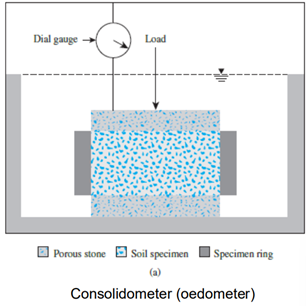
1-D Consolidation Test
Geotechnical test designed to capture the soil consolidation behaviors
Terzaghi’s Spring-Mass analogy
a perforated piston in a water-filled cylinder with internal springs provides a direct analogy for soil consolidation
Before Consolidation of Terzaghi (at t=0)
New Δσ load applied to saturated clay carried by pore water pressure and creating excess pore water pressure (Δu)
After Consolidation of Terzaghi (at t=∞)
effective stress (Δσ) increases, Δu approaches 0, particles reach settlement as water is expelled
Terzaghi theory assumptions for saturated clay soils
system is homogeneous, fully saturated, compressibility of water/soil grains is negligible, water flows in one direction, Darcy’s law is valid
Coefficient of consolidation methods
Logarithm-of-time method, Square-root-of-time method, and Hyperbola method
Coefficient of Consolidation (Cv)
Expresses how quickly excess pore-water pressure dissipates and settlement develops with time after loading
How does failure occur?
Shear stress along the failure surface reaches the shear strength
Soil element does not fail
if the Mohr circle is contained within the envelope
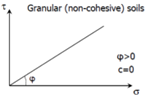
MC failure envelope for granular (non-cohesive) soils
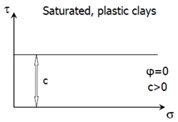
MC failure envelope for Saturated, plastic clays
Types of Triaxial tests
CD, CU, and UU
CD Test
no excess pore pressure throughout the test, very slow shearing (multiple days long) to avoid build-up of pore pressure, and gives c’ and Φ’ for analyzing fully drained situations
CU Test
pore pressure develops during shear to measure σ’, gives c’ and Φ’ faster than CD test and is therefore more preferable for determining the c’ and Φ’ value
UU Test
pore pressure develops during shear but σ’ is not measured but rather unknown, Φ’ is 0 and the failure envelope is horizontal leaving us to analyze the test in terms of σ to give us cu and Φu very quickly