Pain meds
 Call Kai
 Learn
Learn Practice Test
 Spaced Repetition
 Match
Match Flashcards
 Knowt Play
1/66

There's no tags or description
Looks like no tags are added yet.
Name | Mastery | Learn | Test | Matching | Spaced | Call with Kai |
|---|
No analytics yet
Send a link to your students to track their progress
67 Terms
neuropathic pain
1.chronic pain caused by injury to, or disease of, the central and peripheral nervous systems, occurring as a result of a cascade of neurobiological processes, which lead to hyper-excitability in conducting pathways of somatosensory neurons.
Hyper-excitability is also hallmark of epileptic activity
hyperalgesia
hyperalgesia (exacerbated responses to painful stimuli) and allodynia (pain produced by otherwise non-painful stimuli) develop as a result of the pathological plasticity of sodium and calcium channels in several areas in the peripheral and spinal cord afferent pain pathways
neuropathic pain site
nerve
neuropathic pain quality
stinging
numbing
burning
radiating
neuropathic pain example
neuropathy
postherpetic neuralgia
post stroke pain
neuropathic pain medications
TCA
gabapentin
lyrica
somatic pain site
musculoskeletal
somatic pain quality
localized, dull, aching, sharp, throbbing, gnawing
somatic pain example
sports injury
postop nerve pain
bone metastases
somatic pain medications
opioids
NSAIDs
corticosteroids
muscle relaxants
visceral pain site
involuntary muscle internal organs
visceral pain quality
poorly localized, deep, squeezing, pressure, radiating
visceral pain example
IBS, MI
visceral pain medications
opioids
corticosteroids
NSAIDs
inflammatory pain site
noxious stimuli
inflammatory pain quality
warmth, redness, swelling
inflammatory pain example
infections
antibody formation
physical injury
inflammatory pain medications
NSAID
corticosteroid
acute pain
•pain lasting <3-6 months
•Associated with tissue damage
•Self-limiting
•Treatment goal= rapid relief and cure
chronic non cancer pain
•Persisting beyond tissue healing- > 3-6 months
•Cause often unknown
•Treatment goal= some symptomatic relief but mostly improvement in daily function
factors affecting pain
depression, fatigue, insomnia, stress, anxiety, social and family issues, anger
pain meds
opioids
NSAIDs
muscle relaxers
antidepressants
anti epileptic drugs
OTC analgesics
opioid common adverse effects
Opioid Induced Constipation
Dry mouth
Nausea
Vomiting
mental confusion
Histamine-release reactions
Respiratory Depression!
opioid BBW
abuse, misuse, addiction potential, potential for fatal respiratory depression
opioid warnings: all opioids
additive sedation
caution in:
elderly
debilitated
cachectic
chronic pulmonary disease (hypoxia)
TBI (intracranial pressure)
hypotension
dizziness/drowsiness
no alcohol
taper long term use
opioid allergy
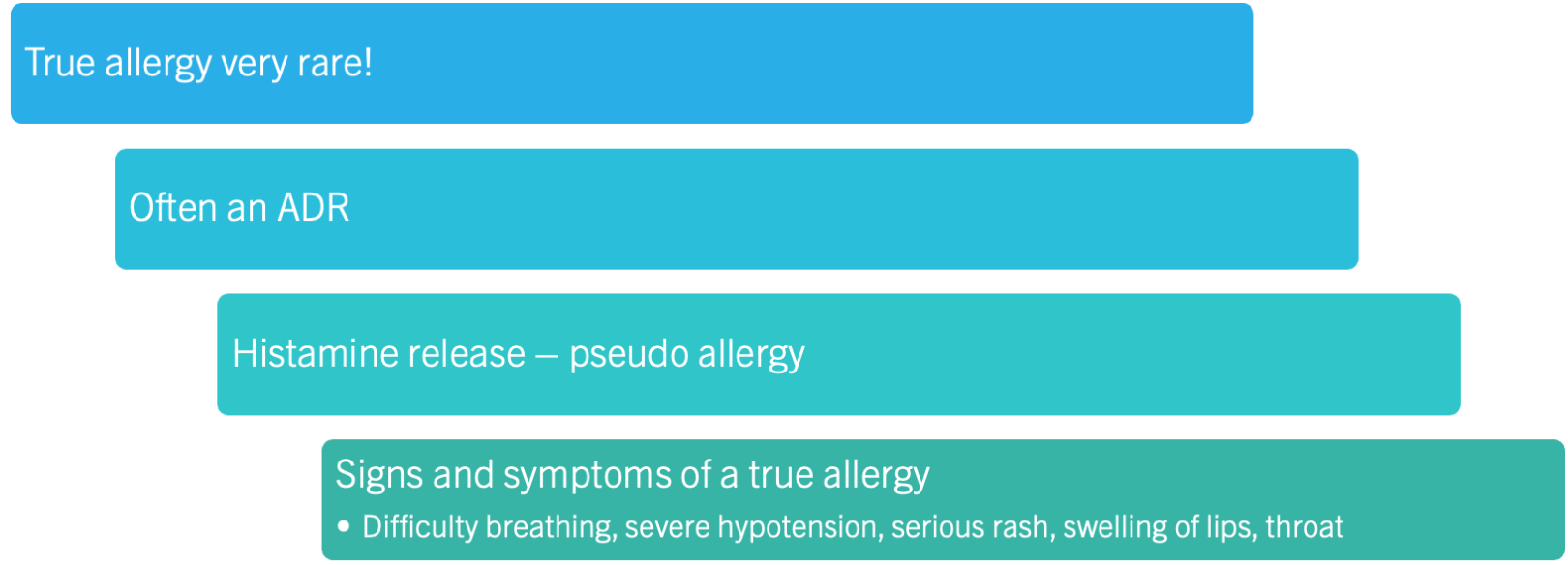
opioid true allergy symptoms
difficulty breathing, severe hypotension, serious rash, swelling of lips, throat
morphine MOA
natural plant alkaloid opioid full agonist
morphine onset and duration
•Onset: IR (oral) = 30-60 min, IV = 5-10 min
•Duration: IR (oral) = 4 hr, ER (oral) = 8-24 hr
morphine dosing
IR = q4h
ER = q8-24h
morphine renal or hepatic
renal adjustments
morphine adverse effects and BBW
Caution in renal insufficiency
Hypotension and itchiness
Black Box: med errors with the oral solution
REMS for ER/CR formulation
codeine onset and duration (dosing)
•Onset: 30-60 min
•Duration: 4 – 6 hr
codeine adverse events
Caution in CYP2D6 altered metabolism
Caution in elderly
Hypotension and itchiness
hydrocodone MOA
semi-synthetic opioid full agonist
hydrocodone onset and duration
•Onset: 30-60 min
•Duration: 4-6 hr
hydrocodone renal or hepatic
CYP2D2 substrate
maybe both hepatic and renal
hydrocodone
•Metabolism: Hepatic CYP3A4 to active (hydromorphone) and inactive metabolites
•Almost always as a combination product, but can be standalone
•Little to no histamine involvement
hydrocodone concerns
Total daily dose of APAP
CYP2D6 poor metabolizer
Zohydro- EtOH accelerates absorption
hydromorphone MOA
Semi-synthetic opioid full agonist
hydromorphone onset and duration
•Onset:
Oral IR= 15-30 min
Oral ER= 6 hours
IV= 5 minutes
•Duration:
Oral, IV IR= 3-4 hours
Oral ER= 13 hours
hydromorphone
•Often used in PCAs and can be used intrathecally due to high potency
•Associated with minimal histamine release
•Metabolism: hepatic, no active metabolites
hydromorphone renal or hepatic
Renal and hepatic adjustments
hydromorphone adverse effects
dosing changes in renal/hepatic adjustments
oxycodone MOA
Semi-synthetic opioid full agonist
oxycodone onset and duration
•Onset: Oral IR= 10-15 min, Oral ER= 60 min
•Duration:
Oral IR= 3-6 hr
Oral ER= < 12 hr
oxycodone metabolism
•hepatic CYP2D6 to active (oxymorphone) and weakly active metabolites
oxycodone renal or hepatic
renal adjustments
oxycodone adverse events
constipation
respiratory depression
meperidine onset duration
•Onset:
Oral= 10-15 min
IV= 10-20 min
•Duration: Oral= 2-4 hr
meperidine indications
•Not used in chronic pain management
•Can be useful in obstetric analgesia
meperidine adverse effects
Respiratory insufficiency and death when given within 14 days of an MAOI
Repeated doses can lead to nomeperidine accumulation. 24-48 hour use only
•Irritability, tremors, siezures
Can cause serotonin syndrome when combined with other serotonergic drugs
Renal adjustments in CrCl <50ml/min
fentanyl MOA
Synthetic opioid full agonist
fentanyl onset and duration
•Onset
Transmucosal= 5-15 min
Transdermal= 6hr
IV= <1 min
•Duration
Transmucosal= variable
Transdermal= 72-96 hr
IV= 30-60 min
fenanyl metabolism
•Metabolism: hepatic, primarily CYP3A4 to inactive metabolites
fentanyl
•Can accumulate in the fat cells
•Very potent- dosed in micrograms
•Preferred anesthesia analgesic
fentanyl cautions
NOT for opioid naïve patient in outpatient settings
NOT for acute pain in outpatient settings
NOT what is being abused- Illicitly manufactured fentanyl (IMF)
methadone onset and duration
•Onset
Oral= 30-60 min
IV= 10-20 min
•Duration
Oral= 4-8 hr
Tissue accumulation with repeated doses can extend this duration to 22-48 hr
methadone metabolism
•hepatic CYP3A4, 2B6, 2C19 to inactive metabolites
methadone cautions
Not for PRN use/ acute pain
Challenging PK- titrate every 3-5 days (longer in elderly)
Dose related QT prolongation
buprenorphine
•Partial agonist
Analgesic affects plateau at higher doses, then it behaves more like an antagonist
• Metabolism
Hepatic CYP3A4 to active metabolite
Extensive first pass effect
•Cautions
Ingestion of liquids decreases systemic exposure to buprenorphine from buccal film by 23%-37%
tramadol MOA
synthetic opioid weak agonist
tramadol onset and duration
•Onset: 1 hr
Duration: 9 hr
tramadol renal or hepatic
renal
tramadol caution
Max dose 400mg/day
Concomitant use of MAOI, risk of serotonin syndrome with other serotonergic agents
Mechanism is mostly working as an opioid on the mu opioid receptors, but also has some SNRI activity
Consider efficacy with hepatic impairment
Dose adjustments with renal insufficiency
tramadol max dose
400 mg/day