Comprehensive Human Body Systems: Anatomy, Functions, and Interactions
 Call Kai
 Learn
Learn Practice Test
 Spaced Repetition
 Match
Match Flashcards
 Knowt Play
 Podcast
1/147

There's no tags or description
Looks like no tags are added yet.
Name | Mastery | Learn | Test | Matching | Spaced | Call with Kai |
|---|
No analytics yet
Send a link to your students to track their progress
148 Terms
Nasal Cavity
Air is warmed, humidified, and filtered by mucus and hair.
Pharynx
Junction for both food and air.
Larynx
Voice box.
Trachea
Cylinder tube with rings of cartilage that provides support.
Right lung
Has 3 lobes.
Left lung
Has 2 lobes.
Alveoli
Tiny air sacs of the lungs that allow gas exchange.
Conducting zone
Transports air from the outside environment to the site of gas exchange; also called the 'anatomical dead space.'
Respiratory zone
Structures in lungs where gas exchange takes place.
Peristalsis
Muscle contractions that move food through the digestive tract.
Central nervous system
Consists of the brain and spinal cord; acts as the command center for all communication and actions of the body.
Peripheral Nervous system
Consists of all nerves and ganglia that branch from the brain and spinal cord.
Nerves
Long bundles of neuronal axons that transmit signals from the central nervous system.
Synapse
A structure that allows neurons to pass signals to other neurons, muscles, or glands.
Dendrite
A nerve fiber that carries a nerve impulse towards the neuron cell body.
Sensory neurons
Send messages to CNS about sensory info like touch, smell, and pain.
Motor neurons
Send messages to muscle and can be subdivided into involuntary motor nervous system and the somatic voluntary nervous system.
Autonomic nervous system
Controls involuntary actions involving cardiac and smooth muscle.
Somatic nervous system
Controls voluntary actions involving skeletal muscle.
Muscular system
Vital for controlling involuntary and voluntary movement.
Tissues
A group of cells with similar structures that function together.
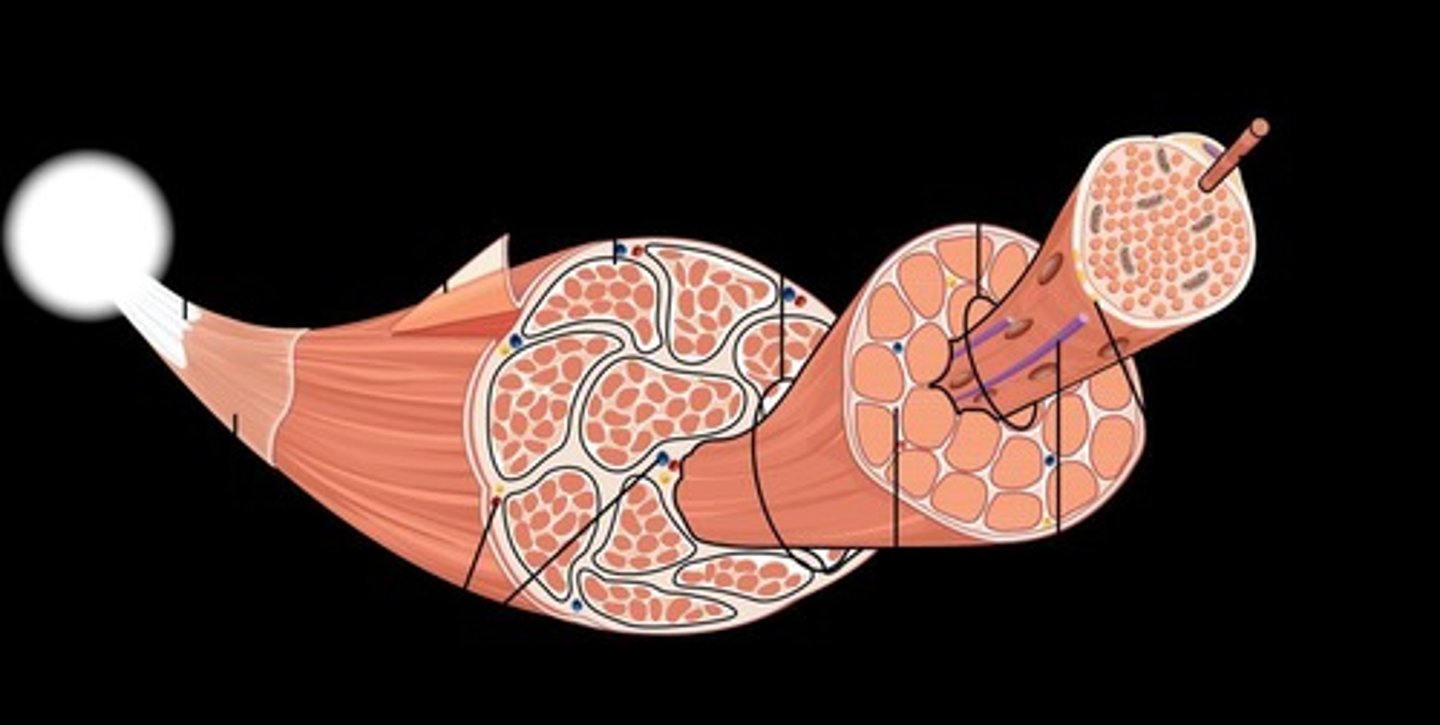
Skeletal muscles
Attach to the bone, involved with movement of bones, striated and strong, and is the only voluntary muscle tissue in the body.
Cardiac muscle
At the heart, striated, and involuntary.
Smooth muscle
Found in walls of hollow organs, weakest muscle, and involuntary.
Tendons
Tough bands of connective tissue that have strong collagen fibers.
Myofibrils
Long strands of proteins made of sarcomere units.
Sarcomere
The contracting unit of a muscle.
Myosin
Thick filaments that can split ATP and react to actin in muscle contraction.
Actin
Thin filaments that form the contractile filaments of muscle cells.
Afferent nerves
Carry sensory information to the brain.
Efferent nerves
Carry signals from the brain to muscles.
Extensibility
Ability of muscles to be stretched or extended.
Elasticity
Ability of muscle to return to original length when relaxed.
Excitability
Ability of muscle to respond to a stimulus from a motor neuron or hormone.
Contractility
Ability of muscle to shrink or contract.
Reproductive system
Purpose is to generate gametes and deliver them to the female reproductive system.
Vas deferens
Duct in which sperm moves from testicle to urethra.
Seminiferous tubules
Where sperm is produced in testes.
Fallopian tubes
Connect the ovaries to the uterus.
Zygote
A fertilized egg.
Implantation
Process by which a blastocyst implants itself in the uterine wall.
Hormones
Part of the endocrine system that allows for cell-to-cell communication.
Follicle-stimulating hormone (FSH)
Hormone secreted by the anterior pituitary that stimulates development of eggs in ovaries and sperm in testes.
Luteinizing hormone (LH)
Hormone secreted by the anterior pituitary that is responsible for triggering ovulation in ovaries and production of testosterone by testes.
Corpus luteum
The empty mature follicle that produces large amounts of progesterone to prepare the endometrium for implantation of the fertilized egg.
Menstrual cycle
The cycle of maturation and shedding of the endometrium.
Testes
Male reproductive organs that produce sperm.
Ovaries
Female reproductive organs that produce eggs.
Integumentary system
Largest organ, the skin, containing organs and glands vital to protecting the body and regulating temperature.
Sebaceous glands
Accessory structures originating in the dermis that secrete sebum onto hair emerging from the hair follicle.
Ceruminous glands
Accessory structures that produce ear wax.
Epidermis
The outermost layer of skin made up of dead cells on the outside and an inner layer of living cells.
Dermis
The middle layer of skin that contains collagen, blood vessels, glands, hair follicles, and nerve endings.
Hypodermis
The innermost layer of skin.
Melanocytes
Cells in the epidermis that produce and distribute melanin, which is a skin pigment.
Homeostasis
The maintenance of stable internal conditions in the body.
Negative feedback
A mechanism that includes monitoring for specific homeostatic levels and a signal to a gland to maintain homeostasis.
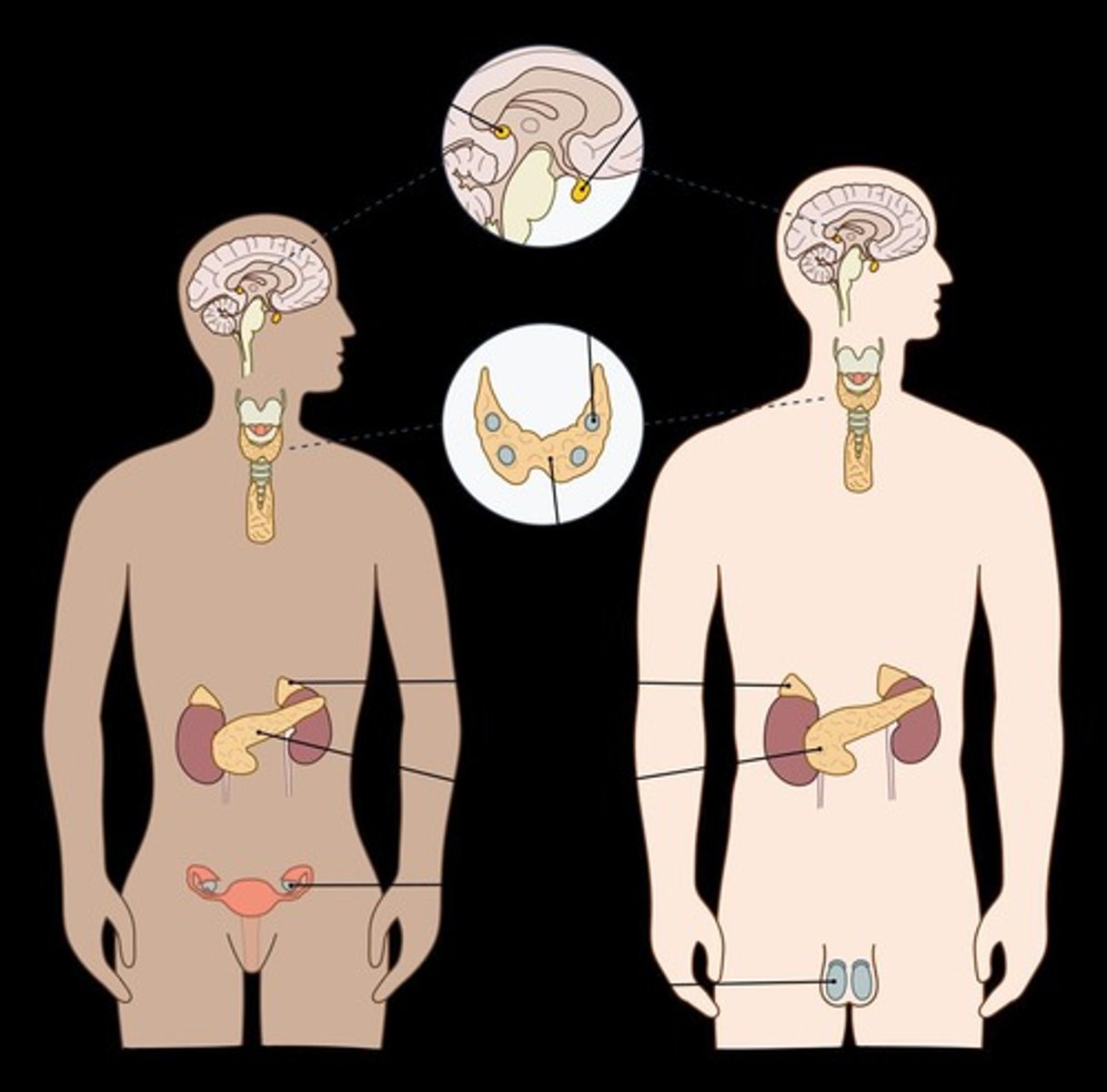
Thyroid gland
Gland in the neck that secretes hormones that regulate growth, development, and metabolic rate.
Parathyroid gland
Gland in the neck that produces parathyroid hormone.
Thymus
Lymphoid organ that produces T cells.
Adrenal gland
Gland above the kidney that produces hormones to regulate heart rate, blood pressure, and other functions.
Pancreas
Gland of digestive and endocrine systems that produces insulin and secretes pancreatic juices.
Pineal gland
Small gland near the center of the brain that secretes melatonin.
Sperm
Male gametes produced by the testes.
Eggs
Female gametes produced by the ovaries.
Sweat glands
Glands that produce sweat to help cool the body.
Vitamin D
Produced by the skin when ultraviolet light hits it.
Collagen
A protein found in the dermis that provides structure and support to the skin.
Blood vessels
Structures in the dermis that supply blood to the skin.
Apocrine sweat glands
Sweat glands found in the skin that are associated with hair follicles.
Eccrine sweat glands
Sweat glands that are distributed throughout the skin and help regulate body temperature.
Monomers
The monomers used to build polysaccharides.
Polysaccharides
Molecules made of two or a few monosaccharide units that are used for fuel in the body.
Endocrine glands
Glands that produce hormones with different chemical structures.
Lipid-based hormones
Hormones that can enter a cell and regulate DNA.
Epinephrine
A polar, water-soluble hormone released in response to stress.
Fight-or-flight response
The response caused by the secretion of epinephrine into the bloodstream.
Hyperthyroidism
A condition where the thyroid gland releases too much thyroxine.
Gigantism
Occurs when the pituitary gland makes too much growth hormone, causing excessive growth.
Antidiuretic hormone (ADH)
Hormone secreted by the pituitary gland that helps maintain the right amount of water in the blood.
Positive feedback
Causes an increase in the secretion of a hormone.
Oxytocin
Hormone that stimulates uterine contractions during childbirth.
Insulin
Hormone released by the pancreas that lowers blood sugar levels.
Glucagon
Hormone that promotes the breakdown of glycogen into glucose, raising blood sugar levels.
Neuroendocrine system
The integration of the nervous and endocrine systems.
Releasing hormones
Hormones secreted by the hypothalamus that stimulate the pituitary gland.
Inhibiting hormones
Hormones that turn off messages to the pituitary gland.
Urinary system
System that functions in the excretory process.
Kidneys
Organs that filter blood and produce urine.
Renal cortex
The outer layer of the kidney where blood vessels are located.
Renal medulla
The inner region of the kidney where the concentration of urine is regulated.
Urinary bladder
Organ that stores urine until it is excreted.
Ureters
Small tubes that carry urine from the kidneys to the urinary bladder.
Urethra
Tube through which urine is excreted from the body.
Nitrogenous waste
Toxic byproduct from protein digestion that must be removed from the body.
Erythropoietin
Hormone produced in the renal cortex that stimulates the production of new red blood cells.
Acromegaly
Condition caused by too much growth hormone in adults.
Nephron
The structural and functional unit of the kidney.
Glomerulus
A small, dense group of capillaries in the nephron where material is filtered from the blood.
Filtrate
Material filtered from the blood, including water, urea, glucose, salts, and other small molecules.